


UK Media Law Pocketbook Second Edition 30th November 2022
By Tim Crook
The separate nature of their legal systems with Scotland being more different from the rest of the UK though there has been recent synchronisation of libel law with the provisions of the 2021 Defamation and Malicious Publication (Scotland) Act.
The restrictions on images/photographs of criminal suspects in Scotland and the fact that there is not a criminal system for young people with social work orientated children’s panels dealing with most crimes committed by people aged 17 and under.
Sexual offence complainant protection is similar in Scotland and Northern Ireland.
Different arrangements for closed courts when sexual offence complainants and children give evidence.
Right to life issue leading to anonymity for criminal defendants in Northern Ireland facing vigilante reprisals. The province’s libel law has been reformed in 2022 with the adoption of similar English statutory defences of truth, public interest, honest opinion and academic qualified privilege. However, Northern Ireland’s new defamation act does not match the serious harm threshold for libel or the first publication rule set out in the Defamation Act 2013 for England and Wales.
If you are reading and accessing this publication as an e-book such as on the VitalSource platform, please be advised that it is Routledge policy for clickthrough to reach the home page only. However, copying and pasting the url into the address bar of a separate page on your browser usually reaches the full YouTube, Soundcloud and online links.
The companion website pages will contain all of the printed and e-book’s links with accurate click-through and copy and paste properties. Best endeavours will be made to audit, correct and update the links every six months.

Video-cast on key differences in Media Law of Scotland and Northern Ireland
9.0 Bullet points summarizing some key differences in the media law of Scotland and Northern Ireland
9.1 Key Scottish differences
A downloadable sound file highlighting some key Scottish media law issues
Online Links Printed Book
Pages 220 and 221
Scottish Courts and Tribunals Service – Reporting restrictions for children younger than 18
https://www.scotcourts.gov.uk/current-business/court-notices/contempt-of-court-orders/reporting-restrictions-children-under-18
Section 47 of the Criminal Procedure (Scotland) Act 1995 – Restriction on report of proceedings involving children younger than 18.
https://www.legislation.gov.uk/ukpga/1995/46/section/47
Section 46 of the Children and Young Persons (Scotland) Act 1937 – Power to prohibit publication of certain matter in newspapers concerning children younger than the age of 17. https://www.legislation.gov.uk/ukpga/Edw8and1Geo6/1/37/section/46
Sexual Offences Amendment Act 1992 extended to Scotland in 2004: https://www.legislation.gov.uk/ssi/2004/408/article/3/made
Section 90 of the Criminal Justice and Licensing (Scotland Act) 2010 – Power to make witness anonymity orders:
https://www.legislation.gov.uk/asp/2010/13/section/90
Section 92(3) of the Criminal Procedure (Scotland) Act 1995 – Trial in presence of accused and circumstances when this is not the case:
https://www.legislation.gov.uk/ukpga/1995/46/section/92
Interview: BBC Scotland legal director Rosalind McInnes on her life in the law:
https://www.scottishlegal.com/article/interview-bbc-scotland-legal-director-rosalind-mcinnes-on-her-life-in-the-law
Her Majesty’s Advocate against Craig Murray [2021] ScotHC HCJ_2 (25 March 2021):
https://www.bailii.org/scot/cases/ScotHC/2021/2021_HCJ_2.html
Petition and complaint by Her Majesty’s Advocate against Craig Murray [2021] ScotHC HCJ_3 (08 June 2021):
https://www.bailii.org/scot/cases/ScotHC/2021/2021_HCJ_3.html
Craig Murray against Her Majesty’s Advocate [2022] ScotHC High Court of Justiciary Appeal Court 14 (25 March 2022):
https://www.bailii.org/scot/cases/ScotHC/2022/2022_HCJAC_14.html
Defamation and Malicious Publication (Scotland) Act Royal Assent 21 April 2021:
https://www.legislation.gov.uk/asp/2021/10/contents
The new Scots law of defamation in 2021 by Lindsays:
https://www.lindsays.co.uk/news-and-insights/insights/the-new-scots-law-of-defamation-in-2021
“You can’t say that about me” – an overview of the new defamation law in Scotland by Thorntons:
https://www.thorntons-law.co.uk/knowledge/you-cant-say-that-about-me-an-overview-of-the-new-defamation-law-in-scotland
Scottish Courts and Tribunals Service – Media Guide
https://www.scotcourts.gov.uk/docs/default-source/scs—taking-action/guide.pdf?sfvrsn=10
Scottish Legal System – Orders and Directions made under Section 4(2) and or Section 11 of the Contempt of Court Act 1981
https://www.scotcourts.gov.uk/current-business/court-notices/contempt-of-court-orders
The Hate Crime and Public Order (Scotland) Act 2021
https://www.legislation.gov.uk/asp/2021/14/enacted/data.pdf
Scottish Government – Hate crime
https://www.gov.scot/policies/crime-prevention-and-reduction/hate-crime/
9.2 Key Northern Ireland differences
A downloadable sound file highlighting some media law issues specific to Northern Ireland
Online Links Printed Book
Pages 223 and 224
Judicial Studies Board of Northern Ireland:
https://www.judiciaryni.uk/judicial-studies-board-publications
Judicial Studies Board of Northern Ireland – Guide on reporting restrictions in the criminal courts:
https://www.judiciaryni.uk/sites/judiciary/files/media-files/JSB%20Reporting%20Restrictions%20Guide%20-%20November%202019%204.12.19.pdf
Article 26 of the Juries (Northern Ireland) Order 1996 (S.I. 1996/1141 (N.I. 6)
https://www.legislation.gov.uk/nisi/1996/1141/article/26A
The protection is further consolidated in section 10 of the Justice and Security (Northern Ireland) Act 2007
https://www.legislation.gov.uk/ukpga/2007/6/crossheading/juries
Judiciary Northern Ireland – Judicial decisions and directions
https://www.judiciaryni.uk/judicial-decisions
A & Ors, Re Judicial Review [2009] NICA 6 (11 February 2009) https://www.bailii.org/nie/cases/NICA/2009/6.html
Robinson v Sunday Newspapers Ltd [2011] NICA 13 (25 May 2011) https://www.bailii.org/nie/cases/NICA/2011/13.html
R v Soldier A and Soldier C (Ruling on application for anonymity) Neutral Citation No. [2021] NICC 2 Delivered 19 April 2021
https://www.judiciaryni.uk/judicial-decisions/2021-nicc-2
Foster v Jessen (Rev1) [2021] NIQB 56 (27 May 2021)
https://www.bailii.org/nie/cases/NIHC/QB/2021/56.html
Fine Point Films & Anor, Re Judicial Review [2020] NIQB 55 (10 July 2020)
https://www.bailii.org/nie/cases/NIHC/QB/2020/55.html
In the matter of an application by D/Inspector Justyn Galloway, PSNI, under Paragraph 5, Schedule 5 Of The Terrorism Act 2000 – Respondent: Suzanne Breen [2009] NICty 4 (18 June 2009)
https://www.bailii.org/nie/cases/Misc/2009/2009_NICty_4.pdf
9.3 Updates and stop press
A downloadable sound file updating media law developments in Scotland and Northern Ireland
While the book was in production, the Northern Ireland Assembly passed the Defamation Act (Northern Ireland) 2022 which substantially reforms the law of libel in this legal jurisdiction, though does not fully mirror the reforms in the England and Wales 2013 Defamation Act.

Here is the structure of the legislation with its sixteen sections.
1.Truth
2.Honest opinion
3.Publication on matter of public interest
4.Peer-reviewed statement in scientific or academic journal etc
5.Reports etc protected by privilege
6.Action against a person not domiciled in the UK
7.Trial to be without a jury unless the court orders otherwise
8.Power of court to order a summary of its judgment to be published
9.Powers of the court
10.Special damage
11.Review of defamation law
12.Interpretation
13.Consequential amendments and savings etc
14.Commencement
15.Short title
The new legislation has been impressively analysed and discussed by Tony Jaffa for Hold The Front Page with the column titled ‘Are libel law reforms enough?’
And also by Ciaran O’Shiel and Holly Johnston for the Informm website with the headline ‘The Defamation Act (NI) 2022, A Swing and a Miss.’
Challenging anonymity orders applied for by defendants on the grounds publicity increased the risk of their self-harming
Northern Ireland court reporter and Local Democracy journalist Tanya Fowles has been seeking to halt a developing trend for courts issuing anonymity orders for trial defendants who say that publicity may cause them to self-harm.
She has been challenging and campaigning against the practice for many years. In November 2021, she succeeded in resisting an application by lawyers representing a woman seeking a life-long anonymity order following convictions for fraud and money-laundering offences.
In addition, District Judge Bernie Kelly at Armagh Magistrates Court rejected an application for anonymity due to the risk of self-harm in respect of a man accused of attempted sexual communication with a child.
The Judge was reported saying: ‘I appreciate this is a balancing critique of rights but I always quote the tagline of the Washington Post – Democracy Dies in Darkness. Never truer words were spoken. Light must be shone into the dark recesses, to ensure the public can have confidence and all of us are answerable. As far as I’m concerned the press is the Fourth Estate and are essential to ensuring the other three branches of our constitution do so in a fit and proper way.’
However, there have been other cases where lifelong anonymity in Northern Ireland courts have been sustained for convicted sex offenders on the basis of publicity being accepted as a threat to their mental health.
In June 2023 Tanya unsuccessfully sought the support of Northern Ireland’s most senior judge to reverse the legal jurisdiction’s unique position of providing this protection to paedophiles beyond the practice of giving lifelong anonymity to exeptional convicted prisoners in notorious murder cases.
She argues that prisoners making such threats in their mitigation would be eligible for immediate placement on the Supporting Prisoners At Risk scheme to prevent self-harm and such orders are disproportionate and contrary to what lifetime anonymity is usually reserved for.
Tanya Fowles, who works for the Enniskillen-based weekly the Impartial Reporter, received the BBC’s Local Democracy Reporter of the Year award in 2022 in recognition of her challenging bids by court defendants, including convicted paedophiles, to have reporting restrictions imposed on their cases.
See the following Hold The Front Page reports:
Reporter slams ‘ridiculous’ decision to give car vandal lifetime anonymity (26 July 2023)
Judge refuses to back reporter’s fight against paedophile’s lifelong anonymity (22 June 2023)
Reporter thwarts murder case secrecy bids after double court fight (2 June 2023)
Second paedophile wins lifelong anonymity after suicide threat (23 April 2023)
Judge slams colleague after journalists barred from naming alleged fraudster (27 Feb 2023)
Press barred from naming alleged abuser over ‘paedophile hunters’ threat risk (17 Feb 2021)
Reporter to fight alleged paedophile name ban after probing police evidence (26 Apr 2021)
Judge sides with journalist over bid to keep alleged sex offender’s address secret (31 Aug 2021)
Alleged sex abuser fails in secrecy bid after judge’s error (13 Oct 2021)
Reporter hits out after judge withdraws right to name paedophile (11 Mar 2022)
Reporter demands top judge acts on defendants’ ‘self-harm’ secrecy bids (28 Oct 2021)
Court reporter wins six-year fight as judge slams self-harm anonymity bids (19 Nov 2021)
Court reporters warned to expect ‘deluge’ of paedophile anonymity bids (06 Apr 2022)
Journalist who battled spurious criminal secrecy bids named top LDR (14 Nov 2022)
Fraudster named after reporter blocks lifetime secrecy bid (20 Dec 2022)
New legislation in Northern Ireland passed which makes it a criminal offence to report anything leading to the identification of persons suspected of sexual offences prior to charge. This legislation came into force 28th September 2023
-o-
On 31st May 2024 the High Court in Belfast made a declaration that sections 12 to 16 of the Justice (Sexual Offences and Trafficking Victims) Act (Northern Ireland) 2022 are not law since they are outside the legislative competence of the Northern Ireland Assembly as they are incompatible with the article 10 rights of the media organisations who brought the challenge.
The NI Justice Minister said the administration would not be appealing the ruling and the Assembly is now obliged to either repeal or amend these sections. See the further analysis and links below.
The legislation had granted anonymity for life – and for 25 years after death – to sexual offence suspects who were not charged with any sexual offences.
Media organisations had joined forces in a bid to have sections of it declared legally invalid.
-o-
The Justice (Sexual Offences and Trafficking Victims) Act (Northern Ireland) 2022 has provisions across Sections 12 to 18 which criminalise any publication leading to the identification of people accused of sexual offences unless they are charged by investigating police. This mirrors the UK legislation anonymising teachers prior to charge.
However, it is unique in extending the anonymity for people accused of sexual offences for 25 years after their deaths.
The legislation is also different from the rest of the UK in extending anonymity for 25 years after the deaths of sexual offence complainants.
Anyone wishing to discharge these restrictions has to make an application to a Magistrates Court and this includes living sexual offence complainants and anyone accused of such crimes who has not been charged.
The legislation was given Royal Assent 27th April 2022 and Sections 1 to 11, 12 to 18, and 19 have been commenced and became applicable law 28th September 2023.
See: Sexual offences: changes in privacy and anonymity protections for victims and suspects at: https://www.justice-ni.gov.uk/news/sexual-offences-changes-privacy-and-anonymity-protections-victims-and-suspects

These unusual statutory provisions are the result of the Northern Ireland Assembly saying it was taking into account the recommendations of Sir John Gillen’s report in 2019 who investigated the law and serious sexual offences in Northern Ireland.
The report itself is 714 pages and takes many original and internationally law comparative approaches to the issues investigated.
At this stage it is useful to mark the following proposed changes that are particularly relevant to journalists and publishers:
Section 8. Sexual offence complainants in Northern Ireland will have additional anonymity beyond their lifetime- ‘during the period of 25 years beginning with the date of the complainant’s death…’
Section 9. During the 25 years following the sexual complainant’s death, interested parties may apply to a magistrates court to disapply or vary the anonymity. These would include ‘persons interested in publishing matters’, the late complainant’s representative, or a family member. The court would have the power to revoke and vary the anonymity:
(a)in the interests of justice, or
(b)otherwise in the public interest
Section 10. Penalties for breaching the anonymity are a maximum of 6 months imprisonment and/or a Level 5 fine which used to be capped at £5,000 but after legislative change in 2015 became unlimited.
Section 12. Statutory anonymity for anyone suspected of having committed a sexual offence in Northern Ireland unless charged by the police. ‘No matter relating to the suspect is to be included in any publication if it is likely to lead members of the public to identify the suspect as a person who is alleged to have, or is suspected of having, committed the offence.’
The legislation is retrospective. The anonymity will last ’25 years beginning with the date of the suspect’s death. Information protected includes:
a)the suspect’s name;
(b)the suspect’s address;
(c)the identity of any school or other educational establishment attended by the suspect;
(d)the identity of any place of work;
(e)any still or moving picture of the suspect.
Section 13. This section sets out the sexual offences that apply and includes abuse of position of trust, possession of extreme pornographic images, and possession of a paedophile manual.
Section 14. This section sets out how the restriction can be disapplied during the suspects’ lifetimes and 25 years after their deaths.
This legislation indicates that journalists and publishers cannot rely on the written consent of the suspect. Both suspect or the Chief Constable of Police Service Northern Ireland have the only locus standi to make the application while the suspect is alive. Following the suspect’s death ‘a person interested in publishing matters’, representative of the suspect or a member of the suspect’s family are able to apply to the Magistrates Court to disapply or vary the duration of the anonymity within the 25 year period.
Anonymity of suspects- Sections 11 to 18 inclusive
Section 19. This provides the courts in Northern Ireland trying sexual offences and any appeal arising to exclude the public from the proceedings. An exception to the exclusion includes ‘bona fide representatives of news gathering or reporting organisations.’
Northern Ireland’s Department of Justice provided the following ‘Media guidance for editors: Legislative changes for information’ on 28th September 2023.
(i) Extended Anonymity of Victim and Complainants – Sections 8 to 11 of the Justice (Sexual Offences and Trafficking Victims) Act (Northern Ireland) 2022(external link opens in a new window / tab) (‘the SOTV Act’). Currently, under the Sexual Offences (Amendment) Act 1992 publication of anything that would help identify the victim or complainant of a sexual offence is prohibited during their lifetime. The SOTV Act amends the 1992 Act to extend these reporting restrictions for 25 years after their death. From commencement on 28 September 2023, anonymity for 25 years after their death will apply to all living victims or complainants of sexual offences regardless of when the sexual offence took place. Where a victim or complainant has died 25 years or less before the commencement date, the extended anonymity will apply. The penalty for breach of anonymity has been increased to up to 6 months’ imprisonment and applies to both lifelong and extended anonymity after the death of the victim. Applications can be made to the magistrates’ court to dis-apply or modify the reporting restrictions after death.
(ii) Anonymity of the Suspect Sections 12 to 18 (external link opens in a new window / tab) of, and Schedule 3(external link opens in a new window / tab). These provisions allow for the anonymity of the suspect in a sexual offence case up to the point of their charge. Where a suspect is not subsequently charged, his or her anonymity will be protected during their lifetime and for 25 years after their death. Under the new law, it will be an offence to publish anything that would lead to the identification of the suspect, punishable with up to six months’ imprisonment. A suspect is defined as a person against whom an allegation of having committed a sexual offence has been made to the police or whom the police are investigating in connection with a sexual offence but where no allegation has been made. Once a suspect has been charged with a sexual offence the protection of anonymity ends. On commencement on 28 September 2023, the anonymity provisions will apply retrospectively. Applications to dis-apply or modify the reporting restrictions can be made to the magistrates’ court.
(iii) Exclusion of the public from Crown Court – Section 19 Justice (Sexual Offences and Trafficking Victims) Act (Northern Ireland) 2022 (external link opens in a new window / tab)Where a sexual offence case is tried on indictment in the Crown Court, only certain persons are allowed to remain in the court. Before the trial, the court must make an exclusion direction which will specify those who are allowed to remain in the court. Under an exclusion direction, all persons are excluded from the court with the exception of those as prescribed in the SOTV Act:
- Members and officers of the court;
- Persons directly involved in the proceedings. This includes: the complainant, the accused, legal representatives acting in the proceedings, any witness while giving evidence in the proceedings, any person acting in the capacity of an interpreter or other person appointed to assist a witness or an accused and members of the jury;
- A relative or friend of the complainant nominated by the complainant and specified in the direction. Only one person may be nominated. A relative or friend of the accused nominated by the accused and specified in the direction. Only one person may be nominated;
- Bona fide representatives of news gathering or reporting organisations;
- Any other person specified in the direction as a person excepted from the exclusion.
Where the complainant in the sexual offence case has died before the start of the trial an exclusion direction does not apply. An exclusion direction has effect from the beginning of the trial until the proceedings, in respect of each serious sexual offence to which the trial relates, have been determined (by acquittal, conviction or otherwise) or abandoned. If the trial continues in respect of other non-sexual offences, the exclusion direction no longer applies. The exclusion direction does not apply during any time when a verdict is being delivered in relation to the accused. The public are allowed to be in the court when a verdict is being delivered.
(iv) Exclusion of the public from appeal hearings – (external link opens in a new window / tab)Section 19 Justice (Sexual Offences and Trafficking Victims) Act (Northern Ireland) 2022(external link opens in a new window / tab). The provisions also place a duty on the Court of Appeal to make an exclusion direction before the start of an appeal hearing or a hearing on an application for leave to appeal against a conviction or sentence (or both) for a serious sexual offence. The exclusion provisions do not apply to proceedings on applications for leave to appeal which are considered by a single judge mechanism on papers submitted. With the exception of the following, the guidance above on exclusion of the public from the Crown Court also applies to the exclusion of the public from appeal hearings:
- Where the complainant has died before the start of the hearing, an exclusion direction does not apply. Where the complainant has died after the hearing has commenced, the exclusion direction continues to apply;
- The exclusion direction does not apply when the following decisions of the court are being pronounced: A decision to grant or refuse leave to appeal; a decision on an appeal; a decision to grant or refuse leave for the Director of Public Prosecutions (DPP) to make a reference on the grounds of undue leniency; a decision on a reference on the grounds of undue leniency by the DPP.’
The media lawyer Sam Brookman analysed the commencement of the Northern Ireland legislation for the regular Jaffa Law Column at Hold The Front Page 3rd October 2023 ‘NI takes lead on anonymity for sexual offence suspects.’
She made the point that statutory anonymity for sexual offence suspects does not substantially change the law because since the sequence of privacy cases such as Richard v BBC, Sicri v Associated Newspapers and ZXC v Bloomberg, the UK Supreme Court consolidated the precedent of the reasonable expectation of privacy for all crime suspects.
However, she points out ‘the main difference created by the statutory measures in Northern Ireland is that the potential penalty for publishers is far more severe – a criminal conviction and up to 6 months in prison’ and ‘The right to claim civil damages will not have been affected.’ That is not the case in the Scottish jurisdiction though.
While recognising a laudable aim in ‘victims to have greater confidence in the criminal justice system’ Sam Brookman raises the issue ‘what price open justice? Some might be asking whether the NI Assembly [has] gone too far and forgotten the importance of open justice. And is this just a start, with this Act being a precedent which the other home countries will follow?’
The commencement of these new and unique laws applying in Northern Ireland has attracted some critical coverage in other journalistic publications.
See Mail Online 29th September 2023 ‘New anonymity law for suspected sex offenders which would have made it illegal to call Jimmy Savile a paedophile comes into force in Northern Ireland.’ See: https://www.dailymail.co.uk/news/article-12572853/New-anonymity-law-paedophiles-Northern-Ireland.html
Belfast Telegraph 28th September 2023 ‘New laws granting anonymity to suspects in sexual offence cases come into force in NI.’ See: https://www.belfasttelegraph.co.uk/news/northern-ireland/new-laws-granting-anonymity-to-suspects-in-sexual-offence-cases-come-into-force-in-ni/a1224888762.html
Belfast Telegraph 29th September 2023 “New NI anonymity laws ‘would have prevented reporting of Savile allegations” See: https://www.belfasttelegraph.co.uk/news/northern-ireland/new-ni-anonymity-laws-would-have-prevented-reporting-of-savile-allegations/a146787537.html
Pdf file Media Law Briefing on this subject
Coroner in Northern Ireland given the power to order an academic researcher to reveal the names of potential witnesses interviewed for a PhD thesis.
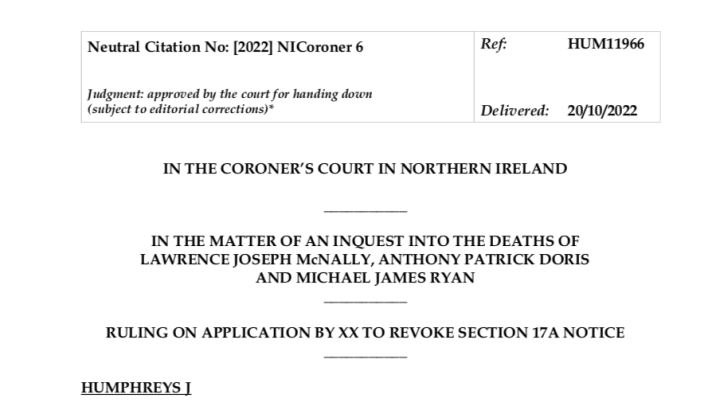
The unnamed academic researcher ‘XX’ was issued an order by the Coroner conducting ongoing inquest proceedings in relation to the deaths of three individuals, Lawrence McNally, Tony Doris and Michael Ryan at Coagh on 3 June 1991.
‘XX researched a thesis between 2011 and 2016 which was awarded a PhD by St Andrews University in Scotland titled Tir Eoghain Rebellion, a local war: a study of insurgency and counter-insurgency in post-1969 County Tyrone, Northern Ireland.
But the thesis is embargoed from publication until 2066 and is held securely by the university and the author’s solicitors.
Three of the researcher’s confidential interviewees, T, F and L, referred to the events at Coagh, and their identities are subject of a notice served under section 17A of the 1959 Coroner’s Act Northern Ireland.
‘XX’ has resisted the order on the basis the information itself is of little or no relevance to the questions which the inquest is obliged to answer, and there is a weighty public interest in academic historical research and in the preservation of confidentiality agreements.
The researcher draws an analogy with the protection afforded to journalists and their sources, and relies upon section 10 of the Contempt of Court Act 1981.
Mr Justice Michael Humphreys ruled ‘these serving police officers were able to provide an account of events which purported to descend into the detail both of the attack on the Ulster Defence Regiment (‘UDR’) soldier and the planned counter terrorist operation. The material was considered worthy of inclusion in an academic thesis the subject matter of which was counter insurgency in Tyrone.’
The judge observed the public policy behind section 10 of the 1981 CCA is to encourage freedom of the press and promote the right of freedom of expression in Article 10 ECHR.
However, the judge ruled: ‘The same public interest does not arise in relation to academic writings such
as the one in question in this case, which is by its very nature private.’ The academic work is not addressed to the public at large or a section of the public- ‘On the contrary, it is expressly embargoed from publication until 2066.’
An article by Fiona McIntyre for Research Professional, a subscription news service for UK Higher Education, drew parallels with the case of Boston College in the United States- forced to hand over some interviews conducted for research purposes with those involved in the conflict after a huge court case that dragged on for years, despite promises of anonymity made to participants by researchers.
New bill introduced by Scottish government in April 2023 to reform Scottish legal system by abolishing ‘not proven’ verdict, reduce the size of juries in criminal trials to 12 with two thirds majority verdicts, and explore ending the use of juries in trials for rape and attempted cases in a pilot project.
The proposals include reducing the number of people who sit on a jury from 15 to 12, which would be the same as the situation in the English and Welsh system.
At least eight of the 12 jurors would have to agree on a guilty verdict rather than the present situation which allows for a simple majority of eight out of 15.
The Victims, Witnesses, and Justice Reform (Scotland) Bill has been introduced to the Scottish Parliament to legislate these reforms.
The bill advocates the creation of a new specialist sexual offences court to run a pilot project where rape and attempted rape cases are tried being without a jury. A single judge would decide the facts and pronounce the verdict of guilty or not guilty and also sentence the accused.
Not proven is one of three verdicts which is unique to the Scottish legal system as an alternative to guilty and not guilty.
The outcome for defendants is the same as if they were found not guilty with the accused being considered innocent in the eyes of the law.
Part Six of the bill provides lifelong anonymity for complainants of sexual offences from the time they make an allegation: ‘This section will insert a new Chapter (Chapter 2B) into Part 6 of the Criminal Justice (Scotland) Act 2016 to make provision, through a prohibition on the publication of information likely to lead to the identification of victims of certain offences, for the lifelong anonymity of such victims.’
The prohibition will not ‘prevent the victim themselves from publishing the information. But a victim who
self-publishes information will not be covered by the exception to the extent that information they publish would be likely to lead to the identification of another person who is a victim of a relevant offence. A victim who is an adult is also able to consent to the publication of the information by another.’
Such restrictions affecting children under the age of 18 cannot be relinquished by the children themselves. An application would have to be made to a Sheriff’s Court and ‘before making a decision on such an application, the applicant and the child victim must be given an opportunity to make representations to the sheriff.’
Publications prevented from publishing information leading to the identification of complainants includes traditional forms of print and broadcast media, social media and other publicly accessible online forms of communication, such as Twitter.
Scottish ministers will have the power to add to or remove sexual offences from the list providing lifelong anonymity.
The legislation also provides the power to dispense with the restriction where a complainant receives a conviction for a ‘relevant offence’ such as ‘perjury, attempting to pervert the course of justice and making false statements and declarations.’
Useful links and further reading
Scottish Government ‘The not proven verdict and related reforms’
See: https://consult.gov.scot/justice/not-proven-verdict/
Victims, Witnesses, and Justice Reform (Scotland) Bill 2023
Victims, Witnesses, and Justice Reform Bill: factsheet
See: https://www.gov.scot/publications/victims-witnesses-and-justice-reform-bill-factsheet/
Single judge rape trial pilot
BBC News: ‘Not proven verdict to be scrapped in Scottish courts.’
See: https://www.bbc.co.uk/news/uk-scotland-65397235
What is Scotland’s not proven verdict?
See: https://www.bbc.co.uk/news/uk-scotland-glasgow-west-65394103
Scrapping ‘not proven’ could edge jurors to guilty, says study
See: https://www.bbc.co.uk/news/uk-scotland-49972637
Secondary Media Law Codes and Guidelines
IPSO Editors’ Code of Practice in one page pdf document format https://www.ipso.co.uk/media/2032/ecop-2021-ipso-version-pdf.pdf
The Editors’ Codebook 144 pages pdf booklet 2023 edition https://www.editorscode.org.uk/downloads/codebook/codebook-2023.pdf
IMPRESS Standards Guidance and Code 72 page 2023 edition https://www.impress.press/wp-content/uploads/2023/02/Impress-Standards-Code.pdf
Ofcom Broadcasting Code Applicable from 1st January 2021 https://www.ofcom.org.uk/tv-radio-and-on-demand/broadcast-codes/broadcast-code Guidance briefings at https://www.ofcom.org.uk/tv-radio-and-on-demand/information-for-industry/guidance/programme-guidance
BBC Editorial Guidelines 2019 edition 220 page pdf http://downloads.bbc.co.uk/guidelines/editorialguidelines/pdfs/bbc-editorial-guidelines-whole-document.pdf Online https://www.bbc.com/editorialguidelines/guidelines
Office of Information Commissioner (ICO) Data Protection and Journalism Code of Practice 2023 41 page pdf https://ico.org.uk/media/for-organisations/documents/4025760/data-protection-and-journalism-code-202307.pdf and the accompanying reference notes or guidance 47 page pdf https://ico.org.uk/media/for-organisations/documents/4025761/data-protection-and-journalism-code-reference-notes-202307.pdf
Police investigation into finances of the SNP, contempt of court, and the applicability of UK Supreme Court ruling in ZXC on reasonable expectation of privacy for crime suspects
It has not gone without notice that very high profile political figures in Scotland, namely former SNP First Minister Nicola Sturgeon, her husband and former SNP Chief Executive Peter Murrell, and the party’s treasurer Colin Beattie have all been arrested, questioned and released without charge.
Police Scotland is investigating what happened to £660,000 of donations given to the SNP by independence activists for use in a future independence referendum campaign.
The UK Supreme Court’s decision in ZXC v Bloomberg in February 2022 set a high bar of reasonable expectation of privacy versus public interest freedom of expression for crime suspects investigated by the police, questioned voluntarily, or arrested, questioned and released without charge.
But this was an English case and it is not binding in Scotland which has its own and separate media law jurisdiction. See Fergus Whyte’s article for Law Society of Scotland ‘Police enquiries: a private matter? The Supreme Court has upheld a privacy-based claim by an individual subject to a criminal investigation but not charged. This article considers the ruling, and its possible effect in Scotland’ at: https://www.lawscot.org.uk/members/journal/issues/vol-67-issue-04/police-enquiries-a-private-matter/
Mr Whyte explains another key difference in the process between Scotland and England:
‘Only after the CPS has made a decision on the case is the suspect formally charged (Director’s Guidance on Charging – Sixth Edition, Crown Prosecution Service). In Scotland, a police decision to “charge” is in fact a decision that they will refer the case to the Crown Office & Procurator Fiscal Service (“COPFS”) for it to decide what further action to take. There are a wide range of options available to COPFS other than instituting proceedings.’
What is clear is that Police Scotland did not publicly identify Nicola Sturgeon or the other people who have been arrested and questioned. See: ‘Investigation into Scottish National Party funding and finances – update’ at: https://www.scotland.police.uk/what-s-happening/news/2023/june/investigation-into-scottish-national-party-funding-and-finances-update/
The police statement also says ‘The matter remains active for the purposes of the Contempt of Court Act 1981 and the public are therefore advised to exercise caution if discussing it on social media.’
The Strict Liability Rule in the 1981 Contempt of Court Act that publication of information when a case is active (after arrest for example) will be a contempt of court if it creates a substantial risk of serious prejudice is fully engaged in such cases whether in Scotland, England and Wales, or Northern Ireland.
And this issue is being commented on and discussed in Scotland and elsewhere.
On February 7th 2023 COPFS in Scotland used its official Twitter channel to publish a reminder about the Contempt of Court Act restrictions. See:
And Roddy Doyle KC, Scotland’s Dean of the Faculty of Advocates, thought he should use his Twitter account to make a ‘public service announcement’ about contempt of court risks, presumably in respect of social media commentary:
What is the right judgment call where the suspect makes an extensive public statement declaring innocence? Early media contempt of court case law in England from 1983 established that it is possible to create a substantial risk of serious prejudice to the prosecution case as much as to that of a defendant whether or not the matter goes to jury trial.
The SNP finances police inquiry story is a difficult case history to navigate given the intense public interest status of the suspects.
An example of how the BBC is managing this is the story published online 13th June 2023: ‘Calls for Nicola Sturgeon to be suspended from SNP following arrest’ at: https://www.bbc.co.uk/news/uk-scotland-scotland-politics-65874678
The Section 5 defence in the 1981 Contempt of Court Act also applies:
‘5. Discussion of public affairs. A publication made as or as part of a discussion in good faith of public affairs or other matters of general public interest is not to be treated as a contempt of court under the strict liability rule if the risk of impediment or prejudice to particular legal proceedings is merely incidental to the discussion.’
Imagine the decisions British media would have to make should equivalent political figures in England be subject to investigation for serious criminal allegations.
These media law decisions are also influenced by any context of law officer warnings and a situation developing where the boundaries are set by the extent to which media publishers and social media communicators are pursued for alleged breaches of contempt of court law.
Fraser Myers, the deputy editor of Spiked Online, has been prompted to discuss the dilemmas and comparative media law issues in ‘Why can’t we talk about the Nicola Sturgeon scandal? Contempt-of-court laws have chilled the debate we need about the former first minister’s arrest’ at: https://www.spiked-online.com/2023/06/12/why-cant-we-talk-about-the-nicola-sturgeon-scandal/
Briefing in PDF file fomat

