


THE UK MEDIA LAW POCKETBOOK
by Tim Crook
Second Edition Published by Routledge 30th November 2022

Second Edition Published by Routledge 30th November 2022
If you are reading and accessing this publication as an e-book such as on the VitalSource platform, please be advised that it is Routledge policy for clickthrough to reach the home page only. However, copying and pasting the url into the address bar of a separate page on your browser usually reaches the full YouTube, Soundcloud and online links.
The companion website pages will contain all of the printed and e-book’s links with accurate click-through and copy and paste properties. Best endeavours will be made to audit, correct and update the links every six months.

Chapter 2
Guide to Court Reporting – Key facts and check-list
A special guide to applying primary and secondary media law to the process of court reporting.
The important of attribution, facts not comment, appropriate dress and conduct, background research and preparing technology and reconnaissance.
Negotiating access and rights of access to court case documents and multi-media materials used in evidence.
The importance of respecting restrictions relating to children and sex offence complainants, appreciating identity of protagonists, their titles and jargon and terminology, trial and case structure and narrative, practice in using cameras, recording and tweeting devices.
Applying the duty in accuracy, fairness, and the technique of note-taking for immediate reporting.
Absence of jury rule, taboos in interviewing jurors and judges, press conferences after a case has ended and the need to keep notes and records.
Video-cast Guide to Covering Court Cases
2.0 Key rules and professional standards when court reporting in bullet points
A downloadable sound file of bullet point professional tips and rules for court reporting
2.1 Attribution, facts not comment etc
A downloadable sound file on this section emphasizing attribution and avoiding comment
2.2 Respectfully dressed and respectfully behaved
A downloadable sound file stressing the need for respectful presentation and behaviour
Online Links Printed Book
Page 72
IPSO Court reporting: What to expect. Information for the public.
https://www.ipso.co.uk/media/1511/court-reporting-public.pdf
Combatting Online Harassment and Abuse: A Legal Guide for Journalists in England and Wales
https://medialawyersassociation.files.wordpress.com/2021/06/combatting-online-harassment-and-abuse-23.06.2021-09.10-5.pdf
Kate Cronin for Northamptonshire Telegraph: ‘Why is it important for Northants Telegraph journalists to cover inquests?’
https://www.northantstelegraph.co.uk/news/people/why-is-it-important-for-northants-telegraph-journalists-to-cover-inquests-3278300
2.3 Information preparation: Check your technology and reconnaissance
A downloadable sound file on how to get ready for your visit to court
2.4 Availability of agreed prosecution opening, skeleton arguments etc
Online Links Printed Book
Page 77
Guardian News and Media Ltd, R (on the application of) v City of Westminster Magistrates’ Court [2012] EWCA Civ 420 (03 April 2012)
https://www.bailii.org/ew/cases/EWCA/Civ/2012/420.html
Criminal Procedure Rules and Practice Directions 2015 updated and consolidated for 2022
https://www.judiciary.uk/wp-content/uploads/2022/03/CrimPD-12-CONSOLIDATED-March-2022.pdf
Protocol for working together: Chief Police Officers, Chief Crown Prosecutors and the Media
https://www.cps.gov.uk/publication/publicity-and-criminal-justice-system
Example of materials released for media use in the trial of former Metropolitan Police Constable, Wayne Couzens, sentenced to life imprisonment for the murder of Sarah Everard in September 2021.
https://twitter.com/cpsuk/status/1443537576523182080?lang=en-GB
The Guardian leads legal battle to show CCTV footage of Thomas Orchard being restrained and an emergency response belt placed over his face
https://www.theguardian.com/uk-news/2016/feb/24/footage-of-thomas-orchard-died-restraint-with-webbing-belt-revealed
2.5 Reporting restrictions – children, sex offence complainants
A downloadable sound file summarizing your need to check reporting restrictions
2.6 Names of protagonists, their titles and proper terminology etc
A downloadable sound file on reporting names and titles when covering criminal trials
Online Links Printed Book
Page 79
England and Wales Courts and Tribunals guide to ‘What do I call a Judge?’
https://www.judiciary.uk/you-and-the-judiciary/what-do-i-call-judge/
The Justice System in England and Wales
https://www.judiciary.uk/about-the-judiciary/the-justice-system/
Structure of the courts and tribunal system in England and Wales
https://www.judiciary.uk/about-the-judiciary/the-justice-system/court-structure/
2.7 Understanding the trial/case structure and narrative
A downloadable sound file on understanding how a criminal trial proceeds
Online Links Printed Book
Page 81
Going to court guide for England and Wales
https://www.judiciary.uk/you-and-the-judiciary/going-to-court/
Court of Appeal: https://www.judiciary.uk/you-and-the-judiciary/going-to-court/court-of-appeal-home/
High Court: https://www.judiciary.uk/you-and-the-judiciary/going-to-court/high-court/
Crown Court: https://www.judiciary.uk/you-and-the-judiciary/going-to-court/crown-court/
Magistrates’ Court: https://www.judiciary.uk/you-and-the-judiciary/going-to-court/magistrates-court/
County Court: https://www.judiciary.uk/you-and-the-judiciary/going-to-court/county-court/
Family Court: https://www.judiciary.uk/you-and-the-judiciary/going-to-court/family-law-courts/
Tribunals: https://www.judiciary.uk/you-and-the-judiciary/going-to-court/tribunals/
Coroners’ Court: https://www.judiciary.uk/about-the-judiciary/the-justice-system/coroners/
2.8 Cameras, recording and tweeting
Online Links Printed Book
Page 82
Ministry of Justice discussion paper on ‘Proposals to allow the broadcasting, filming and recording of selected court proceedings’ May 2012
https://assets.publishing.service.gov.uk/government/uploads/system/uploads/attachment_data/file/217307/broadcasting-filming-recording-courts.pdf
2.9 Accuracy paramount
A downloadable sound file on how to maintain accuracy when reporting court cases
2.10 Fairness paramount
A downloadable sound recording on how to maintain fairness when court reporting
2.11 Use notes/scripts for live broadcasts
A downloadable sound file on best practice when ‘live reporting’ from court cases
2.12 In the absence of the jury usually report nothing
2.13 Interviews – judges and jurors no, others be careful where and how
2.14 Qualified privilege at press conferences – useful
2.15 Keep your notes and case papers
A downloadable sound file advising on the keeping of notes and records
Online Links Printed Book
Page 87
Under the Data Protection (Charges and Information) Regulations 2018, individuals and organisations that process personal data need to pay a data protection fee to the ICO, unless they are exempt.
Registration self-assessment: https://ico.org.uk/for-organisations/data-protection-fee/self-assessment/
2.16 Dealing with stress-related issues when covering disturbing and shocking court cases
Online Links Printed Book
Page 88
Hold the Front Page ‘Reporter urges support for colleagues covering “traumatizing” trials from home’
https://www.holdthefrontpage.co.uk/2020/news/reporter-urges-support-for-colleagues-covering-traumatising-trials-from-home/
The Conversation: ‘Media companies on notice over traumatised journalists after landmark court decision.’
https://theconversation.com/media-companies-on-notice-over-traumatised-journalists-after-landmark-court-decision-112766
The Dart Center for Journalism and Trauma, a project of the Columbia University Graduate School of Journalism, is dedicated to informed, innovative and ethical news reporting on violence, conflict and tragedy.
https://dartcenter.org/europe
2.17 Access to the courts for student journalists
Online Links Printed Book
Page 89
Ewing v Crown Court Sitting at Cardiff & Newport & Ors [2016] EWHC 183 (Admin) (08 February 2016)
https://www.bailii.org/ew/cases/EWHC/Admin/2016/183.html
HMCTS: General guidance to staff on supporting media access to courts and tribunals
https://assets.publishing.service.gov.uk/government/uploads/system/uploads/attachment_data/file/1094686/HMCTS314_HMCTS_media_guidance_June_2022_v2.pdf
2.18 More information on court reporting resources, stop press and updates
Online Links Printed Book
Pages 92 to 94
HMCTS Reporters’ Charter, May 2022
https://assets.publishing.service.gov.uk/government/uploads/system/uploads/attachment_data/file/1074233/HMCTS702_Reporters_Charter_A4P_v4.pdf
HMCTS media guidance – managing high profile cases (accessible version)
https://www.gov.uk/government/publications/guidance-to-staff-on-supporting-media-access-to-courts-and-tribunals/hmcts-media-guidance-managing-high-profile-cases-accessible-version
Jurisdictional guidance to support media access to courts and tribunals: Criminal courts guide (accessible version)
https://www.gov.uk/government/publications/guidance-to-staff-on-supporting-media-access-to-courts-and-tribunals/jurisdictional-guidance-to-support-media-access-to-courts-and-tribunals-criminal-courts-guide-accessible-version
General guidance to staff on supporting media access to courts and tribunals
https://assets.publishing.service.gov.uk/government/uploads/system/uploads/attachment_data/file/1094686/HMCTS314_HMCTS_media_guidance_June_2022_v2.pdf
Jurisdictional guidance to support media access to courts and tribunals: Civil court guide
https://assets.publishing.service.gov.uk/government/uploads/system/uploads/attachment_data/file/869797/HMCTS_media_guidance_-Civil_Court_Guide_March_2020.pdf
Jurisdictional guidance to support media access to courts and tribunals: Family courts guide https://assets.publishing.service.gov.uk/government/uploads/system/uploads/attachment_data/file/1074298/HMCTS707_media_guidance_-_Family_Court_Guide_MAY_2022_V1.pdf
Jurisdictional guidance to support media access to courts and tribunals: Tribunals guide https://assets.publishing.service.gov.uk/government/uploads/system/uploads/attachment_data/file/1103102/HMCTS751_media_guidance_-_Tribunals_Court_Guide_11_Sept_2022.pdf
UK Supreme Court: https://www.supremecourt.uk/
Watch UK Supreme Court live: https://www.supremecourt.uk/live/court-01.html
UK Supreme Court current cases: https://www.supremecourt.uk/current-cases/index.html
UK Supreme Court archive of decided cases: https://www.supremecourt.uk/decided-cases/index.html
The Court of Appeal (Civil Division) – Live streaming of court hearings
https://www.judiciary.uk/you-and-the-judiciary/going-to-court/court-of-appeal-home/the-court-of-appeal-civil-division-live-streaming-of-court-hearings/
HMCTS Guidance on broadcasting sentencing hearings by the media and the Crown Court (Recording and Broadcasting) Order 2020
https://www.gov.uk/guidance/broadcasting-crown-court-sentencing
CourtServe – Court & Tribunal Lists: https://www.courtserve.net/
HMCTS telephone and video hearings
https://www.gov.uk/guidance/hmcts-telephone-and-video-hearings-during-coronavirus-outbreak#media-access-to-proceedings
HMCTS Guidance to staff on supporting media access to courts and tribunals
https://www.gov.uk/government/publications/guidance-to-staff-on-supporting-media-access-to-courts-and-tribunals
Society of Editors ‘Old Bailey allows journalists to cover criminal cases from home in legal first’ March 26 2020
https://www.societyofeditors.org/soe_news/old-bailey-allows-journalists-to-cover-case-in-legal-first/
Making hearing lists more accessible to court and tribunal users
https://insidehmcts.blog.gov.uk/2022/02/01/making-hearing-lists-more-accessible-to-court-and-tribunal-users/
IPSO guidance on court reporting for journalists and editors
https://www.ipso.co.uk/media/2168/ipso-court-reporting-guidance.pdf
HTFP Law Column: IPSO releases court reporting guidance
https://www.holdthefrontpage.co.uk/2022/news/law-column-ipso-releases-court-reporting-guidance/
New Links post publication of the printed book
Reporting Restrictions in the Criminal Courts – fourth edition update https://www.judiciary.uk/guidance-and-resources/reporting-restrictions-in-the-criminal-courts-4th-edition-update/
Judicial College Reporting Restrictions in the Criminal Courts https://www.judiciary.uk/wp-content/uploads/2022/09/Reporting-Restrictions-in-the-Criminal-Courts-September-2022.pdf
Broadcasting Crown Court sentencing Guidance on broadcasting sentencing hearings by the media and the Crown Court (Recording and Broadcasting) Order 2020. https://www.gov.uk/guidance/broadcasting-crown-court-sentencing
Broadcasting from the Crown Court Inside HMCTS Posted by: Rachael Collins, Posted on: 19 August 2022 https://insidehmcts.blog.gov.uk/2022/08/19/broadcasting-from-the-crown-court/
Broadcasting of sentencing remarks in the Crown Court July 28, 2022 https://www.judiciary.uk/broadcasting-of-sentencing-remarks-in-the-crown-court/
The recorded sentencing remarks hosted by Sky News on YouTube https://www.youtube.com/channel/UCF3HqeLrCkZgARQfyqj1m-g
Sections 198 and 199 Police, Crime, Sentencing and Courts Act 2022 allowing the Lord Chancellor to empower the Court to direct the electronic transmission of images or sounds of proceedings of all kinds for the purpose of enabling persons not taking part in the proceedings to watch or listen to them, though onward recording and broadcasting is prohibited.
Transmission and recording of court and tribunal proceedings- https://www.legislation.gov.uk/ukpga/2022/32/part/13/crossheading/transmission-and-recording-of-court-and-tribunal-proceedings
Errata and corrections to printed book
At the bottom of page 20, the case history and link for the Appeal Court ruling in the Guardian‘s bid to unseal the will of the late Duke of Edinburgh should have been placed in the box section for online resources in support of this section.
New edition of the Judicial College’s Guide to Reporting Restrictions in the Criminal Courts September/October 2022
On 30th September 2022 after the second edition of UK Media Law Pocketbook went to printing, the Judicial College publicly released its fourth edition of the guide to reporting restrictions in the criminal courts of England and Wales. The last version was updated in May 2016 and a considerable amount of the content needed updating given the passage of six years.
It is downloadable on this embedded link.
Eloise Spensley in the Jaffa Law Column for Hold The Front Page has analysed the new edition with the headline ‘The [court reporting] Times They Are A-Changin.’
Spensley argues the new guide has an ‘apparent focus on welfare and rehabilitation of juvenile offenders, now states that it would be wrong to dispense with a child’s right to anonymity as a form of additional punishment, so-called “naming and shaming.” It goes on to say that the welfare of the child must be given great weight and that rarely will it be the case that it is in the public interest to identify the child.’
Spensley highlights how the guide says: ‘there may be cases where it is necessary to protect the identity of the complainant where no automatic reporting restriction applies. For example, in cases of extortion, or revenge porn perhaps, the Guidance envisages that the proper administration of justice will generally call for the complainant to be granted anonymity to prevent the suffering of further harm.’
Introduction and development of live televising of Crown Court sentencing in England and Wales
Pages 39 to 42 of Chapter 1 of the printed book has a section on broadcasting and online coverage of the courts and following the inauguration of televising sentencing in the Crown Court for the first time at the Old Bailey 28th July 2022, the practice has been gathering what might be described as ‘gradual momentum.’
The head of law at ITV news, John Battle, who is also chair of the UK Media Lawyers’ Association, has been given credit for successfully leading the campaign for this development over many years.
The guidance on who can and how to apply to televise sentencing is set out at: https://www.gov.uk/guidance/broadcasting-crown-court-sentencing
Authorised media organisations approved for broadcasting the sentencing are the BBC, ITN, Sky and PA Media.
Any one of them needs to apply to the trial judge 5 days in advance of the sentencing hearing.
No one else can film, broadcast or take photos of any hearing at any time. These ‘authorised media’ can make their footage, including photographic stills from the filming available to other media publishers.
The judge makes a provisional decision at least 2 days before the hearing, and a final decision on the day of the hearing and all this decision making happens outside the courtroom.
The prosecution, defence, victim or his/her relatives cannot make representations and there is no right of appeal against the judge’s decision.
The sentencing judge decides whether sentencing can be broadcast live or not and will take into account any reporting restrictions that are in place.
If reporting restrictions do cover some of the content of a sentencing, ‘there will be a short delay before broadcast to comply with reporting restrictions’ and it is recognised ‘authorised media may need to edit footage before it’s broadcast.’
The copyright in the footage is retained by The Ministry of Justice, but the MOJ is not responsible for maintaining and transmitting the recordings on media platforms such as YouTube.
Key rules that have to be complied with:
1.Only the judge and their sentencing remarks can be filmed. Authorised media cannot film any other court user – including defendants, victims, witnesses, jurors and court staff.
2.Apart from those authorised media organisations identified (BBC, ITN, Sky and PA Media) and approved of by the Lord Chancellor ‘No one else can film, broadcast or take photos of any hearing at any time.’
How HMCTS and the Ministry of Justice explained this historic development for the Crown Court System in England and Wales. ‘Broadcasting from the Crown Court’ See: https://insidehmcts.blog.gov.uk/2022/08/19/broadcasting-from-the-crown-court/
Sky’s hosting platform of Crown Court Sentencing. See: https://www.youtube.com/channel/UCF3HqeLrCkZgARQfyqj1m-g
Note to student/trainee journalists. Watching these sentencing recordings offers a good opportunity to practice your shorthand or alternative method note-taking in real-time and then to check accuracy and news/journalistic relevance.
You could also set yourself a time deadline of writing up your reports as further practice.
Examples of televised sentencing since July 2022:-
Man jailed for life in first TV court sentencing 28th July 2022 From the number One Court of the Central Criminal Court.
Woman jailed for 34 years for murdering and decapitating friend 28th October 2022 at the Central Criminal Court, London otherwise known as the Old Bailey.
Mother and boyfriend jailed for life over killing of teenage son 7th November 2022 at Leeds Combined Court Centre.
Reservoir Dogs attacker gets further 15 years for murdering partner 22nd November 20222 at Bristol Crown Court.
Necrophiliac killer gets further four years for abusing dead women. 9th December 2022 at the Central Criminal Court, London also known as the Old Bailey.
Judge sentences Anne Sacoolas over Harry Dunn death. 9th December 2022 at the Central Criminal Court, London, also known as the Old Bailey.
Serial offender gets 38 year minimum jail term for brutal murder of Zara Aleena 9 Dec 2022 Central Criminal Court.
Double jeopardy killer gets 25 years for 1975 rape and murder of teenage victim. 13th January 2023 at Huntingdon Law Courts.
Appeal Court- Criminal Division Sentence increased for rickshaw death crash driver. 25th January 2023.
Pair jailed for 35 years for £4.6m murder and fraud plot. 1st February 2023, Central Criminal Court.
Serial rapist and ex-Met officer David Carrick jailed for at least 30 years 14 Feb 2023 Southwark Crown Court.
Son gets life sentence for fatal attack on mother 14 Feb 2023 Central Criminal Court
Embassy spy who sold secrets to Russians jailed for more than 13 years 17 Feb 2023 Central Criminal Court.
Parents jailed for manslaughter after disabled teen’s death, 2nd March 2023 Old Crown Court.
Wayne Couzens gets 19 months for indecent exposure in months before Sarah Everard killing, 6th March 2023 at the Central Criminal Court.
Woman, 22, jailed for eight-and-a-half years for false abuse and grooming gang claims, 14th March 2023, Preston Combined Court Centre.
14-year minimum term for bed mix-up murderer. 1st April 2023 CANOLFAN CYFIAWNDER TROSEDDOL CAERNARFON CRIMINAL JUSTICE CENTRE
Gunman who shot dead Olivia Pratt-Korbel, 9, jailed for at least 42 years. 4 Apr 2023 MANCHESTER CROWN COURT (CROWN SQUARE)
Mum and stepdad jailed over fatal attack on two-year-old daughter. Mr Justice Griffiths at Swansea Crown Court 26th April 2023.
Nigerian politician, wife and medic jailed over organ harvesting plot. Mr Justice Johnson 9th May 2023 at the Central Criminal Court.
Knifeman, 17, detained for murder of ‘defenceless’ 14-year-old. First televisied sentencing of a serious juvenile offender in the adult courts where anonymity reporting restrictions have been lifted. Judge Sarah Munro KC 10th May 2023 at the Central Criminal Court.
Teenagers get life for killing boy, 16, in mistaken identity attack. Judge Sarah Munro KC at the Central Criminal Court again on the same day (10th May 2023) at the Central Criminal Court. A reflection of the terrible toll of knife crime murders taking place in London with young people, often from Black and Asian ethnic communities being the victims.
Double killer gets third life sentence for sexually abusing boy. The Recorder of Nottingham, Judge Nirmal Shant KC at Nottingham Crown Court 11 May 2023. A double killer who brutally murdered two women in the 1990s was handed a third life sentence for violently sexually abusing a young boy in the years before his fatal attacks.
Killer of Nikki Allan, 7, jailed for at least 29 years three decades on. Mrs Justice Lambert at Newcastle Quayside Law Courts 24 May 2023. David Boyd, now 55, was convicted of the 1992 murder of schoolgirl Nikki Allan after advances in DNA technology allowed police to link him to the crime.
Parents jailed for life over murder of 10-month-old Finley Boden. Mrs Justice Tipples at Derby Combined Court Centre 27 May 2023. A couple who murdered their 10-month-old son on Christmas Day 2020 just weeks after he was returned to their care were both jailed for life. Shannon Marsden, 22, and Stephen Boden, 30, burnt and beat Finley Boden, leaving him with 130 separate injuries, including multiple bone breaks and fractures.
Mother and partner jailed for toddler’s violent death. A mother and her partner were jailed over the death of her 15-month-old son, who was shaken and beaten to death. 28 May 2023 Central Criminal Court before Mr Justice Sweeting.
Life sentence for teen terrorist who plotted attack on police and soldiers. The Recorder of London, Judge Mark Lucraft KC at the Central Criminal Court 2nd June 2023. A teenager who admitted he was planning a terror attack on the police and military was jailed for at least six years.
Killer, 15, gets 12-year minimum term for knife murder. 15 Jun 2023 Newcastle Quayside Law Courts before Mr Justice Martin Spencer. A 15-year-old boy was locked up for at least 12 years for stabbing another teenager to death.
Musician jailed for 15 years for killing student in “Mafia stiletto” stabbing. The Recorder of Manchester, Judge Nicholas Dean KC at Manchester Crown Court 19th June 2023. A musician who stabbed a student to death with a 13-inch ‘mafia stiletto’ knife after a comment over a skateboard was jailed for 15 years.
Government’s Rwanda asylum plan is unlawful, Court of Appeal rules. 29 June Royal Courts of Justice. Lord Burnett, the Lord Chief Justice, Master of the Rolls Sir Geoffrey Vos and Lord Justice Underhill.
Gunman who killed Elle Edwards in Christmas Eve pub shooting jailed for at least 48 years. Mr Justice Goose 8 Jul 2023 at Liverpool Crown Court. A gunman who shot dead a 26-year-old beautician when he opened fire on a packed pub on Christmas Eve was jailed for a minimum of 48 years.
People smuggler jailed for more than 12 years over Essex lorry deaths. Mr Justice Garnham 14 Jul 2023 at the Central Criminal Court. A people smuggler was jailed for more than 12 years for the manslaughter of 39 migrants who were found dead in a lorry trailer in Essex in 2019.
Teens sentenced to total of 34 years for mistaken identity knife murder. Mr Justice Choudhury at Wolverhampton Crown Court 14 Jul 2023. Two teenagers were jailed for a total of at least 34 years for the murder of 16-year-old in a mistaken identity attack. Pradjeet Veadhasa and Sukhman Shergill, both 17, stabbed Ronan Kanda to death close to his family home in Wolverhampton in June 2022.
Whole life term for killer who shot police officer Matt Ratana. Mr Justice Johnson at Northampton Combined Crown and County Courts. 27 July 2023. A gun fanatic who shot dead a Metropolitan Police custody sergeant after smuggling a gun into a holding cell was handed a whole life jail sentence. Louis De Zoysa, 26, opened fire on Matt Ratana without warning using a legally-bought antique revolver and homemade bullets, causing a fatal wound to his heart and lung. Sgt Ratana, 54, later died in hospital.
Rape conviction quashed for man who spent 17 years in jail. 28th July 2023 at the Royal Courts of Justice London. Lord Justice Holroyde with Mr Justice Goose and Sir Robin Spencer. A man who served 17 years in prison had his rape conviction overturned after fresh DNA evidence emerged linking another suspect to the crime. Andrew Malkinson, now 57, was jailed for life with a minimum term of seven years in 2004 after he was found guilty of the attack on a woman in Salford, Greater Manchester – but he stayed in jail for another decade because he maintained his innocence.
Operators fined £14m over Croydon tram disaster failings. Mr Justice Fraser at the Central Criminal Court, 28th July 2023. Tram operators were fined a total of £14m after seven people were killed when a tram crashed in Croydon, south London. Transport for London was fined £10m and Tram Operations Limited was fined £4m for failing in their health and safety duties.
Stepfather and mother jailed over brutal death of baby Jacob Crouch. Mr Justice Kerr at Derby Combined Court Centre 4th August 2023. Craig Crouch, 39, was convicted of murder over a final, fatal attack on the child at his home in Linton, Derbyshire, in December 2020 and jailed for at least 28 years. His partner and Jacob’s mother Gemma Barton, 33, was cleared of murder and manslaughter but found guilty of causing or allowing the infant’s death following a trial at Derby Crown Court. Barton received a total sentence of 10 years.
Killer nurse Lucy Letby gets 14 whole-life sentences. Mr Justice Goss at Manchester Crown Court 21st August 2023. Serial killer nurse Lucy Letby will never be released from prison after she was given 14 whole-life orders for murdering seven babies and attempting to murder six others. The former neonatal nurse, 33, fatally injected seven infants with air, tried to kill two others by lacing their feeding bags with insulin and attempted to force a tube down another’s throat.
Expense fraud MP Jared O’Mara loses bid to appeal jail term. Royal Courts of Justice, Court of Appeal: Criminal Division 27 Sept 2023. The 41 year old former MP had been jailed for fraud and lost a legal bid to challenge his four-year jail term. He was convicted of six counts of fraud following a trial at Leeds Crown Court. He had tried to obtain £52,000 of taxpayers’ money to fund a cocaine habit by submitting bogus claims for parliamentary expenses. Mrs Justice Lambert, sitting with Lord Justice Holroyde and Mr Justice Jeremy Baker rejected permission to appeal saying there was “no arguable ground that the sentence was manifestly excessive,” and it was “wholly proportionate” to the offences committed.
Dame Sue Carr sworn in as first Lady Chief Justice of England and Wales at the Royal Courts of Justice 2nd October 2023. She succeeded Lord Burnett of Maldon, who had held the post since 2017, and became the 98th person – and the first woman – to be appointed head of the judiciary and president of the courts. Speeches were delivered by Master of the Rolls Sir Geoffrey Vos, Lord Chancellor Alex Chalk KC MP, Attorney General Victoria Prentis KC MP, Chairman of the Bar Nick Vineall KC and Law Society President Lubna Shuja.
Windsor Castle intruder gets nine years’ custody for plot to kill the Queen. Mr Justice Hilliard at the Central Criminal Court 6th October 2023. A former supermarket worker who plotted to assassinate the late Queen Elizabeth II was sentenced to nine years in custody – but was told he will remain in hospital until he is deemed fit enough to go to prison. Jaswant Singh Chail, 21, scaled the perimeter of the Windsor Castle grounds with a nylon rope ladder on Christmas Day 2021 armed with a loaded crossbow while wearing a metal Star Wars-inspired mask. He had previously unsuccessfully applied for positions within the Ministry of Defence Police (MDP), the British Army, the Royal Marines, the Royal Navy, and the Grenadier Guards in a bid to get close to the Royal Family.
An example of a ruling from the Court of Appeal (Criminal Division) in July 2022 when the Lord Chief Justice of England and Wales presented judgement in linked appeals concerning the issue of ‘whole life terms.’ The appellants included Metropolitan Police officer Wayne Couzens convicted of the murder of Sarah Everard.
What is the current law in respect of broadcasting the courts in England and Wales?
The new edition of the Judicial College Guidelines on reporting restrictions in the Crown Court (2022) sets this out under section 5(7) at pages 45 and 46:-
Live-streaming, broadcast and electronic transmission of court proceedings
The statutory prohibitions on the recording and transmission of court proceedings do not apply to the transmission of video and audio of court hearings into a second courtroom, or to another location in England and Wales which is designated as an extension of the court. Not infrequently in criminal proceedings which attract a high level of public and press interest a second courtroom will be made available to permit a greater number of people to follow the proceedings in this way.
Until 2022, however, the general rule was that the statutory prohibitions on taking and publishing photographic images and sound recordings of court proceedings meant that courts had no power to allow their proceedings to be electronically transmitted to the general public. Any exception to this general prohibition requires further legislation.
There are four exceptions where Parliament has intervened to permit the live-streaming or electronic transmission of court proceedings.
- First, s.47 Constitutional Reform Act 2005 creates an exception to the general rule for proceedings in the Supreme Court, which are broadcast online on the Supreme Court Live service.209
- Secondly, the Crime and Courts Act 2013 s.32 empowers the Lord Chancellor to make regulations disapplying the prohibitions on making sound recordings and photographic images, thereby permitting the live-streaming of court proceedings. To date, orders have been made permitting the live-streaming of:
- Public hearings before the full court of the Court of Appeal.
- Sentencing remarks of certain specified judges in the Crown Court, with the permission of the relevant judge.
- Thirdly, the Coronavirus Act 2020 made temporary amendments to the Courts Act 2003, in light of the impact of the coronavirus pandemic, to enable certain criminal proceedings to be conducted by means of video or audio link and to permit the ‘broadcast’ of criminal proceedings conducted wholly by means of video or audio, for the purpose of enabling members of the public to see and hear the proceedings. As this power was limited to proceedings conducted ‘wholly’ by video or audio link, it follows that it did not confer power to permit live-streaming of criminal court proceedings which took place in person, or partly in person. This power did not allow a court conducting a fully remote hearing to permit a TV production company to record and then re-broadcast the proceedings.214
- Fourthly, the Police, Crime, Sentencing and Courts Act 2022 replaces the temporary powers under the Coronavirus Act with permanent amendments to the CJA 1925, CCA 1981 and the Courts Act 2003. These allow the Lord Chancellor to empower the Court to direct the electronic transmission of images or sounds of proceedings of all kinds for the purpose of enabling persons not taking part in the proceedings to watch or listen to them, though onward recording and broadcasting is prohibited.
There is now an extensive infrastructure of televised broadcasting of Appeal Court Civil Division cases from the Royal Courts of Justice with streaming on YouTube though permission is not given for the material to be broadcast and re-used by the media:
Court of Appeal – Civil Division – Court 63
Court of Appeal – Civil Division – Court 70
Court of Appeal – Civil Division – Court 71
Court of Appeal Civil Division – Court 73
Court of Appeal – Civil Division – Court 74
Court of Appeal – Civil Division – Court 75
Court of Appeal – Civil Division – Court 76
On 28th July 2023 ITN’s head of legal and compliance John Battle wrote an article for Press Gazette on how the success of filming in UK courtrooms is restoring trust in justice: ‘Cameras in courts one year on: An unqualified success.’ See: https://pressgazette.co.uk/comment-analysis/cameras-in-courts-one-year-on-an-unqualified-success/
Two judges whose sentencing has featured in live televised hearings in the past year, His Honour Judge Mark Lucraft, the Recorder of London, and Mrs Justice Cheema Grubb, have offered their views on the project in a Ministry of Justice media release: ‘One year of broadcasting of sentencing remarks in the Crown Court.’
See: https://www.judiciary.uk/one-year-of-broadcasting-of-sentencing-remarks-in-the-crown-court/
Legal journalist Joshua Rozenberg KC has also written an excellent analysis and review of one year of televising the sentencing in English courts for Law Society Gazette: ‘Letting the public see how the public law works.’ (pages 12 to 13)
The outgoing Lord Chief Justice of England and Wales Lord Burnett has also been making his views on Open Justice and televising the courts in a speech to the Commonwealth Magistrates’ and Judges’ Association in Cardiff in September 2023.
He said: “The question when considering the live-streaming or broadcasting of additional types of case or parts of cases, in my view, should be: why not?”
He supported the common law tradition of Open Justice in identifying judges and parties and resisting anonymization which is the practice in civil and Roman law jurisdictions.
He observed the European Court of Human Rights had not named the duty judge who temporarily prevented the UK from sending asylum-seekers to Rwanda last summer — “something that is alien to the common law tradition.”
See: London Evening Standard 12th September 2023 ‘Strong argument to go further with cameras in courts, says Lord Chief Justice. Lord Burnett said the broadcasting of sentencing in some criminal cases had been ‘successful beyond our expectations’.
Also reported in Standard’s sister online national publication The Independent.
Ministry of Justice Open Justice Consultation 2023
In May 2023, the Ministry of Justice opened a consultation on Open Justice. See: https://www.gov.uk/government/consultations/open-justice-the-way-forward/call-for-evidence-document-open-justice-the-way-forward
A research document ‘Open Justice: the way forward Call for Evidence’ was released 10th May at: https://assets.publishing.service.gov.uk/government/uploads/system/uploads/attachment_data/file/1155744/open-justice-cfe.pdf
The call for evidence ends 7th September 2023 and invites contributions on a wide range of topics: Open Justice; listings; accessing courts and tribunals; remote observations and livestreaming; broadcasting; Single Justice Procedure; publication of judgments and sentencing remarks; access to court documents and information; data access and reuse; and public legal education.
See Law Society Gazette ‘Court photography ban under review in transparency drive’ at: https://www.lawgazette.co.uk/practice/court-photography-ban-under-review-in-transparency-drive/5116009.article
Media Law pdf file briefing on this subject
Parole hearings to be heard in public for the first time
Victims, members of the public and the media will be able to ask for a parole hearing to be heard in public for the first time, following law changes being made 30th June 2022.
See: https://www.gov.uk/government/news/parole-hearings-to-be-heard-in-public-for-the-first-time
Came into effect 21st July 2022. 1. Anyone will be able to apply for a public hearing, with the Parole Board making the final decision on whether to do so. 2. These decisions will consider the welfare and interest of victims and reach a conclusion based on the ‘interests of justice’.
See: The Parole Board (Amendment) Rules 2022
‘An oral hearing (including a directions hearing or case management conference) must be held in private unless the Board chair considers, on their own initiative or on an application to the Board, that it is in the interests of justice for the oral hearing to be held in public.
(3A) Any application for an oral hearing to be held in public under paragraph (3) may not be made later than 12 weeks before the date allocated for the oral hearing.
(3B) If an oral hearing is held in public, the panel chair or duty member may give a direction that part of the oral hearing is to be held in private.’
The first time a Parole Board hearing was reported by the media was December 12th 2022 and concerned convicted murder killer 79 year old Russell Causley.
The decision to have this hearing effectively in public with contemporaneous reporting by journalists was made by Caroline Corby The Chair of the Parole Board for England and Wales 7th September 2022.
It was reported Causley told ‘Britain’s first public parole hearing’ that he burned her body in his garden and disposed of the ashen remains on roadsides and hedgerows
• Causley, 79, killed his wife in 1985 but had never revealed where her body lies
• He told a public parole hearing he burned Carole Packman’s body in his garden
• Then he spread her ashen remains on roadsides and hedgerows in Bournemouth
• Hearing allows the parole board to establish if Causley would be a risk if released
The hearing took place at Lewes prison in East Sussex with relatives, members of the public and journalists allowed to watch the proceedings on a live videolink from the Parole Board’s offices in Canary Wharf, London.
See: ‘First public parole hearing following government reforms.’
Legal journalist Joshua Rozenberg says he was the first journalist allowed to observe a Parole Board hearing for BBC Radio 4’s Law In Action programme in 2020. He was not permitted to identify the prisoner involved.
A further Parole Board hearing has been heard in public with attendance by journalists and members of the public at the Royal Courts of Justice in the Strand London in the case of Charles Bronson in March 2023.
‘Members of the press and public could watch the latest proceedings – taking place in prison – on a live stream from the Royal Courts of Justice in central London’
See Evening Standard report ‘Charles Bronson describes ‘rumble of his life’ prison fight as parole panel told he wouldn’t cope with release. He is only the second inmate in UK legal history to have his case heard in public.’
Keeping reporting files and the importance of accurate and professional shorthand as a journalist/reporting skill when covering the courts.
A High Court ruling on 7th December 2022 is a substantial victory for a freelance court reporter in London whose diligent professionalism in keeping accurate and dated notebooks and applying the Teeline shorthand kill in his work clearly contributed to his defence.
Tony Palmer is described in the ruling of ABC v Palmer [2022] EWHC 3128 (KB) (07 December 2022) as ‘a freelance journalist who is a member of the National Union of Journalists and who sells reports of court hearings to national newspapers and posts them on a blog he runs called Square Mile News. The Claimant brings this action as a result of a report by the Defendant which purported to be of the hearing of her case at the Magistrates Court and which he posted on his blog, Square Mile News (“the Blog Post”) dated 13 May 2015.’

The case relates to a report from a magistrates court case where the claimant pleaded guilty to fraud and received a suspended prison sentence. Seven years after reporting her case and publishing it, Mr Palmer faced litigation for misuse of private information, harassment, breach of the General Data Protection Regulation, and a claim from the women that she had the right to be forgotten because her conviction was now spent under the Rehabilitation of Offenders Act.
Mr Palmer successfully defended himself and the action against him did not succeed on any of the grounds.
The following quotations from Mr Justice Griffiths demonstrate how well Mr Palmer accomplished his assertion of not only his professionalism but the right of journalists to report open criminal court hearings fairly and accurately:
Paragraph 11:-
‘I accept Mr Palmer’s evidence that he makes his living as a journalist and court reporter. He works alone. He showed me a National Union of Journalists press card valid for the period including the date of Ms C’s plea and sentencing hearing. He has been a journalist since 1988. Apart from his working experience, his only training has been in Teeline shorthand, which he learned in about 2010. He sells stories to national newspapers, such as the Sun, the Mirror, the Star, the Daily Mail, the Daily Express, the Times, the Telegraph and the Evening Standard. He showed me some articles with his name “Tony Palmer” as the byline, reporting court cases. He also posts court reports on his blog, Square Mile News, a website which he runs alone and is proud of (“SMN”). When he has failed to gain the interest of the printed press for his reports, he leaves them on SMN. His SMN reports may state, as the Blog Post in issue in this case did, “Exclusivity Option – Contact [email address] for sole rights to story and removal”…He explained that the notice on SMN was to encourage national papers to buy and run his stories, and to assure them that, if they did, they could have them as exclusives and the stories would be removed from SMN in order to give them that exclusivity.’
The claimant alleged Mr Palmer was not in court to report her case. He was able to counter this because between paragraphs 14 and 17:
‘Mr Palmer’s evidence is, however, compelling on this point. I was shown an email from HMCTS sending him the Magistrates Court list for the week commencing 12 May 2015 and I was shown the attached copy list itself, which included both Ms C’s case and another case in the same building on the same day which Mr Palmer reported on, under his Tony Palmer byline, in a national newspaper. He got the cause list in order to spot cases that it might be worth his while to attend and report on.
I was also shown his Teeline shorthand notes of the hearing, and the original notebook from which the photocopies in the bundle were made. In his oral evidence, he read out the meaning of the notes and it was obvious (Teeline being a relatively simple system in which many characters are self-explanatory even to the untrained reader) that his explanation of what they meant was correct. The notes sounded exactly as one would expect a court hearing to go, starting with the submissions of the prosecutor, continuing with the submissions of the defence, and concluding with the sentencing remarks of the District Judge.
I was also shown copies of photographs taken by Mr Palmer of defendants whose stories he had decided to write up which he took outside court. He explained that having a photograph enhances the value and interest of his stories to potential buyers from the national newspapers. These photographs were all grouped together on his Apple Mac (in a screenshot) under the correct date 12 May 2015 in a series of 8 photographs. The first 3 were of the person in the other case on that day which Mr Palmer did successfully sell as a bylined report in a national paper, which I was shown. The next four of the Claimant, of which the most distinct was used in the Blog Post.
I am therefore satisfied on the evidence that Mr Palmer did personally attend the hearing of Ms C’s case as he claims, that he took a contemporaneous Teeline note of the proceedings, and that he took the photograph of Ms C himself. She accepts that it is a photograph of her.’
The claimant also challenged the accuracy of Mr Palmer’s reporting. The High Court judge examined and analysed his notebook meticulously. Again the quality of his journalism and reporting are commendably evaluated and recognised across paragraphs 20 to 26:
‘The notes start with the date, 12 May. They note the relevant Magistrates Court, using the first three letters of the place (which I will not set out) as an obvious abbreviation. They note cases from the cause list which might be of interest to Mr Palmer, including, specifically, the case which he did get published in a national paper, and Ms C’s case.
Then the name of the prosecutor in Ms C’s case, Sue Obeney, is noted. I accept Mr Palmer’s evidence that he either got this name by asking on the day, or because she was the regular prosecutor for local authorities in this court, and he was himself a regular reporter in this court (as press reports corroborate), and knew her name before the case began.
After notes of the cases before Ms C’s case (including the case which he successfully sold under his byline), Ms C’s surname is in the notes. The prosecution opening of the facts is then noted down. These notes cover 3 pages (starting in the middle of electronic page 127 of trial bundle “Evidence 2”, and ending in the middle of page 130, with prosecution costs claimed at £26,500). They closely correspond to what Mr Palmer subsequently included in his Blog Post report.
From the middle of page 130 to the bottom of page 131 are Mr Palmer’s Teeline notes of the defence submissions on behalf of Ms C. They begin (picking up from something noted in the prosecution opening of the facts) “She does have OCD, mental health issues”, “she ended up having to share with other people, and her OCD”, “She claimed for borough she wasn’t living in to top up her benefit to allow her to reside in her self contained flat”, “now receives extra benefit for OCD”, “£5,300 overpayment”, “PIP [Personal Independence Payment] eligible”, “£325 per week extra PIP”, “£20 disability”, “Housing Benefit now £250 per week”, “She’s rated at high end of disability”, “She cares for her younger brother, and has been given two-bedroom flat so her 11 year old brother can live with her”, “Employment Support Allowance of £300 per fortnight”.
I am satisfied that all these things were said, as noted, by Ms C’s own legal representative in open court when making submissions on her behalf to the District Judge. I reject Ms C’s claim that they were not said and that there was no reference to her OCD or mental health issues, or to her brother.
Finally, the Teeline note of this hearing concludes (p 132 of the electronic bundle) with the sentencing remarks of “Wattam”, i.e. District Judge Wattam. There is a note of him referring to “the significant degree of sophistication and you supplied false details. Your offending was quite deliberate and dishonest.” The sentence passed is noted (correctly) as “4 months [imprisonment] suspended for 12 months”, with “£25 costs, £80 victim surcharge”. The name of Ms C’s legal representative is noted, again correctly, as “Ms Goodwin, defence”.
The hearing took place, as I have said, on 12 May 2015.’
When Mr Justice Griffiths analysed his published report of the hearing he said: ‘I am satisfied that this was an honest and accurate report of the hearing.’
At paragraph 84, the judge vindicated his decision to repost the report after the claimant began making allegations about his reporting:
‘I consider that the necessary exercise of Mr Palmer’s legitimate rights of freedom of expression and information outweighed Ms C’s rights to privacy and other rights at this time, because she was actively making false claims about him and about events which he had witnessed. The Blog Post was his version of events, and it was a true version. I also take into account that the harm to her was limited to her own reaction to knowing the Blog Post was up, since no-one else was interested in it and no-one else, so far as the evidence shows, was looking at it so many years after 2015, except in connection with Ms C’s own complaints. This point is particularly strong since Google had de-listed it in 2017 and it was therefore not easy to find.’
The significance of his case is the importance of court reporters, and indeed all journalists, in maintaining their professional discipline in keeping accurate, dated and reliable shorthand notes of their work. Sam Brookman analysed this case for the The Hold The Front Page Jaffa media law column 20th December 2022.
Sam Brookman rightly sees significance in the Judge’s following observation at paragraph 75:
‘The essential record in this respect was his reporter’s notebook. He retains all of these routinely, and operates on the basis that they should be kept for at least 7 years. That is in my judgment reasonable, given that normal limitation periods are 6 years and claims may be issued at the end of that period and not served immediately. Mr Palmer’s retention of records has enabled this trial to be conducted on the basis of good evidence. It is fortunate that he did retain his notebook, in particular. Otherwise, the untrue evidence of Ms C that he was not there, and that things that he reported were never said in court, might not have been so easily disproved. When, as in this case, there is a stark conflict of oral evidence, the retention of documentary records is vindicated.’
Ms Brookman commends the journalist defendant since: ‘the fact remains Mr. Palmer was able to defeat a highly unmeritorious claim based on the Claimant’s “untrue evidence”, because he had been so meticulous in keeping his background materials.’
Sam Brookman concludes her column by saying ‘if you ask me how long a notebook should be kept, my answer will always be: “the longer the better”!’
I am pleased to say that in the printed text of the book at 2.15 on page 86 I recommended: ‘Always keep your notes and background papers on any cases you report for up to six years after the event. There is a case for keeping them until you retire.’
Ethical representation of the identity of transgender defendants and other participants in court reporting
Professional journalists and student journalists, particularly in universities, will be very much aware of the acute debates taking place about proper vocabulary and references to gender identities.
The issue is taken so seriously in professional and institutional life individuals found to have disrespected fair and respectful wishes on gender identification have faced disciplinary proceedings and dismissal.
There is understandable anxiety on the part of trainee journalists about the expectations of how defendants and other participants represent themselves in court, how they are referred to in the legal proceedings and how this must be properly and fairly reported.
IPSO (The Independent Press Standards Organisation) has published fresh draft guidance on reporting of sex and gender identity, which contains advice for newsrooms on covering court cases involving transgender and gender-diverse defendants.
IPSO is seeking consultation before finalising the guidance.
Journalists are being urged to take account of trans defendants’ gender at the time they offended.
IPSO Draft guidance on reporting of sex and gender identity
See: https://www.ipso.co.uk/media/2302/ipso-draft-guidance-on-reporting-of-sex-and-gender-identity.pdf
The key points arising from the guidance on court reporting recommend:
- Taking into account and respecting the way a defendant says they wish to be identified in the court proceedings, including the name used and pronoun used by court officials and/or any witnesses;
- Taking account of the defendant’s gender identity at the time of the alleged crime;
- Considering any guidance provided by the court about a defendant’s gender identity;
- Evaluating the public interest in reporting the gender identity and any transition in the context of protecting public health or safety particularly in respect of the need to ensure accuracy when reporting a major news event;
- Considering the significance of the charges the defendant faces and whether gender identity is relevant to the case brought by the prosecution and the defence and/or mitigation provided during the trial.
The stalwarts of legally safe court reporting: accuracy, fairness and attribution are effective lines of protection from what would be secondary media law complaints to regulatory bodies. However, it might be argued there are still areas of discretion which should be determined by the exercise of an individual’s conscience and the freedom of expression prerogative.
Primary media law litigation could arise if gender transitioning and identity information about an individual has not been put into the public domain by the individual concerned, and if the journalist and publisher cannot show by documentary trail they have carried out a balancing act analysis of whether in reporting gender identity the degree of intrusion is proportionate to the public interest being served.
The navigation of this area is clearly controversial. Dr Amy Binns and Sophie Arnold sought to research the subject and produced guidance on covering court cases involving transgender defendants.
But this was removed by the University of Central Lancashire after its publication online following complaints made to the university.
See the following articles and case law for further guidance and background:
Law Column: IPSO and reporting on sex and gender identity by Sam Brookman Published 21 Feb 2023 https://www.holdthefrontpage.co.uk/2023/news/law-column-ipso-and-reporting-on-sex-and-gender-identity/
Journalists urged to take account of trans defendants’ gender at time they offended https://www.holdthefrontpage.co.uk/2023/news/pronouns-and-transgender-defendants-feature-in-press-watchdogs-new-guidance/
IPSO commissions research into standards of UK media reporting on transgender issues https://pressgazette.co.uk/news/ipso-commissions-research-into-standards-of-uk-media-reporting-on-transgender-issues/
New guidance launched to aid reporting on transgender defendants https://www.holdthefrontpage.co.uk/2022/news/new-guidance-launched-in-bid-to-aid-reporting-on-transgender-defendants/
Guidance on covering transgender defendants removed after complaints https://www.holdthefrontpage.co.uk/2022/news/guidance-on-covering-transgender-defendants-removed-after-complaints/
Editor and reporter leave weekly after transgender column controversy by David Sharman Published 13 Nov 2017 Last updated 17 Nov 2017 https://www.holdthefrontpage.co.uk/2017/news/editor-and-reporter-leave-weekly-after-transgender-column-controversy/
Press Gazette: ‘Kentish Gazette transgender article was wrong – but journalists should not be sacked for exercising freedom of speech’ https://pressgazette.co.uk/publishers/regional-newspapers/kentish-gazette-transgender-article-was-wrong-but-journalists-should-not-be-sacked-for-exercising-freedom-of-speech/
Journalist who launched LGBTQ+ network leaves regional press for national role https://www.holdthefrontpage.co.uk/2023/news/journalist-who-launched-lgbtq-network-leaves-regional-press-for-national-role/
Press Gazette ‘Transgender ex-Times journalist loses discrimination claim against paper’ https://pressgazette.co.uk/news/transgender-ex-times-journalist-loses-discrimination-claim-against-paper/
Press Gazette “Columnist James Wong leaves The Observer and claims ‘institutionalised transphobia.” https://pressgazette.co.uk/news/james-wong-observer-social-media-transphobia/
Media wins right to name transgender man battling to be named ‘father’ on own child’s birth certificate https://pressgazette.co.uk/news/media-wins-right-to-name-transgender-man-battling-to-be-named-father-on-own-childs-birth-certificate/
TT, R (on the application of) v The Registrar General for England and Wales [2019] EWHC 2384 (Fam) (25 September 2019) https://www.bailii.org/ew/cases/EWHC/Fam/2019/2384.html
Courts and Tribunals Judiciary July 2022 ‘interim revision of the Equal Treatment Bench Book issued’ https://www.judiciary.uk/wp-content/uploads/2022/10/Equal-Treatment-Bench-Book-July-2022-revision-2.pdf
The Crown Prosecution Service Trans Equality Statement https://www.cps.gov.uk/publication/trans-equality-statement and https://www.cps.gov.uk/sites/default/files/documents/publications/Trans-equality-statement.pdf
Relevant IPSO rulings
00804-20 Smith v The Herald Decision: No breach – after investigation https://www.ipso.co.uk/rulings-and-resolution-statements/ruling/?id=00804-20 Daily newspaper cleared over SNP trans row story https://www.holdthefrontpage.co.uk/2020/news/daily-newspaper-cleared-over-snp-trans-row-story/
09159-19 Fair Play for Women v kentlive.news Decision: Breach – sanction: action as offered by publication https://www.ipso.co.uk/rulings-and-resolution-statements/ruling/?id=09159-19 Watchdog raps news site over ‘transphobic abuse’ claim https://www.holdthefrontpage.co.uk/2020/news/ipso-raps-news-site-for-reporting-alleged-transphobic-abuse-as-fact/
00572-15 Trans Media Watch v The Sun Decision: Breach – sanction: publication of adjudication https://www.ipso.co.uk/rulings-and-resolution-statements/ruling/?id=00572-15
01972-22 The Radcliffe School v miltonkeynes.co.uk Decision: Breach – sanction: publication of adjudication https://www.ipso.co.uk/rulings-and-resolution-statements/ruling/?id=01972-22
Resolution Statement – 06439-21 Pascoe v spectator.co.uk Decision: Resolved – IPSO mediation https://www.ipso.co.uk/rulings-and-resolution-statements/ruling/?id=06439-21
09309-21 A woman v Daily Mail Decision: No breach – after investigation https://www.ipso.co.uk/rulings-and-resolution-statements/ruling/?id=09309-21
01695-21 Parrott v Norwich Evening News Decision: Breach – sanction: action as offered by publication https://www.ipso.co.uk/rulings-and-resolution-statements/ruling/?id=01695-21
Anonymity in the Magistrates Court, Open Justice victory for journalists 17th March 2023 ruling of the Administrative High Court
This was a Section 11 1981 Contempt of Court Act order made at Westminster Magistrates for withholding a name in a Proceeds of Crime Act 2002 hearing.
The challenge was first made by submissions in court from Martin Bentham, Home Affairs Editor of the Evening Standard and Koos Couvée, Senior Reporter with ACAMS MONEYLAUNDRERING.COM. But they were only able to make their submissions after the hearing applying for the reporting restriction order was held in private from which they were excluded. And the notice news organisations were given about the order being applied for was distributed the night before.
The issue was further taken up by the BBC with a formal application to discharge the order. The journalist Martin Bentham and Leading Counsel for the BBC, Jude Bunting KC (instructed by in-house legal team) made submissions and successfully persuaded the District judge to lift the order.
The Judicial Review was made by the person who sought anonymity ‘MNL’. In an important ruling for professional journalism, the High Court ruled that Open Justice had to prevail in this case over Article 8 privacy rights.
MNL, R (On the Application Of) v Westminster Magistrates’ Court [2023] EWHC 587 (Admin) (17 March 2023)
See: http://www.bailii.org/ew/cases/EWHC/Admin/2023/587.html
And the judgement by Lord Justice Warby and Mr Justice Mostyn includes persuasive observations on journalists’ and news publishers’ rights to be given proper notice and the opportunity to challenge such orders when they are applied for.
Lord Justice Warby’s introduction- paragraphs 1 and 2
- This is a claim for judicial review of a decision of the Westminster Magistrates’ Court to lift an order anonymising the claimant in connection with a claim for forfeiture of assets brought by the National Crime Agency (the NCA) against three other individuals under the Proceeds of Crime Act 2002. The main issue is whether the judge erred in law when resolving a conflict between the imperatives of open justice and the rights of a non-party to respect for his private life.
- The claimant was neither a party nor a witness in the forfeiture proceedings, but he does have some connections with the respondents to those proceedings. Before the hearing began, having learned that prejudicial references to him were likely to be made and fearing the reputational consequences, he applied for an anonymity order. The District Judge made such an order, heard the forfeiture proceedings and gave a public judgment in favour of the NCA which referred to the claimant but did not name him. Thereafter, on the application of the BBC the judge discharged his earlier order. The claimant challenges the judge’s decision as flawed in law. He contends that we should set aside the decision of the judge, re-make the decision and restore the anonymity order.
Key ratio decidedi at paragraph 41, sub-paragraphs 5 to 7:
(5) The next stage is the balancing exercise. Both the judge’s decisions expressly turned on whether it was “necessary and proportionate” to grant anonymity. That language clearly reflects a Convention analysis and the balancing process which the judge was required to undertake. The question implicit in the judge’s reasoning process is whether the consequences of disclosure would be so serious an interference with the claimant’s rights that it was necessary and proportionate to interfere with the ordinary rule of open justice. It is clear enough, in my view, that he was engaging in a process of evaluating the claimant’s case against the weighty imperatives of open justice.
(6) It is in that context that the judge rightly addressed the question of whether the claimant had adduced “clear and cogent evidence”. He was considering whether it had been shown that the balance fell in favour of anonymity. The cases all show that this question is not to be answered on the basis of “rival generalities” but instead by a close examination of the weight to be given to the specific rights that are at stake on the facts of the case. That is why “clear and cogent evidence” is needed. This requirement reflects both the older common law authorities and the more modern cases. In Scott v Scott at p438 Viscount Haldane held that the court had no power to depart from open justice “unless it be strictly necessary”; the applicant “must make out his case strictly, and bring it up to the standard which the underlying principle requires”. Rai (CA) is authority that the same is true of a case that relies on Article 8. The Practice Guidance is to the same effect and cites many modern authorities in support of that proposition. These include JIH v News Group Newspapers Ltd [2011] 1 WLR 1645 where, in an often-cited passage, Lord Neuberger of Abbotsbury said at [22]:
“Where, as here, the basis for any claimed restriction ultimately rests on a judicial assessment, it is therefore essential that (a) the judge is first satisfied that the facts and circumstances of the case are sufficiently strong to justify encroaching on the open justice rule …”
(7) In my opinion, the closing passage of the judgment under review reflects the conclusion arrived at by the judge after conducting the necessary balancing process. This was that, in the light of all the facts and circumstances that were apparent to him at that time, the derogation from open justice that anonymity would represent was no longer shown to be justified as both necessary for the protection of the claimant’s Article 8 rights and proportionate to that aim.’
Mr Justice Mostyn’s ruling in paragraphs 48 to 56 set out what was wrong about the procedure and denail of natural justice to the press/media:
48 In DPP v Shannon [1975] AC 717, 766 Lord Simon of Glaisdale recalled that the father of English legal history, F.W. Maitland, “was wont to observe how rules of substantive law have seemed to grow in the interstices of procedure”[1].
49 Procedural rules exist for a purpose, and that purpose is to ensure that every legal cause is despatched not merely efficiently, but fairly. Procedural rules are not so much directed to ensuring that the content of a judicial decision is just – that is what the substantive law achieves – but that the way it is reached is fair. In their interstices they incorporate and promulgate the elementary rule of natural justice, mirrored in Article 6 of the European Convention of Human Rights, that everyone has the right to a fair hearing.
50 A fair hearing means not only that your judge is not biased (nemo iudex in causa sua) but that you are heard (audi alteram partem). And being heard means not merely that you are allowed to participate in a hearing that affects you, but, critically, that you are given reasonable notice of it.
51 We know that the claimant was warned in the second half of September 2021 that the NCA intended to make allegations against him in forfeiture proceedings brought against monies held in UK bank accounts by members of JF’s family. The claimant therefore had over a month to take whatever steps he judged necessary to protect himself. The choice he made was to apply for a reporting restriction order (“RRO”) on the afternoon of 28 October 2021. Astonishingly, that was the day immediately before the commencement of the substantive forfeiture trial. No explanation has been offered for this delay.
52 The notice given to the NCA was therefore not even of one clear day. It was so short that had the NCA decided to contest the application it is doubtful that it would have been able to assemble its case in the time left. However, that evening the NCA agreed not to refer to the claimant by name in the proceedings.
53 The press were not served until that evening, and so, to all intents and purposes had no notice at all.
54 The following day the application was heard in private. The press were not allowed into the hearing. The NCA did not contest the application. Obviously, the Respondents (JF’s family members) did not contest it. The press were then provided with a copy of the draft order and two journalists were allowed to make oral submissions after the hearing had concluded, and without having heard the submissions on behalf of the claimant. The order records that the court only heard counsel for the claimant and for the parties but the note of the judge’s judgment states that he heard detailed submissions from the press. The procedure is utterly bizarre.
55 The consequence of what looks like a strategic decision to give almost the shortest possible notice to the NCA, and in reality none to the press, was that the application for the RRO was effectively uncontested. Allowing the press to make submissions after the hearing was over does not amount to much of a contest.
56 In my judgment, this process did not meet the requirements of natural justice.
At paragraph 75 he strongly criticised the decision to hold the reporting restriction order application in private with the press excluded:
75. The RRO application was heard by the judge in private in the absence of the press. We have not been told how that came about, but this was an exceptional course to take and could only be justified if the application could not fairly be heard in the presence of the press. Ordinarily, that will not be so as the media will offer undertakings not to publish the hearing papers or, if necessary, reporting restrictions can be imposed to protect any confidential evidence. It is not as if this was one of those cases where the evidence disclosed intimate personal information which the claimant could justifiably wish to withhold from the media. I do not understand why the press were not able to attend the hearing and were only allowed to make oral submissions after it was over.
He further adds at paragraphs 90 and 91:
’90 …I am not surprised, on the facts of this case, that the initial anonymity order was discharged.
91 My only surprise is that the anonymity order was granted in the first place on 29 October 2021. In my judgment, for reasons of procedural unfairness as well as a distinct lack of merit, it should never have been granted.’
This is a very significant victory by the BBC on behalf of journalism and Open Justice rights in the UK and great respect and thanks are due to journalists Martin Bentham and Koos Couvée for doing their best to challenge and resist what was going on at Court and then the BBC and KC Jude Bunting for the strength of advocacy provided at Westminster Magistrates and the High Court.
The ruling has been analysed comprehensively by media lawyer Sam Brookman for Hold The Front Page Jaffa Law Column: ‘A victory for open justice as Judicial Review fails.’ See: https://www.holdthefrontpage.co.uk/2023/news/law-column-a-victory-for-open-justice-as-judicial-review-fails/
The case has also been reported by Press Gazette: “BBC and Evening Standard win right to identify man in ‘dirty money’ trial.” See: https://pressgazette.co.uk/media_law/azerbaijani-laundromat-court-open-justice/
After the media groups challenging the order successfully resisted an appeal on May 16th 2023, it was possible to identify ‘MNL’ and this resulted in high profile coverage in the London Evening Standard and BBC programmes and online.
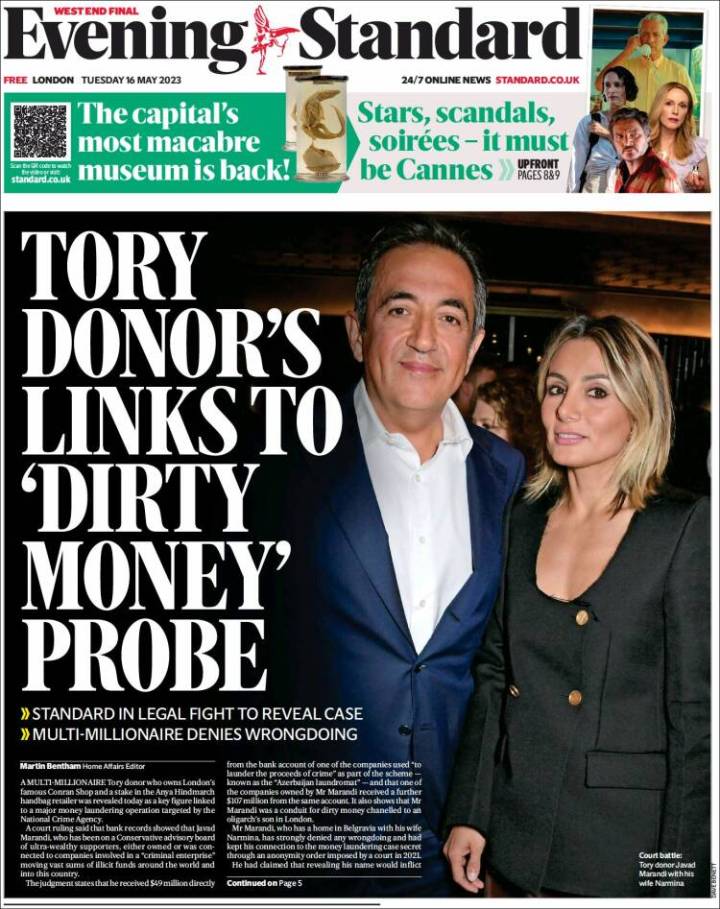
See: ‘Millionaire Tory donor and business tycoon Javad Marandi linked to major money laundering operation’ at: https://www.standard.co.uk/news/uk/conservative-tory-party-donor-javad-marandi-conran-shop-anya-hindmarch-money-laundering-nca-b1081279.html
BBC News ‘Javad Marandi: Tory donor’s link to massive money laundering probe.’ See: https://www.bbc.co.uk/news/uk-61264369
Press Gazette: “BBC and Evening Standard win right to identify man in ‘dirty money’ trial.” See: https://pressgazette.co.uk/media_law/azerbaijani-laundromat-court-open-justice/
Managing the placement of students to experience court reporting- some advice and resources.
The UK’s legal system needs public confidence and support. Access, qualitative, fair and accurate reporting in the media is a critical factor in furthering the constitutional principle of Open Justice. I believe universities educating and training journalists can encourage judges and court staff to improve and enhance the achievement of this purpose through active liaison and collaboration.
Journalism university tutors should directly reach out to the presiding judges for local court centres and their senior HMCTS managers. In partnership university and judicial institutions can facilitate and achieve trust, understanding, knowledge and in the end become models for the Open Justice provision.
Arrange a meeting. Discuss what can be achieved. Reach out and collaborate. If your university has a Law Department find out what they do and if lines of communication can be synchronized.
Tutors should be prepared to accompany student groups on any formal visits and if a busy timetable prevents this every time, they should certainly enquire, communicate and provide advance information about the student journalist groups, their purpose and presence, along with reassurance about the quality of education and training in media law being provided to them.
The students need accreditation letters, and when possible student journalist membership press cards from the CIoJ, NUJ and BAJ. (Is there not an advantage in the universities covering the costs for student membership of professional journalism bodies?)
When judges and court staff fully understand that the education and training of student journalists requires attendance and coverage of court hearings and the writing of reports with their assessment, this is more than likely to forge cooperation and most hopefully a symbiosis of appreciation and education. This can surely work both ways.
The USA developed the model many decades ago of media/bench committees at federal, state and city court centres where there would be the opportunity for the various professions to exchange views, thoughts and ideas on how they could all improve and sustain their respective aims. Whatever the decline in the infrastructure of local and regional journalistic coverage, I believe the university journalism and journalism training sectors are in a position to fill the vacuum and revive the function, purpose and extent of court reporting.
Such interaction could also extend to Coroners Courts and Youth Court centres. Yes, only accredited press card carrying professional journalists have access to Youth Courts, but might there be an argument for Youth Courts to permit student journalist reporting presence when accompanied by professional journalist tutors? The Youth Justice system needs understanding particularly at a time when so many young people are the victims and perpetrators of a worrying trend in knife crime.
Student journalists must respect the courtesies and dignity of the court by ensuring they attend on time and avoid excessive disruption of the proceedings when entering and leaving. Only do so during a lull in the proceedings. You should not be moving when the oath is being taken by a witness or juror.
It should go without saying that student journalists must dress smartly and appropriately in this environment. A guide to essential reporting published in 2007 observed: ‘They won’t actually throw you out if you turn up in jeans and a fcuk tee-shirt, but you will find them less than co-operative. Jacket and tie for men, smart outfit for women. No hats or bare shoulders.’
Student reporters should not bring food and drink into the courtroom, and must not use their smartphones and read newspapers, books and magazines during proceedings for personal entertainment. This includes those times when the court is not in session. Lawyers will be still be working in the courtroom.
Student journalists should avoid yawning openly, however boring and soporific the case and submissions. Falling asleep and snoring is another big no-no.
Raucous conversation and talking aloud, smiling and laughter should also be avoided during proceedings and adjournments. If you must talk to a colleague, whisper or write something down on paper. There is a risk that your exaggerated facial expressions could be misinterpreted by the relatives of crime victims and defendants who may be in the public gallery or well of the court.
When the court session begins everyone is expected to stand up when the judge(s) or justices enter and leave the courtroom. It is customary for solicitors, barristers and court officials to bow. You do not have to, but it would not be held against you if you do.
What does the current HMCTS ‘General guidance to staff on supporting media access to courts and tribunals’ say about student journalist/court reporters?
‘Student journalists
Student journalists will often attend court cases or hearings as part of their training. We should support this as one way to encourage greater court reporting. They are not entitled to sit in press seats but should sit in the public gallery where they are entitled to take notes without permission from the court or judge/magistrate. However, in sensitive cases (such as organised crime), it will help the judge and staff to avoid any misunderstanding if they identify themselves in advance to explain that they plan to do so. Student journalists do need to make an application to the court if they want to use text-based devices to communicate from court. If you receive a request from a student journalist, please speak to the judge presiding over
the case or trial. If a lecturer wants to attend court with a group of students
to observe a case or hearing, it is good practice (but not mandatory) to let the court know in advance.’
Here is an outline of the information which can be pulled together about the legal system in the Greater London Area as an example of what can be done regionally in other parts of the UK.
This briefing is provided by pdf file in two column format with contacts and details for the courtss in the London area.
Secondary Media Law Codes and Guidelines
IPSO Editors’ Code of Practice in one page pdf document format https://www.ipso.co.uk/media/2032/ecop-2021-ipso-version-pdf.pdf
The Editors’ Codebook 144 pages pdf booklet 2023 edition https://www.editorscode.org.uk/downloads/codebook/codebook-2023.pdf
IMPRESS Standards Guidance and Code 72 page 2023 edition https://www.impress.press/wp-content/uploads/2023/02/Impress-Standards-Code.pdf
Ofcom Broadcasting Code Applicable from 1st January 2021 https://www.ofcom.org.uk/tv-radio-and-on-demand/broadcast-codes/broadcast-code Guidance briefings at https://www.ofcom.org.uk/tv-radio-and-on-demand/information-for-industry/guidance/programme-guidance
BBC Editorial Guidelines 2019 edition 220 page pdf http://downloads.bbc.co.uk/guidelines/editorialguidelines/pdfs/bbc-editorial-guidelines-whole-document.pdf Online https://www.bbc.com/editorialguidelines/guidelines
Office of Information Commissioner (ICO) Data Protection and Journalism Code of Practice 2023 41 page pdf https://ico.org.uk/media/for-organisations/documents/4025760/data-protection-and-journalism-code-202307.pd and the accompanying reference notes or guidance 47 page pdf https://ico.org.uk/media/for-organisations/documents/4025761/data-protection-and-journalism-code-reference-notes-202307.pdf
Judge rules governor needs to reconsider request by Life prisoner to be phone interviewed by investigative journalist podcaster in England and Wales High Court judicial review- 16th June 2023
The High Court Judge determined that the refusal by the prison governor should be quashed. The Article 10 freedom of expression issue was not fully determined.
The case law reference is Alexander, R (On the Application Of) v Eveleigh [2023] EWHC 1407 (Admin) (16 June 2023) and available at: https://www.bailii.org/ew/cases/EWHC/Admin/2023/1407.html
Also available on UK judiciary website at: https://www.judiciary.uk/wp-content/uploads/2023/06/Alexander-v-Secretary-of-State-for-Justice-judgment-160623.pdf
Mr Justice Andrew Baker introduced the background and legal issues in the case in paragraphs 1 to 9:
- The claimant seeks a judicial review of a refusal of consent for him to be interviewed
by telephone by the interested party, an independent investigative journalist. Consent
was required because the claimant is a serving prisoner following his conviction in
2010 on a charge of murdering his father. The refusal was therefore a decision made
by the Governor of HMP Coldingley in Surrey (‘the Governor’), where the claimant is
serving his life sentence, the minimum term under which was set at 16 years by the
sentencing judge.
- The defendant Secretary of State is responsible for that decision and the proper
defendant to any judicial review claim in respect of it. Permission to apply for judicial
review was granted in January 2023 by the Court of Appeal (Bean LJ), on paper, in an
application brought by the claimant for permission to appeal against a refusal of
permission in this court. - Mr Callus accepted a direct instruction to represent the claimant in March 2023, and
has done so pro bono in the finest traditions of the English Bar. He brought to what
had been well articulated, but somewhat diffuse and extensive, submissions prepared
by the claimant, both a focus, limiting the argument to a few points that mattered, and
a depth of analysis, underlying and informing the few points taken, that are hallmarks
of the skilled, experienced practitioner. I am very grateful for his assistance, the value
of which – whatever decision I might reach – was rightly acknowledged by Mr
Jolliffe, for whose assistance equally I am very grateful. - It is inevitable and proper that one consequence of imprisonment on the basis of a
criminal conviction is that the prisoner’s freedom of speech is curtailed, but prisoners
are not simply deprived of all right of free speech, nor lawfully could they be. As
Lord Steyn said in the leading case of Simms, “The starting point is the right of
freedom of expression. In a democracy it is the primary right: without it an effective
rule of law is not possible. Nevertheless, freedom of expression is not an absolute
right. Sometimes it must yield to other cogent social interests.” (Reg. v Secretary of
State for the Home Department, ex parte Simms and O’Brien [2000] 2 AC 115 at
125G). - Article 10 ECHR, as given effect under English law by the Human Rights Act 1998,
provides that the basic right to freedom of expression:
(i) “shall include freedom to hold opinions and to receive and impart information
and ideas without interference by public authority and regardless of frontiers
…” (Article 10.1), and
(ii) may be subject to inter alia conditions or restrictions prescribed by law that
are “necessary in a democratic society, in the interests of national security,
territorial integrity or public safety, for the prevention of disorder or crime,
for the protection of health or morals, for the protection of the reputation or
rights of others, for preventing the disclosure of information received in
confidence, or for maintaining the authority and impartiality of the judiciary”
(Article 10.2). The fundamental basis for the legitimacy of curtailing freedom
Judgment Approved by the court for handing down. Alexander v Secretary of State for Justice of expression is that the exercise of such freedom “carries with it duties and
responsibilities” (ibid). - It was common ground that along with Simms, the key authorities considering Article
10 in relation to the curtailment of the ability of serving prisoners to communicate
with the media are Hirst and Casciani, that is to say: R (Hirst) v Home Secretary
[2002] EWHC 602 (Admin), [2002] 1 WLR 2929; and R (BBC and Casciani) v
Justice Secretary [2012] EWHC 13 (Admin), [2013] 1 WLR 964). I note in passing
that in Simms and Hirst, the defendant was the Home Secretary since prisons and
prisoners’ rights were a responsibility of the Home Office until May 2007 when that
responsibility was taken over by the then newly formed Ministry of Justice. - Counsel’s submissions considered those authorities, and a few others, in some detail;
but as will become apparent, I have concluded that this claim succeeds on a basis that
does not require those submissions to be examined. - The grounds for judicial review pursued by the claimant, as focused by Mr Callus, are
that consent for the proposed telephone interview by the interested party was:
(i) unlawfully refused because the Governor misconstrued or misapplied the
policy set out in Prison Service Instruction (‘PSI’) 37/2010, in that:
(a) he treated the policy as requiring there to be an urgent need to
communicate such that written communication would not be effective,
whereas the criterion stated in PSI 37/2010 is that a telephone
conversation must be “the most suitable method of communication” and
urgency is but an example;
(b) he applied the wrong test and/or came to an irrational conclusion as
regards the criterion stated in PSI 37/2010 that “distress to victims
and/or outrage to public sensibilities will not result from the
broadcast”, i.e. (in this case) from the broadcasting of a recording of
the proposed telephone interview;
(ii) unlawfully refused because, if the refusal was in accordance with the policy set
out in PSI 37/2010, then that policy is unlawful in instructing prison
governors, in effect, to operate a blanket ban on telephone contact with the
broadcast media, or at all events to refuse consent in circumstances that would
infringe a prisoner’s Article 10 rights. - Mr Callus did not withdraw entirely reliance that the claimant had placed on ECHR
Articles 6 and 8 as well. However, he did not develop any argument on those
additional Articles at any length, and in my judgment they do not add anything to the
claim in this case.’
The key paragraph in the judge’s ruling is at 55:
‘The question of remedy in judicial review proceedings is discretionary, and for those
reasons I do not consider it just or convenient to pursue the possibility of declaratory
or mandatory relief. The justice of this case is served, in my view, by the quashing of
the Refusal Letter and the consequent requirement upon the Governor to consider
afresh the claimant’s request for consent to be given for the proposed telephone
interviewed by the interested party.’
At paragraph 59, he concluded:
‘The Refusal Letter was a misdirected and irrational decision to refuse the claimant’s
request to be allowed to give a telephone interview to the interested party. It will be
quashed, but I decline to grant further relief beyond that. The Governor will need to
consider the claimant’s request afresh.’
This is how the journalism trade and mainstream media has been reporting the case:
Press Gazette: ‘Man jailed for murder wins legal challenge over ban on speaking to media’ at: https://pressgazette.co.uk/media_law/mark-alexander-journalist-podcast/
Independent: ‘Murderer claiming wrongful conviction wins legal challenge over jail interview. Mark Alexander was found guilty of killing his father in September 2010.’ See: https://www.independent.co.uk/news/uk/crime/government-high-court-moj-surrey-ministry-of-justice-b2358898.html
Hold The Front Page Law Column, 27th June 2023, by Sam Brookman ‘Prisoners and communication with the Press.’ See: https://www.holdthefrontpage.co.uk/2023/news/law-column-prisoners-and-communication-with-the-press/
The Judge limited his ruling to the rationality and reasonabless of the specific decision by the governor in the circumstances of this case and not wider Article 10 freedom of expression Human Rights issues about the right of prisoners to be sound record or video interviewed by journalists. Hence the Ministry of Justice saying afterwards: ‘the court did not find the policy on prisoner access to the media to be unlawful.’
Sam Brookman highlighted that gaining journalistic access to prisoners in circumstances such as this will still turn on the rationality of the decision-making by prison governors:
‘The outcome shows that in considering requests from prisoners, prison Governors need to look at the specific circumstances of the case and can’t rely on broad concepts like causing “distress to victims” without consideration of the specific facts of the case. Will investigative journalists and their editors be prompted by the decision in Alexander to try to interview prisoners who proclaim their innocence? Although claims of miscarriage of justice are not common, it’s easy to envisage that enterprising reporters will use this clarification of the law to try to obtain information from those who continue to assert their innocence after conviction. Though as the final decision remains with prison governors, whether such requests will succeed remains to be seen. Proving irrationality is not straightforward.’
PDF file media law briefing on this subject
Lucy Letby trial and Open Justice- explaining the restrictions and their implications for the English and Welsh Criminal Justice system. 29th August 2023.
The reporting restrictions imposed by judges in the criminal justice process and trial of convicted serial child killer Lucy Letby have been unprecedented and controversial.
There has been no case in British legal history, or indeed as far as I am able to establish in the history of English speaking common law legal jurisdictions such as Australia, New Zealand, Canada, and USA where the identity of seven murder victims, and ten attempted murder victims have been censored, and further reporting restrictions have given life-long anonymity to nine of the adult prosecution witnesses; namely doctors and nurses who worked alongside Lucy Letby on the neonatal unit at the Countess of Chester hospital.
The restrictions were imposed as a result of legislation passed by Parliament in 1999- the Youth Justice and Criminal Evidence Act, specifically section 45 ‘Power to restrict reporting of criminal proceedings involving persons under 18’ See: https://www.legislation.gov.uk/ukpga/1999/23/section/45 , and section 46 ‘Power to restrict reports about certain adult witnesses in criminal proceedings.’ See: https://www.legislation.gov.uk/ukpga/1999/23/section/46
The restrictions in respect of the attempted murder victims could have been much more draconian in terms of running for the lifetime of the victims had the court made orders under Section 45A of the legislation ‘Power to restrict reporting of criminal proceedings for lifetime of witnesses and victims under 18’. See: https://www.legislation.gov.uk/ukpga/1999/23/section/45A
The degree of secrecy and censorship even extended to the return of the guilty verdicts by the jury. It seems the trial judge Mr Justice Goss, imposed an order under Section 4(2) of the 1981 Contempt of Court Act preventing the media from reporting any of the verdicts until all had been returned by the jury or it was clear they were unable to return verdicts on some of the charges, which was the case in respect of some of the attempted murders.
This means there were several days when Lucy Letby had been found guilty of murder, but neither the professional media, nor indeed anyone else were permitted to report this to the general public.
The nature of the censorship is and was a form of discrimination. If you as a member of the public or a journalist (with proper accreditation) could physically gain access to any of the proceedings, you would have been able to hear the names and full identities of everyone mentioned in court. And you would have heard the return of guilty verdicts before they were all reported.
But the public gallery space in the courtroom was very limited and there would have been the added problem of actually finding the location of the murder trial.
The public listing of the trial even omitted the name of the defendant. It is not clear whether this was also on the direction of the judge.

There are still major problems analysing and reporting on the reporting restrictions themselves. I have asked journalists who reported the trial if they might send me copies of the court orders, directions and indeed the ruling of the judges.
It is understandable that they cannot because they say to do so would breach the restrictions themselves and they do not wish to be criminally prosecuted for breaching them.
Qualified barristers and solicitors would be able to see the unredacted rulings naming the murder and attempted murder victims and adult witnesses given anonymity under the legal privilege they enjoy as officers of the court.
While the trial was in progress I asked for information on the reporting restrictions and whether there had been any challenges by media publishers.
Those I asked said they were unable to assist me. An email sent the Media Lawyers’ Association did not elicit any reply.
I have asked if the trial judge Mr Justice Goss and another High Court judge, Mrs Justice Steyn, who made one of the key rulings in respect of child victims, would be prepared to release their rulings to the National Archives, and HM Judiciary website in order to assist the teaching of media law and more accurately inform discussion and analysis of the reporting bans.
As a media law lecturer and solely for the purposes of teaching journalism students and trainee journalists, I do not want or indeed need to know the identities restricted.
I would like access to the reasoning and summary of the challenges made by counsel for the media publishers’ consortium. Would not this be possible with redacted court rulings? This is a longstanding practice on the part of courts at all levels.
The trial judge has gone on very well deserved leave given the fact he has presided over a highly sensitive, high profile, complex, demanding and long criminal trial. A decision will be made when he returns from holiday.
What we understand about these restrictions at the moment has to be based on reports by the Guardian and Telegraph newspapers.
The Guardian seems to be neutral on whether they should have been imposed though discloses it supported the applications by a media consortium of journalism publishers, which also included the BBC, to challenge them.
The Telegraph is very critical of the restrictions and their reports include comments by Geoffrey Robertson KC and the former Lord Chancellor and Secretary of Justice Sir Robert Buckland KC.
The censorship continues with a fair proportion of the parents of the victims giving extensive multimedia interviews providing great detail about their feelings and views about Letby and the NHS executives of the NHS trust which employed her.
This extends to the intense public interest and political debate about what kind of public inquiry should be held.
Will the public inquiry continue the censorship? To what extent will the head of the inquiry be bound by the judicial decisions of Mrs Justice Steyn and Mr Justice Goss?
If media groups did challenge the reporting restrictions before both judges and were unsuccessful, why did they not appeal these decisions to the Court of Appeal Criminal Division, which they could have done under section 159 of the 1988 Criminal Justice Act https://www.legislation.gov.uk/ukpga/1988/33/section/159 ?
I will try to address these issues. First here are the headlines and links to the Guardian and Telegraph articles:
Guardian 18th August 2023 by Helen Pidd: ‘Lucy Letby trial: why the babies remain anonymous. None of the 17 babies involved in the trial have been named and nine hospital staff cannot be identified.’ See: https://www.theguardian.com/uk-news/2023/aug/18/lucy-letby-trial-why-babies-remain-anonymous
Telegraph 18th August 2023 : “‘Rare anonymity orders on Lucy Letby witnesses ‘will have chilling effect on future cases’ Highly unusual reporting restrictions were imposed despite victims and families being widely named when the nurse was first charged.” (Behind paywall) See: https://www.telegraph.co.uk/news/2023/08/18/lucy-letby-court-trial-witnesses-granted-anonymity/
Former Lord Chancellor and Justice Secretary Robert Buckland said: ‘Criminal trials need to be open to secure justice for the public. Imposing reporting restrictions may now have a negative impact on the ability of the press to report an accurate version of events.’ (Behind paywall) 18th August 2023 See: https://www.telegraph.co.uk/news/2023/08/18/criminal-trials-open-secure-justice-for-public-lucy-letby/
Telegraph newspaper editorial 18th August 2023 (behind paywall) ‘A Crime of Unimaginable Horror’ See: https://www.telegraph.co.uk/opinion/2023/08/18/a-crime-of-unimaginable-horror/
The reporting of the attempted murder babies’ names was restricted under section 45 of the Youth Justice and Criminal Evidence Act 1999, while the names of the parents who were potential witnesses for the prosecution were restricted under section 46 of the Youth Justice and Criminal Evidence Act 1999 by Mrs Justice Steyn on 15th January 2021.
This followed a special hearing to rule on the reporting restrictions held during December 2020, two years before the trial before a jury even began.
It is presumed that this was not reported because it would have been covered by a reporting restriction under Section 4(2) of the 1981 Contempt of Court Act postponing reporting until the end of the future trial.
However, the restrictions imposed by Mrs Justice Steyn appear to have been retrospective. They were banning publication of information already placed in the public domain.
According to the Telegraph:
- The murder victims had already been ‘widely named’ when Lucy Letby was first charged and when she first appeared at Warrington Magistrates’ Court on November 12th 2020;
- This was done lawfully by the Magistrates Court. It has always been custom and practice and something of an immutable in Open Justice terms that alleged murder victims, even children, are identified as part of the public domain and historical record.
According to a report by the Chester Standard and other local media ‘District Judge Nicholas Sanders imposed an order restricting the reporting of the names of the surviving babies subject to the attempted murder charge.’ This would have been done under Section 45 of the Youth Justice and Criminal Evidence Act.
The Telegraph reports that the application for reporting restrictions on the identity of the parents of the murder victims, which would render the identity of the infant murder victims anonymous, was made by the prosecution:
- ‘The decision followed highly emotional arguments put forward by the police and prosecutors on behalf of the families that claimed the press would report the trial in an “irresponsible manner”, unless names were removed.’
- ‘There was also an inaccurate comment in one statement submitted to the court, suggesting the media had “released” the names of the murder victims into the public domain, when in fact that was done by the magistrates’ court.’
- ‘In a concerted bid to persuade a judge of the need for blanket anonymity, pro forma application forms were submitted on behalf of the families, stressing the negative impact press coverage would have on them.’
- ‘..the prosecution argued the ability of the victims’ parents to give evidence would be severely affected if they were named in any coverage of the trial.’
- Mrs Justice Steyn agreed saying: ‘the quality of evidence given by each of these witnesses is likely to be diminished by reason of fear or distress on the part of the witness in connection with being identified.’
- ‘…lawyers for a number of Letby’s colleagues also successfully applied for anonymity, arguing that their mental health would suffer if they were identified.’
- ‘Despite one lawyer warning that replacing the names of so many people with letters risked turning the trial into “alphabet soup”, the [Trial] judge granted anonymity orders for all those who applied.’
- ‘Throughout the trial the victims were identified only as Babies A to Q, making it difficult for members of the public to follow the evidence easily.’
The Guardian’s North of England Editor, Helen Pidd, made the following points in her report on the restrictions:
- Mrs Justice Steyn banned publication of anything that could lead to the identification of the only living children [attempted murder victims] until their 18th birthdays. Thus the orders were under section 45 and not section 45A of the Youth Justice and Criminal Evidence Act. Had they been under section 45A they would have been lifetime orders in perpetuity.
- These children were born in either 2015 or 2016 and were between six and eight years old at the time of the hearing in 2020. Some were living with profound disabilities – partly, the prosecution argued, as a result of Letby’s actions.
- The order also prohibited the publication of anything that could lead to the identification of the parents as witnesses in the proceedings, including the surnames of the deceased babies. The law is such that no court has the power to specifically anonymise the identity of any murder victim, but the anonymity can be imposed by the shadow and impact of a restriction order in respect of their parent or other family member who is a party to the proceedings by way of witness, victim of another charge or defendant.
- Consequently the nature of Mrs Justice Steyn’s order had the effect of preventing publication of the dead children’s identities, because of the sibling groups and the fact their parents would be giving evidence. Among the 17 babies were three sets of twins and one set of triplets.
- Some of the parents ‘wanted the restrictions not just to ban publication of their names and addresses but also details of their jobs, their ethnicities or nationalities, their medical conditions and the circumstances of their children’s conception, gestation and births.’
Helen Pidd’s report makes some more interesting points about the hearing before Mrs Justice Steyn.
- A coalition of media outlets through counsel argued that if such wide-reaching restrictions were imposed, the case would be impossible to properly report.
- The Judge partially agreed, ‘ruling that it was relevant that one of the parents involved worked as a GP – given their medical knowledge – and it was not in itself an identifying feature. She thought the same about nationality and ethnicity.
- ‘The judge also allowed the media to report that the triplets were naturally conceived and identical, on the grounds that such detail would be unlikely to lead to the identification of the living triplet or their parents.’
- ‘Although Steyn’s order allowed the media to report the first names of the dead babies, media organisations agreed it would be better not to name any of the children involved in the case. Each baby was allocated a letter from A to Q to protect their identities. They were named chronologically.’
There is no doubt that Mrs Justice Steyn and Mr Justice Goss had the statutory powers to make the orders that they made.
The real damage to the Open Justice principle is clearly the censorship of identities of the murder victims. But close analysis of the terms of Section 46 of the Youth Justice and Criminal Evidence Act demonstrates the wide degree of discretion granted to the court (I have put in bold those parts I think may have been relevant in the Letby case):
‘(3)For the purposes of this section a witness is eligible for protection if the court is satisfied—
(a)that the quality of evidence given by the witness, or
(b)the level of co-operation given by the witness to any party to the proceedings in connection with that party’s preparation of its case, is likely to be diminished by reason of fear or distress on the part of the witness in connection with being identified by members of the public as a witness in the proceedings.
(4)In determining whether a witness is eligible for protection the court must take into account, in particular—
(a)the nature and alleged circumstances of the offence to which the proceedings relate;
(b)the age of the witness;
(c)such of the following matters as appear to the court to be relevant, namely—
(i)the social and cultural background and ethnic origins of the witness,
(ii)the domestic and employment circumstances of the witness, and
(iii)any religious beliefs or political opinions of the witness;
(d)any behaviour towards the witness on the part of—
(i)the accused,
(ii)members of the family or associates of the accused, or
(iii)any other person who is likely to be an accused or a witness in the proceedings.
(5)In determining that question the court must in addition consider any views expressed by the witness.
And under section 46(8) ‘in determining whether to give a reporting direction the court shall consider—(a)whether it would be in the interests of justice to do so, and (b)the public interest in avoiding the imposition of a substantial and unreasonable restriction on the reporting of the proceedings.
The media only had recourse to section 46(8)(b) in challenging the probity, evidence and force of the prosecution’s application.
One only has to put oneself in the position of the court where the prosecution is saying the cooperation of its witnesses is diminished and so is the quality of their evidence if they are named.
And the witnesses themselves are providing detailed statements evidentially setting out why this is the case.
Is it really in ‘the interests of justice’ to allow that to happen?
As for measuring the public interest in ‘a substantial and unreasonable restriction on the reporting of the proceedings.’
Are the reporting bans ‘a substantial’ restriction to reporting the proceedings?
Preventing the identification of murder and attempted murder victims, and key prosecution witnesses such as physicians and medics who worked with the defendant, would certainly be so.
In view of the risk to the interests of justice by not allowing the anonymity, are the substantial restrictions to the reporting reasonable in these circumstances?
Could the prosecution and trial have proceeded successfully without the reporting restrictions?
Here are the points of criticism made by Geoffrey Robertson KC and Sir Robert Buckland KC as well as the Telegraph by way of editorial. They are more generic in terms of the consequences of such a trial taking place with these restrictions in place:
- The imposition of far-reaching and highly unusual reporting restrictions led to the abandonment of the ‘sacred principle’ of open justice and this will have ‘a chilling effect’ on future court cases.
- Geoffrey Robertson: ‘Open justice is the most sacred of all British legal traditions, yet in this case it was abandoned because witnesses and victims said they felt discomfort about being identified;’
- ‘Their claim to privacy was allowed to outweigh the public right to see justice done. But this is not a question of balancing these two irreconcilable values: open justice should always prevail except in cases of national security or where victims would be seriously harmed;’
- ‘That appears not to be the case here and the very fact these secrecy applications succeeded will doubtless encourage more attempts to suppress information about what goes on in court.’
- ‘It was unsatisfactory that in this case the application was made by the prosecution, the agent of a state that should be proud of its open justice tradition;’
- Sir Robert Buckland argued the reporting restrictions ‘may now have a negative impact on the ability of the press to report an accurate version of events. If, as the lead consultant in the neonatal unit where she worked now alleges, hospital bosses failed to investigate allegations against Letby and tried to silence doctors, and that he raised concerns in October 2015, after some children had already been killed, the ability of the press to name victims would allow the public to understand the full timelime of events;’
- ‘The principle of open justice is fundamental to our system – it reflects the principle that justice must be seen to be done. The overwhelming general presumption is that the names of witnesses and defendants are matters of public record, available for use by the media. Public knowledge of, and confidence in, the administration of justice is enhanced by comprehensive media reporting. Clear and accurate news reporting of our courts is part of the lifeblood of journalism in the UK;’
- ‘The starting point must be open justice. Much more should always be required before reporting restrictions are imposed, or we risk more criminal trials being veiled by an impenetrable shroud of secrecy.’
- The Telegraph editorial said anonymising the murder victims had ‘blunted our ability to understand the true impact of the alleged failings; [of the NHS]’
- ‘Normally, murder victims are named in court, including children, because it is judged to be in the public interest that the details of horrifying crimes such as this should be made known and, tragically, there is no longer any question of privacy;’
- The Telegraph argued: ‘Media organisations already face strict guidelines to ensure that court hearings are covered responsibly. Automatic reporting restrictions exist in law on such matters as publishing the identity of complainants in cases involving a sexual offence, modern day slavery or female genital mutilation allegations, as well as of child defendants and witnesses in youth courts. Yet in the Letby case, the limitations went further. As well as restrictions on naming the children who were murdered, the parents were also granted anonymity under section 46 of the Youth Justice and Criminal Evidence Act, to ensure that publicity did not affect the quality of their evidence.’
- ‘It is possible to feel both the greatest sympathy for the families who had their lives ruined by Letby, along with the witnesses who had to recall the circumstances surrounding her unspeakable acts, and be concerned that the decision has established a dangerous principle and that public knowledge of event s has been hindered in this particular case.’
- ‘Courts have consistently ruled that it is perfectly legitimate, and indeed in the public interest, that witnesses and victims of crime should be named. In 2017, the Supreme Court held that media reporting should be permitted, after the end of a major sexual abuse conspiracy trial, of the identity of a man referred to in the proceedings who was arrested but not charged with sex offences. Thus, media freedom outweighed his right to privacy.’
- ‘Anything else is likely to result in only the partial coverage of important cases – with the potential result that misinformation is allowed to spread. Ultimately, access to, and dissemination of accurate and vital information is the best way to shine light on the most disturbing elements of British society, as well as on failing systems.’
There are very few professional journalists and court reporters who would argue with the points and arguments put forward by Geoffrey Robertson KC, Sir Robert Buckland KC and the Telegraph’s editorial.
Yet, why did the media coalition which usually pools its financial and legal resources in cases such as this, not mount an appeal under Section 159 of the 1988 Criminal Justice Act?
[I am presuming they did not in the absence of any evidence or reference to a Section 159 Court of Appeal Criminal Division ruling on the Letby reporting restrictions in the National Archives or at https://www.bailii.org/.%5D
This right of appeal was won after a test case challenge by myself when I was a young court reporter at the Central Criminal Court around 40 years ago.
Geoffrey Robertson KC was my counsel at the Divisional Court when the NUJ and Liberty (then known as NCCL) supported my campaign to overcome the lack of any appeal rights for journalists and media publishers to challenge reporting restrictions imposed by Crown Court Judges.
The case went to Strasbourg and after a preliminary indication the UK legal system was in breach of the European Convention of Human Rights the UK government agreed to settle the action by legislating for an appeal mechanism.
Unfortunately, the reform contained flaws which I strongly argued against at the time. One of which is that under Section 159(1) ‘the decision of the Court of Appeal shall be final.’
This was ten years before the 1998 Human Rights Act.
I thought it was absurd and discriminatory that critical issues about freedom of expression should have a reduced ceiling in terms appeal. Why should Open Justice issues in the Crown Court not be adjudicated for ruling precedents at UK Supreme Court level if necessary? [At that time the highest court in the UK was the judicial committee of the House of Lords.]
In practice they can be, usually if media appellants are able to use judicial review as their mechanism of appeal.
And there are several higher court precedents which would appear to place Open Justice and freedom of expression on a higher plane of pragmatic priority than privacy rights.
The Telegraph referred to the case of PNM v Times Newspapers Ltd & Ors [2017] UKSC 49 (19 July 2017)
By 5 to 2, UK Supreme Court Justices ruled in favour of Times Newspapers, The Oxford Mail & Others.
PNM was ‘a prominent figure in the Oxford area. He was arrested at about the same time as the nine and was released on bail on terms (among others) that he surrender his passport. The reason for his arrest was that one of the complainants had told the police that she had been abused by a man with the same, very common, first name. However, she failed to pick him out at an identity parade. He was later told by the police that he would be released from arrest without charge but that the case would be kept under review. That remains the position. Police investigations are continuing, but PNM has never been charged with any offence, and there is no present reason to believe that he ever will be.’ [Paragraph 3]
He was frequently referred to by name in the criminal trial of others and he repeatedly sought and secured court reporting orders under the 1981 Contempt of Court Act preventing publication of his name.
Lord Sumption provided the majority ruling that he was not entitled to privacy protection in these circumstances.
At paragraph 16 he explained what was at stake constitutionally:
‘…restrictions on the reporting of what has happened in open court give rise to additional considerations over and above those which arise when it is sought to receive material in private or to conceal it behind initials or pseudonyms in the course of an open trial. Arrangements for the conduct of the hearing itself fall within the court’s general power to control its own proceedings. They may result in some information not being available to be reported. But in Convention terms they are more likely to engage article 6 than article 10. Reporting restrictions are different. The material is there to be seen and heard, but may not be reported. This is direct press censorship.’
[Paragraph 34(5)] ‘The policy which permits media reporting of judicial proceedings does not depend on the person adversely affected by the publicity being a participant in the proceedings. It depends on (i) the right of the public to be informed about a significant public act of the state, and (ii) the law’s recognition that, within the limits imposed by the law of defamation, the way in which the story is presented is a matter of editorial judgment, in which the desire to increase the interest of the story by giving it a human face is a legitimate consideration. PNM’s identity is not a peripheral or irrelevant feature of this particular story.’
Another influential precedent is from the Judicial Committee of the House of Lords in S (a child), Re [2004] UKHL 47 (28 October 2004)
The issue here was whether the ruling of the High Court Family Division over the privacy rights of an 8 year-old boy took precedence over the right of the media and public to the Open Justice identification of the boy’s mother as being a murder defendant accused of the murder of his 9 year-old brother by salt poisoning.
In Lord Steyn’s ruling Open Justice in the criminal proceedings was given the pragmatic priority.
At paragraph 30 he said: ‘A criminal trial is a public event. The principle of open justice puts, as has often been said, the judge and all who participate in the trial under intense scrutiny. The glare of contemporaneous publicity ensures that trials are properly conducted. It is a valuable check on the criminal process. Moreover, the public interest may be as much involved in the circumstances of a remarkable acquittal as in a surprising conviction. Informed public debate is necessary about all such matters. Full contemporaneous reporting of criminal trials in progress promotes public confidence in the administration of justice. It promotes the values of the rule of law.’
At paragraph 34 he said:
‘Thirdly, it is important to bear in mind that from a newspaper’s point of view a report of a sensational trial without revealing the identity of the defendant would be a very much disembodied trial. If the newspapers choose not to contest such an injunction, they are less likely to give prominence to reports of the trial. Certainly, readers will be less interested and editors will act accordingly. Informed debate about criminal justice will suffer.’
At paragraph 36 he said:
‘Fifthly, it is easy to fall into the trap of considering the position from the point of view of national newspapers only. Local newspapers play a huge role. In the United Kingdom according to the website of The Newspaper Society there are 1301 regional and local newspapers which serve villages, towns and cities. Apparently, again according to the website of The Newspaper Society, over 85% of all British adults read a regional or local newspaper compared to 70% who read a national newspaper. Very often a sensational or serious criminal trial will be of great interest in the community where it took place. A regional or local newspaper is likely to give prominence to it. That happens every day up and down the country. For local newspapers, who do not have the financial resources of national newspapers, the spectre of being involved in costly legal proceedings is bound to have a chilling effect. If local newspapers are threatened with the prospect of an injunction such as is now under consideration it is likely that they will often be silenced. Prudently, the Romford Recorder, which has some 116,000 readers a week, chose not to contest these proceedings. The impact of such a new development on the regional and local press in the United Kingdom strongly militates against its adoption. If permitted, it would seriously impoverish public discussion of criminal justice.’
The ‘Alphabet Soup’ syndrome in excessive reporting restrictions rendering the reporting of court cases useless is very much represented in Guardian News and Media Ltd & Ors, Re HM Treasury v Ahmed & Ors [2010] UKSC 1 (27 January 2010) where Geoffrey Robertson KC was the lead advocate for the media group appeal.
Lord Rodger’s rather famous opening paragraph highlighted ‘a widespread phenomenon’ in the British legal system. See:
“Your first term docket reads like alphabet soup.” With these provocative words counsel for a number of newspapers and magazines highlighted the issue which confronts the Court in this application. In all the cases down for hearing in the first month of the Supreme Court’s existence at least one of the parties was referred to by an initial or initials. Thanks to the relevant Practice Note, the same goes for the very last case heard by the House of Lords (BA (Nigeria) v Secretary of State for the Home Department [2009] UKSC 7; [2009] 3 WLR 1253) and the very first judgment handed down by the Supreme Court (In re appeals by Governing Body of JFS [2009] UKSC 1; [2009] 1 WLR 2353). See Practice Note (Court of Appeal: Asylum and Immigration Cases) [2006] 1 WLR 2461. Indeed, so deeply ingrained has the habit of anonymisation become that the judgment of the Court of Appeal in AM (Somalia) v Entry Clearance Officer [2009] EWCA Civ 634 was published under that name, and came on appeal to the Supreme Court under the same name, even though Maurice Kay LJ had begun his judgment by saying that anonymity was unnecessary. At the hearing of the appeal that assessment proved to be correct. See Mahad v Entry Clearance Officer [2009] UKSC 16; [2010] 1 WLR 48.’
That was then- 2010. What kind of vocabulary is available to substantially expand the problem or ‘phenomenon’ as much bigger and wider than ‘widespread’ in 2023?
The Alphabet Soup case concerned three appellants ’A, K and M’ who were brothers in their thirties. On 2 August 2007 each of them was informed that the Treasury had reasonable grounds for suspecting that he was, or might be, a person who facilitated the commission of acts of terrorism.
This was freedom of expression Open Justice versus the appellants’ claim to their rights under article 8 of the European Convention on Human Rights and Fundamental Freedoms to respect for their private and family life.
At Paragraph 63 Lord Rodger made the following observation:
‘What’s in a name? “A lot”, the press would answer. This is because stories about particular individuals are simply much more attractive to readers than stories about unidentified people. It is just human nature. And this is why, of course, even when reporting major disasters, journalists usually look for a story about how particular individuals are affected. Writing stories which capture the attention of readers is a matter of reporting technique, and the European Court holds that article 10 protects not only the substance of ideas and information but also the form in which they are conveyed: News Verlags GmbH & Co KG v Austria (2000) 31 EHRR 246, 256, para 39, quoted at para 35 above. More succinctly, Lord Hoffmann observed in Campbell v MGN Ltd [2004] 2 AC 457, 474, para 59, “judges are not newspaper editors.” See also Lord Hope of Craighead in In re British Broadcasting Corpn [2009] 3 WLR 142, 152, para 25. This is not just a matter of deference to editorial independence. The judges are recognising that editors know best how to present material in a way that will interest the readers of their particular publication and so help them to absorb the information. A requirement to report it in some austere, abstract form, devoid of much of its human interest, could well mean that the report would not be read and the information would not be passed on. Ultimately, such an approach could threaten the viability of newspapers and magazines, which can only inform the public if they attract enough readers and make enough money to survive.’
At paragraph 71 Lord Rodger outlined how M had engaged in strong public debate behind the privilege of his anonymity by issuing a press release through his solicitors criticising the UK government:
‘It is unusual, to say the least, for individuals to enter a debate, using highly charged language and accusing the Government of dishonouring a pledge, but at the same time to insist that they should have the right to hide behind a cloak of anonymity. It is also unusual for someone to assert the need for the press to respect his private and family life by not reporting his identity while simultaneously inviting them to report his version of the impact of the freezing orders on himself and members of his family. The public can hardly be expected to make an informed assessment of the argument if they are prevented from knowing who is making these points and, therefore, what his general stance is.’
The media group won this appeal. But as most journalists and specialist media lawyers will fully recognise one or two steps forward for Open Justice and Freedom of Expression in the higher courts can often be followed by one or two steps backward.
Whither a Lucy Letby trial Open Justice appeal?
Of course, in the Lucy Letby case the circumstances are different, as they always tend to be when new issues arise in the tension between freedom of expression Open Justice and privacy rights and the administration of justice.
In PNM and R: S (a child) the request for restrictions came from third parties. They were not parties to the criminal proceedings. In Letby, the request for censorship strongly citing the demands under the administration of justice argument came from the Prosecution and the police. The restrictions did fundamentally engage the parties in the trial- alleged victims and prosecution witnesses.
The Alphabet Soup case of 2010 was not a criminal trial and more in the manner of high court proceedings with the request for anonymity being made by respondents or appellants in respect of designation under terrorism financial regulation.
Mrs Justice Steyn and Mr Justice Goss are experienced and respected High Court judges who in their decision on the reporting restrictions were following the rule of law. As has been demonstrated they derived their powers from existing statute.
Is it not possible the ‘media coalition’ properly evaluated the likelihood and consequences of an appeal?
To deal with this issue, I would recommend an addressing of this further question:
Would a Court of Appeal Criminal Division have seriously overturned two High Court Judges who imposed reporting restrictions on the basis they were asked for by the prosecution because the administration of justice needed them to ensure the quality and cooperation of key witnesses in a trial of a nurse accused of seven murders and ten attempted murders?
If your answer to the question is no, then the decision not to appeal can be considered perfectly reasonable.
Recent Section 159 appeals by the media to the Court of Appeal Criminal Division have not been particularly encouraging. In Pembrokeshire Herald, Re (leave to appeal) (Rev1) [2021] EWCA Crim 1165 (27 July 2021) a weekly newspaper sought to challenge Section 46 orders in the trial of a teacher whose defence succeeded with evidence provided to the jury by his professional colleagues.
The Herald argued the Section 46 order giving these adult witnesses anonymity for life was exceptional ‘as it would in effect prohibit significant reporting of the defence case.’
The Court of Appeal rejected the appeal and said: ‘‘Decisions about reporting restrictions are evaluative in nature, involving a balancing exercise akin to the exercise of a discretion; although the fact that Convention rights are engaged means that review of the decision under challenge must be intense, the appellate court will be slow to interfere…’
And in 2013 ITN News & Ors v R. [2013] EWCA Crim 773 (21 May 2013) was another unsuccessful appeal against a Section 46 order which prevented publication of images of an adult witness and those of her children in a manslaughter trial.
It is possible to make some positive observations about the media reporting of the Lucy Letby trial.
Those UK reporters assigned to cover this extraordinarily long and complicated case have represented the profession of journalism to the highest standards.
An example of bringing outstanding ‘Open Justice’ where reporting restrictions had substantially reduced it has been the Lucy Letby Trial Podcast published by the Daily Mail with weekly reporting and production by Daily Mail northern correspondent Liz Hull and broadcast journalist Caroline Cheetham.
See: https://podcasts.apple.com/gb/podcast/the-trial-of-lucy-letby/id1653090985
By 28th August 2023 there had been 59 episodes downloaded by millions.
Episode 47 covered the subject of Open Justice with an interview with Mike Dodd- ‘former reporter and long term advisor to the Press Association (now PA Media). See: https://podcasts.apple.com/gb/podcast/the-trial-of-lucy-letby/id1653090985
Nevertheless, it can be argued that Open Justice in the British criminal justice system is in a very bad place as a result of this case.
The Section 45 orders under YJCEA 1999 for the attempted murder child victims are standard practice and began being imposed almost by default by the District Judge at the Magistrates Court as they are in most criminal courts.
Is there now ever a case where youth victims of crime in the adult courts are ever identified? That is a rare phenomenon.
Even before the Lucy Letby trial, Section 46 anonymity orders under YJCEA 1999 for adult witnesses and indeed adult victims of crime beyond the statutory automatic categories of sexual offence complainants, victims of FGM, Forced Marriage, Slavery and People Trafficking have been spreading.
An example during the past year included an adult victim of a causing injury by dangerous driving offence. He had been a passenger in the speeding car and lost a leg in the collision.
Police forces have been and will continue to use the possibility, and what may well become the potential likelihood, of anonymity at trial to persuade reluctant witnesses that they will not necessarily face the embarrassment or discomfort of media publicity by agreeing to give evidence.
They cannot guarantee something which only the court has the discretion to provide, but as in the Letby case, they can explain to the potential witnesses of the advantages of making a statement with grounds that qualify under Section 46(2) to 46(5) of the Youth Justice and Criminal Evidence Act legislation.
All families of murder victims are potential witnesses because of the system’s requirement for victim impact statements following conviction. Consequently, the restrictions in the Letby trial do provide a precedent for more orders which ‘shadow’ impact on identifying murder victims.
The reports of the content of the victim’s family statements in the Lucy Letby case reveal a disturbing trend to justify censorship on the basis of anticipating allegedly harmful media coverage rather than actual and specific evidence of coverage which creates a substantial risk of serious prejudice.
What is the threshold of risk that the courts are assessing in respect of the impact of media coverage on a witness?
Is it so they are sure or believe it is more likely than not that media coverage undermines or will undermine the quality of a witness’s evidence and willingness to cooperate and give evidence?
Lucy Letby was convicted of seven murders and six attempted murders. The jury was unable to reach verdicts in respect of four other attempted murder charges.
The anonymity means that seventeen potential local weekly newspapers were unable to fully report on a crime victim from their areas being involved in this high profile trial.
While we can be sure it was never the intention of anyone, anonymising crime victims does dehumanise their presence in media coverage.
It dissolves the essence of human interest and potential sympathy, empathy and understanding.
One of the administration of justice purposes of identifying witnesses in criminal trials and for there to be accurate and fair reporting of what they say is that the public scrutiny enhances the qualities of veracity and integrity.
Reporting of such proceedings serves to protect the administration of justice in preventing miscarriages of justice.
It means potential witnesses either for the prosecution or the defence could come forward with vital evidence.
One of the risks of too much secrecy in criminal trials and the anonymising of trial participants is that the lack of key and specific information undermines the credibility and confidence of the public in the trial process.
The development of any significant conspiracy theories and beliefs about the trial could be evidence that the undermining of public confidence in the trial process is already underway.
It is depressing that the families of Lucy Letby’s victims had such a negative and fearful anticipation and view of the media’s role in covering criminal trials. This may be part of an unfortunate and wider pattern of demonising and delegitimizing professional journalism.
The Lucy Letby trial highlights the need for journalists covering court cases to do everything they can to be vigilant about the importance of Open Justice and to do everything they can to persuade the courts they are covering to maximise openness and identification of trial participants, particularly defendants, victims, prosecution and defence witnesses notwithstanding the automatic anonymity categories.
Those journalists present, and their legal representatives should they be necessary, are still entitled to persuade judges to listen to and respond to their arguments for Open Justice, to adopt and engage in restrictions which in all the circumstances are the least restrictive on open, accurate and fair reporting.
The reporting of the Lucy Letby trial by dedicated and consummate professional court reporting journalists has been a model on how to negotiate a complex nexus of reporting restrictions.
Press Gazette 29th August 2023 ‘Reporting restrictions and writing through tears: The ‘incredibly complex’ task of reporting Lucy Letby trial. Witnesses in the case were unusually given anonymity without reasons of national security or a risk to life.’ See: https://pressgazette.co.uk/media_law/journalists-reporting-lucy-letby-trial-reporting-restrictions/
This briefing may be amended should the detail of the court rulings on reporting restrictions become available or further proceedings relating to the Open Justice issues develop in any way.
PDF file of this media law briefing
 UK Media Law Pocketbook Second Edition