

THE UK MEDIA LAW POCKETBOOK
by Tim Crook

Second Edition Published by Routledge 30th November 2022
If you are reading and accessing this publication as an e-book such as on the VitalSource platform, please be advised that it is Routledge policy for clickthrough to reach the home page only. However, copying and pasting the url into the address bar of a separate page on your browser usually reaches the full YouTube, Soundcloud and online links.
The companion website pages will contain all of the printed and e-book’s links with accurate click-through and copy and paste properties. Best endeavours will be made to audit, correct and update the links every six months.

Chapter 1
Media contempt and reporting crime
This chapter covers all the up-to-date developments in media contempt with summaries of successful prosecutions of national newspapers for prejudicing trials and impeding criminal enquiries.
Clear explanations of how media contempt can be committed after arrest, between charge and trial, during the trial and even when the jury return part-verdicts.
Contempt by words, image and even the conduct of jurors.
Use of digital reporting devices when covering court cases, Twitter, photography, sketching and filming.
Reporting restrictions, respecting them and challenging them.
Secondary media law in relation to avoiding guilt by association, respecting victims of sexual assault, potential harassment of the judiciary, payments to witnesses, criminals and cheque-book journalism; ethics and duties in relation to kidnapping and hostage taking stories.
Chapter 1
Media contempt and reporting crime
1.1 Balancing freedom of expression with the individual’s right to a fair trial.
Schedule 1, Article Six of the Human Rights Act referred to in Page 9 of the printed book:
Article 6 Right to a fair trial:
1 In the determination of his civil rights and obligations or of any criminal charge against him, everyone is entitled to a fair and public hearing within a reasonable time by an independent and impartial tribunal established by law. Judgment shall be pronounced publicly but the press and public may be excluded from all or part of the trial in the interest of morals, public order or national security in a democratic society, where the interests of juveniles or the protection of the private life of the parties so require, or to the extent strictly necessary in the opinion of the court in special circumstances where publicity would prejudice the interests of justice.
2 Everyone charged with a criminal offence shall be presumed innocent until proved guilty according to law.
3 Everyone charged with a criminal offence has the following minimum rights:
a to be informed promptly, in a language which he understands and in detail, of the nature and cause of the accusation against him;
b to have adequate time and facilities for the preparation of his defence;
c to defend himself in person or through legal assistance of his own choosing or, if he has not sufficient means to pay for legal assistance, to be given it free when the interests of justice so require;
d to examine or have examined witnesses against him and to obtain the attendance and examination of witnesses on his behalf under the same conditions as witnesses against him;
e to have the free assistance of an interpreter if he cannot understand or speak the language used in court.
Online Links Printed Book
Page 10
Human Rights Act 1998
https://www.legislation.gov.uk/ukpga/1998/42/contents
Articles are set out at https://www.legislation.gov.uk/ukpga/1998/42/schedule/1
See relevant IPSO rulings:
Bobin v The Times https://www.ipso.co.uk/rulings-and-resolution-statements/ruling/?id=01657-14
McConnell v Ardrossan & Saltcoats Herald:
https://www.ipso.co.uk/rulings-and-resolution-statements/ruling/?id=00456-16
Jamelia v The Sun:
https://www.ipso.co.uk/rulings-and-resolution-statements/ruling/?id=00149-19
Jamelia v Mail Online:
https://www.ipso.co.uk/rulings-and-resolution-statements/ruling/?id=00148-19
Jamelia v dailyecho.co.uk:
https://www.ipso.co.uk/rulings-and-resolution-statements/ruling/?id=00151-19
PCC ruling: Samir El-Atar v Evening Standard (Report 72, 2005)
http://www.pcc.org.uk/cases/adjudicated.html?article=MjE3Mw==
1.2 Explaining Contempt
A downloadable sound file of this section explaining media contempt
1.3 Reporting restrictions and the quasi-contempt in breaching them
Online Links Printed Book
Page 13
1.3.1. Anonymity for Children in Crime Cases
https://www.legislation.gov.uk/ukpga/1999/23/section/45
1.3.2. Lifetime Anonymity Orders for Adult and Child Witnesses in Court Cases
https://www.legislation.gov.uk/ukpga/1999/23/section/45A
https://www.legislation.gov.uk/ukpga/1999/23/section/46
Page 14
1.3.3. Anonymity for Children in Civil and Youth Courts
https://www.legislation.gov.uk/ukpga/Geo5/23-24/12/section/39
https://www.legislation.gov.uk/ukpga/Geo5/23-24/12/section/49
https://www.legislation.gov.uk/ukpga/1998/37/section/52A
1.3.4. Anonymity for Sexual Offence Complainants
https://www.legislation.gov.uk/ukpga/1992/34/section/1
https://www.legislation.gov.uk/ukpga/1992/34/section/2
https://www.legislation.gov.uk/ukpga/1992/34/section/5
Page 15
1.3.5. Anonymity for Teachers Accused of Crimes Against Children They Teach Unless Charged
https://www.legislation.gov.uk/ukpga/2011/21/section/13/enacted
1.3.6. Anonymity for Victims of Female Genital Mutilation
https://www.legislation.gov.uk/ukpga/2015/9/section/71/enacted
1.3.7. Anonymity for Victims of Forced Marriages
https://www.legislation.gov.uk/ukpga/2017/3/section/173
https://www.legislation.gov.uk/ukpga/2017/3/section/174
Page 16
1.3.8. Anonymity for Victims of Modern Slavery and People Trafficking
https://www.legislation.gov.uk/ukpga/2015/30/section/2
https://www.legislation.gov.uk/ukpga/1992/34/section/2
1.3.9. Pre-Trial Hearing Reporting Restrictions
https://www.legislation.gov.uk/ukpga/1980/43/section/8A
https://www.legislation.gov.uk/ukpga/1980/43/section/8C
https://www.legislation.gov.uk/ukpga/1996/25/section/39
https://www.legislation.gov.uk/ukpga/1996/25/section/40
https://www.legislation.gov.uk/ukpga/1996/25/section/41
https://www.legislation.gov.uk/ukpga/1996/25/section/42
1.3.10. Preparatory Hearing Reporting Restrictions
https://www.legislation.gov.uk/ukpga/1996/25/section/37
https://www.legislation.gov.uk/ukpga/1987/38/section/11
Page 17
1.3.11. Dismissal Hearing Reporting Restrictions
https://www.legislation.gov.uk/ukpga/1987/38/section/11
https://www.legislation.gov.uk/ukpga/1991/53/schedule/6
https://www.legislation.gov.uk/ukpga/1998/37/schedule/3
1.3.12. Prosecution Appeal Reporting Restrictions
https://www.legislation.gov.uk/ukpga/2003/44/section/71#section-71-4
1.3.13. Special Measures Reporting Restrictions
https://www.legislation.gov.uk/ukpga/1999/23/section/47
Page 18
1.3.14. Reporting Restrictions Protecting Secret Witnesses and Information
https://www.legislation.gov.uk/ukpga/1981/49/section/11
RXG v Ministry of Justice & Ors [2019] EWHC 2026 (QB) (29 July 2019)
https://www.bailii.org/ew/cases/EWHC/QB/2019/2026.html
Hold The Front Page Law Column: ‘Police officer facing criminal trial fails in bid for anonymity’
https://www.holdthefrontpage.co.uk/2022/news/law-column-police-officer-facing-criminal-trial-fails-in-bid-for-anonymity/
1.3.15. Indecent Details Calculated to Injure Public Morals’ Reporting Restriction
https://www.legislation.gov.uk/ukpga/Geo5/16-17/61/section/1
Page 19
1.3.16. Derogatory Mitigation Reporting Restrictions
https://www.legislation.gov.uk/ukpga/1996/25/section/58
1.3.17. Postponing Publication of Trials Reporting Restrictions
https://www.legislation.gov.uk/ukpga/1981/49/section/4
1.3.18. Photography, Filming, and Sound Recording of Court Hearing Restrictions
https://www.legislation.gov.uk/ukpga/Geo5/15-16/86/section/41
https://www.legislation.gov.uk/ukpga/1981/49/section/9
https://www.legislation.gov.uk/ukpga/2020/7/schedule/25/enacted
Page 20
1.3.19. In-Camera or In-Chambers Secret Hearing Excluding Media and Public
6.6–8 Criminal Procedure Rules 2015 at
https://www.legislation.gov.uk/uksi/2015/1490
Updated version Criminal Procedure Rules and Practice Directions (updated 2022)
Parts 5 and 6 relevant to court reporting
https://www.judiciary.uk/wp-content/uploads/2022/03/CrimPD-12-CONSOLIDATED-March-2022.pdf
https://www.cps.gov.uk/legal-guidance/hearings-private-camera
https://www.legislation.gov.uk/ukpga/1988/33/section/159
Malik v Central Criminal Court & Anor [2006] EWHC 1539 (Admin) (27 June 2006)
https://www.bailii.org/cgi-bin/format.cgi?doc=/ew/cases/EWHC/Admin/2006/1539.htm
Executor of HRH Prince Philip, the Duke of Edinburgh (Deceased) & Anor v Guardian News and Media [2022] EWCA Civ 1081 (29 July 2022)
https://www.bailii.org/ew/cases/EWCA/Civ/2022/1081.html
1.4 Anonymity for crime suspects before being charged and the need to show respect for reasonable expectation of privacy
Online Links Printed Book
Page 22
There are three cases where anonymity for crime suspects has been fully developed:
UK Supreme Court summary, full ruling and video of legal submissions and Lord Hamblen’s presentation in Bloomberg LP (Appellant) v ZXC (Respondent)
https://www.supremecourt.uk/cases/uksc-2020-0122.html
https://www.supremecourt.uk/cases/docs/uksc-2020-0122-judgment.pdf
Summary ruling on YouTube https://youtu.be/uuuE38tX_VY
Anonymising the suspect – The UK Supreme Court delivers blow to press freedom, CIoJ The Journal
http://cioj.org/thejournal/anonymising-the-suspect-the-uk-supreme-court-delivers-blow-to-press-freedom/
ZXC v Bloomberg Appeal Court decision in May 2020
https://www.bailii.org/cgi-bin/format.cgi?doc=/ew/cases/EWCA/Civ/2020/611.html
Richard v BBC High Court decision in July 2018.
https://www.bailii.org/cgi-bin/format.cgi?doc=/ew/cases/EWHC/Ch/2018/1837.html
Sicri v Daily Mail & Mail Online High Court decision in December 2020
https://www.bailii.org/cgi-bin/format.cgi?doc=/ew/cases/EWHC/QB/2020/3541.html
1.5 Importance of keeping written records of decision making- mentioning public interest, and considering reasonable expectation of privacy
Online Links Printed Book
Page 25
Journalism special purpose defence in 2018 Data Protection Act
https://www.legislation.gov.uk/ukpga/2018/12/schedule/2/paragraph/26
Lachaux v Independent Print Ltd & Anor libel ruling July 2021
https://www.bailii.org/cgi-bin/format.cgi?doc=/ew/cases/EWHC/QB/2021/1797.html
1.6 Reporting court cases: Ten simple ground rules– Page 25
The detail of the 10 simple grounds rules referred to in the printed book:
a Never report anything said in the absence of the jury until after all the verdicts have been returned. You can still take notes in order to use the information when reporting restrictions are lifted.
b Stick to reporting accurately what is said in court and do not paraphrase using more sensationalist language.
c Make sure your reports are fair and accurate. To be fair involves putting the other side of the story. Accuracy speaks for itself.
d Find out about any existing court reporting restrictions, in particular orders under sections 4(2) and 11 of the 1981 Contempt of Court Act as well as any other legislation. If you think it is possible that an order might be in place speak to the court clerk, and/or contact the legal adviser and relevant Court Service administrator at the court centre. See Chapter 2 for a more detailed guide on reporting the courts.
e Do not under any circumstances use smartphones, computers or other devices to record and broadcast active or remote court proceedings. You do not under any circumstances take images, video or make sound recordings in the corridors outside the courtroom and in the precints of a court building; that’s anywhere within the court building walls, railings and boundaries.
f You must dress smartly, politely and behave with respect and a sense of sensitivity at all times. People involved in criminal proceedings are usually very stressed. If challenged always respond calmly and politely, identify yourself and show your letter of accreditation and media card(s).
g Enter and leave the court with the minimum of disruption and noise. Do not speak or read newspapers/magazines/tablets during a court hearing. This is disrespectful and unprofessional.
h Only make notes of the information you are likely to use in your report. It’s sometimes useful to write your report while you are in court so you don’t miss anything going on. Calibrate and check the information you have reported with PA Media or other professionally produced copy if reporters from PA and other news producers are present.
i It is preferable that professional journalists use an allocated press/media bench or area of a courtroom and are kept separate from the public gallery to avoid the risk of being threatened or intimidated by people who may object to publication of the proceedings.
j At the Crown Court do not under any circumstances have any contact with anyone who might be a juror or prospective juror.
A downloadable sound file of this section on the ten simple ground rules of reporting court cases
Online Links Printed Book
Page 26
The open justice rights of journalists to report court cases are indicated by Section 4(1) of the 1981 Contempt of Court Act which states ‘a person is not guilty of contempt of court under the strict liability rule in respect of a fair and accurate report of legal proceedings held in public, published contemporaneously and in good faith.’
https://www.legislation.gov.uk/ukpga/1981/49/section/4/2005-09-27
Absolute and qualified privilege in defamation law is determined by producing a ‘fair and accurate report’ of court proceedings, public meetings, press conferences, and local authority and legislative meetings.
https://www.legislation.gov.uk/ukpga/2013/26/section/7
The right to take notes during any court hearing has been confirmed as a key part of the Open Justice principle in the case of Ewing v Crown Court Sitting at Cardiff & Newport & Ors [2016] EWHC 183 (Admin) (08 February 2016)
https://www.bailii.org/ew/cases/EWHC/Admin/2016/183.html
1.7 The public interest defence and merely incidental to court proceedings defence in media contempt law
Online Links Printed Book
Page 27
Section 5 of the 1981 Contempt of Court Act
https://www.legislation.gov.uk/ukpga/1981/49/section/5
ECHR The Sunday Times v The United Kingdom 1979.
https://www.bailii.org/eu/cases/ECHR/1979/1.html
Law Commission Consultation Paper No 209 on Contempt of Court published in 2012. (See chapter 2 on contempt by publication)
https://www.lawcom.gov.uk/app/uploads/2015/03/cp209_contempt_of_court.pdf
1.8 Trial online by Google, Twitter and Facebook etc- Controlling social media prejudice
A downloadable sound file of this section on trial by social media in contempt law
Online Links Printed Book
Page 29
Ruling in the Angela Wrightson case controlling social media commentary. British Broadcasting Corporation & Eight Other Media Organisations, R (on the application of) v F & D 2016.
https://www.bailii.org/ew/cases/EWCA/Crim/2016/12.html
1.9 Successful prosecution of national newspapers which vilified an innocent suspect in murder enquiry
Online Links Printed Book
Page 30
Full court ruling HM Attorney-General v MGN Ltd & Anor [2011] EWHC 2074 (Admin) (29 July 2011)
https://www.bailii.org/cgi-bin/format.cgi?doc=/ew/cases/EWHC/Admin/2011/2074.html
1.10 Successful prosecution of newspapers which published prejudicial online images of a defendant
A downloadable sound file on this section concerning media contempt by online image
Online Links Printed Book
Page 31
Attorney General v Associated Newspapers Ltd & Anor [2011] EWHC 418 (Admin) (03 March 2011)
https://www.bailii.org/ew/cases/EWHC/Admin/2011/418.html
Attorney General v Associated Newspapers Ltd & Anor [2011] EWHC 1894 (Admin) (19 July 2011)
https://www.bailii.org/ew/cases/EWHC/Admin/2011/1894.html
1.11 Successful prosecutions for comment articles prejudicing current and high profile criminal trials
Online Links Printed Book
Page 33
HM Attorney General v The Condé Nast Publications Ltd [2015] EWHC 3322 (Admin) (18 November 2015)
https://www.bailii.org/ew/cases/EWHC/Admin/2015/3322.html
ITV News 9 May 2012 Magazine charged over article
https://www.itv.com/news/story/2012-05-09/spectator-charged-over-article/
BBC News 7 June 2012 Spectator fined after admitting Stephen Lawrence breach
https://www.bbc.co.uk/news/uk-18350615
1.12 Prosecution of two national newspapers for publishing background in trial of serial killer who murdered Milly Dowler when jurors were still deciding on a lesser charge for an attempted kidnap offence in relation to another victim
Online Links Printed Book
Page 34
Full court ruling in HM Attorney General v Associated Newspapers Ltd & Anor [2012] EWHC 2029 (Admin) (18 July 2012)
https://www.bailii.org/cgi-bin/format.cgi?doc=/ew/cases/EWHC/Admin/2012/2029.html
Newspapers each fined £10,000 for contempt with £25,000 legal costs in trial of Levi Bellfield.
Attorney General v Associated Newspapers Ltd & Anor [2012] EWHC 2981 (Admin) (16 October 2012)
https://www.bailii.org/cgi-bin/format.cgi?doc=/ew/cases/EWHC/Admin/2012/2981.html
1.13 Criminal law relating to misconduct of jurors and journalists who solicit information about their confidential deliberations
Online Links Printed Book
Page 36
Section 20D of the Juries Act 1974
https://www.legislation.gov.uk/ukpga/1974/23/section/20D
Michael Alexander Seckerson & Times Newspapers Ltd v the United Kingdom – 32844/10 and 33510/10 [2012] ECHR 241 (24 January 2012)
https://www.bailii.org/eu/cases/ECHR/2012/241.html
Dallas v. The United Kingdom – 38395/12 (Judgment (Merits and Just Satisfaction): Court (First Section)) [2016] ECHR 174 (11 February 2016)
https://www.bailii.org/eu/cases/ECHR/2016/174.html
1.14 Attorney General versus five national newspapers over prejudicial reporting of the case of Michael Fagan who walked into the Queen’s bedroom
The detailed account of the Michael Fagan prosecution of national newspapers case from 1983 referred to in the printed book at Page 37:
Apartments surrounding Buckingham Palace provide homes for serving staff and loyal retainers. Palace security, though tight, has been breached on a number of occasions. In 1840, 17-year-old Edmund Jones was found underneath a sofa on which Queen Victoria had been sitting moments earlier. He had entered through an open window out of curiosity.
On the morning of 9 July 1982, 35-year-old Michael Fagan shinned up a drainpipe and entered the Queen’s bedroom. The Queen’s account of what happened was not revealed in open court at Mr Fagan’s trial. In 2012 he described the incident in an interview with the Independent newspaper and explained that the Queen left her bedroom to summon help as soon as he appeared before her.
The five newspapers were prosecuted under the new 1981 Contempt of Court Act for creating a substantial risk of serious prejudice to Mr Fagan’s trial for burglary at Buckingham Palace, assaulting his stepson and taking his common law wife’s car without her consent. The sensational nature of the case hinged on the fact that security was so bad at the Palace that Fagan had managed to climb through a window on two different occasions. During his first visit he had helped himself to half a bottle of sweet white wine, a wedding present to Prince Charles and Diana Spencer, but had not had enough courage to knock on the Queen’s door. The following week, he plucked up enough courage and simply walked into the Queen’s bedroom while she was in bed waiting for her morning tea.
Three of these publications were cleared of contempt because the prejudicial comment was not judged to go to the heart of the issues to be decided later at the trial. Furthermore the judges did not think potential members of the jury would remember these observations. This was the first test of what was considered to be ‘serious prejudice’ and a ‘substantial risk’. Convictions were brought against two newspapers, which had falsely reported that Michael Fagan ‘had confessed to burglary’ and that he had ‘stabbed his stepson with a screwdriver’. The actual allegation only concerned ‘slapping’.
The Sun made Fagan out to have a long-standing drug problem (asserting he was a ‘junkie’), that he was a glib liar and that he had stolen cigars from the Palace. In alleged interviews with his parents it was stated that Fagan was good with locks, ‘was a real Spider-man and jumped over walls as though they were not there’ and his father was quoted as saying ‘he’d been smoking expensive cigars recently and we wondered if they were Prince Philip’s’. The Lord Chief Justice at the time, Lord Geoffrey Lane, ruled that this was not contempt as it was thought that the risk of prejudice the article created was too remote to qualify as ‘substantial’.
The Sunday People described Fagan as ‘a morose, unsociable, unpredictable misfit’. It said he was a heroin addict and used the term ‘junkie’. Lord Lane said the allegations were similar to those made by The Sun and did not amount to a substantial risk of serious prejudice.
The Daily Star asserted that Fagan had admitted stealing the wine. This was held to be in contempt. Lord Lane said such an allegation, which was not true, created ‘a very substantial risk of serious prejudice’.
The Mail on Sunday contained a clear suggestion of a possible homosexual liaison between Commander Trestrail (the then royal bodyguard) and Fagan. It also referred to Fagan as a ‘rootless neurotic with no visible means of support’. Lord Lane said this created a substantial risk of serious prejudice: ‘A suggestion of the rootless penniless neurotic being a guest of the homosexual royal bodyguard at the Palace created a picture which tended to stay in the mind and was not easy to dismiss.’ However the newspaper was acquitted because they had a defence under section 5 of the Act. The editorial column by Lady Marcia Falkender had been a discussion of the Queen’s security, in the public interest, and was ‘merely incidental to court proceedings’ against Michael Fagan.
The Sunday Times had published two articles. The first prominently published on the front page made the allegation that Fagan was charged with stabbing his stepson in the neck. Lord Lane said this was contempt because he had been charged with assault and not stabbing. This gross misrepresentation did create a substantial risk of serious prejudice. The second article suggested that the driving charge had been dropped and that the stepson’s injuries had been received in some earlier incident before Fagan arrived. This was held to be contempt on the grounds it was prejudicial to the prosecution’s case. The Sunday Times was fined £1,000. No penalty was made against the Daily Star.
Online Links Printed Book
Page 37
Attorney-General v Times Newspapers Ltd and Others: CA 12 Feb 1983
https://swarb.co.uk/attorney-general-v-times-newspapers-ltd-and-others-ca-12-feb-1983/
Independent feature: ‘Who was Michael Fagan and why did he break into the Queen’s bedroom?’
https://www.independent.co.uk/life-style/royal-family/the-crown-michael-fagan-the-queen-b1722584.html
1.15 Use of Twitter and laptop wi-fi/email in court reporting
A downloadable sound file of this section on tweeting from court
Online Links Printed Book
Page 38
Practice Guidance: The use of live text-based forms of communication (including Twitter) from court for the purposes of fair and accurate reporting.
https://www.judiciary.uk/wp-content/uploads/JCO/Documents/Guidance/ltbc-guidance-dec-2011.pdf
1.16 Broadcasting and online coverage of the courts
Online Links Printed Book
Pages 41 to 42
Ministry of Justice: Proposals to allow the broadcasting, filming, and recording of selected court proceedings in 2012
https://assets.publishing.service.gov.uk/government/uploads/system/uploads/attachment_data/file/217307/broadcasting-filming-recording-courts.pdf
Section 41 Criminal Justice Act 1925
https://www.legislation.gov.uk/ukpga/Geo5/15-16/86/section/41/2013-10-30
Section 9 of the Contempt of Court Act 1981
https://www.legislation.gov.uk/ukpga/1981/49/section/9/enacted
Section 47 Constitutional Reform Act 2005
https://www.legislation.gov.uk/ukpga/2005/4/section/47
Schedule 25 of the Coronavirus Act 2020
https://www.legislation.gov.uk/ukpga/2020/7/schedule/25/enacted
PA Media & Press Gazette report on ‘Mail on Sunday features writer avoids jail after recording court hearing on phone.’
https://www.pressgazette.co.uk/mail-on-sunday-features-writer-avoids-jail-after-recording-court-hearing-on-phone/
Attorney General v Stephen Yaxley-Lennon. Mr Justice Warby 9 July 2019
https://www.judiciary.uk/wp-content/uploads/2019/07/ag-v-yaxley-lennon-jmt-190709.pdf
Finch, R (On the Application Of) v Surrey County Council [2021] EWHC 170 (QB) (03 February 2021
https://www.bailii.org/cgi-bin/format.cgi?doc=/ew/cases/EWHC/QB/2021/170.html
Gubarev & Anor v Orbis Business Intelligence Ltd & Anor [2020] EWHC 2167 (QB) (06 August 2020)
https://www.bailii.org/cgi-bin/format.cgi?doc=/ew/cases/EWHC/QB/2020/2167.html
HMCTS Guidance on broadcasting sentencing hearings by the media and the Crown Court (Recording and Broadcasting) Order 2020.
https://www.gov.uk/guidance/broadcasting-crown-court-sentencing
UK Press Card Authority
https://www.ukpresscardauthority.co.uk/
1.17 Key restrictions applying to newsworthy first court appearances at Magistrates’ courts
Online Links Printed Book
Page 44
Section 52A Crime and Disorder Act 1998.
https://www.legislation.gov.uk/ukpga/1998/37/section/52A/2013-04-01
PA Media Lawyer & Press Gazette report: ‘Judge condemns ‘shoddy journalism’ as Sun fined £3,350 for gas explosion reporting-restrictions breach’
https://www.pressgazette.co.uk/judge-condemns-shoddy-journalism-as-sun-fined-3350-for-gas-explosion-reporting-restrictions-breach/
1.18 Breaching reporting restrictions, court injunctions and directions
A downloadable sound file of this section on the consequences of breaching court restrictions and injunctions
Online Links Printed Book
Pages 50 to 51
HM Attorney General v Yaxley-Lennon (Rev 2) [2019] EWHC 1791 (QB) (09 July 2019)
https://www.bailii.org/cgi-bin/format.cgi?doc=/ew/cases/EWHC/QB/2019/1791.html
Sentencing decision 11 July 2019
https://www.judiciary.uk/wp-content/uploads/2019/07/yaxley-lennon-decision-on-penalty-190711.pdf
Finding of contempt of court against Craig Murray. Ruling by Lady Dorrian 25 March 2021
https://www.bailii.org/scot/cases/ScotHC/2021/2021_HCJ_2.html
Sentencing of Craig Murray for contempt of court by Lady Dorrian 11 May 2021
https://www.judiciary.scot/home/sentences-judgments/sentences-and-opinions/2021/05/11/craig-murray-petition-and-complaint
Rejection of appeal by Craig Murray by High Court of Justiciary 8 June 2021
https://www.bailii.org/scot/cases/ScotHC/2021/2021_HCJ_3.html
Attorney General v Mirror Group Newspapers Limited 2002.
https://www.5rb.com/case/attorney-general-v-mgn-ltd-2/
The Costs in Criminal Cases (General)(Amendment) Regulations 2004
https://www.legislation.gov.uk/uksi/2004/2408/made
Decision in the proceedings for Contempt: Mr Tim Crosland May 2021
https://www.supremecourt.uk/news/decision-in-the-proceedings-for-contempt-mr-tim-crosland.html
Her Majesty’s Attorney General v Crosland [2021] UKSC 15 (10 May 2021)
https://www.bailii.org/cgi-bin/format.cgi?doc=/uk/cases/UKSC/2021/15.html
Guardian report: ‘Daily Telegraph fined £80,000 over Adam Johnson photograph’
https://www.theguardian.com/uk-news/2016/oct/10/daily-telegraph-fined-80000-over-adam-johnson-photograph
PJS v News Group Newspapers Ltd (Rev 1) [2016] UKSC 26 (19 May 2016)
https://www.bailii.org/uk/cases/UKSC/2016/26.html
The Scotsman: ‘Jesse Shane Kempson: who is Grace Millane’s killer and why couldn’t he be named under New Zealand law?’
https://www.scotsman.com/news/crime/jesse-shane-kempson-who-grace-millanes-killer-and-why-couldnt-he-be-named-under-new-zealand-law-3075878
Inforrm article by Erica Henshilwood: ‘Justice for Grace Millane: a new Commonwealth contempt framework?’
https://inforrm.org/2019/11/27/justice-for-grace-millane-a-new-commonwealth-contempt-framework-erica-henshilwood/
Hold The Front Page Law Column: Jigsaw ID revisited – the latest guidance from the High Court
https://www.holdthefrontpage.co.uk/2022/news/law-column-jigsaw-id-revisited-the-latest-guidance-from-the-high-court/
HM Attorney General for England and Wales v British Broadcasting Corporation (BBC) (No. 3) [2022] EWHC 1189 (QB) (18 May 2022)
https://www.bailii.org/ew/cases/EWHC/QB/2022/1189.html
1.19 Defences and challenges
Key extract for page 55 of the printed book from the ruling of Lord Chief Justice Burnett in Sarker, R v [2018] EWCA Crim 1341 (13 June 2018) explaining the case law development of the Open Justice principle in media law:
i) In one of the first cases decided under the 1981 Act, Lord Denning MR noted that open justice and freedom of the press are “two of our most fundamental principles”: R -v- Horsham Justices ex parte Farquharson [1982] QB 762, at 793H. At common law, the court has no power to make an order postponing the publication of a report of proceedings conducted in open court; any such power must be conferred by legislation: Independent Publishing Co Ltd at [67] per Lord Hoffmann.
ii) Attending court in person is not practical for any but a handful of people, and live-streaming and broadcasting of court proceedings remain restricted. The only way that citizens can be informed about what takes place in most of our courts is through media reports. In that way the media serve both as the eyes and ears of the wider public and also as a watchdog: In re S at [18] per Lord Steyn.
iii) Full contemporaneous reporting of criminal trials (and other legal proceedings) promotes public confidence in the administration of justice and the rule of law: In re S at [30].
iv) On a practical level, the public nature of court hearings (and media reports of them) fulfils several objectives: (1) it enables the public to know that justice is being administered impartially; (2) it can lead to evidence becoming available which would not have been forthcoming if reports are not published until after the trial has completed or not at all; (3) it reduces the likelihood of uninformed or inaccurate comment about the proceedings; and (4) it deters inappropriate behaviour on the part of the court (and we would add others participating in the proceedings): ex parte Kaim Todner at 977E-G per Lord Woolf MR.
v) On the rare occasions when a court is justified in sitting in private, both the public and media are prevented from accessing the proceedings altogether. Reporting restrictions are different. The proceedings are there to be seen and heard by those who attend court, but they cannot be reported. Reporting restriction orders, albeit not as great a departure from open justice as the court sitting in private, are nevertheless “direct press censorship”: Khuja at [16] per Lord Sumption.
vi) Reporting restrictions orders are therefore derogations from the general principle of open justice. They are exceptional, require clear justification and should be made only when they are strictly necessary to secure the proper administration of justice: Practice Guidance (Interim Non-disclosure Orders) [2012] 1 WLR 1003 at [10]; they are measures of last resort: In re Press Association [2013] 1 WLR 1979 at [13] per Lord Judge CJ.
vii) Any derogation from open justice must be established by clear and cogent evidence: Scott -v- Scott [1913] AC 417, at 438–439 per Viscount Haldane LC; Practice Guidance (Interim Non-disclosure Orders at [13].’
The Lord Chief Justice also advised all Crown Court Judges to adopt ‘The proper approach to a section 4(2) postponement order application.’ He said a clear articulation of the approach to be adopted ‘is to be found in the judgment of Longmore LJ in Sherwood at [22] (which was approved by the Privy Council in Independent Publishing Co Ltd at [69]).
i) The first question is whether reporting would give rise to a substantial risk of prejudice to the administration of justice in the relevant proceedings (see paragraph 32 below). If not, that will be the end of the matter.
ii) If such a risk is perceived to exist, then the second question arises: would a section 4(2) order eliminate it? If not, there could be no necessity to impose such a ban. On the other hand, even if the judge is satisfied that an order would achieve the objective, he or she would still have to consider whether the risk could satisfactorily be overcome by some less restrictive means. If so, it could not be said to be “necessary” to take the more drastic approach: ex parte Central Television plc at 8D-G per Lord Lane CJ.
iii) If the judge is satisfied that there is indeed no other way of eliminating the perceived risk of prejudice; it still does not necessarily follow that an order has to be made. The judge may still have to ask whether the degree of risk contemplated should be regarded as tolerable in the sense of being “the lesser of two evils”. It is at this stage that value judgments may have to be made as to the priority between the competing public interests; fair trial and freedom of expression/open justice: ex parte Telegraph plc at 986B-C.]’
Online Links Printed Book
Page 57
Criminal Procedure Rules and Practice Directions 2015, consolidated and updated March 2022. See 6B.1 to 6B.7 pages 63 to 65.
https://www.judiciary.uk/wp-content/uploads/2022/03/CrimPD-12-CONSOLIDATED-March-2022.pdf
Sarker, R v [2018] EWCA Crim 1341 (13 June 2018)
https://www.bailii.org/ew/cases/EWCA/Crim/2018/1341.html
Judicial College. Reporting Restrictions in the Criminal Courts April 2015 (Revised May 2016)
https://www.judiciary.uk/wp-content/uploads/2015/07/reporting-restrictions-guide-may-2016-2.pdf
HMCTS Reporters’ Charter May 2022
https://assets.publishing.service.gov.uk/government/uploads/system/uploads/attachment_data/file/1074233/HMCTS702_Reporters_Charter_A4P_v4.pdf
UK Ministry of Justice Human Rights Act Reform: A Modern Bill of Rights – A consultation to reform
https://assets.publishing.service.gov.uk/government/uploads/system/uploads/attachment_data/file/1040409/human-rights-reform-consultation.pdf
Bill of Rights Bill 2022
https://publications.parliament.uk/pa/bills/cbill/58-03/0117/220117.pdf
1.20 Contacting members of the UK Judiciary for comment and interview
A downloadable sound file of this section on rules relating to media interviewing of the judiciary
Online Links Printed Book
Page 58
Media Guidance for the Judiciary 2014 (England and Wales)
https://www.transformjustice.org.uk/wp-content/uploads/2017/07/media2014-august-2014.pdf
General guidance to staff on supporting media access to courts and tribunals 2018 updated 2021
https://assets.publishing.service.gov.uk/government/uploads/system/uploads/attachment_data/file/996681/HMCTS314_HMCTS_media_guidance_June_2021.pdf
Updated in 2022
1.21 Payments to witnesses, criminals, reporting crime, and ‘cheque-book journalism’
Online Links Printed Book
Page 62
PCC investigation into an offer of payment by Full House magazine
http://www.pcc.org.uk/cases/adjudicated.html?article=NTExNw
PCC investigation into That’s Life magazine for paying a relative of a convicted criminal for an article headlined ‘A moment of madness,’ published on 10 January 2013
http://www.pcc.org.uk/cases/adjudicated.html?article=ODM2MA
Editors’ Code of Practice. See clauses 15 and 16.
https://www.ipso.co.uk/editors-code-of-practice/
BBC Editorial Guidelines Section 8: ‘Reporting Crime and Anti-social Behaviour – Introduction’
https://www.bbc.co.uk/editorialguidelines/guidelines/crime/
Full guidelines
https://www.bbc.co.uk/editorialguidelines/guidelines/crime/guidelines
Reporting Crime and Anti-Social Behaviour – Mandatory Referrals
https://www.bbc.co.uk/editorialguidelines/guidelines/crime/mandatory-referrals/
Ofcom Broadcasting Code. Section Three: Crime, disorder, hatred and abuse
https://www.ofcom.org.uk/tv-radio-and-on-demand/broadcast-codes/broadcast-code/section-three-crime-disorder-hatred-abuse
Guidance notes in .pdf file for section 3
https://www.ofcom.org.uk/__data/assets/pdf_file/0021/24258/section_3_2016.pdf
Ofcom ruling in complaint against Channel Four’s Dispatches programme ‘Undercover Mosque,’ November 2007
https://www.ofcom.org.uk/__data/assets/pdf_file/0022/46930/issue97.pdf
1.22 Ethical obligations in relation to war, terror, emergencies, kidnapping and hostage-taking news stories
Online Links Printed Book
Page 64
BBC Editorial Guidelines, Section 11: War, Terror and Emergencies
https://www.bbc.com/editorialguidelines/guidelines/war-terror-emergencies/guidelines
Ofcom Broadcasting Code, Section 3: Crime, disorder, hatred and abuse
https://www.ofcom.org.uk/tv-radio-and-on-demand/broadcast-codes/broadcast-code/section-three-crime-disorder-hatred-abuse
IPSO Guide to Reporting Major Incidents
https://www.ipso.co.uk/media/1713/major-incidents-ed-and-journ.pdf
IPSO guide for the public – Dealing with the media reporting on major incidents
https://www.ipso.co.uk/media/1714/major-incidents-public_v3.pdf
IPSO guide for the public – Reporting on a death
https://www.ipso.co.uk/media/1535/reporting-on-deaths-public-18.pdf
IPSO guide for journalists and editors updated 2023 – Reporting deaths and inquests
https://www.ipso.co.uk/media/2296/deaths-and-inquests-guidance.pdf
1.23 Protection against threats, violence and intimidation
Online Links Printed Book
Page 65
Council of Europe: Platform to promote the protection of journalism and safety of journalists
https://www.coe.int/en/web/media-freedom
UK government’s National Action Plan for the Safety of Journalists
https://www.gov.uk/government/publications/national-action-plan-for-the-safety-of-journalists/national-action-plan-for-the-safety-of-journalists
Media Lawyers Association
https://medialawyersassociation.files.wordpress.com/2021/06/combatting-online-harassment-and-abuse-23.06.2021-09.10-5.pdf
1.24 Updates, BBC regulation and editorial guidelines
Online Links Printed Book
Page 68
BBC Editorial Guidelines
https://www.bbc.co.uk/editorialguidelines/guidelines
BBC Editorial Policy Guidance briefings
https://www.bbc.co.uk/editorialguidelines/guidance
The 2003 Hutton Inquiry and Report
https://webarchive.nationalarchives.gov.uk/ukgwa/20090128221550/http://www.the-hutton-inquiry.org.uk/
The 2012 Pollard Review report
https://www.bbc.co.uk/bbctrust/our_work/editorial_standards/pollard_review.html
The 2021 Dyson Report
https://www.bbc.co.uk/mediacentre/2021/dyson-report
1.24 Update: UK Supreme Court confirms case law precedent that all crime suspects are entitled to reasonable expectation of privacy anonymity 16th February 2022
It is a highly significant ruling by UK Supreme Court Justices in Bloomberg LP (Appellant) v ZXC (Respondent)
Lord Reed, Lord Lloyd-Jones, Lord Sales, Lord Hamblen, Lord Stephens presiding.
From the court’s press summary:-
The Respondent (“ZXC”) is a US citizen who worked for a company which operated overseas. He and his employer were the subject of a criminal investigation by a UK Legal Enforcement Body (the “UKLEB”). During that investigation, the UKLEB sent a confidential Letter of Request (the “Letter”) to the authorities of a foreign state seeking, among other things, information and documents relating to ZXC. The Letter expressly requested that its existence and contents remain confidential.
The Appellant (“Bloomberg”), a well-known media company, obtained a copy of the Letter, on the basis of which it published an article reporting that information had been requested in respect of ZXC and detailing the matters in respect of which he was being investigated. After Bloomberg refused to remove the article from its website, and following an unsuccessful application for an interim injunction, ZXC brought a successful claim against Bloomberg for misuse of private information.
ZXC claimed that he had a reasonable expectation of privacy in relation to: (1) the fact that the UKLEB had requested information relating to him in the context of its investigations, and (2) the details of the matters that the UKLEB was investigating in relation to him. The first instance judge held that Bloomberg had published private information that was in principle protected by article 8 of the European Convention on Human Rights (the “ECHR”); and that in balancing ZXC’s rights against those of Bloomberg under article 10 ECHR, the balance favoured ZXC. Bloomberg’s appeal against that judgment was dismissed by the Court of Appeal. Bloomberg now appeals to the Supreme Court.
Judgment
The Supreme Court unanimously dismisses the appeal. It holds that, in general, a person under criminal investigation has, prior to being charged, a reasonable expectation of privacy in respect of information relating to that investigation. Lord Hamblen and Lord Stephens give the sole joint judgment, with which the other Justices agree.
Full bailii.og ruling on this link: United Kingdom Supreme Court >> Bloomberg LP v ZXC [2022] UKSC 5 (16 February 2022 )

The full UK Supreme Court case resources page for Bloomberg LP (Appellant) v ZXC (Respondent)
The full ruling in Bloomberg v ZXC as downloadable pdf file
Reaction and analysis:-
Press Gazette reports: ‘Bloomberg Supreme Court defeat means criminal suspects have media anonymity before charge.‘
Hold The Front Page report: ‘The Society of Editors has hit out after the UK Supreme Court ruled that a person under criminal investigation has a reasonable expectation of privacy prior to charge.’
Guardian reports: ‘Bloomberg loses landmark UK supreme court case on privacy. Media will find it harder to publish information about people in criminal investigations.’
5RB report and analysis of ‘Supreme Court judgment on criminal suspects’ privacy rights: ZXC v Bloomberg.’
Sun newspaper Editorial: ‘Decision to protect the privacy of ALL suspects puts public in far greater danger.’
New 4th Edition of the Judicial College Guide to Reporting Restrictions in the Criminal Courts of England and Wales
After the second edition of UK Pocketbook went to press, the first new edition of the guide since May 2016 was released 30th September 2022. And then as an additional complication it was updated into a 5th edition on 21st July 2023 to take into account ‘new Criminal Practice Directions 2023, which came into force on 29 May 2023.’
See: https://www.judiciary.uk/guidance-and-resources/reporting-restrictions-in-the-criminal-courts-fifth-edition-update/
The versions are also available on this web page below along with the previous 2015/16 edition referred to in the printed UK Media Law Pocketbook Second Edition.
This provides an opportunity to compare and contrast the various editions. However, judges and courts will understandably reference and apply the rubric and guidance contained in the most up to date July 21st 2023 5th edition.
Is there a shift in the Open Justice paradigm towards more reporting restrictions in relation to adult witnesses, victims/complainants as witnesses (beyond the category of statutorily protected sexual offence complainants) and by default deceased victims related to the witnesses?
The question raises a debate that may or may not be taken up by professional journalist organisations, media publishers and their media lawyers.
A number of cases indicate that Section 46 of the Youth Justice and Criminal Evidence Act 1999 is becoming the agency for more restrictions than were issued in the past.
An example is present in the unsuccessful challenge by the Pembrokeshire Herald and BBC in respect of the trial of a teacher whose defence succeeded with evidence provided to the jury by his professional colleagues.
See: Pembrokeshire Herald, Re (leave to appeal) (Rev1) [2021] EWCA Crim 1165 (27 July 2021)

The Herald argued the Section 46 order giving these adult witnesses anonymity for life was exceptional ‘as it would in effect prohibit significant reporting of the defence case.’ The problem for the newspaper is that procedurally it had appealed against the reporting restriction after the time allowed to do so.
However, Lord Justice Warby made pertinent observations about the merits of their case:
‘Decisions about reporting restrictions are evaluative in nature, involving a balancing exercise akin to the exercise of a discretion; although the fact that Convention rights are engaged means that review of the decision under challenge must be intense, the appellate court will be slow to interfere…’
The Appeal Court supported the trial judge’s approach to the issues:
‘Her rulings make plain that she had gained a detailed and intimate knowledge and understanding not only of the evidence, but also of many of the personalities involved, the procedural and other dynamics of the case, and the social and cultural context in which it was being heard. We do not agree that she substituted her own judgment for that of the editor, in deciding what deserved to be published. She took a judicial decision about what reporting it was necessary in the interests of justice to prevent. On our reading of her rulings, the Judge was very much alive both in April and in May to the specific rights in play, and brought the necessary intense focus to bear upon them. She was much better placed than this Court, and – with respect – better placed than the Herald, to evaluate the evidence and to assess the appropriate weight to attach to the competing considerations.’
It might also be relevant to cite the unsuccessful challenge by media organisations of a Section 46 order in 2013 which prevented publication of images of an adult witness and those of her children in a manslaughter trial.
This was the case of ITN News & Ors v R. [2013] EWCA Crim 773 (21 May 2013)

The Court of Appeal Criminal Division, and Lord Chief Justice at the time upheld the trial judge’s decision to issue the order:
‘(1) no photograph, pseudo photograph or other image of
(a) Lisa Willis
(b) Her children or any of them (with or without Lisa Willis)
Shall be published in any way which connects them or any of them (whether through reports of these proceedings or otherwise howsoever) to the case of R v Michael Philpott, Mairead Philpott and Paul Mosley.’
The media argument was that the witness had previously appeared in ITV programmes with her children. But the witness said she wanted the protection in relation to media publicity in the different context of being the witness in a traumatic criminal trial. The media could still identify her by name.
The Lord Chief Justice observed:
‘…the criminal courts must control their own processes, and the fact that the family court may protect the identity of the children, is not sufficient on its own to deprive the Crown Court of the jurisdiction under s.46. The eligibility conditions may be established as here, where publication of the photographs of her children would be likely to lead to the identification of the mother, and the risks would be likely to impact on the quality of the mother’s evidence at trial. As Mr David Farrer QC for the Crown observed, the order offered “reassurance to a witness to preserve the integrity of his or her evidence”. In our view reference in the order to the children was integral to the eligibility test as it applied to their mother.’
The new Judicial College Guide to Reporting Restrictions in the Criminal Courts 2022 rather pointedly takes up the implication of the Court of Appeal Ruling in the Pembrokeshire Herald case and others at paragraph 6.2.
‘However, most decisions in relation to reporting restrictions – including decisions as to anonymity, and in relation to the publication of judgments – are evaluative decisions, involving a balancing exercise, which are akin to the exercise of a discretion. When considering an appeal against such a decision, the appellate court will be slow to interfere.’
Does this amount to discouraging appeals by media organisations under Section 159 of the Criminal Justice Act 1988?
The Judicial College Guide explains the ambit of Section 46 orders at paragraph 4.3 on page 26. Some of the key and relevant factors that may be inviting an increase in the application and imposition of such orders are underlined:
‘Section 46 YJCEA 1999 gives the court power to restrict reporting about certain adult witnesses (other than the accused) in criminal proceedings on the application of any party to those proceedings. The witness protected by the order may be the complainant or any other witness.
The Court may make a reporting direction that no matter relating to the witness shall during his/her lifetime be included in a publication if it is likely to lead members of the public to identify him/her as being a witness in the proceedings. Again, publication of the name, address, educational establishment, workplace or a still or moving picture of the witness is not of itself an offence, unless its inclusion is likely to lead to his/her identification by the public as a witness in the criminal proceedings. A s.46 order may also restrict the identification of children where it would lead to the identification of the adult in question.
An adult witness is eligible for protection if the quality of his/her evidence or his/her co-operation with the preparation of the case is likely to be diminished by reason of fear or distress in connection with identification by the public as a witness. The applicant for an order under s.46 must explain why a reporting direction would improve the quality of the witness’ evidence or level of cooperation. Quality of evidence relates to its quality in terms of completeness, coherence and accuracy. Factors which the court must take into consideration include the nature and circumstances of the offence, the age of the witness, any behaviour towards the witness by the defendant or his/her family or associates and the views of the witness.‘
At the time of writing it would seem Section 46 YJCEA 1999 restrictions have provided anonymity for the adult victim in a causing GBH by dangerous driving trial, and adult witnesses and child complainants in a murder/attempted murder trial which appears to prevent identification of the alleged murder victims in the trial.
The balancing exercise being determined is between the interests of administering justice and the open justice of reporting proceedings fairly and accurately. It may well be the case that the evaluative consensus on the balancing exercise of these rights when they are in conflict with each other is changing compared to what news organisations may have expected in the past.
The Judicial College 2022 guide at page 17 made the following observation about restrictions protecting children:
‘The welfare of the child must be given very great weight and it will rarely be the case that it is in the public interest to dispense with the reporting restrictions.’ It highlighted the view ‘It is wrong for the court to dispense with a child’s prima facie right to anonymity as an additional punishment, or by way of “naming and shaming.”‘
The inclusion of the phrase ‘very great weight’, which I have underlined in the quotation, could be the anticipation of the proposed Bill of Rights Bill which provides for a statutory ‘great weight’ standard for freedom of expression. There can be no doubt that ‘very great weight’ outweighs, to forgive the pun, ‘great weight.’
Significant Judicial Committee of the House of Lords case law (equivalent of current UK Supreme Court) from 2004 which gave precedence to open justice and freedom of expression when balanced with the interests of a child who was not party to the proceedings.
It is now 18 years old, but the ruling of Lord Steyn should be supportive of court reporting journalists and their publishers faced with reporting restrictions which prevent identification of defendants and their alleged victims.
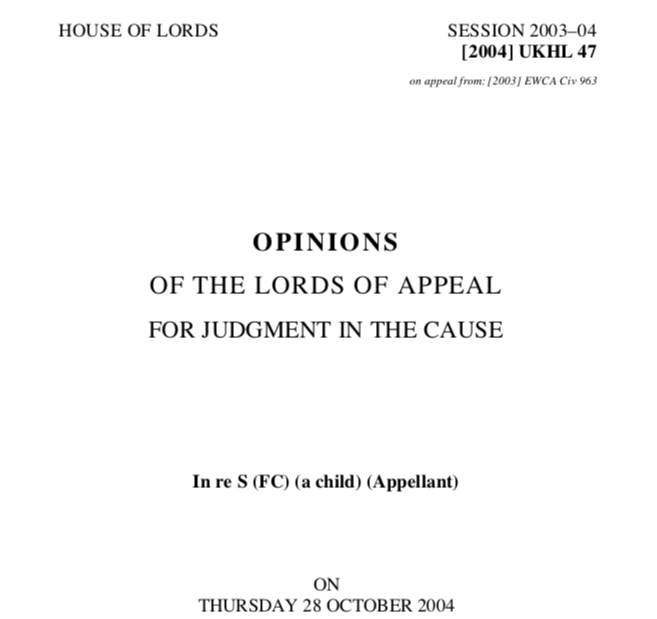
S (a child), Re [2004] UKHL 47 (28 October 2004)
https://www.bailii.org/uk/cases/UKHL/2004/47.html
This is a 19 page judgement given by Lord Steyn with four other Law Lords (Lord Bingham of Cornhill, Lord Nicholls of Birkenhead, Lord Hoffmann, and Lord Carswell) in agreement.
The issue to be decided was whether a Family Division High Court Judge was right or wrong to refuse to injunct the media from identifying a mother charged with murdering her 9 year old son by poisoning on the grounds of the psychological harm that would be caused to the mother’s younger son who was eight years old- referred to in the proceedings as ‘CS’.
Could a restriction imposed on the media not to identify the alleged murder victim’s younger brother mean that they should not be allowed to identify the mother, her husband, the alleged murder victim, their photographs, and other facts such as the home address of the family and school attended by the alleged murder victim? The implication of such restrictions is the concertina effect in closing down publication of other facts usually regarded as essential to the reporting of criminal trials.
It could also be described as an oppressive secret justice shadow doctrine where the best interests of peripheral individuals in a criminal trial are virtuously upheld to the detriment of the public interest in freedom of expression to receive and communicate accurate and fair reporting of court proceedings.
This was a clash between open justice Article 10 freedom of expression rights for the media and public, and Article 8 privacy rights for the alleged murder victim’s younger brother.
This was also a test of the applicability of reporting restrictions in the criminal courts when imposed to protect the interests of children who are not party to the proceedings.
One Crown Court judge had imposed an order under Section 39 of the Children and Young Person’s Act stating: ‘prohibiting publication of information calculated to lead to the identification of the child [alleged murder victim’s younger brother]. The judge stated that publication of the family’s surname would be considered an act calculated to lead to such identification.’
Another Crown Court judge discharged the order after representations from a local newspaper, The Romford Recorder, stating ‘section 39 was inapplicable to the case because the child was not a “child concerned in the proceedings, either as being the person by or against or in respect of whom the proceedings were taken, or as being a witness therein.”’
Section 39 orders under the CYPA 1933 have since been replaced with Section 45 orders under the Youth Justice and Criminal Evidence Act 1999.
Lord Steyn said: ‘ For present purposes section 45 is in material respects the same as the extant section 39(1): see section 45(3). As the words, which I have italicised, make clear section 39(1) is not engaged in the present case. My reason for referring to it is, however, the reflection that, in regard to children not concerned in a criminal trial, there has been a legislative choice not to extend the right to restrain publicity to them. This is a factor which cannot be ignored.’
The Family Division High Court Judge, Mr Justice Hedley initially granted an application for an injunction sought by the guardian of ‘CS’, and this included preventing ‘any person “publishing any particulars of or information relating to any part of the proceedings before any court which may or is calculated to lead to the identification of the said child”.
Lord Steyn observed: ‘The order was clearly designed to prohibit publication of the name of the mother and the deceased child in any report of the impending criminal trial. It is common ground that the order also prevented publication of any photographs of the mother or deceased child.’
The Romford Recorder applied for a modification of the order to prevent the potential censorship applying to any reporting of the mother’s forthcoming criminal trial.
Mr Justice Hedley agreed and explained:
“First I recognise the primacy in a democratic society of the open reporting of public proceedings on grave criminal charges and the inevitable price that that involves in incursions on the privacy of individuals. Secondly, I recognise that Parliament has in a number of statutes qualified that right to report and, in the context of this case, most notably in section 39 of the 1933 Act; where a set of circumstances arise not covered by those provisions the court should in my judgment be slow to extend the incursion into the right of free speech by the use of the inherent jurisdiction. Thirdly, I have to recognise that not even the restrictions contended for here offer real hope to CS of proper isolation from the fallout of publicity at this trial; it is inevitable that those who know him will identify him and thus frustrate the purpose of the restriction. Lastly, I am simply not convinced that, when everything is drawn together and weighed, it can be said that grounds under article 10(2) of the ECHR have been made out in terms of the balance of the effective preservation of CS’s article 8 rights against the right to publish under article 10. I should add, although it is not strictly necessary to do so, that I think I would have come to the same conclusion even had I been persuaded that this was a case where CS’s welfare was indeed my paramount consideration under section 1(1) of the 1989 [Children] Act.”
The case went to the Court of Appeal which decided by a majority of 2 to 1 to sustain Justice Hedley’s ruling.
At the Judicial Committee of the House of Lords, counsel for the guardian of ‘CS” submitted:
‘the majority [at Court of Appeal] misapplied the principle of proportionality in a case of competing rights under the ECHR and in so doing exposed a vulnerable child to interference with his private and family rights. In outline her submissions were as follows. The child had a right to respect for his private and family life in that he was entitled to expect the state to provide, by way of his access to the court, protection against harmful publicity concerning his family. The child has a right to protection from publicity which could damage his health and well-being and risk emotional and psychiatric harm. Recognising that the subject matter of the trial is a matter of public interest counsel for the child submitted that a proportionate response would be to permit only newspaper reports which do not refer to the family name or incorporate photographs of family members or the deceased. ‘
Lord Steyn explained the methodology in carrying out a balancing act when Article 10 and Article 8 rights under the European Convention of Human Rights come into conflict with one another (author has underlined and emboldened key points):
‘First, neither article has as such precedence over the other. Secondly, where the values under the two articles are in conflict, an intense focus on the comparative importance of the specific rights being claimed in the individual case is necessary. Thirdly, the justifications for interfering with or restricting each right must be taken into account. Finally, the proportionality test must be applied to each. For convenience I will call this the ultimate balancing test. This is how I will approach the present case.’
Here are some key paragraphs from Lord Steyn’s ruling that could be of assistance to journalists, their news publishers and counsel if needing to appeal or make applications to overturn or vary similar reporting restrictions.
Paragraph 18: ‘In oral argument it was accepted by both sides that the ordinary rule is that the press, as the watchdog of the public, may report everything that takes place in a criminal court. I would add that in European jurisprudence and in domestic practice this is a strong rule. It can only be displaced by unusual or exceptional circumstances. It is, however, not a mechanical rule. The duty of the court is to examine with care each application for a departure from the rule by reason of rights under article 8. ‘
Paragraph 25: ‘But it is necessary to measure the nature of the impact of the trial on the child. He will not be involved in the trial as a witness or otherwise. It will not be necessary to refer to him. No photograph of him will be published. There will be no reference to his private life or upbringing. Unavoidably, his mother must be tried for murder and that must be a deeply hurtful experience for the child. The impact upon him is, however, essentially indirect.’
Paragraph 27: ‘The interference with article 8 rights, however distressing for the child, is not of the same order when compared with cases of juveniles, who are directly involved in criminal trials. In saying this I have not overlooked the fact that the mother, the defendant in the criminal trial, has waived her right to a completely public trial, and supports the appeal of the child. In a case such as the present her stance can only be of limited weight.’
Paragraph 28: ‘Article 10 is also engaged. This case is concerned with the freedom of the press, subject to limited statutory restrictions, to report the proceedings at a criminal trial without restriction. It is necessary to assess the importance of this freedom. I start with a general proposition. In Reynolds v Times Newspapers Limited [2001] 2 AC 127 Lord Nicholls of Birkenhead described the position as follows (200G-H):
“It is through the mass media that most people today obtain their information on political matters. Without freedom of expression by the media, freedom of expression would be a hollow concept. The interest of a democratic society in ensuring a free press weighs heavily in the balance in deciding whether any curtailment of this freedom bears a reasonable relationship to the purpose of the curtailment.”
These observations apply with equal force to the freedom of the press to report criminal trials in progress and after verdict.
Paragraph 29: ‘The importance of the freedom of the press to report criminal trials has often been emphasised in concrete terms. In R v Legal Aid Board ex parte Kaim Todner (A firm) [1999] QB 966, Lord Woolf MR explained (at 977):
“The need to be vigilant arises from the natural tendency for the general principle to be eroded and for exceptions to grow by accretion as the exceptions are applied by analogy to existing cases. This is the reason it is so important not to forget why proceedings are required to be subjected to the full glare of a public hearing. It is necessary because the public nature of the proceedings deters inappropriate behaviour on the part of the court. It also maintains the public’s confidence in the administration of justice. It enables the public to know that justice is being administered impartially. It can result in evidence becoming available which would not become available if the proceedings were conducted behind closed doors or with one or more of the parties’ or witnesses’ identity concealed. It makes uninformed and inaccurate comment about the proceedings less likely . . . Any interference with the public nature of court proceedings is therefore to be avoided unless justice requires it. However Parliament has recognised there are situations where interference is necessary.”
At paragraph 30, Lord Steyn said: ‘A criminal trial is a public event. The principle of open justice puts, as has often been said, the judge and all who participate in the trial under intense scrutiny. The glare of contemporaneous publicity ensures that trials are properly conducted. It is a valuable check on the criminal process. Moreover, the public interest may be as much involved in the circumstances of a remarkable acquittal as in a surprising conviction. Informed public debate is necessary about all such matters. Full contemporaneous reporting of criminal trials in progress promotes public confidence in the administration of justice. It promotes the values of the rule of law.’
Lord Steyn then set out the harmful consequences of granting the injunction in paragraphs 32 to 36:
‘32. There are a number of specific consequences of the grant of an injunction as asked for in this case to be considered. First, while counsel for the child wanted to confine a ruling to the grant of an injunction restraining publication to protect a child, that will not do. The jurisdiction under the ECHR could equally be invoked by an adult non-party faced with possible damaging publicity as a result of a trial of a parent, child or spouse. Adult non-parties to a criminal trial must therefore be added to the prospective pool of applicants who could apply for such injunctions. This would confront newspapers with an ever wider spectrum of potentially costly proceedings and would seriously inhibit the freedom of the press to report criminal trials.
33. Secondly, if such an injunction were to be granted in this case, it cannot be assumed that relief will only be sought in future in respect of the name of a defendant and a photograph of the defendant and the victim. It is easy to visualise circumstances in which attempts will be made to enjoin publicity of, for example, the gruesome circumstances of a crime. The process of piling exception upon exception to the principle of open justice would be encouraged and would gain in momentum.
34. Thirdly, it is important to bear in mind that from a newspaper’s point of view a report of a sensational trial without revealing the identity of the defendant would be a very much disembodied trial. If the newspapers choose not to contest such an injunction, they are less likely to give prominence to reports of the trial. Certainly, readers will be less interested and editors will act accordingly. Informed debate about criminal justice will suffer.
35. Fourthly, it is true that newspapers can always contest an application for an injunction. Even for national newspapers that is, however, a costly matter which may involve proceedings at different judicial levels. Moreover, time constraints of an impending trial may not always permit such proceedings. Often it will be too late and the injunction will have had its negative effect on contemporary reporting.
36. Fifthly, it is easy to fall into the trap of considering the position from the point of view of national newspapers only. Local newspapers play a huge role. In the United Kingdom according to the website of The Newspaper Society there are 1301 regional and local newspapers which serve villages, towns and cities. Apparently, again according to the website of The Newspaper Society, over 85% of all British adults read a regional or local newspaper compared to 70% who read a national newspaper. Very often a sensational or serious criminal trial will be of great interest in the community where it took place. A regional or local newspaper is likely to give prominence to it. That happens every day up and down the country. For local newspapers, who do not have the financial resources of national newspapers, the spectre of being involved in costly legal proceedings is bound to have a chilling effect. If local newspapers are threatened with the prospect of an injunction such as is now under consideration it is likely that they will often be silenced. Prudently, the Romford Recorder, which has some 116,000 readers a week, chose not to contest these proceedings. The impact of such a new development on the regional and local press in the United Kingdom strongly militates against its adoption. If permitted, it would seriously impoverish public discussion of criminal justice.’
Journalists and their editors may justifiably argue that these are compelling arguments. Sadly, the situation for British journalism since 2004 has greatly deteriorated. There are many less local newspapers in terms of the number published, their circulation and journalists working for them.
This is the result of ‘Big Tech’ harvesting the major proportion of what was their print advertising income, an exponential decline in printed newspaper readership as a social value and economic market, and the digitisation of communications without any equivalent sustaining model of economic viability for online news publishing.
Many journalists and editors would argue that the problem Lord Steyn described as ‘The process of piling exception upon exception to the principle of open justice’ has in fact occurred, is being ‘encouraged’ by higher court rulings and has ‘gained in momentum.‘
There is also an argument that however costly it is for news organisations to challenge reporting restrictions recent court rulings actually discourage them from doing so.
Has public discussion of criminal justice been impoverished as well? Is there less court reporting now in local, regional and national media publications? Has informed debate about criminal justice suffered? These are now questions which beg urgent answers. Contemporary journalists and editors may argue that the answer to all three questions is in the affirmative.
Returning to Lord Steyn’s conclusion. He supported Mr Justice Hedley’s approach to ‘the ultimate balancing test’ at paragraph 37:
‘Given the weight traditionally given to the importance of open reporting of criminal proceedings it was in my view appropriate for him, in carrying out the balance required by the ECHR, to begin by acknowledging the force of the argument under article 10 before considering whether the right of the child under article 8 was sufficient to outweigh it.’
House of Commons Justice Committee report ‘Open justice: court reporting in the digital age’ published 1st November 2022

Some of the rhetorical questions raised in the analysis of Lord Steyn’s ruling in S (a child), Re [2004] UKHL 47 above have been addressed in this report by the House of Commons Justice Committee which received a range of submissions of evidence from qualitative and qualified sources.
The Committee’s report provided a wide range of recommendations set out across 45 paragraphs:-
Conclusions and recommendations
Introduction
- We would encourage every family court in England and Wales to invite their local MPs to visit so that they can hear accounts of the issues facing the family justice system from those who are responsible for delivering justice on a daily basis. (Paragraph 2)
- The Lord Chancellor and the Lord Chief Justice should consider producing a White Paper that clarifies and publicises the right of the public to attend court hearings and access information on court proceedings in the digital age. (Paragraph 11)
- Open justice is a common law principle, and it is for the courts to determine its requirements in particular cases. However, responsibility for deciding how the principle should operate should not be left to the courts alone. Deciding the proper limits of open justice can often give rise to significant policy questions that Government and Parliament can only tackle through legislation. (Paragraph 19)
- The internet and social media are changing the way that the public access court proceedings, which is making the work of the courts more accessible; but this also presents dangers for the administration of justice. In the digital age, it is vital the Government, Parliament and the Judiciary work together to ensure that a balanced approach to open justice is achieved so that public scrutiny of justice can be secured without damaging the quality of the justice administered in the courts. (Paragraph 20)
Court reporting in the digital age - The well-documented decline in the news media’s coverage of the courts, particularly the Magistrates’ courts, is concerning. In acting as the eyes and ears of the public, the media perform a vital role in keeping the public informed on the operation of the justice system. (Paragraph 32)
- The decline in court reporting has had a negative effect on open justice in England and Wales. (Paragraph 33)
- As the public receives less information through the media on the work of the courts, HMCTS should do more to enable the courts to communicate information on court proceedings directly to the public. In addition, HMCTS needs to use technology and organisational reform, building on the work done with Courtsdesk News, to provide the media with the information it needs in a consistent manner, as soon as possible, to facilitate court reporting. HMCTS should also pilot the use of regional communication and information officers to support media and public access to hearings. Furthermore, the decrease in the media’s coverage of the courts also strengthens the case for the re-establishment of a courts’ inspectorate, which could help to identify wider issues within the justice system, particularly in the Magistrates’ courts and the Family Court, which are not well covered by the media. (Paragraph 33)
The barriers to open justice - The evidence from the Bureau of Investigative Journalism on its experience of attempting to access possession hearings presents a concerning picture of the practical reality of open justice in England and Wales. The legal and constitutional status of open justice is immaterial if journalists face the sort of hurdles experienced
by the Bureau of Investigative Journalism. Those barriers have the potential to create a chilling effect for journalists and the public by discouraging them from exercising their right to attend hearings. Everyone working within the justice system, especially judges and court staff, has a role to play in translating the principle of open justice into reality. (Paragraph 39) - We welcome the publication of the Reporters’ Charter, which for the first time sets out the rights and obligations of journalists reporting on court proceedings. We note, however, that the rights of access that flow from the principle of open justice are not exclusively for reporters’—it is vital that members of the public are also aware of their right to attend proceedings and access information. (Paragraph 40)
- HMCTS should publish a citizens’ charter that outlines the public’s rights to access information on the courts. (Paragraph 40)
- The Reporters’ Charter helpfully directs the media to the MOJ press office and the Judicial Press Office to deal with enquiries and issues on accessing court proceedings and information. There should be a single point of contact for all accessibility and open justice inquiries from the media and from the public. The Lord Chief Justice told us that, if a journalist encounters an issue accessing a court, he or she should “get in touch with their local court and ask why”. In reality, at present there is no formal official mechanism for the media or the public to raise accessibility enquiries or complaints in relation to the courts. The creation of regional communication and information officers within HMCTS could provide that point of contact for reporters and the public. The courts’ inspectorate, as we proposed in our report on court capacity, could have a specific remit to examine the operation of open justice. (Paragraph 41)
- HMCTS should institute a programme of open days to encourage the public to visit their local courts, for example during Justice Week. This programme should be used to improve the awareness of both the public and HMCTS staff of the public’s right to attend court proceedings. Furthermore, there should be a programme to encourage schools to organise visits to their local courts to improve public legal education. (Paragraph 42)
- Every court should list an email address on its website to enable the media and thepublic to request access to remote hearings. (Paragraph 44)
- Remote hearings are still a relatively new and innovative feature of the justice system in England and Wales. The evidence to our inquiry suggests that there is a problem
with a lack of coherence and consistency in relation to the ability of the media and the public to access remote court hearings. (Paragraph 49) - We recommend that HMCTS gathers and publishes data on requests to observe proceedings remotely. In particular, it would be useful to know the number of requests received and the number of requests granted by jurisdiction. (Paragraph 49)
- HMCTS should ensure that the Crown Court provides the same level of information to journalists on the outcome of cases as is currently provided by the Magistrates’ court. (Paragraph 57)
- We welcome the planned digitisation of the publication of court and tribunal lists and the consolidation into a single service in one location. (Paragraph 59)
- We request further information on when this service will go live and what improvements are planned to the level of information on the lists and the accessibility of the service. We recommend that HMCTS considers whether the proposed digital portal should be expanded to include all court information, including results, reporting restrictions and court documents. (Paragraph 59)
- The Committee would welcome an update on the work being undertaken by the Civil Procedure Rule Committee to improve access to documents in civil proceedings. (Paragraph 64)
- The Government and HMCTS should establish a streamlined process for accessing court documents, including courts lists, using a digital portal modelled on Public Access to Court Electronic Records (PACER) in the United States. This should also be used to inform the media of reporting restrictions, including automatic restrictions and notice of applications for reporting restrictions. (Paragraph 72)
- The Government and HMCTS should conduct, or ask the Law Commission to conduct, a comprehensive review on access to documents referred to in open court and propose legislation if necessary to clarify the position. (Paragraph 73)
- Reporting restrictions play a key role in securing the fairness of the justice system. However, it is clear that there is inconsistency in the courts’ approach to notifying the media when restrictions are in place, and they are often not effective at ensuring compliance, particularly on social media. This is an important example of where the modernisation of the infrastructure of open justice is long overdue (Paragraph 82)
- The proposed new digital portal should also enable access to a centralised database of reporting restrictions on cases. (Paragraph 82)
- The current situation on court transcripts is unsatisfactory. (Paragraph 87)
- HMCTS should explore whether greater use of technology, such as AI-powered transcription, could be piloted to see whether it can be used to reduce the cost of producing court transcripts. HMCTS should also consider whether the sentencing remarks in the Magistrates’ courts could be routinely recorded and transcribed on
request. HMCTS should also review its existing contracts for transcription services to ensure that transcripts are more accessible to the media and the public. (Paragraph 87) - We welcome the establishment of the National Archives Find Case Law Service. However, this service should represent the first step in improving the public accessibility of judgments. (Paragraph 93)
- HMCTS should reform the way that judgments are collected, stored and published sothat there is less reliance on commercial legal publishers. The judgments of courts are the product of a publicly funded justice system and the public, the media and the legal sector should not have to pay significant sums for access. (Paragraph 93)
- All Crown Court sentencing remarks should be published in audio and/or written form. HMCTS should ensure that the necessary resources are made available to enable sentencing remarks to be published. (Paragraph 97)
- We are concerned over whether the Ministry of Justice has allocated sufficient funding to ensure that the court reform programme can overcome some of the barriers to public and media access to information on courts. We ask the Government to provide a status update on any ongoing projects that are designed to enhance open justice, outlining how much funding has been allocated to deliver them and providing a date by which they will be completed. (Paragraph 98) Court reform and open justice
- We welcome the new legislative framework for remote observation of court proceedings. The combination of this framework and improvement of the technological facilities of courts has the potential to enhance open justice by making it easier for the public and the media to observe proceedings. (Paragraph 109)
- It is right that judges are in control of the decision as to whether to allow remote observation. In some cases, judges will find these decisions difficult to make. It is crucial therefore that the effect of this new framework is evaluated. The concerns raised by the Lord Chief Justice and the Senior President of Tribunals, in particular
in relation to the impact on court resources and the potential for unauthorised transmissions, will need to be followed up by an evaluation of how this new framework is operating in practice. (Paragraph 110) - HMCTS should commission an evaluation in June 2023 to examine how the new framework has worked in its first year of operation. (Paragraph 110)
- The power to allow the transmission of proceedings to designated livestreaming premises has great potential to enable more people to observe court proceedings and enhance open justice. If students were able to observe cases in classrooms and lecture halls, or if community centres could host livestreams of court proceedings,
the accessibility of court proceedings would be greatly enhanced. (Paragraph 111) - We welcome the broadcasting of Crown Court sentencing remarks. It is a positive step for both open justice and the public understanding of sentencing. (Paragraph 118)
- More widely, we recommend that HMCTS and the Judiciary commission research to determine which civil and criminal proceedings could be suitable for broadcast and video archiving. In principle, we would support the extension of broadcasting and recording to civil trials that do not involve oral evidence. In the criminal context, the broadcast and recording of sentencing in Magistrates’ courts could also be beneficial. However, we do not support the broadcasting of any elements of criminal trials other than the sentencing remarks of the judge. (Paragraph 119)
- The changes to criminal procedure in the Judicial Review and Courts Act 2022 should be carefully monitored. After one year of their operation, the Ministry of Justice should initiate an evaluation of how the changes are operating in practice, including their impact on open justice. (Paragraph 125)
- The potential effect of these changes on open justice might also be mitigated by ensuring that the relevant information that would have otherwise been said in open court is documented and published online in a timely fashion. (Paragraph 126)
- We remain concerned by the Single Justice Procedure’s lack of transparency. (Paragraph 130)
- The Government should review the procedure and seek to enhance its transparency by ensuring that any information that would have been available had the cases been heard in open court is published in a timely fashion. (Paragraph 130)
- The Government should clarify and strengthen the governance structures on open justice. The Senior Data Governance Panel should be formalised and its powers and remit should be defined and published. It is vital that the decisions made by the Panel are as transparent as possible. The positive work of the Media Working Group should be built upon and it should be empowered to make recommendations that are then considered and decided upon by the Senior Data Governance Panel. A separate court information user group should be established to represent the interests of groups other than the media, such as court observers, NGOs, researchers and law tech that can also make recommendations that are considered and decided upon by the Senior Data Governance Panel. (Paragraph 134)
The Family Court - We agree with the President of the Family Division that there should be a review of section 12 of the Administration of Justice Act 1960. In our view section 12 of the Act should be reviewed and reformed so that it can replaced with a much more targeted measure that respects the principle of open justice. The Government should ask the Law Commission to produce a proposal for the reform of section 12 of the Administration of Justice Act 1960 that provides a better balance between transparency and confidentiality. (Paragraph 145)
- In broad terms, we support the Transparency Review’s principal recommendation that media representative and bloggers should be able to report, subject to the relevant restrictions, on the cases they observe in the Family Court. We would caution, however, that given the decline in the number of court reporters in recent
years, it is unclear whether media outlets will necessarily dedicate greater resources to reporting on the family courts as a result of these changes. We look forward to seeing the results of the pilots. (Paragraph 152) - We welcome the commitment to produce more informative family court lists. The success of the proposed pilot will depend on journalists and bloggers being able to identity cases that will generate wider public interest. (Paragraph 153)
- We welcome the Transparency Review’s proposal to set a target of every judge publishing 10% of their judgments. If achieved, this would make a significant contribution to the transparency of the Family Court and to open justice. It is crucial that the public and the media are able to access a greater number of judgments
from the Family Court. However, we share the concern raised by witnesses as to whether sufficient resources will be allocated to enable the proposed anonymisation unit to function as effectively as it needs to in order to ensure that a consistent and representative number of judgments are published and to minimise the number of
anonymisation errors. (Paragraph 155) - His Majesty’s Court and Tribunal Service should ensure that the requisite resources are provided to enable the establishment of an anonymisation unit that facilitates the publication of at least 10% of Family Court judgments without the risk of identification of the parties involved. (Paragraph 155)
Here is a selection of pertinent written evidence provided by experienced court reporting journalists, news organisations and journalism bodies.
PA Media https://committees.parliament.uk/writtenevidence/41211/html/
The Chartered Institute of Journalists https://committees.parliament.uk/writtenevidence/40531/html/
Kirk, Mr Tristan (Courts Correspondent, London Evening Standard) https://committees.parliament.uk/writtenevidence/40146/html/
Media Lawyers Association https://committees.parliament.uk/writtenevidence/40481/html/
Casciani, Dominic (Home and Legal Correspondent, BBC News) https://committees.parliament.uk/writtenevidence/40488/html/
Gardham, Duncan (Journalist, Freelance) https://committees.parliament.uk/writtenevidence/40142/html/
Dearden, Lizzie (Home Affairs and Security Correspondent, The Independent) https://committees.parliament.uk/writtenevidence/40118/html/
The Bureau of Investigative Journalism https://committees.parliament.uk/writtenevidence/40572/html/
Pennink, Ms Emily (Old Bailey Correspondent, PA Media) https://committees.parliament.uk/writtenevidence/40083/html/
College of Policing plans to give the green light to police forces wishing to keep names of suspects accused of many serious offences secret and then does a U-turn after intense criticism
Following pressure and advice from the Information Commissioner on data protection law it seems The College of Policing was moved to propose guidance that forces no longer ‘should’ name those charged with crimes including indecent exposure, domestic violence or child sexual abuse, instead advising that individuals ‘can be named’.
This led to a significant outcry of criticism and complaints from journalism industry bodies with detailed warnings from experienced crime reporters about how this would undermine open justice and damage the public interest and trust in policing and criminal justice.
By Monday 27th March 2023, the online journalism trade press was reporting that there had been a U-turn. However, a more interventionist policy by the Information Commissioner on how public bodies interpret privacy rights could lead to more instances of scale-backs on previously accepted conventions in public disclosure practice.
The current APP (Authorised Professional Practice) on Media Relations is set out at https://www.college.police.uk/app/engagement-and-communication/media-relations
The public row over the proposed changes is effectively summarized in the article published by Police Professional “No changes to police media relations guidance without consultation, says college after ‘deep concerns’ raised.”
See: Hold The Front Page ‘New police guidance would making naming of suspects optional.’ and Press Gazette ‘Police could keep names secret after charge under new draft guidelines. The proposed guidance states that forces “can” name charged suspects. The current advice is they “should.”‘
Rebecca Camber wrote for Mail Online: ‘Secret justice and how the Nicola Bulley fiasco is driving the police to make another catastrophic error.
Mike Sullivan wrote for the Sun: ‘Cop plans to stop public knowing who has been charged with crime could let rapists like David Carrick carry on attacking.’
Hold The Front Page: “Police chiefs back down on suspect naming plan in ‘huge victory for press.’” See: https://www.holdthefrontpage.co.uk/2023/news/huge-victory-for-press-hailed-as-police-chiefs-back-down-on-suspect-naming-plan/
Press Gazette: “Police U-turn to say suspects ‘should be named’ on charge after Press Gazette story prompts backlash.” See: https://pressgazette.co.uk/media_law/police-name-on-charge-policy-proposal-reversed/
Secondary Media Law Codes and Guidelines
IPSO Editors’ Code of Practice in one page pdf document format https://www.ipso.co.uk/media/2032/ecop-2021-ipso-version-pdf.pdf
The Editors’ Codebook 144 pages pdf booklet 2023 edition https://www.editorscode.org.uk/downloads/codebook/codebook-2023.pdf
IMPRESS Standards Guidance and Code 72 page 2023 edition https://www.impress.press/wp-content/uploads/2023/02/Impress-Standards-Code.pdf
Ofcom Broadcasting Code Applicable from 1st January 2021 https://www.ofcom.org.uk/tv-radio-and-on-demand/broadcast-codes/broadcast-code Guidance briefings at https://www.ofcom.org.uk/tv-radio-and-on-demand/information-for-industry/guidance/programme-guidance
BBC Editorial Guidelines 2019 edition 220 page pdf http://downloads.bbc.co.uk/guidelines/editorialguidelines/pdfs/bbc-editorial-guidelines-whole-document.pdf Online https://www.bbc.com/editorialguidelines/guidelines
Office of Information Commissioner (ICO) Data Protection and Journalism Code of Practice 2023 41 page pdf https://ico.org.uk/media/for-organisations/documents/4025760/data-protection-and-journalism-code-202307.pdf and the accompanying reference notes or guidance 47 page pdf https://ico.org.uk/media/for-organisations/documents/4025761/data-protection-and-journalism-code-reference-notes-202307.pdf
Ministry of Justice Open Justice Consultation 2023
In May 2023, the Ministry of Justice opened a consultation on Open Justice. See: https://www.gov.uk/government/consultations/open-justice-the-way-forward/call-for-evidence-document-open-justice-the-way-forward
A research document ‘Open Justice: the way forward Call for Evidence’ was released 10th May at: https://assets.publishing.service.gov.uk/government/uploads/system/uploads/attachment_data/file/1155744/open-justice-cfe.pdf
The call for evidence ends 7th September 2023 and invites contributions on a wide range of topics: Open Justice; listings; accessing courts and tribunals; remote observations and livestreaming; broadcasting; Single Justice Procedure; publication of judgments and sentencing remarks; access to court documents and information; data access and reuse; and public legal education.
See Law Society Gazette ‘Court photography ban under review in transparency drive’ at: https://www.lawgazette.co.uk/practice/court-photography-ban-under-review-in-transparency-drive/5116009.article
Reviving common law media contempt- Attorney-General’s intervention in the Russell Brand scandal September 2023
On 22nd September The Attorney General for England and Wales issued a media release titled ‘Media Advisory Notice: Russell Brand’which ‘confirms the requirement not to publish material which could prejudice any potential criminal investigation or prosecutions.’
It stated:
‘Following the airing of “Russell Brand: In Plain Sight: Dispatches” on 16 September 2023, there has been extensive reporting about Russell Brand. The Attorney General, the Rt Hon Victoria Prentis KC MP, wishes to amplify the importance of not publishing any material where there is a risk that it could prejudice any potential criminal investigation or prosecutions.
Publishing this material could amount to contempt of court.
Editors, publishers, and social media users should take legal advice to ensure they are in a position to fully comply with the obligations to which they are subject under the common law and Contempt of Court Act 1981. The Attorney General’s Office is monitoring the coverage of these allegations.’
This advisory precipitated what can be described as a furious reaction from newspapers, journalism bodies and commentators.
On 25th September 2023, Sean O’Neill of the Times wrote a ‘Thunderer’ editorial in the paper headlined: ‘Attorney-general is showing contempt for press freedom.’ He said: ‘The Attorney General is either poorly informed about the law of contempt or has taken it upon herself to issue a thinly veiled threat intended to have a chilling effect on reporting of the Brand allegations.’
He added: ‘As a journalist for more than 35 years, I have always understood that contempt of court “bites” when proceedings are active (i.e. there has been a summons, an arrest or a charge). There have been no arrests in this case. No one has been interviewed by detectives. There are no active proceedings that can be prejudiced.’
The editorial continued: ‘Prentis’s intervention is a shocking overreach. It is not her job to tell reporters to stop reporting on issues where there is merely the “potential” for criminal proceedings.’
He concluded: ‘The attorney-general’s censorious warning has no basis in law. She should withdraw it immediately.’
On the same day the Telegraph reported “Contempt of court warning on Russell Brand coverage ‘worrying and unnecessary.’ Society of Editors questions advice from Victoria Prentis, the attorney general, not to publish material that could prejudice investigations.’
Dawn Alford, executive director of the Society of Editors told the paper ‘journalists were “well versed” in contempt of court laws.’ The article also quoted media law expert and consultant David Banks ‘I expect that newspapers and their lawyers will be treating this advice with a pinch of salt.’
And the very influential law journalist and qualified solicitor Joshua Rozenberg, who is an honorary KC and honorary bencher of Gray’s Inn, said of the Attorney General’s warning: ‘some very strange things being said about contempt of court’ and ‘For the time being, we can surely put common-law contempt back in its box.’
Press Gazette waded in with the article 25th September 2023: ‘Attorney General makes Russell Brand contempt warning despite no active proceeding.s Russell Brand has not been arrested, nor is any criminal investigation currently taking place.’
See: https://pressgazette.co.uk/media_law/attorney-general-russell-brand-contempt-warning/
And on the following day Press Gazette’s editor Dominic Ponsford published a further article seeking to clarify the media law surrounding the Russell Brand developing story: ‘Russell Brand investigation: Why Met Police issued statement to media despite privacy rules.’
See: https://pressgazette.co.uk/comment-analysis/russell-brand-met-police-statement-privacy-rules/
What the media coverage demonstrates is that the journalism profession does have an excellent command and understanding of the 1981 Contempt of Court Act.
This introduced a statutory regime for media contempt which between sections 1 and 5 sets out the rudiments of a strict liability rule that operates from the time a case is active.
Schedule 1 of the act sets out the times when criminal proceedings are active: ‘The initial steps of criminal proceedings are:— (a)arrest without warrant; (b)the issue, or in Scotland the grant, of a warrant for arrest; (c)the issue of a summons to appear, or in Scotland the grant of a warrant to cite; (d)the service of an indictment or other document specifying the charge; (e)except in Scotland, oral charge;’
And at (f) there are some very rare further circumstances where a criminal case becomes active again ‘the making of an application under section 2(2) (tainted acquittals), 3(3)(b) (admission made or becoming known after acquittal), 4(3)(b) (new evidence), 11(3) (eventual death of injured person) or 12(3) (nullity of previous proceedings) of the Double Jeopardy (Scotland) Act 2011 (asp 16).’ This just goes to show how complicated statutory and indeed common law contempt law can be.
There are specialist law books on contempt law. The latest fourth edition of Borrie and Lowe on Contempt (2010) is 778 pages long and costs £736.00.
Strict liability means that intention is no defence and media contempt is defined as a publication which ‘creates a substantial risk that the course of justice in the proceedings in question will be seriously impeded or prejudiced.’
If Parliament intended this legislation to abolish the common law of contempt, it would say so.
But, it does not.
Common law contempt still applies. See Section 6 ‘Savings’ of the 1981 Contempt of Court Act:
‘Nothing in the foregoing provisions of this Act—(a) prejudices any defence available at common law to a charge of contempt of court under the strict liability rule; (b)implies that any publication is punishable as contempt of court under that rule which would not be so punishable apart from those provisions; (c)restricts liability for contempt of court in respect of conduct intended to impede or prejudice the administration of justice.’
Mainstream media publications and their editors like to refer to McNae’s Essential Law for Journalists as ‘the media law bible.’ But even the bible of media law still has sections and references on common law contempt. See pages 306-7, 164, 169 and 330 of the 26th edition (2022) and pages 262-3, 148 and 153 of the 25th (2020) edition.
And the UK Media Law Pocketbook 2nd edition at pages 11, 17, 35, 57 and 78 deals with common law contempt matters though much more briefly.
One purpose in retaining common law media contempt would be to deal with situations where there is a campaign to make allegations against somebody in order to apply pressure for the authorities to arrest and prosecute and with the campaign intending to generate so much prejudice that a future fair trial is in doubt.
If it can be proved a journalist or media publisher intended to create as much prejudice to achieve this purpose, there could be common law contempt liability.
The Attorney General would have to be able to prove intent at the criminal standard of proof. A future court trying the journalist/publisher would be a panel of judges and not a jury.
The key test cases on common law contempt prosecutions of journalists and news publications are more than 30 years old. But that does not mean the law has changed in any way.
The AG would have to prove specific intent where the accusation is that of interference with particular legal proceedings. Any potential prosecution for media law contempt will depend on the circumstances. For example, has a legal process already begun with the announcement of an actual police investigation? Can it be shown that journalists and news publishers have been heedless or reckless to the obvious risk of prejudice and can this be equated with intent.
It can be argued that a journalist could be in contempt at common law if (a) they desired to interfere with the due process of justice or (b) they did not desire it but must have realised it was highly probable or (c) they neither desired it nor realised it was highly probable, but recognised it was a possibility and deliberately took a risk or, possibly (d) they were heedless of a perfectly obvious risk. These possibilities were actually set out at page 92 in the 11th edition of McNae’s Essential Law for Journalists (1990).
The Sun was fined £75,000 in 1988 for contempt at common law when during 1986 they offered to fund a private prosecution of a doctor on a charge of raping an eight-year-old girl, and then published two articles with details of the allegation.
In one of the articles the newspaper had identified the doctor and accused him of other indecencies. Two of the Sun’s articles had been headlined: ‘He’s a real swine’ and ‘Beast must be named, says MP.’
The proceedings were not active under the 1981 Contempt of Court Act, but the court decided criminal proceedings were imminent at common law.
During the private prosecution, the doctor was accorded anonymity and evidence and information previously published about him was legally inadmissible.
The Divisional Court decided when the Sun published its articles, a criminal prosecution was virtually certain to begin in the near future and an intention to prejudice the future trial had been established.
The doctor was in fact acquitted after a trial at Chelmsford Crown Court.
Lord Justice Watkins said: ‘The need for a free press is axiomatic, but the press cannot be allowed to charge about like a wild unbridled horse.’
He continued: ‘It has, to a necessary degree, in the public interest to be curbed. The curb is in no circumstance more necessary than when the principle that every man accused of crime shall have a fair trial is at stake. It is a principle which, in my experience, newspaper proprietors and editors are usually as alert as anyone to avoid violating.
There may not have been in fact, as was suggested, another case quite like this, but the kind of threat which the articles complained of posed to the proper administration of justice is by no means novel, as reports of previous cases of criminal contempt committed by publishers of newspaper articles show.
The respondents here had very much in mind particular proceedings which they were determined, as far as it lay within their power and influence, to ensure took place.’
To those who might argue now that the common law of media contempt is redundant and has been supplanted by statutory law, it might be useful to call in mind the observations of Lord Justice Watkins in his 1988 ruling:
‘The common law surely does not tolerate conduct which involves the giving of encouragement and practical assistance to a person to bring about a private prosecution accompanied by an intention to interfere with the court of justice by publishing material about the person to be prosecuted which could only serve to and was so intended to prejudice the fair trial of that person. This is especially so where the publisher of them makes it plain that he believes the person referred to in the articles is guilty of serious crime, that he is deserving of punishment for that, and that he has committed some other similar crime.
The common law is not a worn-out jurisprudence rendered incapable of further development by the ever increasing incursion of parliamentary legislation. It is a lively body of law capable of adaptation and expansion to meet fresh needs calling for the exertion of the discipline of law.’
This precedent indicates that the circumstances in which a criminal contempt at common law could be committed were not necessarily confined to those in which proceedings were either pending or imminent.
See: Attorney General v News Group Newspapers Ltd – [1988] 2 All ER 906
In 1987 the Independent, Evening Standard, and London Daily News were held in contempt of court at common law and each later fined £50,000 for publishing material from Peter Wright’s book Spycatcher. In 1990 the fines were discharged, but convictions confirmed.
At the time of their publication interim injunctions were in force preventing the Observer and Guardian from publishing the material.
The Court of Appeal held there could be contempt of court at common law if there was an attempt to impede or prejudice the administration of justice. It was well established that an act which interfered with the course of justice was capable of constituting a contempt of court.
Furthermore, the court’s power to commit for contempt where the conduct complained of was intended to impede or prejudice the administration of justice was saved by Section 6(c) of the 1981 Act, and accordingly, where the court had made orders to preserve the subject matter of an action pending trial, a third party who knew of those orders but who nevertheless destroyed or seriously damaged that subject matter would be guilty of criminal contempt if in doing so he intended to impede or prejudice the administration of justice.
See: Attorney General v Newspaper Publishing plc and others — [1987] 3 All ER 276
In 1991 the Sport newspaper and its editor were found not guilty of contempt after they published the previous convictions of a rapist being sought by the police abroad for questioning about a missing schoolgirl.
The case was not active and no warrant for arrest had been issued, though the police had specifically asked the media not to publish the suspect’s previous convictions.
The editor justified his actions and defiance of police advice on the basis that the rapist was ‘on the run and a danger to other women.’ Publisher and editor were acquitted because the court held the AG had not proved intent beyond reasonable doubt.
There was no specific knowledge of the whereabouts of the suspect at the time of the publication and it was argued that his arrest and the criminal proceedings arising could not be said to be apparently imminent.
See: Attorney General v Sport Newspapers and others [1992] 1 All ER 503.
In a largely forgotten contempt of court prosecution by the Attorney General against Private Eye magazine and its editor Ian Hislop in 1990, the Court of Appeal eventually ruled that both respondents had committed contempt by common law and the statutory provisions of the 1981 Contempt of Court Act.
In 1989 Sonja Sutcliffe had been suing the magazine for libel over allegations about her dealings with newspapers covering the arrest and prosecution of her husband Peter Sutcliffe for multiple murders. He was known as ‘The Yorkshire Ripper.’ The libel case was to be tried by jury and the magazine had published articles in February 1989 about the impending case.
The Court of appeal judges ruled the articles went beyond fair and temperate criticism or a private warning before trial of possible cross-examination.
They held Mrs Sutcliffe up to public obloquy, were untrue, defamatory and designed to deter her from proceeding with her action by what amounted to threats to expose her to cross-examination on her alleged knowledge of her husband’s murderous activities and her alleged fraud on the social security authorities.
The court decided they accordingly amounted to improper pressure on Mrs Sutcliffe to abandon her claim against the defendants, notwithstanding the defendants’ belief at the time of publication that the articles were true or that they would be entitled to cross-examine her on the matters contained in them by way of justification.
The court ruled there was also a risk that potential jurors at the trial of the action might be prejudiced by the articles.
In these circumstances the court decided the articles gave rise to a substantial risk that the course of the proceedings would be seriously impeded or prejudiced and amounted to a contempt both at common law and under the Contempt of Court Act 1981.
The Attorney General’s appeal was accordingly allowed and the defendants each fined £10,000.
Lord Justice Nicholls in his ruling observed: ‘I do not understand how a responsible editor came to do this. This is not an instance of fair and temperate criticism. A journal was using its own columns to publish highly defamatory material, and make threats, with the view thereby of putting pressure on a plaintiff to abandon a claim—against itself—which was in the warned list and due to be heard within two or three months. Such conduct does no service to the cause of the freedom of the press. It was, I much regret to have to say, an abuse of that freedom.’
On the subject of the boundaries of the 1981 Contempt of Court Act and media contempt at common law, Lord Justice Nicolls said: ‘…the 1981 Act left untouched, and outside the strict boundaries set for the strict liability rule, cases such as the present one, where the conduct was intended to impede or prejudice the administration of justice … in my view publication of these two articles by Private Eye was a serious contempt of court at common law.’
See: Attorney General v Hislop and another [1991] 1 All ER 911
In the light of these old test cases and precedents, there is no reason why new circumstances could arise where the Attorney General may wish to respond with a move to protect the administration of justice where it was felt that the media had become by their investigations some kind of proxy police, prosecutor, and then judge and jury.
It is a long time since the last media contempt common law case, but we cannot rule out the development of a new more contemporary precedent which is not something any journalist or news publisher would like be at the centre of.
Pdf file of this media law briefing
 UK Media Law Pocketbook Second Edition
Great insights on UK media law! This blog post highlights important legal aspects content creators must stay aware of.
LikeLike