

THE UK MEDIA LAW POCKETBOOK
by Tim Crook

Second Edition Published by Routledge 30th November 2022
If you are reading and accessing this publication as an e-book such as on the VitalSource platform, please be advised that it is Routledge policy for clickthrough to reach the home page only. However, copying and pasting the url into the address bar of a separate page on your browser usually reaches the full YouTube, Soundcloud and online links.
The companion website pages will contain all of the printed and e-book’s links with accurate click-through and copy and paste properties. Best endeavours will be made to audit, correct and update the links every six months.

Chapter 3
Libel, Privacy, Accuracy and Balance
This chapter covers the nature of libel law for UK media publication, the defences available and potential pitfalls.
Focus on the defences of truth/justification, responsible journalism, honest opinion, absolute and qualified privilege, neutral reportage, innocent dissemination , and web-site operator’s defence.
Full coverage of the developing media law of privacy, how it operates and the potential defences.
Full explanation of secondary media law in relation to inaccurate speech that neither harms reputation nor breaches privacy law and the implications in relation to print and broadcasting regulation.
Duties in relation to published correction, apology, right to reply, and critical adjudication.
Secondary media law on ‘unfair’ publication, causing ‘harm and offence’ and breaching impartiality and the law relating to ‘giving undue prominence of views and opinions’ in broadcasting.
The print regulation on ‘distinguishing clearly between comment, conjecture and fact.’
Video-cast on Libel, Privacy, Accuracy and Balance in Media Law
Key bullet points setting out legal duties in relation to libel, privacy, accuracy and balance
3.1 Libel and privacy – The chilling effect
A downloadable sound file on the chilling effect of libel and privacy laws in UK media
Online Links Printed Book
Page 99
Richard v The British Broadcasting Corporation (BBC) & Anor [2018] EWHC 1837 (Ch) (18 July 2018)
https://www.bailii.org/ew/cases/EWHC/Ch/2018/1837.html
United Kingdom Supreme Court, Bloomberg LP v ZXC [2022] UKSC 5 (16 February 2022)
https://www.bailii.org/uk/cases/UKSC/2022/5.html
The Use of SLAPPs to Silence Journalists, NGOs and Civil Society 2021. Study commissioned by the European Parliament’s Policy Department for Citizens’ Rights and Constitutional Affairs at the request of the JURI Committee
https://www.europarl.europa.eu/RegData/etudes/STUD/2021/694782/IPOL_STU(2021)694782_EN.pdf
Council of Europe ‘Time to take action against SLAPPs’ 27 October 2020
https://www.coe.int/en/web/commissioner/-/time-to-take-action-against-slapps
UK Ministry of Justice Strategic Lawsuits Against Public Participation. A Call for Evidence March 2022
https://consult.justice.gov.uk/digital-communications/strategic-lawsuits-against-public-participation/supporting_documents/slappscallforevidenceweb.pdf
Government Response to the Call for Evidence
https://consult.justice.gov.uk/digital-communications/strategic-lawsuits-against-public-participation/results/slapps-call-evidence-response.pdf
3.2 Libel – Defamation law in definition and explanation
A downloadable sound file defining and explaining libel
Online Links Printed Book
Page 104
2013 Defamation Act
https://www.legislation.gov.uk/ukpga/2013/26/contents
Explanatory notes and guidance to 2013 Defamation Act
https://www.legislation.gov.uk/ukpga/2013/26/pdfs/ukpgaen_20130026_en.pdf
3.3 Defences to libel
&
3.3.1 Truth
A downloadable sound file on truth as a defence to libel
Online Links Printed Book
Pages 106 and 107
Section 2 of the Defamation Act 2013
https://www.legislation.gov.uk/ukpga/2013/26/section/2
Depp II v News Group Newspapers Ltd & Anor [2020] EWHC 2911 (QB) (02 November 2020)
https://www.bailii.org/ew/cases/EWHC/QB/2020/2911.html
Press Gazette 6 June 2022 ‘Johnny Depp vs Amber Heard: Why did Pirates star lose libel case in UK but win in US?’
https://pressgazette.co.uk/johnny-depp-amber-heard-trial-uk-us-libel-law/
Burgon MP v News Group Newspapers Ltd & Anor [2019] EWHC 195 (QB) (06 February 2019)
https://www.bailii.org/ew/cases/EWHC/QB/2019/195.html
Begg v British Broadcasting Corporation [2016] EWHC 2688 (QB) (28 October 2016) https://www.bailii.org/ew/cases/EWHC/QB/2016/2688.html
Yeo v Times Newspapers Ltd [2015] EWHC 3375 (QB) (25 November 2015)
https://www.bailii.org/ew/cases/EWHC/QB/2015/3375.html
Rowland v Mitchell [2014] EWHC 4015 (QB) (27 November 2014)
https://www.bailii.org/ew/cases/EWHC/QB/2014/4015.html
David Hunt v Times Newspapers Ltd, EWHC 1868 (QB) (4 July 2013)
https://www.5rb.com/wp-content/uploads/2013/07/david-hunt-v-times-newspapers-ltd-5.pdf
3.3.2 Absolute privilege/high qualified privilege
A downloadable sound file on the libel defence of absolute and high qualified privilege
Online Links Printed Book
Page 108
Section 7 Defamation Act 2013
https://www.legislation.gov.uk/ukpga/2013/26/section/7
Section 14 Defamation Act 1996
https://www.legislation.gov.uk/ukpga/1996/31/section/14
3.3.3 Lower qualified privilege
Online Links Printed Book
Page 110
Schedule 1 of the Defamation Act 1996. Qualified privilege. Part I Statements having qualified privilege without explanation or contradiction, and Part II Statements privileged subject to explanation or contradiction
https://www.legislation.gov.uk/ukpga/1996/31/schedule/1
Section 7 Defamation Act 2013, ‘Reports etc protected by privilege’
https://www.legislation.gov.uk/ukpga/2013/26/section/7
Turkington and Others v. Times Newspapers Limited (Northern Ireland) [2000] UKHL 57 (2nd November, 2000)
https://www.bailii.org/uk/cases/UKHL/2000/57.html
3.3.4 Honest opinion
A downloadable sound file on the libel defence of honest opinion
Online Links Printed Book
Page 111
Section 3 Honest Opinion, Defamation Act 2013
https://www.legislation.gov.uk/ukpga/2013/26/section/3
Butt v The Secretary of State for the Home Department [2019] EWCA Civ 933 (06 June 2019)
https://www.bailii.org/ew/cases/EWCA/Civ/2019/933.html
Guardian ‘David Soul wins libel battle with Mirror’ 11 December 2001
https://www.theguardian.com/media/2001/dec/11/pressandpublishing
3.3.5 Public interest
A downloadable sound file on the public interest defence for libel
Online Links Printed Book
Page 114
Section 4 Public Interest, Defamation Act 2013
https://www.legislation.gov.uk/ukpga/2013/26/section/4
Lachaux v Independent Print Ltd & Anor [2021] EWHC 1797 (QB) (01 July 2021)
https://www.bailii.org/ew/cases/EWHC/QB/2021/1797.html
Serafin v Malkiewicz & Ors [2020] UKSC 23 (3 June 2020)
https://www.bailii.org/uk/cases/UKSC/2020/23.html
Economou v David De Freitas (Rev 1) [2016] EWHC 1853 (QB) (27 July 2016)
http://www.bailii.org/ew/cases/EWHC/QB/2016/1853.html
Reynolds v. Times Newspapers Ltd and Others [1999] UKHL 45 (28th October, 1999)
https://www.bailii.org/cgi-bin/format.cgi?doc=/uk/cases/UKHL/1999/45.html
Jameel & Ors v. Wall Street Journal Europe Sprl [2006] UKHL 44 (11 October 2006)
https://www.bailii.org/cgi-bin/format.cgi?doc=/uk/cases/UKHL/2006/44.html
Flood v Times Newspapers Ltd [2012] UKSC 11 (21 March 2012)
https://www.bailii.org/cgi-bin/format.cgi?doc=/uk/cases/UKSC/2012/11.html
3.3.6 Neutral reportage
A downloadable sound file on the neutral reportage defence to libel
Online Links Printed Book
Page 115
Al-Fagih v HH Saudi Research & Marketing (UK) Ltd [2001] EWCA Civ 1634 (5 November 2001)
https://www.bailii.org/ew/cases/EWCA/Civ/2001/1634.html
Roberts & Anor v Gable & Ors [2006] EWHC 1025 (QB) (12 May 2006)
https://www.bailii.org/ew/cases/EWHC/QB/2006/1025.html
3.3.7 Innocent dissemination
A downloadable sound file on the libel defence of innocent dissemination
Online Links Printed Book
Page 116
Defamation Act 1996
https://www.legislation.gov.uk/ukpga/1996/31/contents
3.3.8 Peer-reviewed statement in scientific or academic journal and at conference
Online Links Printed Book
Page 117
Section 6 Defamation Act 2013 Peer-reviewed statement in scientific or academic journal etc
https://www.legislation.gov.uk/ukpga/2013/26/section/6
3.3.9 Website operator defence
A downloadable sound file on libel defences and issues for website publication
Online Links Printed Book
Page 119
Section 8 Defamation Act 2013 Single publication rule
https://www.legislation.gov.uk/ukpga/2013/26/section/8
Section 5 Defamation Act 2013 Operators of websites
https://www.legislation.gov.uk/ukpga/2013/26/section/5
The Defamation (Operators of Websites) Regulations 2013
https://www.legislation.gov.uk/ukdsi/2013/9780111104620
Crookes v. Newton, 2011 SCC 47 (CanLII), [2011] 3 SCR 269
https://www.canlii.org/en/ca/scc/doc/2011/2011scc47/2011scc47.html
Gutnick v Dow Jones & Co Inc [2001] VSC 305 (28 August 2001)
https://www.austlii.edu.au/cgi-bin/viewdoc/au/cases/vic/VSC/2001/305.html
Dow Jones and Company Inc v Gutnick [2002] HCA 56; 210 CLR 575; 194 ALR 433; 77 ALJR 255 (10 December 2002)
https://www.austlii.edu.au/cgi-bin/viewdoc/au/cases/cth/HCA/2002/56.html
3.4 Privacy – Introduction to the legal concept
Online Links Printed Book
Page 122
PJS v News Group Newspapers Ltd (Rev 1) [2016] UKSC 26 (19 May 2016)
https://www.bailii.org/uk/cases/UKSC/2016/26.html
Human Rights Act 1998
https://www.legislation.gov.uk/ukpga/1998/42/contents
Schedule 1 of the Human Rights Act 1998. The Articles Part I The Convention Rights and Freedoms
https://www.legislation.gov.uk/ukpga/1998/42/schedule/1
3.5 Development of UK media privacy law
A downloadable sound file on the development of media privacy law in the UK
Online Links Printed Book
Pages 126 and 127
Campbell v MGN Ltd [2004] UKHL 22 (6 May 2004)
https://www.bailii.org/uk/cases/UKHL/2004/22.html
HRH The Duchess of Sussex v Associated Newspapers Ltd [2021] EWHC 273 (Ch) (11 February 2021)
https://www.bailii.org/ew/cases/EWHC/Ch/2021/273.html
HRH The Duchess of Sussex v Associated Newspapers Ltd [2021] EWHC 510 (Ch) (05 March 2021)
https://www.bailii.org/ew/cases/EWHC/Ch/2021/510.html
HRH the Duchess of Sussex v Associated Newspapers Ltd [2021] EWCA Civ 1810 (02 December 2021)
https://www.bailii.org/ew/cases/EWCA/Civ/2021/1810.html
Mail On Sunday will pay Meghan Markle just £1 in damages for privacy breach after losing court battle over letter to her father
https://www.dailymail.co.uk/news/article-10370935/Mail-Sunday-pay-Meghan-Markle-just-1-damages-privacy.html
Will of His Late Royal Highness the Prince Philip, Duke of Edinburgh, Re The [2021] EWHC 77 (Fam) (16 September 2021)
https://www.bailii.org/ew/cases/EWHC/Fam/2021/77.html
Associated Newspapers Ltd v HRH Prince of Wales [2006] EWCA Civ 1776 (21 December 2006)
https://www.bailii.org/ew/cases/EWCA/Civ/2006/1776.html
PNM v Times Newspapers Ltd & Ors [2017] UKSC 49 (19 July 2017)
http://www.bailii.org/uk/cases/UKSC/2017/49.html
Mario Costeja Gonzalez v Google Spain and Google (Judgment of the Court) [2014] EUECJ C-131/12 (13 May 2014)
https://www.bailii.org/eu/cases/EUECJ/2014/C13112.html
NT 1 & NT 2 v Google LLC [2018] EWHC 799 (QB) (13 April 2018)
https://www.bailii.org/ew/cases/EWHC/QB/2018/799.html
HURBAIN v. BELGIUM – 57292/16 (Judgment: No Freedom of expression-{general} : Third Section) French Text [2021] ECHR 544 (22 June 2021)
https://www.bailii.org/eu/cases/ECHR/2021/544.html (ruling in French only)
Information note on Hurbain v. Belgium – 57292/16
https://hudoc.echr.coe.int/fre#{%22itemid%22:[%22002-13318%22]}
3.6 Privacy by media regulation (secondary media law)
A downloadable sound file on privacy by secondary media law and regulation
Online Links Printed Book
Page 130
Ofcom Broadcasting Code Section 8. Privacy
https://www.ofcom.org.uk/tv-radio-and-on-demand/broadcast-codes/broadcast-code/section-eight-privacy
Case history: Issue 412 12th October 2020 Complaint by Mrs Nichola Corner on behalf of Ms Lyra McKee (deceased) about Newsnight: The ‘Real’ Derry Girls and the Dissidents.
https://www.ofcom.org.uk/__data/assets/pdf_file/0015/204504/Complaint-by-Mrs-Nichola-Corner-obo-the-Ms-Lyra-McKee-deceased-about-Newsnight-The-Real-Derry-Girls-and-the-Dissidents.pdf
BBC Editorial Guidelines Section 7: Privacy – Introduction
https://www.bbc.co.uk/editorialguidelines/guidelines/privacy
Mandatory referrals for section 7 Privacy
https://www.bbc.co.uk/editorialguidelines/guidelines/privacy/mandatory-referrals/
Detailed guidelines for section 7 Privacy
https://www.bbc.co.uk/editorialguidelines/guidelines/privacy/guidelines/
3.7 Recognizing the boundaries in privacy
A downloadable sound file on recognizing the ethical boundaries in media privacy
Online Links Printed Book
Page 133
IPSO ruling A man v Daily Star Sunday March 2017 Decision: Breach – sanction: publication of adjudication
https://www.ipso.co.uk/rulings-and-resolution-statements/ruling/?id=02299-17
HRH Princess Beatrice of York v Mail Online November 2016 Decision: Breach – sanction: publication of adjudication
https://www.ipso.co.uk/rulings-and-resolution-statements/ruling/?id=04455-16
Ofcom regulatory ruling in 2008 on complaints about BBC Radio 2 Russell Brand show
https://stakeholders.ofcom.org.uk/binaries/enforcement/content-sanctions-adjudications/BBCRadio2TheRussellBrandShow.pdf
IPSO Guidance for journalists: Using material from social media
https://www.ipso.co.uk/media/1485/social-media_v3.pdf
IPSO Guidance on researching and reporting stories involving transgender individuals
https://www.ipso.co.uk/media/1275/guidance_transgender-reporting.pdf
3.8 Inaccurate publication – neither libellous nor breach of privacy, broadcasting impartiality and ‘undue prominence of views and opinions’
A downloadable sound file on the secondary media law relating to balance and accuracy
Online Links Printed Book
Pages 139 and 140
Section 12 of the Defamation Act 2013
https://www.legislation.gov.uk/ukpga/2013/26/section/12/enacted
Office of the First Minister v The Daily Telegraph June 2015 Decision: Breach – sanction: publication of adjudication
https://www.ipso.co.uk/rulings-and-resolution-statements/ruling/?id=02572-15
A man v Daily Record August 2016 Decision: Breach – sanction: publication of adjudication
https://www.ipso.co.uk/rulings-and-resolution-statements/ruling/?id=03188-16
Bramwell v Express & Star November 2017 Decision: Breach – sanction: publication of adjudication
https://www.ipso.co.uk/rulings-and-resolution-statements/ruling/?id=17394-17
Express and Star 19 December 2017: ‘IPSO upholds Oliver Bramwell complaint over Express & Star court report’
https://www.expressandstar.com/news/2017/12/19/ipso-upholds-oliver-bramwell-complaint-over-express–star-court-report/
Enticknap v The Gazette (North East, Middlesbrough & Teesside) May 2020
Decision: Breach – sanction: action as offered by publication
https://www.ipso.co.uk/rulings-and-resolution-statements/ruling/?id=00665-20
Ofcom Broadcasting Code. Section five: Due impartiality and due accuracy
https://www.ofcom.org.uk/tv-radio-and-on-demand/broadcast-codes/broadcast-code/section-five-due-impartiality-accuracy
Issue 336 of Ofcom’s Broadcast and On Demand Bulletin 11 September 2017 Broadcast Standards cases In Breach Channel 4 News Channel 4, 22 March 2017, 19:00
https://www.ofcom.org.uk/__data/assets/pdf_file/0014/106232/issue-336-broadcast-on-demand-bulletin.pdf
Ofcom decision. Press TV licence revoked 20 January 2012.
https://www.ofcom.org.uk/__data/assets/pdf_file/0031/67198/press-tv-revocation.pdf
Ofcom finds RT in breach of due impartiality rules 18 July 2022.
https://www.ofcom.org.uk/__data/assets/pdf_file/0019/241723/RT-News-RT-various-dates-and-times.pdf
BBC Editorial Guidelines Section 3.1 : Accuracy – Introduction
https://www.bbc.com/editorialguidelines/guidelines/accuracy/
BBC Editorial Guidelines Section 3.2: Accuracy – Mandatory Referrals
https://www.bbc.com/editorialguidelines/guidelines/accuracy/mandatory-referrals/
BBC Editorial Guidelines Section 3.3 Accuracy – Guidelines
https://www.bbc.com/editorialguidelines/guidelines/accuracy/guidelines/
BBC Editorial Guidelines Section 4.1: Impartiality – Introduction
https://www.bbc.com/editorialguidelines/guidelines/impartiality/
BBC Editorial Guidelines Section 4.2: Impartiality – Mandatory Referrals
https://www.bbc.com/editorialguidelines/guidelines/impartiality/mandatory-referrals/
BBC Editorial Guidelines Section 4.3: Impartiality – Guidelines
https://www.bbc.com/editorialguidelines/guidelines/impartiality/guidelines/
3.9 Unfair publication and/or causing harm and offence
A downloadable sound file on media law issues relating to harm and offence
Online Links Printed Book
Pages 143 and 144
Ofcom Broadcasting Code, Section 2: Harm and offence
https://www.ofcom.org.uk/tv-radio-and-on-demand/broadcast-codes/broadcast-code/section-two-harm-offence
Ofcom Broadcasting Code, Section 7: Fairness
https://www.ofcom.org.uk/tv-radio-and-on-demand/broadcast-codes/broadcast-code/section-seven-fairness
Ofcom ruling on complaint of harm and offence. ITV Good Morning Britain, 8 March 2021 at 0600. Outcome: Not in breach.
https://www.ofcom.org.uk/__data/assets/pdf_file/0024/223746/Good-Morning-Britain,-ITV,-8-March-2021,-0600.pdf
BBC Editorial Guidelines Section 5.1: Harm and Offence – Introduction
https://www.bbc.co.uk/editorialguidelines/guidelines/harm-and-offence/
BBC Editorial Guidelines Section 5.2: Harm and Offence – Mandatory Referrals
https://www.bbc.co.uk/editorialguidelines/guidelines/harm-and-offence/mandatory-referrals/
BBC Editorial Guidelines Section 5.3: Harm and Offence – Guidelines
https://www.bbc.co.uk/editorialguidelines/guidelines/harm-and-offence/guidelines/
IPSO ruling May 2015. Trans Media Watch v The Sun Decision: Breach – sanction: publication of adjudication
https://www.ipso.co.uk/rulings-and-resolution-statements/ruling/?id=00572-15
IPSO Guidance on Reporting Suicide
https://www.ipso.co.uk/media/1725/suicide-journo-v7-online-crazes.pdf
IPSO Guidance Reporting on Muslims and Islam
https://www.ipso.co.uk/media/1972/islam-guidance.pdf
CPS Social Media -–Guidelines on prosecuting cases involving communications sent via social media
https://www.cps.gov.uk/legal-guidance/social-media-guidelines-prosecuting-cases-involving-communications-sent-social-media
Chambers v Director of Public Prosecutions [2012] EWHC 2157 (Admin) (27 July 2012)
https://www.bailii.org/ew/cases/EWHC/Admin/2012/2157.html
Miller, R (On the Application Of) v The College of Policing & Anor [2020] EWHC 225 (Admin) (14 February 2020)
https://www.bailii.org/ew/cases/EWHC/Admin/2020/225.html
Miller, R (On the Application Of) v The College of Policing [2021] EWCA Civ 1926 (20 December 2021)
https://www.bailii.org/ew/cases/EWCA/Civ/2021/1926.html
3.10 Arbitration and additional useful online resources
A downloadable sound file on arbitration as an alternative to going to court for media law disputes
Online Links Printed Book
Pages 145 and 146
Section 39 Crime and Courts Act 2013
https://www.legislation.gov.uk/ukpga/2013/22/section/39
IPSO Arbitration Scheme
https://www.ipso.co.uk/arbitration/
IMPRESS Arbitration Scheme
https://www.impress.press/regulation/arbitration.html
IMPRESS Arbitration Awards
https://www.impress.press/regulation/arbitration-awards.html
Editors’ Code of Practice Committee The Editors’ Codebook (2021 edition)
https://www.editorscode.org.uk/downloads/codebook/Codebook-2021.pdf
Full IPSO Editors’ Code of Practice
https://www.ipso.co.uk/editors-code-of-practice/
Full IMPRESS Standards Code
https://www.impress.press/standards/
Full Ofcom Broadcasting Code TV, Radio and OnDemand
https://www.ofcom.org.uk/tv-radio-and-on-demand/broadcast-codes/broadcast-code
BBC Editorial Guidelines, Values and Standards
https://www.bbc.co.uk/editorialguidelines/
BBC Editorial Guidelines, Individual Use of Social Media
https://www.bbc.co.uk/editorialguidelines/guidance/individual-use-of-social-media
Channel 4 Producers’ Handbook online
https://www.channel4.com/producers-handbook/
3.11 Update and stop press
3.11 Update. 16th February 2022 UK Supreme Court ruled that there should be reasonable expectation of privacy anonymity rights for crime suspects prior to being charged.
This confirms the analysis of this developing provision in relation to Richard v BBC, and Sicri v Associated Press case histories fully covered in Chapters 1 and 3.
Full ruling on this following link:
Bloomberg LP v ZXC [2022] UKSC 5 (16 February 2022 )
Malicious Falsehood – a remedy for damaging falsity but not to reputation
This is an equivalent to the civil wrong known as ‘False Light’- a remedy available in a fair number of United States’ jurisdictions where a publication can be sued for publishing inaccurate information that is damaging but not defamatory.
Actions for malicious falsehood in Britain are rare in comparison to those for libel. The law in the UK is largely determined by the legislation set out in sections 2 and 3 of the Defamation Act 1952. It is also accurately set out in an online briefing from Liverpool solicitors Carruthers Law.
The civil wrong of malicious falsehood operates on a basis that it is substantially different to libel, and some journalists would argue that freedom of expression would be improved by its criteria applying to libel.
Necessary ingredients for malicious falsehood include:
1) Burden of proof is on the claimant, not on the defendant in terms of establishing that the allegation is untrue;
2) Allegation must have been ‘calculated to cause pecuniary damage’
to the claimant’s ‘office, profession, calling, trade or business.’
3) Allegation must have been published maliciously.
In many respects malicious falsehood mirrors the position of libel in the USA in terms of public interest claimants: it can only succeed when the claimant proves financial damage, falsity and either reckless disregard for the truth, or actuation by malice.
Useful precedents:
Spring v Guardian Assurance [1994] UKHL 7 (07 July 1994)
The key legal issue related to ‘is whether one who supplies a defamatory reference about a person in response to a request from a concern with which that person is seeking employment is liable in negligence to the subject of the reference if it has been compiled without reasonable care.’ Effect of the House of Lords ruling is that it would not be legally malicious to be negligent without an intention to cause harm, but it would be legally malicious to combine negligence with an intention to injure.
Kaye v Robertson from the English Court of Appeal in 1991 is probably the most famous malicious falsehood action of modern times; largely for reasons beyond malicious falsehood and being the seed for media respect for the right to privacy. The remedy allowed by the courts was the damage to the actor Gordon Kaye’s commercial/professional office in it being posited by the Sunday Sport that he would have agreed to an interview with a tabloid reporter while recovering from a catastrophic brain injury in his hospital bed.
Short summary of the precedent from 5RB.
A rare Court of Appeal ruling on malicious falsehood in 2022 in the case of George v Cannell & Anor appears to have provided some flexibility in interpreting and applying the phrase ‘calculated to cause pecuniary damage.’
Lord Justice Warby supported the argument that a claimant need only prove that it was ‘inherently probable’ that the complained of statements would cause financial loss, rather than having to prove that they probably had caused such loss.
He extracted from case law the view that the word “calculated” in S.3(1) [of the 1952 Defamation Act] does not mean “intended”, but “objectively likely.”
The court agreed this was a forward looking interpretation and further supported the contention an award for injury to feelings could be granted in circumstances where the Claimant was unable to establish actual financial loss.
The ruling prompted Tony Jaffa in the Hold The Front Page Law Column to ask the question: ‘Has the Court of Appeal made malicious falsehood the new libel?’
Lord Justice Warby said at paragraph 70: ‘ The remedy for those in the position of these defendants is to avoid conspiring to utter false, malicious, and financially damaging statements, or to settle the claim promptly if discovered to have done so. I am not persuaded that giving s.3 its natural meaning is likely to have a significant chilling effect on truthful and honest speech. Experience suggests that claims for malicious falsehood are relatively rare and that the main brakes upon them are the need to prove falsity and, in particular, malice. This is notoriously hard to plead (allegations of malice are frequently struck out at the interim stage) and to prove. There are safeguards against abuse, including the Jameel jurisdiction.’
It would appear that the Appeal Court judge’s view is that these nuanced changes are not going to open the floodgates and create a new frontier in media law.
Malicious falsehood for journalists (sound file):
The relevance of the Reynolds 1999 criteria to the statutory public interest defence in Section 4 of the 2013 Defamation Act
Section 4(6) of the 2013 Defamation Act states: ‘The common law defence known as the Reynolds defence is abolished.’
But does it mean that journalists should ignore the ten criteria that for many years have been seen as a bedrock of ethical and professional obligations in ensuring the protection against wrongly damaging somebody’s reputation?
They founded the concept of the developing common law public interest defence.
Precedents twisted and turned on whether all should be satisfied for the defence, or it was a matter of each case on its merits and context.
What appears to be happening in libel cases where the statutory public interest defence is put forward is that High Court judges of first instance are evaluating the success or failure of the defence on whether key and relevant criteria from Lord Nicholls’ 10 Reynolds case criteria were complied with.
The Reynolds criteria became known as the responsible journalism defence. Indeed, this is how Lord Nicholls defined it four years after the Reynolds ruling in 1999.
In a ruling of the Judicial Committee of the Privy Council- Bonnick v Morris in 2003 he said:
‘Stated shortly, the Reynolds privilege is concerned to provide a proper degree of protection for responsible journalism when reporting matters of public concern. Responsible journalism is the point at which a fair balance is held between freedom of expression on matters of public concern and the reputations of individuals. Maintenance of this standard is in the public interest and in the interests of those whose reputations are involved. It can be regarded as the price journalists pay in return for the privilege. If they are to have the benefit of the privilege journalists must exercise due professional skill and care.’
‘Depending on the circumstances, the matters to be taken into account include the following. The comments are illustrative only.
- The seriousness of the allegation. The more serious the charge, the more the public is misinformed and the individual harmed, if the allegation is not true.
- The nature of the information, and the extent to which the subject-matter is a matter of public concern.
- The source of the information. Some informants have no direct knowledge of the events. Some have their own axes to grind, or are being paid for their stories.
- The steps taken to verify the information.
- The status of the information. The allegation may have already been the subject of an investigation which commands respect.
- The urgency of the matter. News is often a perishable commodity.
- Whether comment was sought from the plaintiff. He may have information others do not possess or have not disclosed. An approach to the plaintiff will not always be necessary.
- Whether the article contained the gist of the plaintiff’s side of the story.
- The tone of the article. A newspaper can raise queries or call for an investigation. It need not adopt allegations as statements of fact.
- The circumstances of the publication, including the timing.’
Lord Nicholls added: ‘This list is not exhaustive. The weight to be given to these and any other relevant factors will vary from case to case.’
In the end, can it not be argued that operation of the statutory public interest defence is not that different from the old and ‘abolished’ common law defence?
Looking at the statutory 2013 Defamation Act defence media defendants need to be under no illusions that unlike their compatriots in the USA, the onus is on them to defend and indeed prove this defence on the balance of probabilities.
The statutory defence offers the rubric that the media defendant is entitled to it if they ‘reasonably believed that publishing the statement complained of was in the public interest.’
Under Section 4(3) criterion 4 of Reynolds is negated when the court may ‘disregard any omission of the defendant to take steps to verify the truth of the imputation conveyed by it.’ But this only applies where the publication ‘was, or formed part of, an accurate and impartial account of a dispute to which the claimant was a party.’
Notice the qualifications- the report needs to be ‘an accurate and impartial account of a dispute.’
When judging whether the media defendant had a reasonable belief the publication was in the public interest, a ‘court must make such allowance for editorial judgement as it considers appropriate.’
And the defene is available ‘irrespective of whether the statement complained of is a statement of fact or a statement of opinion.’
Recent case law points to Judges regularly applying Reynolds’ criterion 7- ‘Whether comment was sought from the plaintiff [claimant]. He may have information others do not possess or have not disclosed.’
It is known as the right to reply. It is very much there in some professional journalist codes.
Mr Justice Nicklin in a 2021 ruling between the newspapers The Independent, i, and the Evening Standard and Bruno Lachaux said the newspapers should have verified the allegations because of their seriousness. And he criticised the failure to contact the claimant for comment, and to include his response in the articles.
Here are some of the key passages:-
Paragraph 173. ‘As a result of the failure to carry out any verification and the failure to contact the Claimant, the Independent Article did not contain anything by way of rebuttal from the Claimant or include his version of events. That was a serious failure in basic journalist good practice and a breach of the Defendants’ Code. This was not a case in which it could be concluded that the Claimant could have nothing valuable to contribute by way of response or answer. The only justification advanced for not contacting the Claimant was that he was not the (main) subject of the article. The Claimant was plainly a subject of the article and, in terms of likely reputational harm, likely to be the main casualty from its publication. Leaving aside the instruction in the Defendants’ Code that it was important “to abide not only by the letter but also [its] spirit”, the terms of the article squarely engaged the obligation to put the story to the Claimant. Beyond the argument that the Claimant was not the subject of the article, none of the First Defendants’ witnesses suggested that there was any other justification for not complying with this “good journalistic practice.”’
Paragraph 177. ‘The fact that the Claimant was libelled by the Independent Article was not a product of a carefully reasoned editorial judgment; it was a mistake, as was the failure to approach him for comment. Those involved in the original decision to publish simply failed to recognise the Claimant as someone who was likely to suffer serious reputational damage as a result of publication of the Independent Article. Even allowing for hindsight bias, this is not a borderline case. The First Defendant has failed to demonstrate that a belief that publication of the Independent Article was in the public interest was reasonable. The First Defendant’s s.4 defence in respect of the original publication of the Independent Article fails on this ground as well.’
The judge had explained in his analysis of the law that ‘providing they are not treated as any sort of ‘checklist’, the Reynolds factors will remain potentially relevant when assessing whether a defendant’s belief that publication was in the public interest was objectively reasonable.’
Mr Justice Nicklin relied on the speech of Lord Wilson in the Serafin v Makievizc case of 2020:
‘“In [Flood -v- Times Newspapers Ltd [2012] 2 AC 273] …, the defendant published an article taken to mean that there were reasonable grounds to suspect that the claimant, a police officer, had corruptly taken bribes. The allegation was false. This court held that the defendant nevertheless had a valid defence of public interest. Lord Phillips of Worth Matravers, the President of the court, said at [26] that in that case analysis of the defence required particular reference to two questions, namely public interest and verification; at [27] that it was misleading to describe the defence as privilege; at [78], building on what Lord Hoffmann had said in the Jameel case at [62], that the defence normally arose only if the publisher had taken reasonable steps to satisfy himself that the allegation was true; and at [79] that verification involved both a subjective and an objective element in that the journalist had to believe in the truth of the allegation but it also had to be reasonable for him to have held the belief. Lord Brown at [113] chose to encapsulate the defence in a single question. “Could”, he asked, “whoever published the defamation, given whatever they knew (and did not know) and whatever they had done (and had not done) to guard so far as possible against the publication of untrue defamatory material, properly have considered the publication in question to be in the public interest?”. Lord Mance at [137], echoing what Lord Nicholls had said in the Reynolds case at p.205, stressed the importance of giving respect, within reason, to editorial judgement in relation not only to the steps to be taken by way of verification prior to publication but also to what it would be in the public interest to publish; and at [138] Lord Mance explained that the public interest defence had been developed under the influence of the principles laid down in the European Court of Human Rights.”
It is also significant that Mr Justice Nicklin recognised how Lord Wilson extracted from the guidance and wording of the 2013 Defamation Act legislation the observation that: ‘the Explanatory Notes to the Defamation Act 2013 stated that the intention behind s.4 was to: “reflect the common law as recently set out in the Flood case and in particular the subjective and objective elements of the requirement now both contained in subsection 1(b).”’
This is a key factor about the statutory public interest defence. It needs to reflect the latest common law established prior to its enactment. This must be the discussion of the Reynolds criteria/privilege/responsible journalism defence in the Flood v Times UKSC ruling of 2012.
This ruling has been carefully analysed by Tony Jaffa in ‘Law Column: Bruno Lachaux and the Public Interest defence’ for Hold The Front Page.
Secondary Media Law Codes and Guidelines
IPSO Editors’ Code of Practice in one page pdf document format https://www.ipso.co.uk/media/2032/ecop-2021-ipso-version-pdf.pdf
The Editors’ Codebook 144 pages pdf booklet 2023 edition https://www.editorscode.org.uk/downloads/codebook/codebook-2023.pdf
IMPRESS Standards Guidance and Code 72 page 2023 edition https://www.impress.press/wp-content/uploads/2023/02/Impress-Standards-Code.pdf
Ofcom Broadcasting Code Applicable from 1st January 2021 https://www.ofcom.org.uk/tv-radio-and-on-demand/broadcast-codes/broadcast-code Guidance briefings at https://www.ofcom.org.uk/tv-radio-and-on-demand/information-for-industry/guidance/programme-guidance
BBC Editorial Guidelines 2019 edition 220 page pdf http://downloads.bbc.co.uk/guidelines/editorialguidelines/pdfs/bbc-editorial-guidelines-whole-document.pdf Online https://www.bbc.com/editorialguidelines/guidelines
Solicitors’ Regulation Authority (SRA) using professional disciplinary rules to curb and prevent law firms pursuing legal action that might threaten free speech or the rule of law
More stringent professional disciplinary regulation may turn out to be a more effective or equally useful method of curbing ‘Strategic Lawsuits Against Public Participation’ SLAPPs or ‘lawfare’ by the rich and powerful against journalists and publishers.
The SRA in November 2022 explained regulatory action would be taken against firms of solicitors ’seeking to threaten or advance meritless claims, including in pre-action correspondence, and including claims where it should be clear that a defence to that type of claim will be successful based on what you know.’
The warning has been issued ‘to guard against getting involved in abusive litigation aimed at silencing legitimate critics.’
Solicitors have been warned it would be a gross breach to mislead recipients of correspondence:
’Examples of abusive conduct or misuse of the legal system include bringing cases or allegations without merit, making unduly aggressive and intimidating threats, or claiming misleading outcomes such as exaggerated cost consequences or imprisonment in a civil claim.’ This includes pre-action letters.
See: SRA issues new warning on solicitors using SLAPPs https://www.lawgazette.co.uk/news/sra-issues-new-warning-on-solicitors-using-slapps/5114434.article
SRA wants statutory designation to encourage reporting of SLAPPs https://www.lawgazette.co.uk/sra-wants-statutory-designation-to-encourage-reporting-of-slapps/5114475.article
The use of professional regulatory standards in the legal profession is a well-established method of achieving a change in social legal practices identified as being problematic to the process of justice.
The disrupting and prejudicial use of photographing and filming court proceedings during the trial of Bruno Hauptmann for kidnapping the child of Charles Lindburgh in 1935 was curbed by a rule passed and enforced by the American Bar Association in 1937.
This acted as a brake on broadcasting coverage of courtroom proceedings until 1981 when the Supreme Court ruling in Chandler v Florida on First Amendment grounds declared that states would be entitled to experiment with televising court proceedings.
See: ‘ABA Repeals Its 1937 Canon Against Cameras in the Courtroom’ https://www.washingtonpost.com/archive/politics/1982/08/12/aba-repeals-its-1937-canon-against-cameras-in-the-courtroom/2418b074-dbe0-4aac-acf6-ff0b6b71f5b4/
Chandler v. Florida, 449 U.S. 560 (1981) state could allow the broadcast and still photography coverage of criminal trials. See: https://tile.loc.gov/storage-services/service/ll/usrep/usrep449/usrep449560/usrep449560.pdf & https://www.oyez.org/cases/1980/79-1260
Ruling on interpretation of the serious harm of libel in the media ‘echo chamber’ of a defendant’s supporters. Court of Appeal Civil Division England and Wales 28th February 2023.
Banks v Cadwalladr (Rev1) [2023] EWCA Civ 219 (28 February 2023)
See: https://www.bailii.org/cgi-bin/format.cgi?doc=/ew/cases/EWCA/Civ/2023/219.html
More links:- Court summary https://www.judiciary.uk/wp-content/uploads/2023/02/Banks-v-Cadwalladr-summary-280223.pdf
Full judgement https://www.judiciary.uk/wp-content/uploads/2023/02/Banks-v-Cadwalladr-judgment-280223.pdf
Ruling given by Lord Justice Warby with the other two Appeal Court judges in agreement.
Lord Justice Warby’s summary of the issues is set out in paragraphs 1 to 11.
1 The claimant sued the defendant for libel in a talk (“the TED Talk”) and a tweet (“the Tweet”) each of which suggested that the claimant had secretly broken the law on electoral funding by taking money from a foreign power and lied about the matter. The TED Talk and the Tweet were published online to a substantial audience in this jurisdiction. By the time of trial official investigations had found no evidence that there had been any such breach of the law. A defence of truth had been abandoned. The defendant had apologised. But she relied on the statutory defence of publication on matters of public interest.
2 The trial judge dismissed both claims, holding that although the initial publication of the TED Talk had caused serious harm to the claimant’s reputation it was protected by the public interest defence; later publication of the TED Talk was not so protected but had not caused serious harm and was therefore not actionable; as for the Tweet, its publication would have been protected by the public interest defence to the same extent as the TED Talk but none of it was actionable anyway as it had not caused any serious harm to the claimant’s reputation. The claimant now appeals.
3 The appeal raises three issues about the interpretation and application of section 1(1) of the Defamation Act 2013 (“the 2013 Act”). This provides that “a statement is not defamatory unless its publication has caused or is likely to cause serious harm to the reputation of the claimant”. This is sometimes referred to as the serious harm requirement.
4 The first issue concerns the meaning of section 1(1) and its relationship with section 4(1) of the 2013 Act in a case of continuing publication. Section 4(1) provides that “[i]t is a defence to an action for defamation for the defendant to show that (a) the statement complained of was, or formed part of, a statement on a matter of public interest; and (b) the defendant reasonably believed that publishing the statement complained of was in the public interest.”. Where the defendant has a public interest defence which falls away, is the fact that the first, lawful phase of publication caused serious harm to the claimant’s reputation enough as a matter of law to justify a judgment for the claimant in respect of the second phase?
5 The trial judge said that it is not. She held that in such a situation it is necessary for the claimant to prove that that publication in the second phase has caused serious harm or is likely to do so. The claimant challenges that conclusion but in my view it was correct. The effect of section 1(1) of the 2013 Act is that a statement is only to be regarded as defamatory if and to the extent that its publication causes serious harm to reputation or is likely to do so; publication that does not cause serious harm and is not likely to do so is not actionable. The judge was therefore right to consider whether the claimant had shown that the second phase of publication of the TED Talk had caused serious harm to the claimant’s reputation or was likely to do so.
6 The second issue is whether the judge’s approach to the question of whether serious harm was established was wrong in law. The claimant makes three main points on this issue. He argues that the judge failed to focus on the actual scale of the publication with which she was concerned, looking instead at how it compared with the scale of other publications; that her conclusion that harm was diminished because most of those to whom the relevant publications were made were in the defendant’s “echo chamber” was legally wrong or untenable on the evidence; and that her finding that harm was reduced because many of the publishees were people whose opinion of the claimant was of “no consequence” to him was also wrong in law. The judge is said to have made all three mistakes when dealing with the TED Talk and with the Tweet.
7 I am not persuaded that the judge made the first of the alleged mistakes, but I have concluded that she did make the second and the third of them. If what the judge meant by the term “echo chamber” was that most of the publishees were people who disliked or had a generally low opinion of the claimant that was irrelevant to the question she had to decide. If, as I believe, what she meant was that in the minds of most publishees the claimant already had a bad reputation for the specific misconduct of taking foreign money in breach of electoral law and lying about it the evidence did not allow such a finding. The judge’s finding that harm to the claimant’s reputation in the eyes of these publishees was of “no consequence” to him was also unsustainable. If she meant that the claimant did not care what these publishees thought, that was legally irrelevant to the issue of whether serious reputational harm was established. There was no evidence to support a conclusion that others’ adverse opinions of the claimant were of “no consequence” to him in the sense that they could have no practical impact upon his life.
8 The third issue is whether these errors of principle invalidate the judge’s overall conclusions and her decision to dismiss both claims. The claimant argues that they do, and that on a proper application of the law to the facts of the case it was not open to the judge to dismiss either claim. He says the only legitimate conclusion is that the serious harm requirement was satisfied and so there should be judgment for the claimant. This argument is advanced in respect of the TED Talk and the Tweet.
9 I would accept these submissions so far as the TED Talk is concerned. The TED Talk conveyed a serious allegation, involving dishonesty and breach of electoral law, which was inherently likely to cause serious reputational harm. On any view there was extensive publication of the TED Talk in this jurisdiction in phase two. The judge rejected the defendant’s attempt to show that the claimant had a pre-existing bad reputation. Her own reasoning about an “echo chamber” and the lack of any “consequence” was unsound as I have said. There was nothing else to act as a counterweight to the natural inference that publication in phase two had caused serious harm to the reputation of the claimant. The precise measure of that harm remains to be assessed but it is not possible to conclude that it was not “serious”. To that extent, I would allow the appeal against the dismissal of the claim in respect of the TED Talk.
10 The position in respect of the Tweet is different. Although it conveyed the same serious imputation as the TED Talk the judge found that its publication peaked at or near the time it was first posted, after which it fell further and further down the defendant’s timeline, as one would expect. For 10 months any publication was protected by the public interest defence. In my judgment, whatever might be said about harm caused by the initial phase of publication, there was no basis for any inference that there was any publication of the Tweet in phase two that caused any serious reputational harm. To that extent the judge was clearly right. I would therefore uphold her decision in respect of the Tweet and dismiss that aspect of the appeal.
At paragraphs 66 and 67 Lod Justice Warby amplified on his decision about serious harm in respect of continuing publication of the Ted talk after official investigations had determined that Arron Banks had not secretly broken the law on electoral funding by taking money from a foreign power and lied about the matter.
‘66 Nonetheless, so far as the TED Talk is concerned, I have concluded that the judge’s errors do fatally undermine her conclusion. In my judgment, if those errors are put to one side it was an inevitable inference from the evidence before the judge that publication of the TED Talk after 29 April 2020 caused serious harm to the reputation of the claimant. There was little direct evidence of harm, but as the judge held this was “unsurprising” given the well-known difficulties of obtaining such evidence: see Economou v De Freitas [2018] EWCA Civ 2591, [2019] EMLR 7 at [28] and [31]. This was, as the judge also held, “a serious talk on a serious subject” given by “an award-winning journalist” on an “authoritative and credible international platform”. In these circumstances the inference that serious harm was caused flows from the inherent gravity of the allegation and its natural tendency to cause serious reputational harm, coupled with the judge’s own findings as to the scale of publication in this phase, taken at its lowest.
67 As for the gravity of the allegation, I would endorse the judge’s summary. It was one of “serious, repeated dishonesty … about a secret relationship he had with a potentially hostile foreign power.” Beyond this, the claimant was accused of acting in breach of the law on electoral funding, which is a significant additional element. As I have indicated, the judge implicitly found that initial publication of the TED Talk in this jurisdiction was in the order of 1 million views. She estimated that the scale of publication after 29 April 2020 was about a tenth of what went before. The implicit finding is therefore that the TED Talk was viewed in this jurisdiction at least 100,000 times in Phase Two. That is broadly equivalent to the circulation of a broadsheet national daily newspaper. Those are weighty considerations. Given the claimant’s prominent role in public life and business a conclusion that there was serious harm to his reputation must follow. There is nothing about the circumstances of publication or the identity or characteristics of the publishees that could undermine such a conclusion.’
An analysis of this ruling by Eloise Spensley for the Jaffa Law column of Hold The Front Page 8th March 2023
‘Law Column: TED Talk and serious harm – latest guidance from the Court of Appeal’
‘Thus, Mr. Banks had, in fact, satisfied the serious harm test, so he had a claim in libel after all. And Ms. Cadwalladr had no defence once the NCA and Electoral Commission decided as they did.
In his ruling, Lord Justice Warby stated that “reasoning about an “echo chamber” and the lack of any consequence was unsound…there was nothing else to act as a counterweight to the natural inference that publication in phase two had caused serious harm to the reputation of the Claimant.”
Both parties responded to the judgment by claiming victory, clams which, to some extent, are both true. The dispute is not yet over, because a number of consequential matters have to be determined, principally the level of damages to be awarded to Mr. Banks, whether he is entitled to an injunction, and whether the Court can (or should) make an order against the TED organisation over which the parties were agreed that Ms. Cadwalladr has no control. And that’s before the parties and the Court have to deal with the very difficult issue of costs.’
Analysis by 5RB ‘Arron Banks wins Cadwalladr TED Talk appeal.’
See: https://www.5rb.com/news/arron-banks-wins-cadwalladr-ted-talk-appeal-2/
‘Warby LJ, with whom Sharp P and Singh LJ agreed, held that Steyn J had been correct in principle to reconsider the issue of serious harm in relation to the period after Ms Cadwalladr’s public interest defence fell away. The Court held that the Judge had also not been wrong to dismiss the claim in respect of Ms Cadwalladr’s tweet. However, the Judge had erred in ruling that the continuing publication of Ms Cadwalladr’s TED Talk had not caused serious harm to Mr Banks’ reputation.
Warby LJ said that the Judge had had no proper basis to find that the publishees of Ms Cadwalladr’s statements were within her “echo chamber” and of “no consequence” to Mr Banks, and so wrong to find no serious harm to Mr Banks’ reputation as a result. Serious harm was an inevitable inference from the inherent gravity of the allegation and the scale of publication.’
On 18th of May 2023 Press Gazette, PA Media and other news publishers reported: ‘Arron Banks awarded £35,000 damages and 60% of his costs after Cadwalladr libel ruling appeal’, see: https://pressgazette.co.uk/media_law/arron-banks-wins-carole-cadwalladr-libel-appeal/ and the BBC reported ‘Carole Cadwalladr ordered to pay £1.2m costs in Arron Banks libel trial’ see: https://www.bbc.co.uk/news/uk-65644475
The Observer wrote an editorial: ‘on the high costs order against Carole Cadwalladr’, observing ‘The effect on public interest journalism could be chilling.’ See: https://www.theguardian.com/commentisfree/2023/may/20/carole-cadwalladr-arron-banks-high-costs-order-editorial and ‘Observer’s Carole Cadwalladr facing heavy legal costs in Arron Banks case. Criticism over latest development in long-running libel dispute between the leading Brexit backer and the journalist’ see: https://www.theguardian.com/media/2023/may/20/observers-carole-cadwalladr-facing-heavy-legal-costs-in-arron-banks-case There are reports that Cadwalladr is intending to appeal the costs burden on the basis that it amounts to a chilling effect such as to breach Article 10 freedom of expression. See: ‘Carole Cadwalladr to appeal against ruling that she pay Arron Banks’s legal costs’ at https://www.theguardian.com/uk-news/2023/may/23/carole-cadwalladr-to-appeal-ruling-that-she-pay-legal-costs-in-arron-banks-case and ‘Cadwalladr seeks Supreme Court ruling over ‘chilling’ Arron Banks £1m costs order’ at https://pressgazette.co.uk/media_law/carole-cadwalladr-arron-banks-supreme-court/
The media lawyer Eloise Spensley analysed the implications of the high costs order against Cadwalladr in the Hold The Front Page Law Column: “Final ruling in Banks v. Cadwalladr a ‘dark day for press freedom.’” The judge ruled that Mr. Banks was entitled to recover 60% of his legal costs. Initial reports suggest that this sum will equate to more than a million pounds. Ms Spensley concludes if Cadwalladr ‘is correct in characterising the outcome of the litigation as “a dark day for press freedom in the UK” and an “arbitrary and punitive ruling” resulting in “many abuses of power which will never see the light of day,” then journalists and publishers will rightly be concerned.’ See: https://www.holdthefrontpage.co.uk/2023/news/law-column-final-ruling-in-banks-v-cadwalladr-a-dark-day-for-press-freedom/
On 25th May 2023 Mr Justice Saini gave judgment in a high profile libel trial over allegations published in an online website combined with Tweets.
The case concerned the naturalist Chris Packham who sought libel damages against the authors of the online Country Squire Magazine alleging he had misled people into donating to a tiger rescue charity.
The case is interesting in its evaluation of serious harm by online and social media publication, the engagement of truth and public interest defences and the successful defence by the third defendant on the grounds he was merely a proof-reader for the articles in dispute and he had only retweeted the libellous allegations and not been responsible for their original content.
See: Packham v Wightman & Ors [2023] EWHC 1256 (KB) (25 May 2023) at https://www.bailii.org/ew/cases/EWHC/KB/2023/1256.html
From judiciary uk website https://www.judiciary.uk/wp-content/uploads/2023/05/Packham-v-Wightman-Judgment-250523.pdf
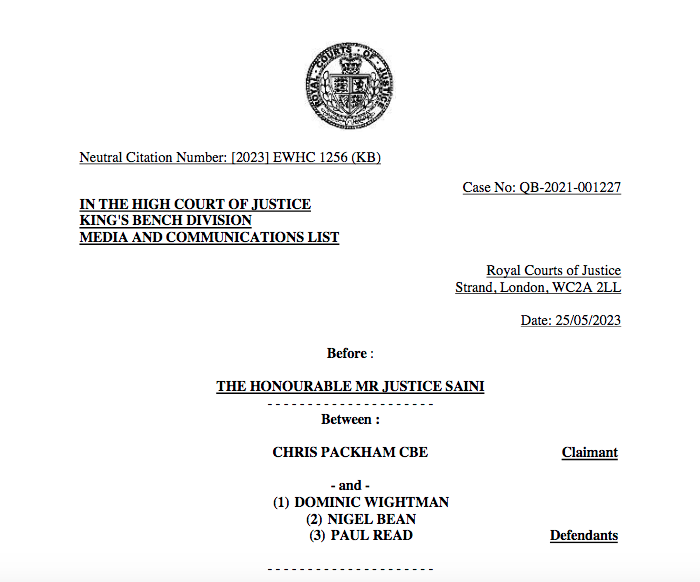
Between paragraphs 1 to 8, Mr Justice Saini provides an introduction to the overview:
- ‘This is the trial of a defamation claim in which the Claimant (“Mr Packham”), a naturalist, television presenter and campaigner, sues three individuals in respect of articles published on the website of an online publication called Country Squire Magazine (“CSM”), and by way of social media including Twitter. The claim concerns three separate and unrelated matters.
- The first concerns the tigers Girona, Mondo, Antonella, Natasha and Zoppa (“the Tigers”), that once performed in a Spanish circus (Circo Wonderland) but were later either “re homed” or “rescued” (depending on one’s perspective) and given what have been called “forever homes” in an animal sanctuary (“the Sanctuary”) on the Isle of Wight. The Sanctuary is associated with Mr Packham and is operated by the Wildheart Trust (“the Trust”). Mr Packham is a trustee of the Sanctuary. He is alleged to have made fraudulent statements during 2018 in order to raise money from the public to fund the Tigers’ journey from Spain to the Sanctuary, and for their subsequent care in their new home. This was the focus of the trial. I will call this the “Circus Big Cats Allegation”.
- The second subject of the claim is a statement made by Mr Packham to raise money from the public for the Sanctuary during the Covid-19 Pandemic in March 2020. He is alleged to have acted fraudulently in concealing insurance payments, or availability of insurance, from potential donors which made such a statement misleading and dishonest by omission. I will call this “the Insurance Allegation”.
- The third subject is a statement made by Mr Packham, during COP26 in Glasgow in November 2021, which concerned Muirburns. A Muirburn is the Scottish term for the practice of burning off old heather to encourage new growth. Mr Packham is said to have falsely stated that this practice has the effect of burning peat below the heather, thereby releasing harmful carbon into the atmosphere. I will call this “the Muirburn Allegation”.
- On its website, CSM describes itself as “a platform for voices from the overlooked Great British Countryside” and professes a hope “to be a beacon for Truth in a world where moral relativists often have the loudest voices.” In broad terms, CSM’s slant is pro-field sports and before me has been called a voice for “traditional” countryside management. It has
previously published articles critical of Mr Packham and those who share his views on animal welfare and nature conservation issues. - The First Defendant (“Mr Wightman”, or “D1”) is the editor of CSM. He accepts responsibility for each of the publications, including those made by social media. Mr Wightman is an asset manager by profession. He explains that CSM was set up as an online magazine in 2016 by him and two other “Brexiteers” to illuminate what they perceived as the injustice of the undemocratic positions taken by some “Remainers” at that time, and to partake in the campaign to see through the national referendum result, using “the cloak of the Brexit-voting ‘countryside’ to help achieve its aims”. He describes CSM and himself as “conservative”. CSM is said to be principally focussed on current affairs and politics with about a fifth of its articles covering countryside issues. He described the magazine as a “humble blog”. That said, on his own evidence, certain of the articles in issue in these proceedings were read by numbers going into the 170,000s on Facebook.
- The Second Defendant (“Mr Bean”, or “D2”) is an IT consultant. Together with Mr Wightman, he accepts responsibility for the publications in CSM attributable to him and all his social media postings.
- The Third Defendant (“Mr Read”, or “D3”) is a retired computer programmer. He puts in issue any legal responsibility for the publications. He argues that he acted as a form of “proof-reader” in relation to the First to Fourth Articles and not as an author or editor of them. Although he was named in the by-line to these articles, together with D2, he says that was a decision made by D1 and D2, by way of a “thank-you” gesture to reflect his free proof-reading assistance. D3 says it was not reflective of any wider responsibility or role in drafting or making publication decisions. He admits sending the retweets pleaded against him but raises a number of defences to liability.’
Paragraphs 205 to 207 set out the judge’s decision on the amount of damages to be awarded against defendants one and two and a conclusion on liability for the libels:
- I turn to quantum. I was referred to a number of awards in other cases involving imputations of dishonesty. Each case must however depend on its own facts and I am not limited by the cap which Mr Packham placed on the amount sought in his Claim Form. Having regard to the data before me as to the extent of publication, the nature of the allegations, the attempt to seek his dismissal from the BBC through making them, the evidence of Mr Packham as to the effect on him, and my findings as to additional conduct, I award the sum of £75,000 in respect of the Circus Big Cats Allegation. I award £10,000 in respect of the Insurance Allegation, and £5,000 in respect of the Muirburn Allegation. Those allegations are less serious in context and were not the subject of repetition. I also bear in mind the need to ensure that any overall damages award is proportionate given that free speech interests are implicated.
XI. Conclusion - Mr Packham’s defamation claims against Mr Wightman and Mr Bean succeed. Mr Packham did not commit any acts of fraud or dishonesty. I will enter judgment for damages against Mr Wightman and Mr Bean in the sum of £90,000.00. I understand that they do not oppose injunctive relief.
- The claims against Mr Read are dismissed. I will hear further argument in relation to additional relief including orders under section 12(1), and section 13(1), of the Defamation Act 2013, and in relation to costs.
Chris Packham was represented by counsel Jonathan Price and Claire Overman.
Paul Read’s defence as advocated by Mr David Price KC is analysed and evaluated by the judge between paragraphs 53 and 76 and while the arguments are specific to the circumstances and facts of this case, the ruling could be influential to libel defendants in the future arguing that they were proof-readers and not authors or editors of online publications and the issue of serious harm in relation to retweets.
Sam Brookman has analysed the ruling for the Law Column of Hold The Front Page from the aspect of best journalistic practice to approach the subject of a story for their comment prior to publication. She concludes:
‘Whilst this case came down to more than the Defendants’ failure to approach Mr Packham for comment, in other cases such a failure could very well be the deciding factor for the public interest defence.
Every journalist is aware that best practice demands you should approach the subject of an article for comment prior to publication, and provide them with a reasonable amount of time in which to respond. Of course, commercial pressures will often mean that taking the time to make that approach for comment is not easy – after all, news is a “perishable commodity” – but if you don’t, make sure you have an exceptionally good reason for not doing so.’
Law Column: Approaching for comment, the Public Interest defence, and the Packham case
by Sam Brookman Published 13 Jun 2023. See: https://www.holdthefrontpage.co.uk/2023/news/law-column-approaching-for-comment-the-public-interest-defence-and-the-packham-case/
Coverage by mainstream media
BBC News- ‘Chris Packham wins libel claim against website’ see: https://www.bbc.co.uk/news/uk-england-hampshire-65707076
Guardian- ‘Chris Packham awarded £90,000 damages in libel case. Naturalist wins claim over articles on Country Squire Magazine website that accused him of lying about charity’ see: https://www.theguardian.com/uk-news/2023/may/25/chris-packham-wins-libel-claim-against-website-that-accused-him-of-lying
Mail Online- “Triumphant Chris Packham calls for tougher punishment for ‘online abuse and hate crimes’ as he wins £90,000 libel battle over claims he ‘manipulated’ the public into donating to wildlife charity” see: https://www.dailymail.co.uk/news/article-12124575/Chris-Packham-calls-tougher-punishments-victims-online-abuse-hate-crimes.html
High Court judge stops high profile defamation action and criticises the claimant saying ‘witness statements in litigation are not to be used for settling scores or advancing some wider agenda.’ (Court ruling 7th June 2023)
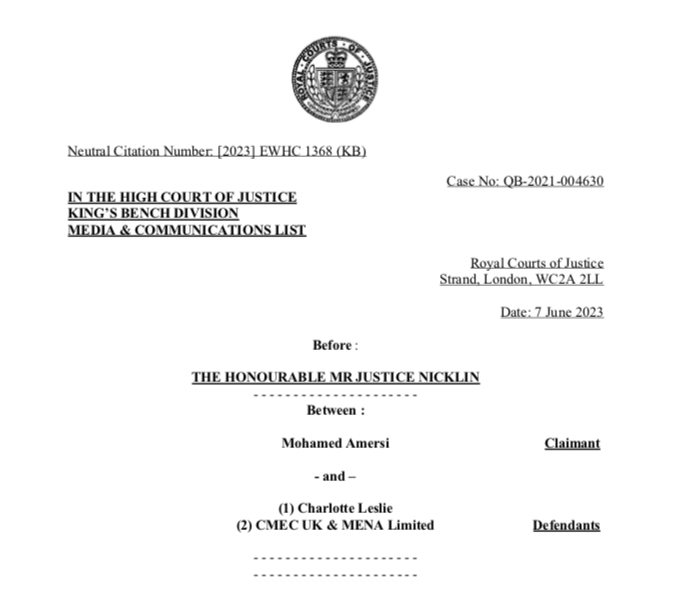
Mr Justice Nicklin is the head of the High Court media list and in Amersi v Leslie and others, he said the litigation brought by businessman Mohamed Amersi claiming his reputation had been seriously harmed by publication of memos to a former lord chancellor, Sir David Lidington, was ‘fanciful and devoid of reality.’
He observed: ‘The claimant’s case of serious harm to his reputation is not based on any properly premised inference. It is speculative and optimistic guesswork.’
108 page ruling of Amersi v Leslie & Anor [2023] EWHC 1368 (KB) (07 June 2023) available at https://www.judiciary.uk/wp-content/uploads/2023/06/Amersi-v-Leslie-judgment-070623.pdf
And:
Amersi v Leslie & Anor [2023] EWHC 1368 (KB) (07 June 2023)
Media coverage:-
Guardian: ‘Conservative donor has defamation case against Tory MP struck out. Mohamed Amersi criticised by high court judge for his conduct in proceedings against Charlotte Leslie.’ See: https://www.theguardian.com/politics/2023/jun/07/conservative-donor-has-defamation-case-against-tory-mp-struck-out
Independent: ‘Millionaire Tory donor’s libel action against ex-MP thrown out in ‘landmark’ ruling. Exclusive: Verdict comes after long-running legal battle between multi-millionaire donor and former Tory MP.’ See: https://www.independent.co.uk/news/uk/home-news/tory-donor-press-freedom-mohamed-amersi-b2353216.html
Law Society Gazette: ‘High-profile defamation case dismissed by judge.’ See: https://www.lawgazette.co.uk/news/high-profile-defamation-case-dismissed-by-judge/5116258.article
This is a long and complicated ruling in terms of detail. The alleged libels were in memos. The judge described the parties in paragraphs 5 and 6.
(1) The parties
5. In the Particulars of Claim in this action, the Claimant describes himself as a “businessman and philanthropist”. The Claimant is the founder of the Conservative Friends of the Middle East and North Africa Limited, a company limited by guarantee, incorporated on 21 January 2021, which aims to promote a better relationship between the Conservative Party, the UK Government and the Middle East and North Africa (“COMENA”).
6. The First Defendant is a former member of Parliament and the managing director of the Second Defendant. The Second Defendant is a company limited by guarantee, incorporated in March 2019. According to evidence filed by the Defendants, however, the organisation, the Conservative Middle East Council (“CMEC”), has been in existence for over 40 years. It was established by the former Foreign Secretary, Lord Carrington, on the instruction of the then Prime Minister, Margaret Thatcher. Its purpose was to forge and maintain relationships between the Conservative Party and the Middle East and North Africa region and included organising events, debates, facilitating interaction between Conservative MPs and Middle Eastern embassies in the United Kingdom and arranging fact-finding missions to the region for Conservative MPs. CMEC is associated with, but no longer formally affiliated to, the Conservative Party.
The judge’s view on whether there had been serious harm to his reputation caused by the publication of the memos to Sir David Lidington is set out in paragraphs 191 and 192:
‘191. The case of serious harm to reputation caused by publication of the Memos to Sir David will be as evidentially hopeless at trial as it is now. There can be no real prospect of the position improving before trial and there is no material dispute of fact that would require to be resolved at trial. It has not been suggested by the Claimant that there is any real possibility of something turning up in disclosure. Sir David has refused to get involved and so the prospect that he will provide a witness statement for the Claimant must be somewhere between remote and nil. Even if the Claimant were, by use of a witness summons, to compel Sir David’s attendance at the trial of this claim to answer questions as to the impact that the publication of the Memos had on the reputation of the Claimant, Sir David has already made clear that he cannot now differentiate between harm caused by the Memos and subsequent press coverage of the Claimant. Had the Claimant approached Sir David for a witness statement when he received the 14 May Documents, that problem might have been overcome. This is perhaps one of the pitfalls of adopting what I have found to be a tactical approach to the conduct of these defamation proceedings adopted by the Claimant.
192. Overall, the Claimant’s case that his reputation has been seriously harmed (or is likely to be) as a result of publication of the Memos to Sir David Lidington is fanciful and devoid of reality. The Claimant’s case of serious harm to his reputation is not based on any properly premised inference. It is speculative and optimistic guesswork. Applying the merits test, the time has come to bring an end to this part of the Claimant’s claim. Allowing it to continue would not serve the overriding objective. Permission to amend is refused for the case of serious harm to reputation alleged to have been caused by Publications 3 and 4 to Sir David Lidington.’
Mr Justice Nicklin’s conclusion and criticism of the claimant can be seen at paragraphs 240 and 241:
‘240. Nevertheless, there are several aspects of the conduct of the Claimant – many of which were relied upon by the Defendants – that give real cause for concern as to (1) whether his pursuit of these proceedings has been genuinely to seek vindication rather than some other impermissible collateral purpose(s) and (2) whether he has sought to obtain this vindication at proportionate cost.
(1) First, the delay in commencing the defamation proceedings (and then taking almost the maximum permitted period to serve the claim) is inconsistent with a desire to seek prompt vindication. The Claimant had sufficient information to commence a libel claim, substantially in the form in which it has now been advanced, after receipt of the 14 May Documents. The failure to do so has not been adequately explained.
(2) Second, the Claimant has adopted an exorbitant approach to the litigation (including the Data Protection Claim) and has refused to provide information about his costs to the Court. When this defamation claim was finally commenced, it advanced multiple causes of action (including several to unidentified publishees) that substantially added to the complexity (and likely cost) of the proceedings without adding anything of tangible benefit that a more restrained approach to selection of the causes of action could not have achieved. A litigant suitably concerned about the costs of the litigation – having proper regard to the overriding objective – would not have acted in this exorbitant way. Given the overlap of defamatory meanings, the cost of pursuing multiple causes of action was likely to be wholly disproportionate to any benefit that the Claimant could legitimately achieve. Whilst conducting the proceedings in this manner, the Claimant has steadfastly refused to provide accurate information about his incurred costs to the Court (see [43] and [47]-[49] above), including on the ground that the information was confidential. It is difficult to treat that submission seriously when the Claimant was willing to share the figure of his costs with a journalist (for publication) (see [18] above).
(3) Third, in his interview with Mr Burgis, given at some point before 7 July 2021, the Claimant said that he intended to “take [the First Defendant] to the cleaners” and that once the Data Protection Action had been completed, he intended to commence a libel action. This demonstrates that, at least by early July 2021, the Claimant fully intended to bring a further claim against the Defendants for libel (which he did not finally serve until April 2022). Subjecting a person to successive civil claims can be a hallmark of abusive conduct: see Henderson -v- Henderson (1843) 3 Hare 100. Without good reason, a claimant is expected to bring all his/her civil claims against a defendant in one action. The Claimant could and should have brought his libel action when he commenced his Data Protection Action. The decision to proceed first with the Data Protection Claim was, I am satisfied, both deliberate and tactical. A claimant who was genuinely interested in vindication is unlikely to have delayed as the Claimant did. Pursuit of two sets of proceedings has also taxed the resources of the Court and the Defendants beyond what was justifiable.
(4) Fourth, the Claimant’s interviews in the media (particularly the Observer Article – see [23] above) – and some parts of his witness statements filed in these proceedings – strongly suggest that the Claimant has treated this libel action as providing him with an opportunity also to seek to embarrass (and possibly to punish) the Conservative Party for, as he perceives it, having wronged him. That is not a legitimate purpose of civil proceedings for defamation.
241. For the reasons I have explained, I do not need to resolve whether the Claimant has pursued this libel action for an impermissible collateral purpose. What I am entitled to conclude is that, by conducting the proceedings in the way I have identified, the Claimant has exhausted any claim he might have on the further allocation of the Court’s resources to this action. Although I have concluded that no purpose would be served by giving the Claimant a further opportunity to replead his claim, I am also satisfied that it would not serve the overriding objective to permit the Claimant to do so. As a result, this claim is at an end.’
Pdf file version of this briefing
UK government announced 13th June 2023 that ‘Judges will be given greater powers to dismiss lawsuits designed purely to evade scrutiny and stifle freedom of speech through government amendments to the Economic Crime and Corporate Transparency Bill.’
The government expained:
‘Definition of an economic crime SLAPP
For the purposes of section (Strategic litigation against public participation: requirement to make rules of court) a claim is a “SLAPP claim” if—
- the claimant’s behaviour in relation to the matters complained of in the claim has, or is intended to have, the effect of restraining the defendant’s exercise of the right to freedom of speech
- the information that is or would be disclosed by the exercise of that right has to do with economic crime
- that disclosure is or would be made for a purpose related to the public interest in combating economic crime
- any of the behaviour of the claimant in relation to the matters complained of in the claim is intended to cause the defendant—
- harassment, alarm or distress
- expense
- any other harm or inconvenience
- beyond that ordinarily encountered in the course of properly conducted litigation
SLAPPs legislation will only apply to England and Wales.
Coverage in UK media
Guardian: ‘UK judges to be given powers to dismiss oppressive Slapps lawsuits at early stage. Amendments to bill address concerns that strategic lawsuits against public participation stifle free speech.’ See: https://www.theguardian.com/law/2023/jun/13/uk-judges-to-be-given-powers-to-dismiss-oppressive-slapps-lawsuits-at-early-stage
Financial Times: ‘Judges in England to gain new powers in clampdown on abusive litigation. Long-awaited restrictions on ‘Slapp’ suits will cover only economic crime cases.’ See: https://www.ft.com/content/2a9607c5-c1be-47c8-8fcd-027b5cbf4c42
Hold The Front Page: ‘Editors welcome plan to protect journalists from ‘intimidating’ legal threats.’ See: https://www.holdthefrontpage.co.uk/2023/news/editors-welcome-plan-to-protect-journalists-from-intimidating-legal-threats/
A further development in the SLAPP issue took place in September 2023 when the UK government announced it was setting up a ‘task force’ to address the problems.
See: ‘Government-led task force launched to protect journalism from SLAPPs Culture Secretary Lucy Frazer writes for Press Gazette about a new task force to tackle the rise of SLAPPs.’
Press Gazette 13th September 2023 at: https://pressgazette.co.uk/media_law/government-led-task-force-protect-journalism-from-slapps/
It was reported that the task force would meet every two months and is expected to commission research to investigate the prevalence of SLAPPs against journalists, draw up plans for specialist training for judges and law professionals to help them recognise and throw out SLAPPs, and develop guidance to support journalists and publishers.
The Culture Secretary Lucy Frazer was quoted as saying: ‘The health of our democracy relies on journalists and investigators having the freedom to criticise the powers that be.’
The UK Government media release on the subject: ‘New plans to stop journalists being silenced by baseless lawsuits.’
See: https://www.gov.uk/government/news/new-plans-to-stop-journalists-being-silenced-by-baseless-lawsuits
The government claims: ‘New taskforce will build on work in Economic Crime Bill to ban SLAPPs in British courts. Journalists will be better protected exposing the crimes of powerful figures under plans for a new government-led taskforce to clamp down on obstructive and costly legal action designed to silence critics.’
News Group Newspapers for the Sun successfully defends privacy action to enable them to illustrate their investigation into a couple making substantial profits selling PPE to the government during the COVID pandemic.
A Court of Appeal ruling 19th May 2023 enabled the Sun newspaper and other publications such as the Mail Online and Private Eye Magazine to continue publishing images of Richard and Sarah Stoute while on holiday and in proximity to a villa in the Caribbean they have bought following the profits made by their company Full Support Healthcare Ltd selling PPE in government contracts.
Stoute & Anor v News Group Newspapers Ltd [2023] EWCA Civ 523 (19 May 2023)
See: https://www.bailii.org/ew/cases/EWCA/Civ/2023/523.html
Courts and Tribunals Judiciary judgments ‘May 19, 2023 Stoute and Stoute -v- News Group Newspapers Limited’ See: https://www.judiciary.uk/judgments/stoute-and-stoute-v-news-group-newspapers-limited/
Mr Justice Johnson’s ruling 17th January 2023 in favour of the Sun’s news website sustaining his refusal to restrain publication of two photographs of the Claimants arriving at a restaurant on a public beach and ‘the claimants are not likely to succeed at trial in showing that the publication of the two photographs involved a breach of a reasonable expectation of privacy.’ See: https://www.5rb.com/wp-content/uploads/2023/03/Judgment-for-Website-Stoute-v-News-Group-Newspapers-Ltd-.pdf
See 5RB’s analysis of this ruling and report of the Court of Appeal Outcome at: https://www.5rb.com/case/stoute-v-news-group-newspapers-limited/ and https://www.5rb.com/news/appeal-dismissed-in-stoute-v-ngn/
The Private Eye coverage has been online with the headline ‘Taking the PPE. Covid profiteering’ and printed in the Issue 1599 and the following articles have been published in the Sun and Daily Mail both in their printed editions and online:
Maill Online 1st and 2nd January 2023 ‘Frolicking at their Caribbean island hideaway: The couple who netted £2 billion from PPE contracts after their firm became the biggest beneficiary of NHS protective clothing deals.’ See: https://www.dailymail.co.uk/news/article-11590919/Couple-netted-2-billion-PPE-contracts-splash-Caribbean-surf.html
Sun 31st December 2022 and updated 5th January 2023 ‘LIVING IT UP Ex-nurse whose firm netted £2billion PPE contracts enjoys luxury life in Caribbean.’ See: https://www.thesun.co.uk/news/20909304/nurse-ppe-billions-caribbean/
Sun 7th January 2023 ‘HAPPE XMAS Ex-nurse and husband who pocketed billions from NHS PPE deals swig £250 bottles of fizz in winter Caribbean break.’ See: https://www.thesun.co.uk/news/20974181/nurse-husband-billions-nhs-ppe-caribbean-break/
In the Court of Appeal ruling Lord Justice Arnold explained at paragraph 1 the key legal issue to be decided:
‘The principal issue on this appeal is whether the Claimants (“Mr and Mrs Stoute”) have a reasonable expectation of privacy in respect of photographs taken of them by paparazzi on a public beach and published by the Defendant (“NGN”) in The Sun on Sunday. Mr Justice Johnson held for the reasons given in his judgment dated 17 January 2023 [2023] EWHC 232 (KB) that Mr and Mrs Stoute were unlikely to establish that they had a reasonable expectation of privacy, and he therefore refused Mr and Mrs Stoute’s application for an interim injunction to restrain further publication of the photographs pending the trial of Mr and Mrs Stoute’s claim for misuse of private information. Mr and Mrs Stoute appeal with permission granted by Warby LJ.’
In paragraphs 2 to 5, the ruling sets out the background of why the claimants became the subject of media interest:
‘The facts
- The following account of the facts is taken largely from the judge’s judgment, which in turn was based on two witness statements made by Mrs Stoute and the correspondence between the parties, NGN not having filed any substantive evidence. I have added a few details from Mrs Stoute’s statements.
- Mrs Stoute was formerly a nurse. In 2002 Full Support Health Care Ltd (“FSH”) was incorporated by Mrs Stoute and her parents to sell personal protective equipment (“PPE”) to NHS and private hospitals. It is now owned and run by Mr and Mrs Stoute. In the accounting period to March 2019, FSH’s profits were just over £800,000. In March to July 2020 there was a huge demand for PPE as a result of the Covid-19 pandemic. FSH secured government contracts worth about £2 billion.
- Mrs Stoute’s evidence is that, since 2021, there has been a lot of press interest in her, Mr Stoute and FSH, and that they have worked hard with their lawyers to protect their privacy. She says that, prior to the events giving rise to the present dispute, there were only a few photographs of them available online from the FSH website, from when she gave evidence to the Public Accounts Committee and in an article in The Sunday Times.
- In late 2021 Mr and Mrs Stoute bought a second home which abuts a public beach in Barbados. They also bought a boat. Mr Stoute’s family is from Barbados. Mr and Mrs Stoute have three children now aged 16, 18 and 23. On 26 December 2022 Mr and Mrs Stoute went to stay at their second home, together with their children, several adult friends and their friends’ children.’
Lord Justice Arnold’s 24 page ruling concludes at paragraph 65 and 66:
65. It follows that the judge made no error in concluding that it was unlikely that Mr and Mrs Stoute would be able to establish that they had a reasonable expectation of privacy in respect of the publication of the photographs. Even if he was wrong about that, however, he made no error in concluding that the balance of the risk of injustice favoured the refusal of an injunction. Counsel for Mr and Mrs Stoute submitted that the judge had failed correctly to apply PJS as to the effect of further publication of material that has already entered the public domain, but the judge directed himself in accordance with PJS. Given that the photographs had been published three times in two national newspapers, both in print and online, he was entitled to conclude that Mr and Mrs Stoute would suffer little additional irreparable damage in the event of further publication of them before trial and that the balance favoured refusal of an injunction.
Conclusion
- For the reasons given above I would dismiss this appeal. I would nevertheless endorse what the judge said at [37]:
Judgment Approved by the court for handing down. Stoute v NGN
“This does not mean that the defendant or others may publish any pictures of the claimants with impunity. It just means that the claimants have not established their case in respect of the application for an injunction that they have made. It is entirely possible that there are pictures in the possession of the defendant or others which would, if published, amount to an actionable tort.”’
PDF file of this briefing
High Court Judge Mrs Justice Collins Rice developed new legal ground in protecting the anonymity of crime suspects on 29th June 2023 by imposing an injunction against the BBC which prevents identification of a high national and international public profile person, referred to as WFZ, who is under active criminal investigation for serious criminal sexual offences.
The judge has issued the injunction on the main ground that the court is sure to a criminal standard of proof that there would be a substantial risk of serious prejudice to the administration of justice.
The judge made clear that she would have also granted the injunction on the basis that identification of the claimant by the BBC would have been a misuse of his private information since he has reasonable expectation of privacy about having been arrested and questioned in a police inquiry prior to being charged. This was the starting point for the UK Supreme Court ruling in ZXC in February 2022.

See: WFZ v British Broadcasting Corporation [2023] EWHC 1618 (KB) (29 June 2023)
at https://www.bailii.org/ew/cases/EWHC/KB/2023/1618.html
See full pdf file of ruling at https://www.bailii.org/ew/cases/EWHC/KB/2023/1618.pdf
The judge said it was exceptional that she had heard the case in private.
The BBC informed the court it intended to report that at least a quarter of businesses in the sector in which the Claimant works have had employees investigated by the police for serious sexual offences, yet despite this the sector does not have any policies or procedures for employees who are accused of violence against women, nor any consistency of approach to allegations.
The reports would also use the Claimant’s case ‘as a stark illustration of these issues‘. The BBC was going to report the Claimant has been investigated by the police and arrested in respect of the allegations, since it is important to explain that his employer knows that this is the position and has taken no action.’
The summary of the background in paragraphs 5 to 7:-
- The Claimant is a man with a high public profile.
- On 5th June 2023, a journalist in the BBC’s News Investigation team, wrote him a ‘Right of Reply’ letter about an investigation the BBC had conducted into sexual misconduct allegations against him. It said they had spoken to a number of women who had given detailed accounts of behaviour by him including the commission of serious sexual offences. It said they intended to identify him in their reporting of this investigation. Although none of the complainants had agreed to be identified in the report, information about dates and places was provided to enable the Claimant to identify them. The letter set out the content of the allegations of four identifiable complainants, in brief, but explicit, form. It also referenced information provided by friends of the complainants and others. It recorded that the Claimant had been arrested in relation to allegations made by two of the complainants and interviewed under caution in relation to those of a third, and that police investigations were continuing.
- The Claimant thereupon sought an urgent interim non-disclosure injunction, without having issued an application or claim.
The Claimant was granted the interim injunction by Mr Justice Nicklin 8th June pending hearing the parties before Mrs Justice Collins Rice.
The key factor in deciding whether to grant an injunction on the grounds of protecting the claimant’s reasonable expectation of privacy is whether ‘he will probably (‘more likely than not’) succeed at the trial. In general, that should be the threshold an applicant must cross before the court embarks on exercising its discretion, duly taking into account the relevant jurisprudence on article 10 and any countervailing Convention rights.’
The Judge drew on two aspects of the recent UK Supreme Court ruling in ZXC, one of which was at paragraph 13 of her ruling:
…the UKSC’s confirmation, at [146], that ‘as a legitimate starting point, a person under a criminal investigation has, prior to being charged, a reasonable expectation of privacy in respect of information relating to that investigation…’. The nature of and rationale for that proposition are considered in more detail at [64]-[73]. Its rationale is that ‘publication of such information ordinarily causes damage to the person’s reputation together with harm to multiple aspects of the person’s physical and social identity such as the right to personal development, the right to establish and develop relationships with other human beings and the outside world all of which are protected by article 8 of the ECHR… The harm and damage can on occasions be irremediable and profound.’. That rationale, and the ‘negative effects of publishing information that a person is under criminal investigation’ and the ‘resulting uniform general practice’, are further expanded on at [80]-[89]. But the Court emphasised that it is a general rule or legitimate starting point only, not a legal rule or presumption; it does not replace the need for evidence and for fact-specific inquiry in every case. And much may turn on what the information and the investigation are about, and in particular how far they include information of an ‘intimate and personal nature’.’
Between paragraphs 17 and 27, the judge explored the previous case law concerning contempt of court. The potential legal ground for issuing the injunction would be derived from the 1981 Contempt of Court Act’s strict liability rule that a contemptuous media publication would have to be a substantial risk of serious prejudice to justice and Article 6 of the Human Rights Act and European Convention which protects the right to a fair trial.
At paragraph 27 she explained: ‘The authorities are in any event clear that courts should be slow to grant injunctions restraining contempt of court on a quia timet (prospective) basis. ‘It is the wise and settled practice of the courts not to grant injunctions restraining the commission of a criminal act – and contempt of court is a criminal or quasi-criminal act – unless the penalties available under the criminal law have proved to be inadequate to deter the commission of the offences’ (Pickering v Liverpool Daily Post at 381-2). Again, ‘… the courts should not award him such an injunction except in a clear case where there would manifestly be a contempt of court for the publication to take place’ (A-G v BBC [1981] AC 303 at 311-2).’
The judge said the case was active in terms of criminal proceedings because at paragraphs 33 and 34:
‘Police arrested the Claimant in 2022 on suspicion of a serious sexual offence following one of the complainants’ allegations. They released a statement to the media identifying the offence. The Claimant was not identified but the place of his arrest was. They later released another statement saying he had been further arrested on suspicion of two serious sexual offences alleged to have been committed against a different woman. The Claimant was bailed shortly afterwards. The police later confirmed it was taking no further action in relation to one of the alleged offences.
The police subsequently interviewed the Claimant under caution in relation to a third complainant, on suspicion of committing a sexual offence the year before. They issued a statement to that effect.’
The judge said at paragraph 51:
‘But the BBC naming the Claimant in connection with criminal investigations into allegations of serious sexual offending would undoubtedly be a substantial game- changer. The step up from rumour and gossip to a researched and substantiated breaking and rolling news item on a professional and edited national platform is one of orders of magnitude. The decision to identify would itself be a major and high-impact news story in its own right.’
The judge explained why she believes naming the claimant by the BBC in their reporting would be a contempt of court between paragraphs 66 and 70:
- The question I must start with is whether I can be sure that what I have called the bare minimum intended publication here – naming the Claimant in connection with his arrest and a police investigation into multiple allegations of (similar) serious sexual offending – is a publication which creates a substantial risk that the course of justice in the proceedings in question will be seriously impeded or prejudiced.
- My answer is that I can and must. This is a clear case. The risk that the course of justice in the criminal proceedings will be seriously impeded or prejudiced is substantial and manifest. The case is distinguished by the exceptional, and truly enormous, degree of publicity and public reaction I am entirely satisfied publication by the BBC would generate. It would be wholly naïve to proceed on any other basis and it was not seriously suggested that I should. I do not accept that that publicity could be managed satisfactorily or at all, including by any of the means indicated by the BBC. The identification of the Claimant in however a broad or allusive a manner in connection with the subject matter of its report would ignite a fire it could not hope to control and which would permanently disfigure him in the public mind. The BBC could not in the circumstances of this case avoid causal responsibility by pointing to others who may fan the flames of the fire it would deliberately have set. Even if responsible and regulated publishers reported nothing else at all over and above the bare minimum content the BBC proposes, the harm is inevitably done. The reality of modern public discourse must be faced. The BBC’s naming of the Claimant, not least because it is a national public service broadcaster, would inevitably be perceived as authorising unrestrained debate subject only to the anonymity of the complainants (which itself might be short-lived). That would bring into play all of the forensic problems set out above in an acute form, and risk irreparable harm to the forensic objectivity essential for any fair criminal trial.
- I am entirely satisfied on the evidence provided, and by reference to what I regard as its inevitable consequences, that the proposed publication creates a substantial risk that the course of justice in the live criminal proceedings currently under way will be seriously impeded or prejudiced by it. That is because, in the respects and for the reasons set out, I am satisfied it creates a substantial risk of impeding or prejudicing the necessary efforts to ensure that all the evidence, and only the evidence, properly forensically relevant to the trial of any criminal charges brought will be available to a jury. It consequently also creates a substantial risk of interfering with the proper making of the charging decisions themselves, depending as they do on the evidential prospects. I do not consider these risks capable of ultimately being mitigated by jury management or other measures in a way which would bring it below the substantial, because of the magnitude of the publicity and obloquy I am sure would be created by publication before the reporting restrictions attendant on post-charge proceedings have had a chance to be applied, and before any court apart from this one has had an opportunity to manage criminal proceedings in this case in a way which ensures they will be fair.
- I am therefore sure now, and that the Claimant would establish at trial, that the publication should not be allowed in a form which identifies him or enables him to be identified – that is to say, the publication of the ‘specified information’ which the BBC has undertaken until now not to publish – because to do so would amount to a contempt of court. It is not suggested that any further evidence of potential assistance to the BBC is likely to become available before a trial of the Claimant’s claim. Certainly, the course of the criminal proceedings themselves will continue to evolve, and the substance of the Claimant’s claim may be overtaken by events in due course. But that is not my concern on this application.
- In reaching my conclusion, I have had particular regard to the importance of the Convention right to freedom of expression, especially in the context of press freedom, and to the undoubted public interest in the subject matter of the proposed publication in general. The BBC has a story which brings a legitimate and serious issue of general public concern to attention. I intervene with great reluctance, and only to the extent that the BBC wishes to illustrate its story by identifying a man currently under arrest. In that respect alone, Parliament has provided that, on the facts I have before me, the press’s freedom to publish and the public’s ‘right to know’ are definitively outweighed by the powerful public interest in criminal justice, not least where very serious charges may be brought, and not least in the interests of obtaining justice for complainants if they are. That, as well as a suspect’s interests, is the public interest specifically protected by the Contempt of Court Act.
At paragraph 77, Mrs Justice Collins Rice confirmed in her ruling that if the injunction had not been granted on the ground she was sure publication would have been a substantial risk of serious prejudice and impedance to justice, she would have granted it on the grounds of reasonable expectation of privacy and the precedent set by ZXC in February 2022:
‘First, I have no hesitation in adopting the ZXC ‘starting point’ that there is a reasonable expectation of privacy in criminal allegations in the period between arrest and charge, for all the reasons set out in that case. I reject the BBC’s assertion that that starting point is of relevance only to a case in which, like ZXC itself, information has been obtained (a) in breach of confidence and (b) wholly as a result of criminal investigation by organs of the state. The former contention posits a necessary relationship between confidence and privacy which, for the reasons set out in ZXC itself, does not exist in law. I accept that the circumstances in which and the purposes for which any information comes into the hands of the publisher is a relevant Murray factor, and I consider that below. But I see no reason in law, principle or practice why the ZXC starting point is to be excluded unless breach of confidence is established. Its rationale, as explained in the case, is entirely independent of the origins of the information and is based on the consequences of identifying a suspect between arrest and charge and the harm it can do – harm and damage to human autonomy that ‘can on occasions be irremediable and profound’.’
Her decision was set out in paragraphs 89 and 90:-
- I grant the Claimant’s application to restrain publication of the information which has been subject to the BBC’s undertakings until now – that is, publication of the BBC’s report in a form which identifies him or enables him to be identified as the subject of active criminal proceedings.
- The BBC’s editorial choice is therefore either to publish its report now without identifying the Claimant, or to await charging decisions (either way) when a fully informed and balanced decision can be taken about the competing interests that might then be engaged. That is a fair and proper choice, and one to which it is rightly constrained by law.
What are the implications of this ruling for professional journalism?
The courts in England and Wales through judicial activism derived from the Human Rights Act and ECtHR jurisprudence have over the last 23 years severely limited the reach and possibilities of professional journalistic practice in covering crime and questionable moral conduct by public figures and stories which were regarded as being in the public interest- not just in terms of what interested the public- meaning their news and journalistic publication audiences.
The House of Lords ruling in Lewis v Telegraph in 1964 made it clear there could be no successful libel action taken against news publications which identified people helping the police with their enquiries and therefore being person suspect of and investigated for crime.
ZXC and other privacy cases subverted this precedent because reasonable expectation of privacy encompassed impact and damage to reputation by the very fact of publishing the truth of a police investigation and or arrest.
Media contempt law usually operated without the intervention of prior restraint injunctions.
Prosecution was only by the consent and at the behest of the Attorney General.
This would take place after publication deemed to have been judged prima facie as creating substantial risk of serious prejudice to the administration of justice.
Media contempt law had no tradition of being pursued and enforced by prior restraint injunction on the part of private claimants until now.
Mrs Justice Collins Rice engaged predictive and prospective reasoning for what she judged to have been a future media contempt that could only be convicted at some future trial according to the criminal standard of proof. That is a huge leap and reach of legal adjudication.
The judge made only one reference to what now appears to be a redundancy in respect of protection for the media in prior restraint interventions.
At paragraph 62 she observed ‘If a suspect is not charged – and if he has not yet been arrested – then the law of defamation is the principal restraint on publication and claimants face a high hurdle indeed at the interlocutory stage (the ‘rule in Bonnard v Perryman’ [1891] 2 Ch 269).’
The hurdle established in that case is a claimant will ordinarily be unable to obtain an interim injunction to restrain an apprehended alleged defamatory publication where a defendant states an intention to raise an affirmative defence.
But the developments in privacy law which telescope libel into privacy in terms of harm to reputation by the publication of true and false private information have surely circumvented this vital freedom of the press protection.
Media lawyers and academics have been discussing the death of the Bonnard v Perryman rule for some years now. See the 5RB publication online ‘How to get a libel injunction By Adam Speker KC’ at: https://www.5rb.com/article/libel-injunction/
WFZ did not seek an injunction in libel. He had no need to. As the judge explained, he would have succeeded in the context of the ZXC privacy regime. Now he has been successful in what I would suggest is an extension of prior restraint powers in media contempt law.
I would argue that the chilling effect on freedom of expression in professional journalism will be immense.
And the current furore over the high profile BBC presenter accused of paying a teenager for indecent images highlights the problem and mischief of legal restraint effectively censoring freedom of expression public knowledge exposing wholly innocent individuals and indeed groups of people to rumour and unfounded suspicion.
The law now allows WFZ to remain protected and anonymous in perpetuity should the police decide not to charge him with any offence.
This is also the case with ZXC. We shall never know if the huge time and resources deployed by the BBC and Bloomberg into long form investigative journalism served any purpose.
And if the public interest of their efforts, and like those of other journalistic publishers, is negated and obviated by no prospect of impactful publication as a result of legal restraint and apprehension of expensive litigation, then what is the point of their existence and their for public benefit inquiries?
Here lies the substantial deficit in democratic accountability and pressing social needs and purposes that arise when freedom of expression is subtracted and denuded in the equal balancing act with other rights extant in the Human Rights Act and European Convention.
Useful articles and additional references discussing this case.
Mail Online ‘Fresh fears about the gagging of the media arise after a ‘high public profile’ man wins a High Court bid for anonymity ahead of a BBC broadcast. The man won an interim injunction to prevent the BBC from identifying him.’ See: https://www.dailymail.co.uk/news/article-12253145/High-public-profile-man-wins-High-Court-bid-anonymity-ahead-BBC-broadcast.html
BBC and PA Media: “Court injunction stops BBC from naming ‘high profile’ man accused of sex offences. The judge acknowledged the BBC’s story was on ‘a legitimate and serious issue of general public concern.’” See: https://pressgazette.co.uk/media_law/bbc-stopped-naming-man-accused-sex-offences-high-court/
Informm Online: ‘High Court grants injunction to restrain publication of information concerning an arrest for sexual offences.’ See: https://inforrm.org/2023/06/29/news-high-court-grants-injunction-to-restrain-publication-of-information-concerning-an-arrest-for-sexual-offences/
Media Lawyer Eloise Spensley analysed the case for the Hold The Front Page Jaffa Law Column 11th July 2023 ‘High Court grants high profile injunction on grounds of contempt.’ See: https://www.holdthefrontpage.co.uk/2023/news/law-column-high-court-grants-high-profile-injunction-on-grounds-of-contempt/
She concluded: ‘The BBC is reportedly considering their position, so we may yet see this case come before the Court of Appeal. But an appeal carries its own risks, so there can be no certainty that an attempt will be made to overturn this High Court judgment. It would be fascinating to be able to eavesdrop on those deliberations, but as we all know, patience is a virtue. But whether there is an appeal or not, what the decision in WFZ shows is that the trend of giving anonymity to those being investigated by the police, continues apace. It’s all rather worrying.’
PDF file of media law briefing
The ruling of the European Court of Human Rights Grand Chamber on 4th July 2023 in Hurbain v Belgium is nothing short of a disaster for professional journalism and historians.
The court confirmed the decision of the 3rd Section lower Chamber that the right to be forgotten concept in Article 8 privacy can be extended to the anonymization of online newspaper archives. To do so is not a breach of Article 10 Freedom of Expression.
Hurbain v Belgium Grand Chamber ruling. Legal summary.
See: https://hudoc.echr.coe.int/#{%22itemid%22:[%22002-14115%22]}
Full ruling in English. See: https://hudoc.echr.coe.int/eng#{%22appno%22:[%2257292/16%22],%22itemid%22:[%22001-225546%22]}
Original first Chamber ruling HURBAIN v. BELGIUM – 57292/16 (Judgment : No Freedom of expression-{general} : Third Section) French Text [2021] ECHR 544 (22 June 2021)
See: https://www.bailii.org/cgi-bin/format.cgi?doc=/eu/cases/ECHR/2021/544.html
Previously, case law in Gonzales v Google Spain, at the EU’s European Court of Justice in 2014 had established the principle of such privacy protection to being limited to delisting of online data processing search engines. In the UK this was confirmed in UK domestic law in NT 1 and NT 2 v Google in 2018 where the parties seeking delisting were anonymised by court order in the litigation.
Biancardi v Italy in the first section ECtHR in 2021 extended the reach of privacy protection to ‘de-indexing’ of an online news site, which effectively means that on request individuals mentioned and referred to in news articles can make privacy requests, followed by litigation in the courts if necessary, for the removal of ‘tags’ in search engine optimisation.
The first ECtHR ruling in June 2021 in the Hurbain case (Patrick Hurbain was the editor of the Belgium newspaper Le Soir) was in favour of the doctor in Belgium known as G.
G had been under the influence of alcohol when he killed two people and injured three others by his driving in 1994. He was convicted in 2000 and received a suspended jail sentence of two years.
In Belgium law his criminal conviction was ‘rehabilitated’ by 2006. Le Soir published the electronic archive of the printed 1994 report in 2008.
The ECtHR judgment in 2021 sought to downplay the impact on journalism publishers.
In the last paragraph at 134 it stated: ‘The Court wishes to make it clear that the conclusion it reaches cannot be interpreted as implying an obligation for the media to check their archives systematically and permanently. Without prejudice to their duty to respect privacy during the initial publication of an article, it is for them, with regard to the archiving of the article, to carry out a verification and therefore to balance of rights at stake only in the event of an express request to this effect.’
The Grand Chamber ruling on July 4th 2023 tried to do something similar with an added legal opinion from Judge Frédéric Krenc (at page 86 and paragraphs 32 to 35 ) that he did not believe the judgment ‘sacrifice[s] press freedom in favour of an undue and dangerous focus on the right to respect for private life, by forcing news publishers to systematically anonymise their archives.’

The Grand Chamber ruling introduced the case at paragraph 1:
‘The present case concerns a civil judgment against the applicant, the publisher of the Belgian daily newspaper Le Soir, ordering him to anonymise, on grounds of the “right to be forgotten”, the electronic online version of an article in the archives which mentioned the full name of G., the driver responsible for a fatal road-traffic accident in 1994. In his application the applicant relied on Article 10 of the Convention.’
As with the judiciary in most European countries, including the UK, there is a strong argument that the majority of judges and lawyers engaged in media law and journalism rights do not fully understand the practical realities and principled exigencies and purposes of professional journalism in a democratic society.
The stubborn commitment to ‘the balancing exercise’ and the idea that rights must compete on equal terms in respect of freedom of expression with interference being judged to be ‘proportionate’ and ‘limited to what was strictly necessary’ is continually leading to the diminishing and decaying role of freedom of the media and expression in everyday life.
Unless the UK Parliament, or nation parliaments and assemblies in Scotland, Wales and Northern Ireland legislatively extend the qualified privilege in court and crime reports to privacy as well as libel, there is more than likely to be an exponential growth in formal requests for anonymising, and indeed removal of archive court and crime reports, backed up by litigation.
This is a major attack on the Open Justice principle since it posits the idea that truth is a diminishing law of return in the context of the passage of time. It loses its value retrospectively in favour of rehabilitation and the right of individuals with a criminal and questionable past not to be burdened by anyone seeking to find out about who they were and what they had said and done.
Philosophically, morally and indeed jurisprudentially it is extraordinary that judges should control history by adopting the postmodernist idea that identity is divorced from the past and something to be constructed through censorship.
It is a potential bonanza for the largely privatized and profit led media lawyer profession.
There is the likelihood that news publishers with free to access and subscription online archives, and indeed, library services, both public and commercial, which would include the British Library, will need to set up an infrastructure to receive right to be forgotten requests.
This will need to be backed up by a rational and legally reasonable and accountable adjudication decision-making process, and then the resources to defend potential litigation when anyone is unhappy with a refusal to de-list, anonymize or delete.
I raise the issue of deletion because as most litigation proceeds on the unique and particular circumstances of a case, it is virtually inevitable deletion of an entire archive article will be the next frontier in privacy litigation in the domestic courts of signatories to the ECHR convention and consequently to the ECtHR in Strasbourg.
The argument could well be made in relation to a crime or court report that redaction/anonymisation cannot effectively prevent identification, and/or the nexus of surrounding information will always lead to the identification of an individual seeking the right to be forgotten.
And might there also be a leap of this legal liability from the online and digitised platform to printed paper and written documentary form?
The ruling seriously impacts on the work of academic historians. How are they to navigate sources where past publication in the public interest is censored, redacted, and ‘fact mutilated?’
They may well enter the frame for potential litigation should their publications meet the similar threshold identified in Hurbain where the contested information- the identity of a convicted criminal responsible for killing two people in a road collision- supposedly ‘had no topical, historical or scientific interest’, was ‘not well known’, and the individual concerned had been caused ‘serious harm’ by the ‘virtual criminal record’ being continually available online for what was judged to be an excessive length of time since the original publication.
It is not as if the Grand Chamber judges had not been warned of the consequences of deciding Article 10 had not been breached.
There had been an intervention in the case from UK publishers Times Newspapers and Guardian News and Media and other press freedom organisations. They submitted that forcing news websites to remove archive material would not be a ‘proportionate restriction on freedom of expression,’ since this is an ‘essential component of modern-day newsgathering and reporting.’ See paragraphs 162 to 166 and pages 57 to 59 of the ruling
The potential mischief and negative impact of this case is shared by the NGO Article 19.
See ‘European Court of Human Rights: A blow to integrity of media archives’ See:
https://www.article19.org/resources/european-court-of-human-rights-a-blow-to-integrity-of-media-archives/
See Press Gazette ‘European Court extends ‘right to be forgotten’ from search engines to news sites’ at: https://pressgazette.co.uk/media_law/right-to-be-forgotten-hurgain-le-soir-echr/
PDF file of the media biefing
Jeremy Clarkson apologised for the content of his Sun column denigrating the Duchess of Suffolk, Meghan Markle, and the newspaper withdrew the article from publication and also apologised.
Yet the UK’s press self-regulatory body IPSO decided to investigate third party complaints from The Fawcett Society and The WILDE Foundation and adjudicated against the Sun on the ground of discrimination in clause 12 of the Editors’ Code on press standards.
It has sanctioned the publication of the adjudication.
The ruling, somewhat curiously, does not even mention Jeremy Clarkson by name.
See: 18626-22 The Fawcett Society and The WILDE Foundation v The Sun
Decision: Breach – sanction: publication of adjudication at: https://www.ipso.co.uk/rulings-and-resolution-statements/ruling/?id=18626-22

In conclusion it states:
‘… to argue that a woman is in a position of influence due to “vivid bedroom promises”, to compare the hatred of an individual to other women only, and to reference a fictional scene of public humiliation given to a sexually manipulative woman, read as a whole, amounted to a breach of Clause 12 (i). IPSO therefore found that the column included a number of references which, taken together, amounted to a pejorative and prejudicial reference to the Duchess of Sussex’s sex in breach of the Editors’ Code.’
The decision has drawn criticism as a worrying extension of press regulation to curtail and discipline the expression of opinion however offensive.
The article was headlined “One day, Harold the glove puppet will tell the truth about A Woman Talking Bollocks” and was published 17th December 2022.
The article also appeared online in substantially the same format, under the headline “One day, Harold the glove puppet will tell the truth about A Woman Talking B*****ks”. This version of the article was published 16th December 2022.
IPSO explained: ‘IPSO’s Regulations allow it to consider complaints from representative groups – i.e., a body or an organisation representing a group of people who have been affected by an alleged breach of the Code – where the alleged breach of the Code is significant and there is a substantial public interest in IPSO considering the complaint.’
The article said the following about the Duchess of Sussex:
“I hate her. Not like I hate Nicola Sturgeon or Rose West. I hate her on a cellular level.”
“At night, I’m unable to sleep as I lie there, grinding my teeth and dreaming of the day when she is made to parade naked through the streets of every town in Britain while the crowds chant, “Shame!” and throw lumps of excrement at her.”
It also included comments about the Duchess and her relationship with her husband:
“Along came Meghan, who obviously used some vivid bedroom promises to turn him into a warrior of woke. And now it seems she has her arm so far up his bottom, she can use her fingers to alter his facial expressions.”
The article then said that “younger people, especially girls, think she’s pretty cool. They think she was a prisoner of Buckingham Palace, forced to talk about nothing but embroidery and kittens.”
IPSO acknowledged the extent of mea culpas issued by Clarkson, who they refer throughout as ‘one of the newspaper’s regular columnists’ and who tweeted:
“Oh dear. I’ve rather put my foot in it. In a column I wrote about Meghan, I made a clumsy reference to a scene in Game of Thrones and this has gone down badly with a great many people. I’m horrified to have caused this much hurt and I shall be more careful in the future.”
IPSO recognised that the Sun removed the online version of the article on 19th December 2022 replacing it with Clarkson’s tweet and accompanied with the declaration: “In light of [columnist’s] tweet he has asked us to take last week’s column down”
The Sun published a further statement on 23rd December 2022, which was repeated in a January edition:
“In The Sun on December 17, [the columnist] wrote a comment article about the Duchess of Sussex. It provoked a strong response and led to a large number of complaints to IPSO, the independent press regulator.
In a tweet last week, [the columnist] said he had made a ‘clumsy reference to a scene in Game of Thrones’, which had ‘gone down badly with a great many people’ and he was ‘horrified to have caused so much hurt’. He also said he will be more careful in future.
Columnists’ opinions are their own, but as a publisher, we realise that with free expression comes responsibility.
We at The Sun regret the publication of this article and we are sincerely sorry.
The article has been removed from our website and archives. The Sun has a proud history of campaigning, from Help for Heroes to Jabs Army and Who Cares Wins, and over 50 years of working in partnership with charities, our campaigns have helped change Britain for the better.
Working with our readers, The Sun has helped to bring about new legislation on domestic abuse, provided beds in refuges, closed harmful loopholes in the law and empowered survivors of abuse to come forward and seek help.
We will continue to campaign for good causes on behalf of our readers in 2023.”
Across paragraphs 10 to 16 of the IPSO ruling The Fawcett Society was described as ‘a gender equality charity’ and had ‘made a complaint to IPSO about the article. It complained in its capacity as “an organisation that represents women and campaigns for women’s rights”. It further noted that it had “over 3000 members and over 17,000 supporters, on behalf of whom” the complaint was made.’ The WILDE Foundation was described as ‘a charity supporting women and girls who are survivors of domestic abuse and had ‘made a separate complaint about the article. It said that it had been asked to complain on behalf of its service users, as they felt that the article “allowed, perpetrated, and promoted [violence] toward a woman.”’
The Sun’s position was that it ‘did not accept that the article breached the Editors’ Code. The newspaper said that, while it had ultimately reached the decision to remove the article and apologise, the concerns raised by the complainants were a matter of “taste and judgment” – rather than a case where the Editors’ Code had been breached. It considered that the matter had already been dealt with effectively “as a matter of taste, not one of regulation”, noting its position that “matters of subjective taste are not for the Code.”’
The newspaper’s arguments are set out across paragraphs 18 to 22 of the ruling and the complainants between paragraphs 23 to 28.
The IPSO committee explained: ‘The Code acknowledges that the right to freedom of expression includes the right to shock and challenge, but it also provides protections for individuals from discrimination. The Committee set aside the question of whether the article was offensive; the question was only whether it breached the Code.’
The Committee found that ‘this was a pejorative and prejudicial reference to the Duchess of Sussex’s’ sex and upheld the complaint of a breach of Clause 12 (i) of the Editors’ Code.’
The Committee ‘did not uphold the complaint under Clause 12 that the article contained pejorative or prejudicial references to the race of the Duchess.’
The Committee also rejected the complaints under clause 3 Harassment and clause 1 accuracy.
IPSO decided to issue the sanction of publication of its adjudication because ‘the apology had not been published in a prominent position – appearing on page 6 – and did not address the references to the Duchess’ sex in the article which the Committee had found together represented a breach of Clause 12, which the publication had not accepted.’
In respect of the online publication IPSO observed: ‘the website itself did not include any form of acknowledgment or apology on the part of the newspaper for the column – this appeared only on the publisher’s corporate website, and so would not have been visible or easily accessible to the newspaper website’s usual readers.’
At the concluding paragraph 52 of the ruling IPSO declared:
‘The terms of the adjudication for publication are as follows:
The Fawcett Society and The WILDE Foundation complained to the Independent Press Standards Organisation that The Sun breached Clause 12 (Discrimination) in an article headlined “One day, Harold the glove puppet will tell the truth about A Woman Talking Bollocks”, published on 17 December 2022.
The complaint was upheld, and IPSO required The Sun to publish this adjudication to remedy the breach of the Code.
The article under complaint was written by one of the newspaper’s regular columnists, setting out his views on the Duke and Duchess of Sussex. The article said that the columnist: “hate[d] her on a cellular level”; listed her, Nicola Sturgeon, and Rose West as people that he hated; “dream[t] of the day when” the Duchess would be subject to public punishment; and referred to her using “vivid bedroom promises” on her husband.
The complainants said that Clause 12 had been breached because “[t]he acts described by the author in his column and the language used is inherently misogynistic and sexualised, pointing to gender-based discrimination”, and that the article included what they believed to be “[r]eferences to methods historically used to punish and publicly shame women”. They also said that making references to the hatred of other women linked the hatred of one woman with hatred towards other women.
The newspaper said that the article had fallen short of its high editorial standards, and that it had removed the column, after a request from the columnist to do so, and apologised. However, it did not accept that the article breached the Editors’ Code. It said that the concerns raised by the complainants were a matter of “taste and judgment” – rather than a case where the Editors’ Code had been breached.
The newspaper also said that the complainants had interpreted the Clause 12 too broadly, and that IPSO should not uphold a complaint by applying subjective value judgments held by particular people.
IPSO noted that The Editors’ Code doesn’t prevent criticism of public figures, even when it might seem mean-spirited or cruel. However, an article can be offensive or mean-spirited and also breach the Code. The Code protects the right to shock and challenge, but not to discriminate against individuals. IPSO therefore set aside the question of whether the article was offensive. The question was only whether it breached the Editors’ Code.
IPSO found that the article included a number of references to the Duchess’ sex. Specifically: the writer’s claim that the Duchess exercised power via her sexual hold over her husband which, in the view of the Committee, was a reference to stereotypes about women using their sexuality to gain power, and also implied that it was the Duchess’ sexuality – rather than any other attribute or accomplishment – which was the source of her power; a comparison with two other individuals – Nicola Sturgeon and Rose West – and the only clear common characteristic between the three being their sex and the writer’s “hate”; it highlighted her position as a specifically female negative role model by referring to the Duchess’s influence on “younger people, especially girls”; and the end-point of these references being a “dream” of humiliation and degradation.
IPSO considered that any of these references, individually, might not represent a breach of the Code. However, to argue that a woman is in a position of influence due to “vivid bedroom promises”, to compare the hatred of an individual to other women only, and to reference a fictional scene of public humiliation given to a sexually manipulative woman, read as a whole, amounted to a breach of Clause 12 (i).
IPSO therefore found that the column included a number of references which, taken together, amounted to a pejorative and prejudicial reference to the Duchess of Sussex’s sex in breach of the Editors’ Code.’
The significance of the ruling has been met with a range of journalistic coverage and comment.
Press Gazette 30th June 2023: ‘IPSO says Jeremy Clarkson’s Meghan Markle Sun column was sexist and breached Editors’ Code’ at: https://pressgazette.co.uk/the-wire/newspaper-corrections-media-mistakes-errors-legal/jeremy-clarkson-sun-column-meghan-markle-ipso-ruling/
Press Gazette 3rd July 2023: ‘IPSO faces backlash from publishers over Jeremy Clarkson ruling. The NUJ and Women in Journalism, however, said they welcomed the decision’ at: https://pressgazette.co.uk/media_law/fraser-nelson-spectator-ipso-sun-markle-jeremy-clarkson/
Spectator Editor Fraser Nelson argued 3rd July 2023: ‘The Clarkson ruling puts Ipso in violation of its own charter’ at https://www.spectator.co.uk/article/the-clarkson-ruling-puts-ipso-in-violation-of-its-own-charter/
Mick Hume argued at Spiked Online 4th July 2023: ‘The Jeremy Clarkson ruling is an outrageous attack on press freedom. IPSO’s ruling against his Sun column will empower the easily offended to meddle in our media’ at https://www.spiked-online.com/2023/07/04/the-jeremy-clarkson-ruling-is-an-outrageous-attack-on-press-freedom/
PDF File of media briefing
Secondary Media Law Codes and Guidelines
IPSO Editors’ Code of Practice in one page pdf document format https://www.ipso.co.uk/media/2032/ecop-2021-ipso-version-pdf.pdf
The Editors’ Codebook 144 pages pdf booklet 2023 edition https://www.editorscode.org.uk/downloads/codebook/codebook-2023.pdf
IMPRESS Standards Guidance and Code 72 page 2023 edition https://www.impress.press/wp-content/uploads/2023/02/Impress-Standards-Code.pdf
Ofcom Broadcasting Code Applicable from 1st January 2021 https://www.ofcom.org.uk/tv-radio-and-on-demand/broadcast-codes/broadcast-code Guidance briefings at https://www.ofcom.org.uk/tv-radio-and-on-demand/information-for-industry/guidance/programme-guidance
BBC Editorial Guidelines 2019 edition 220 page pdf http://downloads.bbc.co.uk/guidelines/editorialguidelines/pdfs/bbc-editorial-guidelines-whole-document.pdf Online https://www.bbc.com/editorialguidelines/guidelines
Office of Information Commissioner (ICO) Data Protection and Journalism Code of Practice 2023 41 page pdf https://ico.org.uk/media/for-organisations/documents/4025760/data-protection-and-journalism-code-202307.pd and the accompanying reference notes or guidance 47 page pdf https://ico.org.uk/media/for-organisations/documents/4025761/data-protection-and-journalism-code-reference-notes-202307.pdf
 UK Media Law Pocketbook Second Edition