


THE UK MEDIA LAW POCKETBOOK
by Tim Crook

Published by Routledge 30th November 2022
Chapter 7
Laws and rules for elections and politics
Elections, referendums and political journalism are subject to same primary and secondary media laws as any other event or sphere.
Understanding the separate criminal offence of making a false statement about a candidate’s character or conduct in order to influence voters. Lack of qualified privilege status for election addresses.
How qualified privilege applies to election ‘hustings.’ The law relating to exit polls on polling day.
The different legal obligation to broadcasters to be impartial and balanced in their election coverage, offering candidates and their parties to participate in election programmes and reports and the ban on presenters expressing their support for candidates during the election campaign.
If you are reading and accessing this publication as an e-book such as on the VitalSource platform, please be advised that it is Routledge policy for clickthrough to reach the home page only. However, copying and pasting the url into the address bar of a separate page on your browser usually reaches the full YouTube, Soundcloud and online links.
The companion website pages will contain all of the printed and e-book’s links with accurate click-through and copy and paste properties. Best endeavours will be made to audit, correct and update the links every six months.

Video-cast on Media Law of Elections and Politics
7.0 Key bullet points on UK media law when covering elections and politics
A downloadable sound file vocalizing key bullet points on the media law of UK elections
7.1 Coverage of the campaign
Online Links Printed Book
Page 198
CPS Legal Guidance on election offences
https://www.cps.gov.uk/legal-guidance/election-offences
Section 106 of the Representation of the People Act 1983 False statements as to candidates.
https://www.legislation.gov.uk/ukpga/1983/2/section/106
Watkins v Woolas [2010] EWHC 2702 (QB) (05 November 2010)
https://www.bailii.org/ew/cases/EWHC/QB/2010/2702.html
How the Chartered Institute of Journalists challenged the mayor of London and Greater London Authority for turning ‘purdah into Pravda’
https://cioj.org/thejournal/how-the-chartered-institute-of-journalists-challenged-the-mayor-of-london-and-greater-london-authority-for-turning-purdah-into-pravda/
7.2 Impartiality rules for broadcasters
Online Links Printed Book
Pages 200 and 201
Ofcom Broadcasting Code Section 6: Elections and referendums
https://www.ofcom.org.uk/tv-radio-and-on-demand/broadcast-codes/broadcast-code/section-six-elections-referendums
BBC Editorial Guidelines Section 10: Politics, Public Policy and Polls
https://www.bbc.co.uk/editorialguidelines/guidelines/politics/
Broadcast Bulletin Issue number 123 – 8 December 2008, The James Whale Show, Talksport, 20 March 2008, 22:00 (Page 6)
https://www.ofcom.org.uk/__data/assets/pdf_file/0031/46777/issue123.pdf
BBC Election Guidelines 2021
https://bbc.com/editorialguidelines/documents/may2021-electionguidelines.pdf
7.3 Coverage of polling day, counting and result
Online Links Printed Book
Page 202
Section 66A of the Representation of the People Act 1983
https://www.legislation.gov.uk/ukpga/1983/2/section/66A/2018-05-24
Electoral Commission Media Centre
https://www.electoralcommission.org.uk/media-centre
Electoral Commission Resources for Media made available during 2021
https://www.electoralcommission.org.uk/canolfan-cyfryngau/resources-media
7.4 Updates and stop press
UK General Election 2024
The broad explanation for applicable election law during the General Election is fully set out in the printed chapter of UK Media Law Pocketbook 2022 pages 195 to 203 of the printed paperback edition. See all the relevant links to resources and sound podcasting files of the chapter’s sections.
-o-
Ofcom’s role in a General Election (July 4th 2024) – what you need to know
The key regulatory principle is: ‘The highest level of due impartiality applies during the election period. During this period, political parties and independent candidates must be given due weight across a broadcaster’s TV and radio coverage.’
-o-
Ofcom published the following directive on 24th April 2024 ‘Broadcasters put on notice to maintain due impartiality ahead of General Election.’ See: https://www.ofcom.org.uk/tv-radio-and-on-demand/broadcast-standards/broadcasters-put-on-notice-to-maintain-due-impartiality-ahead-of-general-election/
Ofcom explained: Viewers and listeners have their say on politicians presenting TV and radio programmes; Audience feedback broadly supports existing ‘due impartiality’ rules in Broadcasting Code and Ofcom issues strengthened industry guidance on politicians as presenters rule.
New research underlines the significant value viewers and listeners place on due impartiality as Ofcom puts broadcasters on notice that they must maintain the highest editorial standards ahead of a General Election.
Following a series of decisions about programmes presented by politicians found in breach of Rules 5.1 and 5.3 of the Code – ‘a number of important learnings for broadcasters have been hardwired into strengthened industry guidance’
See: Section five: Due impartiality and due accuracy at: https://www.ofcom.org.uk/tv-radio-and-on-demand/broadcast-standards/section-five-due-impartiality-accuracy/
Key regulatory rules that licenced broadcasters must follow:
Meaning of “due impartiality”
“Due” is an important qualification to the concept of impartiality. Impartiality itself means not favouring one side over another. “Due” means adequate or appropriate to the subject and nature of the programme. So “due impartiality” does not mean an equal division of time has to be given to every view, or that every argument and every facet of every argument has to be represented. The approach to due impartiality may vary according to the nature of the subject, the type of programme and channel, the likely expectation of the audience as to content, and the extent to which the content and approach is signalled to the audience. Context, as defined in Section two: Harm and offence of the Code, is important.
Meaning of “matters of political or industrial controversy and matters relating to current public policy”
Matters of political or industrial controversy are political or industrial issues on which politicians, industry and/or the media are in debate. Matters relating to current public policy need not be the subject of debate but relate to a policy under discussion or already decided by a local, regional or national government or by bodies mandated by those public bodies to make policy on their behalf, for example non-governmental organisations, relevant international institutions, etc.
Meaning of “series of programmes taken as a whole”
This means more than one programme in the same service, editorially linked, dealing with the same or related issues within an appropriate period and aimed at a like audience. A series can include, for example, a strand, or two programmes (such as a drama and a debate about the drama) or a ‘cluster’ or ‘season’ of programmes on the same subject.
Meaning of “personal view” and “authored”
“Personal view” programmes are programmes presenting a particular view or perspective. Personal view programmes can range from the outright expression of highly partial views, for example by a person who is a member of a lobby group and is campaigning on the subject, to the considered “authored” opinion of a journalist, commentator or academic, with professional expertise or a specialism in an area which enables her or him to express opinions which are not necessarily mainstream.
Meaning of “matters of major political or industrial controversy and major matters relating to current public policy”
These will vary according to events but are generally matters of political or industrial controversy or matters of current public policy which are of national, and often international, importance, or are of similar significance within a smaller broadcast area.
Meaning of “undue prominence of views and opinions”
Undue prominence is a significant imbalance of views aired within coverage of matters of political or industrial controversy or matters relating to current public policy.
Meaning of “programmes included in any service…Taken as a whole”
Programmes included in any service taken as a whole means all programming on a service dealing with the same or related issues within an appropriate period.
-o-
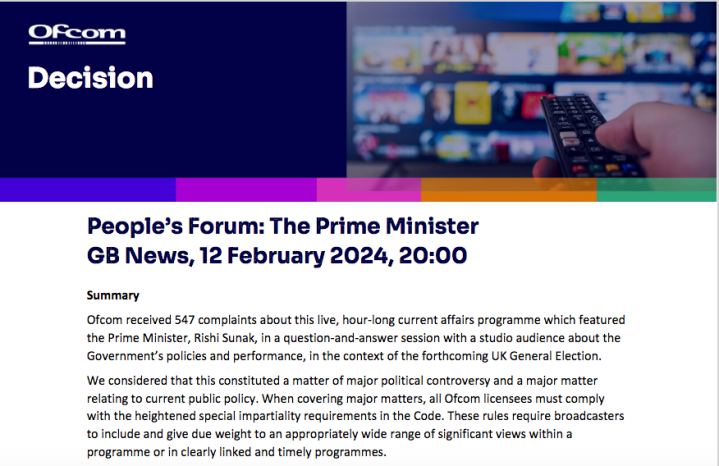
The strengthened guidance on due impartiality follows recent decisions on complaints- the most high profile released on 20th May 2024 relating to GB News in bulletin number 498 relating to ‘The People’s Forum: The Prime Minister’, broadcast 12th February 2024.
Ofcom received 547 complaints about this live, hour-long current affairs programme which featured the Prime Minister, Rishi Sunak, in a question-and-answer session with a studio audience about the Government’s policies and performance, in the context of the forthcoming UK General Election.
Ofcom found that an appropriately wide range of significant viewpoints was not presented and given due weight in this case. As a result, Rishi Sunak had a mostly uncontested platform to promote the policies and performance of his Government in a period preceding a UK General Election.
GB News failed to preserve due impartiality, in breach of Rules 5.11 and 5.12 of the Code.
Our decision is that this breach was serious and repeated. We will therefore consider this breach for the imposition of a statutory sanction.
See the full Ofcom ruling at: https://www.ofcom.org.uk/siteassets/resources/documents/about-ofcom/bulletins/broadcast-bulletins/2024/issue-498/peoples-forum-gb-news-12-february-2024.pdf
During 2023, Ofcom found that GB News had been in breach of due impartiality in its programming on five different occasions.
See Guardian news report: ‘Ofcom considers sanction against GB News for breaking impartiality rules. Regulator says channel breached rules by failing to sufficiently challenge Rishi Sunak’s views in February broadcast’ at: https://www.theguardian.com/media/article/2024/may/20/ofcom-considers-sanction-against-gb-news-for-breaking-impartiality-rules
See: BBC News: ‘GB News could face Ofcom punishment after breach’ at: https://www.bbc.co.uk/news/articles/cyxxlge97deo
GB News has launched legal proceedings against Ofcom, after the media regulator ruled earlier this week the channel had breached broadcasting rules.
In late May 2024, GB News said it had decided to launch formal legal action following the number of rulings against it made by Ofcom. It said Ofcom’s rulings ‘go against journalists and broadcasters rights to make editorial judgements in line with the law.’ See BBC News report: ‘GB News launches legal action against Ofcom’ at: https://www.bbc.co.uk/news/articles/c800pk00d75o
-o-
BBC Editorial Guidelines for elections held 2nd May 2024. See: https://www.bbc.co.uk/editorialguidelines/documents/2024-local-election-guidelines.pdf
BBC Editorial Guidelines for General Election held 4th July 2024. See: https://www.bbc.co.uk/editorialguidelines/documents/2024generalelectionguidelines.pdf
The Electoral Commission UK Parliamentary general election media guide for 4th July 2024. See: https://www.electoralcommission.org.uk/uk-parliamentary-general-election-media-guide
Setting out relevant electoral law and process in detail for England, Wales and Scotland.
The Electoral Commission UK Parliamentary general election 4th July 2024 media guide for Northern Ireland. See: https://www.electoralcommission.org.uk/uk-parliamentary-general-election-2024-media-guide-northern-ireland
Setting out relevant electoral law and process in detail for Northern Ireland.
Secondary Media Law Codes and Guidelines
IPSO Editors’ Code of Practice in one page pdf document format https://www.ipso.co.uk/media/2032/ecop-2021-ipso-version-pdf.pdf
The Editors’ Codebook 144 pages pdf booklet 2023 edition https://www.editorscode.org.uk/downloads/codebook/codebook-2023.pdf
IMPRESS Standards Guidance and Code 72 page 2023 edition https://www.impress.press/wp-content/uploads/2023/02/Impress-Standards-Code.pdf
Ofcom Broadcasting Code Applicable from 1st January 2021 https://www.ofcom.org.uk/tv-radio-and-on-demand/broadcast-codes/broadcast-code Guidance briefings at https://www.ofcom.org.uk/tv-radio-and-on-demand/information-for-industry/guidance/programme-guidance
BBC Editorial Guidelines 2019 edition 220 page pdf http://downloads.bbc.co.uk/guidelines/editorialguidelines/pdfs/bbc-editorial-guidelines-whole-document.pdf Online https://www.bbc.com/editorialguidelines/guidelines
Office of Information Commissioner (ICO) Data Protection and Journalism Code of Practice 2023 41 page pdf https://ico.org.uk/media/for-organisations/documents/4025760/data-protection-and-journalism-code-202307.pdf and the accompanying reference notes or guidance 47 page pdf https://ico.org.uk/media/for-organisations/documents/4025761/data-protection-and-journalism-code-reference-notes-202307.pdf
 UK Media Law Pocketbook Second Edition