


UK Media Law Pocketbook Second Edition published 30th November 2022
By Tim Crook
Media Law is one of the most dynamic areas of the UK’s legal systems. There are continual changes in case and statutory law. This chapter tries to keep you up-to-date so far as possible. Each addition to the foregoing online chapters will be copied here chronologically.
If you have decided to enter the profession of journalism and do your very best to report accurately and fairly without fear or favour and to navigate the increasingly treacherous waters of UK media law, you have the author’s admiration and thanks.
You are a true agency of democracy, open justice and holding power to account. You work in the spirit of the proverb carved into the granite of the Central Criminal Court- ‘Defend the children of the poor and punish the wrongdoer’- Line 4 of Psalm 72 Deus, judicium of the Old Testament.
Other lines 5-7 from Psalm 72 are compliments and tributes to the good people of journalism through the ages:
‘They shall fear thee, as long as the sun and moon endureth, from one generation to another.
He shall come down like the rain upon the mown grass, even as the drops that water the earth.
In his time shall the righteous flourish; yea, and abundance of peace, so long as the moon endureth.’
-o-
If you are reading and accessing this publication as an e-book such as on the VitalSource platform, please be advised that it is Routledge policy for clickthrough to reach the home page only. However, copying and pasting the url into the address bar of a separate page on your browser usually reaches the full YouTube, Soundcloud and online links.
The companion website pages will contain all of the printed and e-book’s links with accurate click-through and copy and paste properties. Best endeavours will be made to audit, correct and update the links every six months.

United Kingdom gains three places in 2024 world press freedom index.
There has been some moderately good news in the United Kingdom’s evaluation for press and media freedom by Reporters Without Borders in their 2024 global press freedom index.
See detailed briefing at: https://kulturapress.com/2024/05/07/united-kingdom-gains-three-places-in-2024-world-press-freedom-index/
And pdf file version below.
Update for Chapters 1 and 3- UK Supreme Court confirms case law precedent that all crime suspects are entitled to reasonable expectation of privacy anonymity 16th February 2022
It is a highly significant ruling by UK Supreme Court Justices in Bloomberg LP (Appellant) v ZXC (Respondent)
Lord Reed, Lord Lloyd-Jones, Lord Sales, Lord Hamblen, Lord Stephens presiding.
From the court’s press summary:-
The Respondent (“ZXC”) is a US citizen who worked for a company which operated overseas. He and his employer were the subject of a criminal investigation by a UK Legal Enforcement Body (the “UKLEB”). During that investigation, the UKLEB sent a confidential Letter of Request (the “Letter”) to the authorities of a foreign state seeking, among other things, information and documents relating to ZXC. The Letter expressly requested that its existence and contents remain confidential.
The Appellant (“Bloomberg”), a well-known media company, obtained a copy of the Letter, on the basis of which it published an article reporting that information had been requested in respect of ZXC and detailing the matters in respect of which he was being investigated. After Bloomberg refused to remove the article from its website, and following an unsuccessful application for an interim injunction, ZXC brought a successful claim against Bloomberg for misuse of private information.
ZXC claimed that he had a reasonable expectation of privacy in relation to: (1) the fact that the UKLEB had requested information relating to him in the context of its investigations, and (2) the details of the matters that the UKLEB was investigating in relation to him. The first instance judge held that Bloomberg had published private information that was in principle protected by article 8 of the European Convention on Human Rights (the “ECHR”); and that in balancing ZXC’s rights against those of Bloomberg under article 10 ECHR, the balance favoured ZXC. Bloomberg’s appeal against that judgment was dismissed by the Court of Appeal. Bloomberg now appeals to the Supreme Court.
Judgment
The Supreme Court unanimously dismisses the appeal. It holds that, in general, a person under criminal investigation has, prior to being charged, a reasonable expectation of privacy in respect of information relating to that investigation. Lord Hamblen and Lord Stephens give the sole joint judgment, with which the other Justices agree.
Full bailii.og ruling on this link: United Kingdom Supreme Court >> Bloomberg LP v ZXC [2022] UKSC 5 (16 February 2022 )

The full UK Supreme Court case resources page for Bloomberg LP (Appellant) v ZXC (Respondent)
The full ruling in Bloomberg v ZXC as downloadable pdf file
bloombergvzxcuksc-2020-0122-judgment
Reaction and analysis:-
Press Gazette reports: ‘Bloomberg Supreme Court defeat means criminal suspects have media anonymity before charge.‘
Hold The Front Page report: ‘The Society of Editors has hit out after the UK Supreme Court ruled that a person under criminal investigation has a reasonable expectation of privacy prior to charge.’
Guardian reports: ‘Bloomberg loses landmark UK supreme court case on privacy. Media will find it harder to publish information about people in criminal investigations.’
5RB report and analysis of ‘Supreme Court judgment on criminal suspects’ privacy rights: ZXC v Bloomberg.’
Sun newspaper Editorial: ‘Decision to protect the privacy of ALL suspects puts public in far greater danger.’
Update for Chapter 4 The legal jeopardy for journalists when arrested while covering news events in the UK.
The widespread criticism of arrests by Hertfordshire police of journalists and photographers covering Just Stop Oil protests, including an LBC/Global reporter is an opportunity to explore the law and ethics over reporters’ rights when covering stories of this kind.
What are the rights of journalists if wrongfully stopped from doing their job by the police, and even worse arrested for doing so?
This does not constitute qualified legal advice, but journalists should always have direct contact with their employer’s lawyers or professional legal advice in the event of arrest while carrying out their work.
It is also recommended that professional journalists covering public news events are members of professional journalist organisations such as the National Union of Journalists (NUJ), Chartered Institute of Journalists (CIoJ) or British Association of Journalists (BAJ).
The UK National Police Chiefs’ Council accredited Press Card states categorically ‘The National Police Chiefs’ Council recognise the holder of this card as a bona fide newsgatherer.’
Furthermore the College of Policing guidance on media relations (updated for 2022) states under the heading ‘Reporting from a scene’:-
‘Reporting or filming from the scene of an incident is part of the media’s role and they should not be prevented from doing so from a public place. Police have no power or moral responsibility to stop the filming or photographing of incidents or police personnel. It is for the media to determine what is published or broadcast, not the police. Once an image has been recorded, the police have no power to seize equipment, or delete or confiscate images or footage, without a court order.’
College of Policing guidance is available online at: https://www.college.police.uk/app/engagement-and-communication/media-relations
The largest police force in the UK is the Metropolitan Police in London who have an online public declaration of media rights for journalists and members of the public and what they expect their officers to understand and comply with at: https://www.met.police.uk/advice/advice-and-information/ph/photography-advice/
‘Freedom to photograph and film
Members of the public and the media do not need a permit to film or photograph in public places and police have no power to stop them filming or photographing incidents or police personnel.
Creating vantage points
When areas are cordoned off following an incident, creating a vantage point, if possible, where members of the media at the scene can see police activity, can help them do their job without interfering with a police operation. However, media may still report from areas accessible to the general public.
Identifying the media
Genuine members of the media carry identification, for instance the UK Press Card, which they will present on request.
The press and the public
If someone distressed or bereaved asks the police to stop the media recording them, the request can be passed on to the media, but not enforced.
Access to incident scenes
The Senior Investigating Officer is in charge of granting members of the media access to incident scenes. In the early stages of investigation, evidence gathering and forensic retrieval take priority over media access, but, where appropriate, access should be allowed as soon as is practicable.’
Apologies to journalists by Hertfordshire Police and independent review of what happened
Hertfordshire Police instituted an independent review of the arrests of journalists covering the Just Stop Oil protests which was carried out by the Cambridgeshire Constabulary. It concluded that the journalists should not have been arrested. The Chief Constable of Hertfordshire Police directly apologised to the arrested journalists.
M25 arrests review See: https://www.herts.police.uk/news/hertfordshire/news/2022/november/m25-arrests-review/
Chief Constable Charlie Hall said: ‘“Whilst the review has correctly concluded that the arrests of the journalists were not justified, and that changes in training and command need to be made, it found no evidence to indicate that officers acted maliciously or were deliberately disproportionate. They made mistakes and I now reiterate my apologies.’
As a result of the review Hertfordshire Police accepted five recommendations:
1.Hertfordshire Constabulary should consider selecting commanders with commensurate skills and experience when balanced against the nature of the operation.
2.Hertfordshire Constabulary should consider ensuring that mentors collate with commanders for the duration of the operation.
3.Hertfordshire Constabulary should consider ensuring that all commanders have access to Public Order Safety (POPS) advisors.
4.Hertfordshire Constabulary should consider affording commanders with the ability and capacity to maintain accurate decision logs.
5.Hertfordshire Constabulary should consider ensuring that all officers engaged with public order activity complete the NUJ package and identified learning is shared.
Legislative change to the new Public Order Act in 2023 to protect journalists from arrest when covering public protests
An amendment in the House of Lords to the Public Order Act 2023 passed on 7th February 2023 introduced statutory safeguards protecting journalists from arrest when observing or reporting on the type of protests carried out by climate change activists.
The aim has been to separate in law the professional work of journalists of merely being there to report from any suspicion or belief on the part of the police that by doing so they are conspiring or participating in ‘direct political action’ that is so disruptive as to amount to actual public order offences.
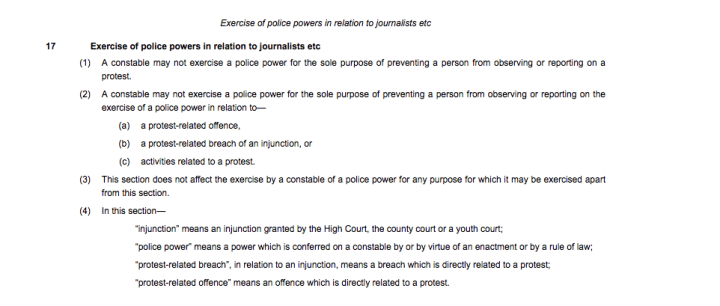
Section 17 under subsection (1) states the police may not use their powers ‘for the sole purpose of preventing a person from observing or reporting on a protest.’
Subsection (2) prevents the police from using their powers for the sole purpose of preventing a person from observing or reporting on the exercise of a police power in relation to:
(a) a protest-related offence,
(b) a protest-related breach of an injunction, or
(c) activities related to a protest.
These safeguards were proposed by the former director of Liberty and Labour peer Baroness Chakrabarti who explained that the amendment was designed to protect journalists, legal observers, academics and bystanders who might observe or report on protests or the police’s use of powers related to protests.
The amendment was approved by a majority of 283 to 192 and is expected to be brought into effect on 2nd July 2023.
Section 17 of the Public Order Act 2023
https://www.legislation.gov.uk/ukpga/2023/15/section/17
Press Gazette: ‘Protection for journalists added into anti-protest Public Order Bill. Campaigners had warned the Public Order Bill could make arrests of journalists “commonplace.”‘
See: https://pressgazette.co.uk/news/protection-for-journalists-added-into-public-order-bill/https://pressgazette.co.uk/news/protection-for-journalists-added-into-public-order-bill/
Some key journalists’ rights criteria when covering public news events.
1.Journalists have Article 10 freedom of expression and media rights under the European Convention of Human Rights and UK Human Rights Act (HRA) 1998 combined with English common law freedom of expression rights to cover news events without hindrance or interference from government authorities.
2.The National Press Card recognised by the National Police Chiefs’ Council should be a guarantee to any UK police officer that the holder is a legitimate professional journalist.
3.In the absence of this kind of card, any other identifying document or card from an employing organisation or association, even a commissioning letter/email from an editor, should be sufficient evidence of professional bone fide status.
4. Professional journalists never participate in protests and demonstrations and properly distinguish themselves from those people they are reporting on. This should be obvious to police officers. Everything should be done to avoid any ambiguity on this point. This is why the value of professional impartiality extends to a journalists’ personal social media and online presence.
5.Professional journalists have a right to cover news events using multimedia technology from public places and this is lawful behaviour. Privacy law issues should be a matter for the civil courts and not criminal police investigation.
6.Police officers should not ask journalists how and why they know protests or demonstrations are taking place. This is a prima facie interference with the Article 10 right to the protection of journalists’ sources.
7. Police officers need to have reasonable cause to suspect any journalist has committed an offence before proceeding to arrest, detention, and other processes such as taking DNA and photographs. If they do not, they face potential action for false arrest and unlawful imprisonment.
8. Police officers are obliged under the 1984 Police and Criminal Evidence Act to perform reasonable steps when making any request of an individual in respect of an arrest or interruption of a working journalist. It is always useful for journalists or their colleagues to make notes, record/film the conduct and behaviour of the officer(s) though it is understandable why this might be difficult in some circumstances.
9. What should be done if police officers mistakenly arrest a journalist while lawfully covering a news event? It is advisable to politely ask the officers what their ‘reasonable suspicion’ amounts to. It is not advisable for journalists to resist the police officers physically in any situation. It might help to always make it clear that there is no intention to obstruct, or give actual interference with the police officers carrying out their duties. It might also help to try and stress the advantage of clarifying any misunderstanding; avoiding the waste, expense, cost, and paperwork of complaints and future litigation.
10.There is no harm in professional journalists reminding the police that they have been lawfully covering a public interest news event, they have properly identified themselves as such and the arrest is not reasonable or necessary in law. The circumstances and personalities of the arresting officers might be such that silence and not over-stating the issue could be the best strategy. There may be an advantage in suggesting that arresting police officers sought the advice of their senior officers and commanders in respect of their actions.
11. The police may have a power under the Criminal Justice and Police Act 2001 (Section 19) to seize under lawful search digital reporting equipment with photographs, video and sound, but journalists are entitled to the protection under 1984 PACE that this material is protected as ‘special procedure material.’ The police must get a court order to search this material and only a Crown Court judge can issue a warrant. The police can seize equipment in order to ascertain whether or not the content is ‘special procedure material,’ but if the journalism equipment, smart phone, digital recording devices and SD cards, are labelled “Special Procedure Material collected for the purposes of journalism under PACE 1984” then the police can be in no doubt about their legal obligations.
12.There is further protection for ‘confidential journalistic’ material under the 1984 PACE legislation that effectively blocks police access, even with application for court orders, unless there is an investigation for a very serious indictable offence. When journalists collect information and media material subject to a journalistic confidentiality agreement it is advisable to label this as ‘Confidential Journalistic Records under 1984 PACE.’ However, journalists might have difficulty getting the courts to recognise the ‘confidential’ designation if they have been recording a public event because actions in public can be hardly evaluated as ‘confidential’- only the special procedure material protection applies. It can certainly be argued that a smartphone is likely to include confidential journalistic records and journalists would have a right to withhold the password accessing the device.
13. It would seem journalists and photographers had been arrested by Hertfordshire Police for alleged ‘conspiracy to commit a public nuisance.’ The professional journalistic coverage of a public interest news event is not a criminal nuisance. This includes photographing, digitally videoing and sound recording such an event. It can be argued that for such an arrest to be ‘reasonable’, the police would need to have evidence that journalists agreed to protest and disrupt with the activists. No professional journalists carrying out their impartial reporting duties would ever agree to such a course of action. It can be strongly argued that journalists receiving information from protest groups that ‘something is going to happen at such a time and in such a place’ does not amount to ‘conspiracy to commit a public nuisance.’ Such communications should have the shield of journalist source protection law under Article 10 Human Rights Law. Journalists have the right not to disclose anything about such communications.
14.Unfortunately the Investigatory Powers Act 2016 does give the police (and other state bodies) powers to access mobile, computer and digital communications information between journalist sources and journalists if they are investigating serious crime which is defined as any criminal offence with a minimum jail sentence of one year’s imprisonment. The oversight by the Investigatory Powers Commissioner’s Office (IPCO) and The Office for Communications Data Authorisations (OCDA) is done in secret by judicial commissioners and civil service with very limited accountability. If journalist communications have been intercepted and the connections made by the police, journalists have no right to know about this or even represent their position in any review by a judicial commissioner. Consequently, journalists should think carefully about the digital trails of their communications with sources.
15. Do journalists have any positive legal obligation to report prior knowledge of potential criminal behaviour to the police? At the moment there is only a positive duty under
Section 38B(1) and (2) of the Terrorism Act 2000 which makes it an offence if someone does not inform the police if he/she believes that someone they know is in preparation of acts of terrorism. The maximum sentence in respect of Section 38B is for a term not exceeding five years’ imprisonment, although it is a defence to prove that he/she had reasonable excuse for not making the disclosure. Obviously the disruptive actions of Just Stop Oil protesters and environmental activists are not acts of terrorism. In any communications between journalists and their sources in protest groups, it is advisable to avoid receiving any information about the detail and nature of protests and events being planned. It is enough to receive information about time and place in order to avoid any potential ethical dilemmas generated by the nature of the full detail of prior knowledge offered.
16. Some self-evident observations:- professional journalists covering Just Stop Oil disruption can obviously do so in a lawful way from public places. It would not be lawful for them to join the activists on an M25 gantry. Similarly if a criminal fugitive who has escaped custody contacts a journalist and wants to provide an interview, this should only be done remotely. The journalist should not agree to meet the fugitive for an interview unless the fugitive agrees to surrender back into custody at the same time. There are obviously risk assessment and personal safety issues for the employing organisation to resolve with their journalist(s) beforehand.
17. Journalists need to be provided with effective identifying documentation, media cards and lanyards to demonstrate their bona fide status as journalists when covering public interest news events. If they have not been issued with a UK Press Card Authority card, they should be in possession of an accreditation letter from their editor and employing/commissioning news publisher with contact numbers and details for verification.
18. Some useful background case histories-
-o-
The wrongful arrest of two investigative journalists and the search of their homes by the police in Northern Ireland on behalf of the Durham Constabulary led to legal condemnation by the Northern Ireland High Court and the award of hundreds of thousands of pounds in damages. See Belfast Telegraph story in 2020: ‘Police to pay out millions after settling case over journalist arrests’ at: https://www.belfasttelegraph.co.uk/news/northern-ireland/police-to-pay-out-millions-after-settling-case-over-journalist-arrests-39799447.html
And ‘Journalist gets police apology for arrest over Kent barracks photos. Force admits detention of Andy Aitchison after he covered protest at Napier barracks was unlawful.’ See Guardian story in October 2021: https://www.theguardian.com/media/2021/oct/22/journalist-gets-police-apology-for-arrest-over-kent-barracks-photos
Updates for Chapter 9- Northern Ireland libel reform enacted 2022
While the book was in production, the Northern Ireland Assembly passed the Defamation Act (Northern Ireland) 2022 which substantially reforms the law of libel in this legal jurisdiction, though does not fully mirror the reforms in the England and Wales 2013 Defamation Act.
Very briefly the act mirrors the 2013 Defamation Act applying to the England and Wales jurisdiction providing statutory defences for truth, honest opinion, public interest, and peer reviewed statement in an academic or scientific journal, but does not offer the serious harm threshold for libel and single publication rule.

Here is the structure of the legislation with its sixteen sections.
1.Truth
2.Honest opinion
3.Publication on matter of public interest
4.Peer-reviewed statement in scientific or academic journal etc
5.Reports etc protected by privilege
6.Action against a person not domiciled in the UK
7.Trial to be without a jury unless the court orders otherwise
8.Power of court to order a summary of its judgment to be published
9.Powers of the court
10.Special damage
11.Review of defamation law
12.Interpretation
13.Consequential amendments and savings etc
14.Commencement
15.Short title
The new legislation has been impressively analysed and discussed by Tony Jaffa for Hold The Front Page with the column titled ‘Are libel law reforms enough?’
And also by Ciaran O’Shiel and Holly Johnston for the Informm website with the headline ‘The Defamation Act (NI) 2022, A Swing and a Miss.’
Challenging anonymity orders applied for by defendants on the grounds publicity increased the risk of their self-harming
Northern Ireland court reporter and Local Democracy journalist Tanya Fowles has been seeking to halt a developing trend for courts issuing anonymity orders for trial defendants who say that publicity may cause them to self-harm.
She has been challenging and campaigning against the practice for many years. In November 2021, she succeeded in resisting an application by lawyers representing a woman seeking a life-long anonymity order following convictions for fraud and money-laundering offences.
In addition, District Judge Bernie Kelly at Armagh Magistrates Court rejected an application for anonymity due to the risk of self-harm in respect of a man accused of attempted sexual communication with a child.
The Judge was reported saying: ‘I appreciate this is a balancing critique of rights but I always quote the tagline of the Washington Post – Democracy Dies in Darkness. Never truer words were spoken. Light must be shone into the dark recesses, to ensure the public can have confidence and all of us are answerable. As far as I’m concerned the press is the Fourth Estate and are essential to ensuring the other three branches of our constitution do so in a fit and proper way.’
However, there have been other cases where lifelong anonymity in Northern Ireland courts have been sustained for convicted sex offenders on the basis of publicity being accepted as a threat to their mental health.
In June 2023 Tanya unsuccessfully sought the support of Northern Ireland’s most senior judge to reverse the legal jurisdiction’s unique position of providing this protection to paedophiles beyond the practice of giving lifelong anonymity to exeptional convicted prisoners in notorious murder cases.
She argues that prisoners making such threats in their mitigation would be eligible for immediate placement on the Supporting Prisoners At Risk scheme to prevent self-harm and such orders are disproportionate and contrary to what lifetime anonymity is usually reserved for.
Tanya Fowles, who works for the Enniskillen-based weekly the Impartial Reporter, received the BBC’s Local Democracy Reporter of the Year award in 2022 in recognition of her challenging bids by court defendants, including convicted paedophiles, to have reporting restrictions imposed on their cases.
See the following Hold The Front Page reports:
Judge refuses to back reporter’s fight against paedophile’s lifelong anonymity (22 June 2023)
Reporter thwarts murder case secrecy bids after double court fight (2 June 2023)
Second paedophile wins lifelong anonymity after suicide threat (23 April 2023)
Judge slams colleague after journalists barred from naming alleged fraudster (27 Feb 2023)
Press barred from naming alleged abuser over ‘paedophile hunters’ threat risk
Reporter to fight alleged paedophile name ban after probing police evidence
Judge sides with journalist over bid to keep alleged sex offender’s address secret
Alleged sex abuser fails in secrecy bid after judge’s error
Reporter hits out after judge withdraws right to name paedophile
Reporter demands top judge acts on defendants’ ‘self-harm’ secrecy bids
Court reporter wins six-year fight as judge slams self-harm anonymity bids
Court reporters warned to expect ‘deluge’ of paedophile anonymity bids
Journalist who battled spurious criminal secrecy bids named top LDR
New legislation in Northern Ireland passed which makes it a criminal offence to report anything leading to the identification of persons suspected of sexual offences prior to charge. These laws were commenced and came into effect 28th September 2023.
The Justice (Sexual Offences and Trafficking Victims) Act (Northern Ireland) 2022 has provisions across Sections 12 to 18 which criminalise any publication leading to the identification of people accused of sexual offences unless they are charged by investigating police. This mirrors the UK legislation anonymising teachers prior to charge.
However, it is unique in extending the anonymity for people accused of sexual offences for 25 years after their deaths.
The legislation is also different from the rest of the UK in extending anonymity for 25 years after the deaths of sexual offence complainants.
Anyone wishing to discharge these restrictions has to make an application to a Magistrates Court and this includes living sexual offence complainants and anyone accused of such crimes who has not been charged.
The legislation was given Royal Assent 27th April 2022 and Sections 1 to 11, 12 to 18, and 19 commenced 28 September 2023.
The online public record of the legislation states ‘The other provisions of this Act come into operation on such day or days as the Department of Justice may by order appoint.’

These unusual statutory provisions are the result of the Northern Ireland Assembly taking into account the recommendations of Sir John Gillen’s report in 2019 who investigated the law and serious sexual offences in Northern Ireland.
The report itself is 714 pages and takes many original and internationally law comparative approaches to the issues investigated.
At this stage it is useful to mark the following proposed changes that are particularly relevant to journalists and publishers:
Section 8. Sexual offence complainants in Northern Ireland will have additional anonymity beyond their lifetime- ‘during the period of 25 years beginning with the date of the complainant’s death…’
Section 9. During the 25 years following the sexual complainant’s death, interested parties may apply to a magistrates court to disapply or vary the anonymity. These would include ‘persons interested in publishing matters’, the late complainant’s representative, or a family member. The court would have the power to revoke and vary the anonymity:
(a)in the interests of justice, or
(b)otherwise in the public interest
Section 10. Penalties for breaching the anonymity are a maximum of 6 months imprisonment and/or a Level 5 fine which used to be capped at £5,000, but after legislative change in 2015 became unlimited.
Section 12. Statutory anonymity for anyone suspected of having committed a sexual offence in Northern Ireland unless charged by the police. ‘No matter relating to the suspect is to be included in any publication if it is likely to lead members of the public to identify the suspect as a person who is alleged to have, or is suspected of having, committed the offence.’
The legislation when commenced will be retrospective. The anonymity will last ’25 years beginning with the date of the suspect’s death. Information protected includes:
a)the suspect’s name;
(b)the suspect’s address;
(c)the identity of any school or other educational establishment attended by the suspect;
(d)the identity of any place of work;
(e)any still or moving picture of the suspect.
Section 13. This section sets out the sexual offences that apply and includes abuse of position of trust, possession of extreme pornographic images, and possession of a paedophile manual.
Section 14. This section sets out how the restriction can be disapplied during the suspects’ lifetimes and 25 years after their deaths.
This legislation indicates that journalists and publishers cannot rely on the written consent of the suspect. Both suspect or the Chief Constable of Police Service Northern Ireland have the only locus standi to make the application while the suspect is alive. Following the suspect’s death ‘a person interested in publishing matters’, representative of the suspect or a member of the suspect’s family are able to apply to the Magistrates Court to disapply or vary the duration of the anonymity within the 25 year period.
Anonymity of suspects- Sections 11 to 18 inclusive
Section 19. This provides the courts in Northern Ireland trying sexual offences and any appeal arising to exclude the public from the proceedings. An exception to the exclusion includes ‘bona fide representatives of news gathering or reporting organisations.’
Northern Ireland’s Department of Justice provided the following ‘Media guidance for editors: Legislative changes for information’ on 28th September 2023.
(i) Extended Anonymity of Victim and Complainants – Sections 8 to 11 of the Justice (Sexual Offences and Trafficking Victims) Act (Northern Ireland) 2022(external link opens in a new window / tab) (‘the SOTV Act’). Currently, under the Sexual Offences (Amendment) Act 1992 publication of anything that would help identify the victim or complainant of a sexual offence is prohibited during their lifetime. The SOTV Act amends the 1992 Act to extend these reporting restrictions for 25 years after their death. From commencement on 28 September 2023, anonymity for 25 years after their death will apply to all living victims or complainants of sexual offences regardless of when the sexual offence took place. Where a victim or complainant has died 25 years or less before the commencement date, the extended anonymity will apply. The penalty for breach of anonymity has been increased to up to 6 months’ imprisonment and applies to both lifelong and extended anonymity after the death of the victim. Applications can be made to the magistrates’ court to dis-apply or modify the reporting restrictions after death.
(ii) Anonymity of the Suspect Sections 12 to 18 (external link opens in a new window / tab) of, and Schedule 3(external link opens in a new window / tab). These provisions allow for the anonymity of the suspect in a sexual offence case up to the point of their charge. Where a suspect is not subsequently charged, his or her anonymity will be protected during their lifetime and for 25 years after their death. Under the new law, it will be an offence to publish anything that would lead to the identification of the suspect, punishable with up to six months’ imprisonment. A suspect is defined as a person against whom an allegation of having committed a sexual offence has been made to the police or whom the police are investigating in connection with a sexual offence but where no allegation has been made. Once a suspect has been charged with a sexual offence the protection of anonymity ends. On commencement on 28 September 2023, the anonymity provisions will apply retrospectively. Applications to dis-apply or modify the reporting restrictions can be made to the magistrates’ court.
(iii) Exclusion of the public from Crown Court – Section 19 Justice (Sexual Offences and Trafficking Victims) Act (Northern Ireland) 2022 (external link opens in a new window / tab)Where a sexual offence case is tried on indictment in the Crown Court, only certain persons are allowed to remain in the court. Before the trial, the court must make an exclusion direction which will specify those who are allowed to remain in the court. Under an exclusion direction, all persons are excluded from the court with the exception of those as prescribed in the SOTV Act:
- Members and officers of the court;
- Persons directly involved in the proceedings. This includes: the complainant, the accused, legal representatives acting in the proceedings, any witness while giving evidence in the proceedings, any person acting in the capacity of an interpreter or other person appointed to assist a witness or an accused and members of the jury;
- A relative or friend of the complainant nominated by the complainant and specified in the direction. Only one person may be nominated. A relative or friend of the accused nominated by the accused and specified in the direction. Only one person may be nominated;
- Bona fide representatives of news gathering or reporting organisations;
- Any other person specified in the direction as a person excepted from the exclusion.
Where the complainant in the sexual offence case has died before the start of the trial an exclusion direction does not apply. An exclusion direction has effect from the beginning of the trial until the proceedings, in respect of each serious sexual offence to which the trial relates, have been determined (by acquittal, conviction or otherwise) or abandoned. If the trial continues in respect of other non-sexual offences, the exclusion direction no longer applies. The exclusion direction does not apply during any time when a verdict is being delivered in relation to the accused. The public are allowed to be in the court when a verdict is being delivered.
(iv) Exclusion of the public from appeal hearings – (external link opens in a new window / tab)Section 19 Justice (Sexual Offences and Trafficking Victims) Act (Northern Ireland) 2022(external link opens in a new window / tab). The provisions also place a duty on the Court of Appeal to make an exclusion direction before the start of an appeal hearing or a hearing on an application for leave to appeal against a conviction or sentence (or both) for a serious sexual offence. The exclusion provisions do not apply to proceedings on applications for leave to appeal which are considered by a single judge mechanism on papers submitted. With the exception of the following, the guidance above on exclusion of the public from the Crown Court also applies to the exclusion of the public from appeal hearings:
- Where the complainant has died before the start of the hearing, an exclusion direction does not apply. Where the complainant has died after the hearing has commenced, the exclusion direction continues to apply;
- The exclusion direction does not apply when the following decisions of the court are being pronounced: A decision to grant or refuse leave to appeal; a decision on an appeal; a decision to grant or refuse leave for the Director of Public Prosecutions (DPP) to make a reference on the grounds of undue leniency; a decision on a reference on the grounds of undue leniency by the DPP.’
The media lawyer Sam Brookman analysed the commencement of the Northern Ireland legislation for the regular Jaffa Law Column at Hold The Front Page 3rd October 2023 ‘NI takes lead on anonymity for sexual offence suspects.’
She made the point that statutory anonymity for sexual offence suspects does not substantially change the law because since the sequence of privacy cases such as Richard v BBC, Sicri v Associated Newspapers and ZXC v Bloomberg, the UK Supreme Court consolidated the precedent of the reasonable expectation of privacy for all crime suspects.
However, she points out ‘the main difference created by the statutory measures in Northern Ireland is that the potential penalty for publishers is far more severe – a criminal conviction and up to 6 months in prison’ and ‘The right to claim civil damages will not have been affected.’ That is not the case in the Scottish jurisdiction though.
While recognising a laudable aim in ‘victims to have greater confidence in the criminal justice system’ Sam Brookman raises the issue ‘what price open justice? Some might be asking whether the NI Assembly [has] gone too far and forgotten the importance of open justice. And is this just a start, with this Act being a precedent which the other home countries will follow?’
The commencement of these new and unique laws applying in Northern Ireland has attracted some critical coverage in other journalistic publications.
See Mail Online 29th September 2023 ‘New anonymity law for suspected sex offenders which would have made it illegal to call Jimmy Savile a paedophile comes into force in Northern Ireland.’ See: https://www.dailymail.co.uk/news/article-12572853/New-anonymity-law-paedophiles-Northern-Ireland.html
Belfast Telegraph 28th September 2023 ‘New laws granting anonymity to suspects in sexual offence cases come into force in NI.’ See: https://www.belfasttelegraph.co.uk/news/northern-ireland/new-laws-granting-anonymity-to-suspects-in-sexual-offence-cases-come-into-force-in-ni/a1224888762.html
Belfast Telegraph 29th September 2023 “New NI anonymity laws ‘would have prevented reporting of Savile allegations” See: https://www.belfasttelegraph.co.uk/news/northern-ireland/new-ni-anonymity-laws-would-have-prevented-reporting-of-savile-allegations/a146787537.html
Pdf file Media Law Briefing on this subject
NorthernIrelandanonymityforpeopleaccusedofsexoffencesuntilchargedMediaLawBriefingDownload
Coroner in Northern Ireland given the power to order an academic researcher to reveal the names of potential witnesses interviewed for a PhD thesis.
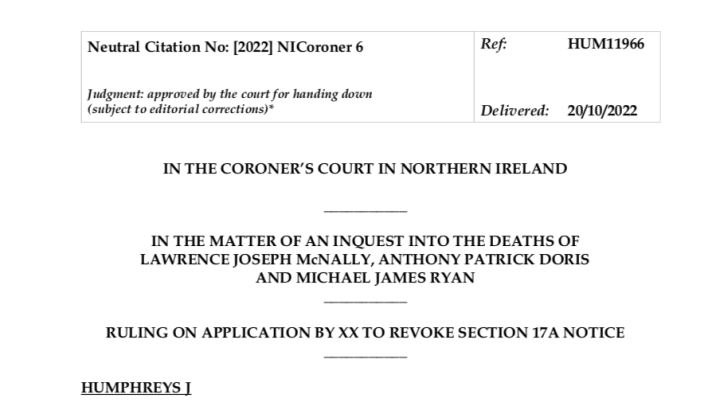
The unnamed academic researcher ‘XX’ was issued an order by the Coroner conducting ongoing inquest proceedings in relation to the deaths of three individuals, Lawrence McNally, Tony Doris and Michael Ryan at Coagh on 3 June 1991.
‘XX researched a thesis between 2011 and 2016 which was awarded a PhD by St Andrews University in Scotland titled Tir Eoghain Rebellion, a local war: a study of insurgency and counter-insurgency in post-1969 County Tyrone, Northern Ireland.
But the thesis is embargoed from publication until 2066 and is held securely by the university and the author’s solicitors.
Three of the researcher’s confidential interviewees, T, F and L, referred to the events at Coagh, and their identities are subject of a notice served under section 17A of the 1959 Coroner’s Act Northern Ireland.
‘XX’ has resisted the order on the basis the information itself is of little or no relevance to the questions which the inquest is obliged to answer, and there is a weighty public interest in academic historical research and in the preservation of confidentiality agreements.
The researcher draws an analogy with the protection afforded to journalists and their sources, and relies upon section 10 of the Contempt of Court Act 1981.
Mr Justice Michael Humphreys ruled ‘these serving police officers were able to provide an account of events which purported to descend into the detail both of the attack on the Ulster Defence Regiment (‘UDR’) soldier and the planned counter terrorist operation. The material was considered worthy of inclusion in an academic thesis the subject matter of which was counter insurgency in Tyrone.’
The judge observed the public policy behind section 10 of the 1981 CCA is to encourage freedom of the press and promote the right of freedom of expression in Article 10 ECHR.
However, the judge ruled: ‘The same public interest does not arise in relation to academic writings such
as the one in question in this case, which is by its very nature private.’ The academic work is not addressed to the public at large or a section of the public- ‘On the contrary, it is expressly embargoed from publication until 2066.’
An article by Fiona McIntyre for Research Professional, a subscription news service for UK Higher Education, drew parallels with the case of Boston College in the United States- forced to hand over some interviews conducted for research purposes with those involved in the conflict after a huge court case that dragged on for years, despite promises of anonymity made to participants by researchers.
Update on law of Malicious Falsehood for Chapter 3
A rare Court of Appeal ruling on malicious falsehood in 2022 in the case of George v Cannell & Anor appears to have provided some flexibility in interpreting and applying the phrase ‘calculated to cause pecuniary damage.’
Lord Justice Warby supported the argument that a claimant need only prove that it was ‘inherently probable’ that the complained of statements would cause financial loss, rather than having to prove that they probably had caused such loss.
He extracted from case law the view that the word “calculated” in S.3(1) [of the 1952 Defamation Act] does not mean “intended”, but “objectively likely.”
The court agreed this was a forward looking interpretation and further supported the contention an award for injury to feelings could be granted in circumstances where the Claimant was unable to establish actual financial loss.
The ruling prompted Tony Jaffa in the Hold The Front Page Law Column to ask the question: ‘Has the Court of Appeal made malicious falsehood the new libel?’
Lord Justice Warby said at paragraph 70: ‘ The remedy for those in the position of these defendants is to avoid conspiring to utter false, malicious, and financially damaging statements, or to settle the claim promptly if discovered to have done so. I am not persuaded that giving s.3 its natural meaning is likely to have a significant chilling effect on truthful and honest speech. Experience suggests that claims for malicious falsehood are relatively rare and that the main brakes upon them are the need to prove falsity and, in particular, malice. This is notoriously hard to plead (allegations of malice are frequently struck out at the interim stage) and to prove. There are safeguards against abuse, including the Jameel jurisdiction.’
It would appear that the Appeal Court judge’s view is that these nuanced changes are not going to open the floodgates and create a new frontier in media law.
Update on applicability of Reynolds responsible journlism defence/privilege to statutory Section 4 Public Interest defence in 2013 Defamation Act. Chapter Three.
Section 4(6) of the 2013 Defamation Act states: ‘The common law defence known as the Reynolds defence is abolished.’
But does it mean that journalists should ignore the ten criteria that for many years have been seen as a bedrock of ethical and professional obligations in ensuring the protection against wrongly damaging somebody’s reputation?
They founded the concept of the developing common law public interest defence.
Precedents twisted and turned on whether all should be satisfied for the defence, or it was a matter of each case on its merits and context.
What appears to be happening in libel cases where the statutory public interest defence is put forward is that High Court judges of first instance are evaluating the success or failure of the defence on whether key and relevant criteria from Lord Nicholls’ 10 Reynolds case criteria were complied with.
The Reynolds criteria became known as the responsible journalism defence. Indeed, this is how Lord Nicholls defined it four years after the Reynolds ruling in 1999.
In a ruling of the Judicial Committee of the Privy Council- Bonnick v Morris in 2003 he said:
‘Stated shortly, the Reynolds privilege is concerned to provide a proper degree of protection for responsible journalism when reporting matters of public concern. Responsible journalism is the point at which a fair balance is held between freedom of expression on matters of public concern and the reputations of individuals. Maintenance of this standard is in the public interest and in the interests of those whose reputations are involved. It can be regarded as the price journalists pay in return for the privilege. If they are to have the benefit of the privilege journalists must exercise due professional skill and care.’
‘Depending on the circumstances, the matters to be taken into account include the following. The comments are illustrative only.
- The seriousness of the allegation. The more serious the charge, the more the public is misinformed and the individual harmed, if the allegation is not true.
- The nature of the information, and the extent to which the subject-matter is a matter of public concern.
- The source of the information. Some informants have no direct knowledge of the events. Some have their own axes to grind, or are being paid for their stories.
- The steps taken to verify the information.
- The status of the information. The allegation may have already been the subject of an investigation which commands respect.
- The urgency of the matter. News is often a perishable commodity.
- Whether comment was sought from the plaintiff. He may have information others do not possess or have not disclosed. An approach to the plaintiff will not always be necessary.
- Whether the article contained the gist of the plaintiff’s side of the story.
- The tone of the article. A newspaper can raise queries or call for an investigation. It need not adopt allegations as statements of fact.
- The circumstances of the publication, including the timing.’
Lord Nicholls added: ‘This list is not exhaustive. The weight to be given to these and any other relevant factors will vary from case to case.’
In the end, can it not be argued that operation of the statutory public interest defence is not that different from the old and ‘abolished’ common law defence?
Looking at the statutory 2013 Defamation Act defence media defendants need to be under no illusions that unlike their compatriots in the USA, the onus is on them to defend and indeed prove this defence on the balance of probabilities.
The statutory defence offers the rubric that the media defendant is entitled to it if they ‘reasonably believed that publishing the statement complained of was in the public interest.’
Under Section 4(3) criterion 4 of Reynolds is negated when the court may ‘disregard any omission of the defendant to take steps to verify the truth of the imputation conveyed by it.’ But this only applies where the publication ‘was, or formed part of, an accurate and impartial account of a dispute to which the claimant was a party.’
Notice the qualifications- the report needs to be ‘an accurate and impartial account of a dispute.’
When judging whether the media defendant had a reasonable belief the publication was in the public interest, a ‘court must make such allowance for editorial judgement as it considers appropriate.’
And the defene is available ‘irrespective of whether the statement complained of is a statement of fact or a statement of opinion.’
Recent case law points to Judges regularly applying Reynolds’ criterion 7- ‘Whether comment was sought from the plaintiff [claimant]. He may have information others do not possess or have not disclosed.’
It is known as the right to reply. It is very much there is some professional journalist codes.
Mr Justice Nicklin in a 2021 ruling between the newspapers The Independent, i, and the Evening Standard and Bruno Lachaux said the newspapers should have verified the allegations because of their seriousness. And he criticised the failure to contact the claimant for comment, and to include his response in the articles.
Here are some of the key passages:-
Paragraph 173. ‘As a result of the failure to carry out any verification and the failure to contact the Claimant, the Independent Article did not contain anything by way of rebuttal from the Claimant or include his version of events. That was a serious failure in basic journalist good practice and a breach of the Defendants’ Code. This was not a case in which it could be concluded that the Claimant could have nothing valuable to contribute by way of response or answer. The only justification advanced for not contacting the Claimant was that he was not the (main) subject of the article. The Claimant was plainly a subject of the article and, in terms of likely reputational harm, likely to be the main casualty from its publication. Leaving aside the instruction in the Defendants’ Code that it was important “to abide not only by the letter but also [its] spirit”, the terms of the article squarely engaged the obligation to put the story to the Claimant. Beyond the argument that the Claimant was not the subject of the article, none of the First Defendants’ witnesses suggested that there was any other justification for not complying with this “good journalistic practice.”’
Paragraph 177. ‘The fact that the Claimant was libelled by the Independent Article was not a product of a carefully reasoned editorial judgment; it was a mistake, as was the failure to approach him for comment. Those involved in the original decision to publish simply failed to recognise the Claimant as someone who was likely to suffer serious reputational damage as a result of publication of the Independent Article. Even allowing for hindsight bias, this is not a borderline case. The First Defendant has failed to demonstrate that a belief that publication of the Independent Article was in the public interest was reasonable. The First Defendant’s s.4 defence in respect of the original publication of the Independent Article fails on this ground as well.’
The judge had explained in his analysis of the law that ‘providing they are not treated as any sort of ‘checklist’, the Reynolds factors will remain potentially relevant when assessing whether a defendant’s belief that publication was in the public interest was objectively reasonable.’
Mr Justice Nicklin relied on the speech of Lord Wilson in the Serafin v Makievizc case of 2020:
‘“In [Flood -v- Times Newspapers Ltd [2012] 2 AC 273] …, the defendant published an article taken to mean that there were reasonable grounds to suspect that the claimant, a police officer, had corruptly taken bribes. The allegation was false. This court held that the defendant nevertheless had a valid defence of public interest. Lord Phillips of Worth Matravers, the President of the court, said at [26] that in that case analysis of the defence required particular reference to two questions, namely public interest and verification; at [27] that it was misleading to describe the defence as privilege; at [78], building on what Lord Hoffmann had said in the Jameel case at [62], that the defence normally arose only if the publisher had taken reasonable steps to satisfy himself that the allegation was true; and at [79] that verification involved both a subjective and an objective element in that the journalist had to believe in the truth of the allegation but it also had to be reasonable for him to have held the belief. Lord Brown at [113] chose to encapsulate the defence in a single question. “Could”, he asked, “whoever published the defamation, given whatever they knew (and did not know) and whatever they had done (and had not done) to guard so far as possible against the publication of untrue defamatory material, properly have considered the publication in question to be in the public interest?”. Lord Mance at [137], echoing what Lord Nicholls had said in the Reynolds case at p.205, stressed the importance of giving respect, within reason, to editorial judgement in relation not only to the steps to be taken by way of verification prior to publication but also to what it would be in the public interest to publish; and at [138] Lord Mance explained that the public interest defence had been developed under the influence of the principles laid down in the European Court of Human Rights.”
It is also significant that Mr Justice Nicklin recognised how Lord Wilson extracted from the guidance and wording of the 2013 Defamation Act legislation the observation that: ‘the Explanatory Notes to the Defamation Act 2013 stated that the intention behind s.4 was to: “reflect the common law as recently set out in the Flood case and in particular the subjective and objective elements of the requirement now both contained in subsection 1(b).”’
This is a key factor about the statutory public interest defence. It needs to reflect the latest common law established prior to its enactment. This must be the discussion of the Reynolds criteria/privilege/responsible journalism defence in the Flood v Times UKSC ruling of 2012.
This ruling has been carefully analysed by Tony Jaffa in ‘Law Column: Bruno Lachaux and the Public Interest defence’ for Hold The Front Page.
Update Chapter Two
Introduction and development of live televising of Crown Court sentencing in England and Wales
Pages 39 to 42 of Chapter 1 of the printed book has a section on broadcasting and online coverage of the courts and following the inauguration of televising sentencing in the Crown Court for the first time at the Old Bailey 28th July 2022, the practice has been gathering what might be described as ‘gradual momentum.’
The head of law at ITV news, John Battle, who is also chair of the UK Media Lawyers’ Association has been given credit for successfully campaigning for this development over many years.
The guidance on who can and how to apply to televise sentencing is set out at: https://www.gov.uk/guidance/broadcasting-crown-court-sentencing
Authorised media organisations approved for broadcasting the sentencing are the BBC, ITN, Sky and PA Media.
Any one of them needs to apply to the trial judge 5 days in advance of the sentencing hearing.
No one else can film, broadcast or take photos of any hearing at any time. These ‘authorised media’ can make their footage, including photographic stills from the filming available to other media publishers.
The judge makes a provisional decision at least 2 days before the hearing, and a final decision on the day of the hearing and all this decision making happens outside the courtroom.
The prosecution, defence, victim or his/her relatives cannot make representations and there is no right of appeal against the judge’s decision.
The sentencing judge decides whether sentencing can be broadcast live or not and will take into account any reporting restrictions that are in place.
If reporting restrictions do cover some of the content of a sentencing, ‘there will be a short delay before broadcast to comply with reporting restrictions’ and it is recognised ‘authorised media may need to edit footage before it’s broadcast.’
The copyright in the footage is retained by The Ministry of Justice, but the MOJ is not responsible for maintaining and transmitting the recordings on media platforms such as YouTube.
Key rules that have to be complied with:
1.Only the judge and their sentencing remarks can be filmed. Authorised media cannot film any other court user – including defendants, victims, witnesses, jurors and court staff.
2.Apart from those authorised media organisations identified (BBC, ITN, Sky and PA Media) and approved of by the Lord Chancellor ‘No one else can film, broadcast or take photos of any hearing at any time.’
How HMCTS and the Ministry of Justice explained this historic development for the Crown Court System in England and Wales. ‘Broadcasting from the Crown Court’ See: https://insidehmcts.blog.gov.uk/2022/08/19/broadcasting-from-the-crown-court/
Sky’s hosting platform of Crown Court Sentencing. See: https://www.youtube.com/channel/UCF3HqeLrCkZgARQfyqj1m-g
Examples of televised sentencing since July 2022:-
Man jailed for life in first TV court sentencing (From the number One Court of the Central Criminal Court)
Woman jailed for 34 years for murdering and decapitating friend (Central Criminal Court)
Mother and boyfriend jailed for life over killing of teenage son (Leeds Combined Court Centre)
Reservoir Dogs attacker gets further 15 years for murdering partner (Bristol Crown Court)
Necrophiliac killer gets further four years for abusing dead women. 9th December 2022 at the Central Criminal Court, London also known as the Old Bailey.
Judge sentences Anne Sacoolas over Harry Dunn death. 9th December 2022 at the Central Criminal Court, London, also known as the Old Bailey.
Serial offender gets 38 year minimum jail term for brutal murder of Zara Aleena 9 Dec 2022 Central Criminal Court
Double jeopardy killer gets 25 years for 1975 rape and murder of teenage victim. 13th January 2023 at Huntingdom Law Courts.
Appeal Court- Criminal Division Sentence increased for rickshaw death crash driver. 25th January 2023
Pair jailed for 35 years for £4.6m murder and fraud plot. 1st February 2023, Central Criminal Court.
Serial rapist and ex-Met officer David Carrick jailed for at least 30 years 14 Feb 2023 Southwark Crown Court
Son gets life sentence for fatal attack on mother 14 Feb 2023 Central Criminal Court
Embassy spy who sold secrets to Russians jailed for more than 13 years 17 Feb 2023 Central Criminal Court
Parents jailed for manslaughter after disabled teen’s death, 2nd March 2023 Old Crown Court.
Wayne Couzens gets 19 months for indecent exposure in months before Sarah Everard killing, 6th March 2023 at the Central Criminal Court.
Woman, 22, jailed for eight-and-a-half years for false abuse and grooming gang claims, 14th March 2023, Preston Combined Court Centre.
Gunman who shot dead Olivia Pratt-Korbel, 9, jailed for at least 42 years. 4 Apr 2023 MANCHESTER CROWN COURT (CROWN SQUARE)
Mum and stepdad jailed over fatal attack on two-year-old daughter. Mr Justice Griffiths at Swansea Crown Court 26th April 2023.
Nigerian politician, wife and medic jailed over organ harvesting plot. Mr Justice Johnson 9th May 2023 at the Central Criminal Court.
Knifeman, 17, detained for murder of ‘defenceless’ 14-year-old. First televisied sentencing of a serious juvenile offender in the adult courts where anonymity reporting restrictions have been lifted. Judge Sarah Munro KC 10th May 2023 at the Central Criminal Court.
Teenagers get life for killing boy, 16, in mistaken identity attack. Judge Sarah Munro KC at the Central Criminal Court again on the same day (10th May 2023) at the Central Criminal Court. A reflection of the terrible toll of knife crime murders taking place in London with young people, often from Black and Asian ethnic communities being the victims.
Double killer gets third life sentence for sexually abusing boy. The Recorder of Nottingham, Judge Nirmal Shant KC at Nottingham Crown Court 11 May 2023. A double killer who brutally murdered two women in the 1990s was handed a third life sentence for violently sexually abusing a young boy in the years before his fatal attacks.
Killer of Nikki Allan, 7, jailed for at least 29 years three decades on. Mrs Justice Lambert at Newcastle Quayside Law Courts 24 May 2023. David Boyd, now 55, was convicted of the 1992 murder of schoolgirl Nikki Allan after advances in DNA technology allowed police to link him to the crime.
Parents jailed for life over murder of 10-month-old Finley Boden. Mrs Justice Tipples at Derby Combined Court Centre 27 May 2023. A couple who murdered their 10-month-old son on Christmas Day 2020 just weeks after he was returned to their care were both jailed for life. Shannon Marsden, 22, and Stephen Boden, 30, burnt and beat Finley Boden, leaving him with 130 separate injuries, including multiple bone breaks and fractures.
Mother and partner jailed for toddler’s violent death. A mother and her partner were jailed over the death of her 15-month-old son, who was shaken and beaten to death. 28 May 2023 Central Criminal Court before Mr Justice Sweeting.
Life sentence for teen terrorist who plotted attack on police and soldiers. The Recorder of London, Judge Mark Lucraft KC at the Central Criminal Court 2nd June 2023. A teenager who admitted he was planning a terror attack on the police and military was jailed for at least six years.
Killer, 15, gets 12-year minimum term for knife murder. 15 Jun 2023 Newcastle Quayside Law Courts before Mr Justice Martin Spencer. A 15-year-old boy was locked up for at least 12 years for stabbing another teenager to death.
Musician jailed for 15 years for killing student in “Mafia stiletto” stabbing. The Recorder of Manchester, Judge Nicholas Dean KC at Manchester Crown Court 19th June 2023. A musician who stabbed a student to death with a 13-inch ‘mafia stiletto’ knife after a comment over a skateboard was jailed for 15 years.
Government’s Rwanda asylum plan is unlawful, Court of Appeal rules. 29 June Royal Courts of Justice. Lord Burnett, the Lord Chief Justice, Master of the Rolls Sir Geoffrey Vos and Lord Justice Underhill.
Gunman who killed Elle Edwards in Christmas Eve pub shooting jailed for at least 48 years. Mr Justice Goose 8 Jul 2023 at Liverpool Crown Court. A gunman who shot dead a 26-year-old beautician when he opened fire on a packed pub on Christmas Eve was jailed for a minimum of 48 years.
People smuggler jailed for more than 12 years over Essex lorry deaths. Mr Justice Garnham 14 Jul 2023 at the Central Criminal Court. A people smuggler was jailed for more than 12 years for the manslaughter of 39 migrants who were found dead in a lorry trailer in Essex in 2019.
Teens sentenced to total of 34 years for mistaken identity knife murder. Mr Justice Choudhury at Wolverhampton Crown Court 14 Jul 2023. Two teenagers were jailed for a total of at least 34 years for the murder of 16-year-old in a mistaken identity attack. Pradjeet Veadhasa and Sukhman Shergill, both 17, stabbed Ronan Kanda to death close to his family home in Wolverhampton in June 2022.
Whole life term for killer who shot police officer Matt Ratana. Mr Justice Johnson at Norhtampton Combined Corwn and County Courts. 27 July 2023. A gun fanatic who shot dead a Metropolitan Police custody sergeant after smuggling a gun into a holding cell was handed a whole life jail sentence. Louis De Zoysa, 26, opened fire on Matt Ratana without warning using a legally-bought antique revolver and homemade bullets, causing a fatal wound to his heart and lung. Sgt Ratana, 54, later died in hospital.
Rape conviction quashed for man who spent 17 years in jail. 28th July 2023 at the Royal Courts of Justice London. Lord Justice Holroyde with Mr Justice Goose and Sir Robin Spencer. A man who served 17 years in prison had his rape conviction overturned after fresh DNA evidence emerged linking another suspect to the crime. Andrew Malkinson, now 57, was jailed for life with a minimum term of seven years in 2004 after he was found guilty of the attack on a woman in Salford, Greater Manchester – but he stayed in jail for another decade because he maintained his innocence.
Operators fined £14m over Croydon tram disaster failings. Mr Justice Fraser at the Central Criminal Court, 28th July 2023. Tram operators were fined a total of £14m after seven people were killed when a tram crashed in Croydon, south London. Transport for London was fined £10m and Tram Operations Limited was fined £4m for failing in their health and safety duties.
Stepfather and mother jailed over brutal death of baby Jacob Crouch. Mr Justice Kerr at Derby Combined Court Centre 4th August 2023. Craig Crouch, 39, was convicted of murder over a final, fatal attack on the child at his home in Linton, Derbyshire, in December 2020 and jailed for at least 28 years. His partner and Jacob’s mother Gemma Barton, 33, was cleared of murder and manslaughter but found guilty of causing or allowing the infant’s death following a trial at Derby Crown Court. Barton received a total sentence of 10 years.
Killer nurse Lucy Letby gets 14 whole-life sentences. Mr Justice Goss at Manchester Crown Court 21st August 2023. Serial killer nurse Lucy Letby will never be released from prison after she was given 14 whole-life orders for murdering seven babies and attempting to murder six others. The former neonatal nurse, 33, fatally injected seven infants with air, tried to kill two others by lacing their feeding bags with insulin and attempted to force a tube down another’s throat.
An example of a ruling from the Court of Appeal (Criminal Division) in July 2022 when the Lord Chief Justice of England and Wales presented judgement in linked appeals concerning the issue of ‘whole life terms.’ The appellants included Metropolitan Police officer Wayne Couzens convicted of the murder of Sarah Everard.
What is the current law in respect of broadcasting the courts in England and Wales?
The new edition of the Judicial College Guidelines on reporting restrictions in the Crown Court (2022) sets this out under section 5(7) at pages 45 and 46:-
Live-streaming, broadcast and electronic transmission of court proceedings
The statutory prohibitions on the recording and transmission of court proceedings do not apply to the transmission of video and audio of court hearings into a second courtroom, or to another location in England and Wales which is designated as an extension of the court. Not infrequently in criminal proceedings which attract a high level of public and press interest a second courtroom will be made available to permit a greater number of people to follow the proceedings in this way.
Until 2022, however, the general rule was that the statutory prohibitions on taking and publishing photographic images and sound recordings of court proceedings meant that courts had no power to allow their proceedings to be electronically transmitted to the general public. Any exception to this general prohibition requires further legislation.
There are four exceptions where Parliament has intervened to permit the live-streaming or electronic transmission of court proceedings.
- First, s.47 Constitutional Reform Act 2005 creates an exception to the general rule for proceedings in the Supreme Court, which are broadcast online on the Supreme Court Live service.209
- Secondly, the Crime and Courts Act 2013 s.32 empowers the Lord Chancellor to make regulations disapplying the prohibitions on making sound recordings and photographic images, thereby permitting the live-streaming of court proceedings. To date, orders have been made permitting the live-streaming of:
- Public hearings before the full court of the Court of Appeal.
- Sentencing remarks of certain specified judges in the Crown Court, with the permission of
the relevant judge. - Thirdly, the Coronavirus Act 2020 made temporary amendments to the Courts Act 2003, in light of the impact of the coronavirus pandemic, to enable certain criminal proceedings to be conducted by means of video or audio link and to permit the ‘broadcast’ of criminal proceedings conducted wholly by means of video or audio, for the purpose of enabling members of the public to see and hear the proceedings. As this power was limited to proceedings conducted ‘wholly’ by video or audio link, it follows that it did not confer power to permit live-streaming of criminal court proceedings which took place in person, or partly in person. This power did not allow a court conducting a fully remote hearing to permit a TV production company to record and then re-broadcast the proceedings.214
- Fourthly, the Police, Crime, Sentencing and Courts Act 2022 replaces the temporary powers under the Coronavirus Act with permanent amendments to the CJA 1925, CCA 1981 and the Courts Act 2003. These allow the Lord Chancellor to empower the Court to direct the electronic transmission of images or sounds of proceedings of all kinds for the purpose of enabling persons not taking part in the proceedings to watch or listen to them, though onward recording and broadcasting is prohibited.
On 28th July 2023 ITN’s head of legal and compliance John Battle wrote an article for Press Gazette on how the success of filming in UK courtrooms is restoring trust in justice: ‘Cameras in courts one year on: An unqualified success.’ See: https://pressgazette.co.uk/comment-analysis/cameras-in-courts-one-year-on-an-unqualified-success/
There is now an extensive infrastructure of televised broadcasting of Appeal Court Civil Division cases from the Royal Courts of Justice with streaming on YouTube though permission is not given for the material to be broadcast and re-used by the media:
Court of Appeal – Civil Division – Court 63
Court of Appeal – Civil Division – Court 70
Court of Appeal – Civil Division – Court 71
Court of Appeal Civil Division – Court 73
Court of Appeal – Civil Division – Court 74
Court of Appeal – Civil Division – Court 75
Court of Appeal – Civil Division – Court 76
Two judges whose sentencing has featured in live televised hearings in the past year, His Honour Judge Mark Lucraft, the Recorder of London, and Mrs Justice Cheema Grubb, have offered their views on the project in a Ministry of Justice media release: ‘One year of broadcasting of sentencing remarks in the Crown Court.’
See: https://www.judiciary.uk/one-year-of-broadcasting-of-sentencing-remarks-in-the-crown-court/
Legal journalist Joshua Rozenberg KC has also written an excellent analysis and review of one year of televising the sentencing in English courts for Law Society Gazette: ‘Letting the public see how the public law works.’ (pages 12 to 13)
The outgoing Lord Chief Justice of England and Wales Lord Burnett has also been making his views on Open Justice and televising the courts in a speech to the Commonwealth Magistrates’ and Judges’ Association in Cardiff in September 2023.
He said: “The question when considering the live-streaming or broadcasting of additional types of case or parts of cases, in my view, should be: why not?”
He supported the common law tradition of Open Justice in identifying judges and parties and resisting anonymization which is the practice in civil and Roman law jurisdictions.
He observed the European Court of Human Rights had not named the duty judge who temporarily prevented the UK from sending asylum-seekers to Rwanda last summer — “something that is alien to the common law tradition.”
See: London Evening Standard 12th September 2023 ‘Strong argument to go further with cameras in courts, says Lord Chief Justice. Lord Burnett said the broadcasting of sentencing in some criminal cases had been ‘successful beyond our expectations’.
Also reported in Standard’s sister online national publication The Independent.
Ministry of Justice Open Justice Consultation 2023
In May 2023, the Ministry of Justice opened a consultation on Open Justice. See: https://www.gov.uk/government/consultations/open-justice-the-way-forward/call-for-evidence-document-open-justice-the-way-forward
A research document ‘Open Justice: the way forward Call for Evidence’ was released 10th May at: https://assets.publishing.service.gov.uk/government/uploads/system/uploads/attachment_data/file/1155744/open-justice-cfe.pdf
Ministry of Justice Open Justice Consultation 2023
In May 2023, the Ministry of Justice opened a consultation on Open Justice. See: https://www.gov.uk/government/consultations/open-justice-the-way-forward/call-for-evidence-document-open-justice-the-way-forward
A research document ‘Open Justice: the way forward Call for Evidence’ was released 10th May at: https://assets.publishing.service.gov.uk/government/uploads/system/uploads/attachment_data/file/1155744/open-justice-cfe.pdf
The call for evidence ends 7th September 2023 and invites contributions on a wide range of topics: Open Justice; listings; accessing courts and tribunals; remote observations and livestreaming; broadcasting; Single Justice Procedure; publication of judgments and sentencing remarks; access to court documents and information; data access and reuse; and public legal education.
See Law Society Gazette ‘Court photography ban under review in transparency drive’ at: https://www.lawgazette.co.uk/practice/court-photography-ban-under-review-in-transparency-drive/5116009.article
Media law pdf file briefing on this subject
Update to Chapter 10 Freedom of Information
Unsuccessful Judicial Review challenge of failure of FTT and UT Information Rights to apply ECtHR Grand Chamber ruling Magyar v Helsinki 2016
The ruling of Mr Justice Ritchie on 11th November 2022 is the end of the road for a longstanding attempt through multiple appeals to the First Tier Tribunal and Upper Tribunal (Information Rights) by Professor Tim Crook to persuade the UK domestic legal system to read down Article 10 Freedom of Expression rights against the statutory absolute exempltions in the Freedom of Information Act 2000.
This was in the context of the ECtHR Grand Chamber in Magyar v Helskini ruling in 2016 that public watchdog journalists, academic researchers, and NGOs had a qualifed standing right under Article 10 to state information.
Mr Justice Ritchie decided ‘There is no arguable error of law asserted, only an impassioned plea for the law in S.23 of the Freedom Of Information Act to be changed. Parliament changes the law, not the Courts.’
He rejected Professor Crook’s application for leave for judicial review and certified it as ‘totally without legal merit.’ This provision meant it would have been highly unlikely that further appeal attempts to the Appeal Court Civil Division and UK Supreme Court would have had any chance of success.
Professor Crook had mounted five First Tier Tribunal appeals and three Upper Tribunal applications for permission to appeal in striving to achieve recogntion of his public interest/watchdog right to information withheld from him by a state information monopoly.
In every case the tribunals insisted they were determined by Act of Parliament (creatures of FOIA) and the King’s Bench Division Administrative Court was not prepared to accommodate any judicial review seeking declaration of incompatilibity with Article 10 rights.
For lawyers, journalists, academics and law students interested in finding out more about the background to this case, please see Profesor Crook’s statement of facts, legal grounds and rememdies sought which were submitted in the application for judicial review. The full core bundle is not in the public domain because it contained some private information and documents covered by privacy/confidentiality issues. Relevant Upper Tribunal rulings and links to FTT rulings are provided below.
Please also find the three rulings by Upper Tribunal (Information Rights) Judges refusing permission to appeal against First Tier Tribunal rulings on appeals pursued by Professor Crook.
Judge Edward Jacobs Upper Tribunal ruling 20th April 2022 Crook v Met Police & ICO UA-2021-000143-GIA
Judge Rupert Jones Upper Tribunal Ruling Crook v ICO 13th September 2021 GlA 446 & 447/2021
Judge Stewart Wright Upper Tribunal Ruling 22nd July 2021 GlA/2103/2019 & GIA/753/2020
Prof Tim Crook v IC & Metropolitan Police (Dismissed) | Judgment | 3 Aug 2021 — 1 IN THE FIRST–TIER TRIBUNAL EA/2019/0014. (INFORMATION RIGHTS) In the matter of an appeal under section 57 of the Freedom of Information Act
[2021] UKFTT 2019 0014 (GRC) https://www.casemine.com/judgement/uk/610924b92c94e0239c457ee6
| Freedom of Information Act 2000 | Tim Crook v IC Additional Party Foreign and Commonwealth Office EA/2015/0224 | 28/06/2016 | Dismissed | |
| Decisions from 1 April 2019 | Prof Tim Crook v IC Additional Party EA/2019/0282 | 27/02/2020 | Dismissed | |
| Decisions from 1 April 2019 | Prof Tim Crook v IC Additional Party Home Office EA/2019/0073 | 24/07/2019 | Dismissed | |
| Decisions from 1 April 2019 | Prof Tim Crook v IC Additional Party The Commissioner of Police for The Metropolis EA/2019/0014 | 03/08/2021 | Dismissed |
Ruling by Judge Moira MacMillan First Tier Tribunal Prof Tim Crook v ICO 18 January 2021 QJ/2020/0013 & 0014
Commentary:-
Professor Crook’s multiple actions through the FOIA system were made in good faith in order to simply ask an independent judicial body to adjudicate on a request to access historical files relating to public watchdog and public interest academic history and journalism projects.
There would have been no risk to national security as this could have been done in closed session in respect of closed files. Partial release of information with redactions is now standard and an effective method of guaranteeing as much disclosure as possible in respect of people deceased long ago and events long in the past.
The information sought is held by security bodies listed as exempt in FOIA and the Special Branch of the Metropolitan Police which is not, though it does enjoy the absolute exemption shield because historically Special Branch and its successor organisation, Counter Terrorism Command, works closely with the Security Service MI5.
The FOIA system and High Court have denied him the right to have that independent judicial adjudication, despite the fact the ECtHR Grand Chamber in Magyar 2016 clearly stated he had that right and its denial amounts to a breach of Article 10 Freedom of Expression and Information rights.
His requests were in the context of the Met Police and Security Bodies, such as MI5 exercising their own information monopoly over the release of historical files to the National Archives, which currently amounts to nearly 6,000 such files at the time of writing.
As will be seen in the arguments and grounds presented to the Tribunals and High Court, some information relevant to the Goldsmiths History project has been released to the Public Inquiry into Undercover Policing and a FOI request to the Met Police by an author on a book about policing left-wing intellectuals, but absolutely nothing has been offered and made available by way of remedy in respect of his requests.
The case would have been a reasonable opportunity of providing clarification over whether seeking state information in the context of Article 10 and English Common Law freedom of information rights in the face of FOIA absolute exemptions should be adjudicated by the FOI Tribunal system or judicial review at the High Court, and if judicial review is the only course whether it should operate similarly to FOI Tribunal appeals with each side bearing its own costs.
Professor Crook began the Met Police Special Branch appeal over access to historical files concerning Goldsmiths’ College, University of London staff and students in early 2018, well before the Upper Tribunal ruling in Moss in July 2020. He and the ICO asked for the case to be joined to Moss so that the position of Article 10 standing rights raised by Magyar for journalists, historical researchers and public watchdog NGOs could be properly represented before Judge Stewart Wright. But this request was rejected by the Presidents of the Upper Tribunal and First Tier Tribunal (Information Rights).
Having said all this, an FOI applicant seeking to crack open the absolute exemptions in FOIA should have an arguable case via Section 78 of the legislation at judicial review in the High Court and can rely on the English Common Law powers of freedom of expression so strongly identified by the majority of UK Supreme Court in Kennedy v Charity Commissioners in 2014, and indeed European Convention of Human Rights freedom of expression powers in Article 10 so precisely identified in Magyar Helsinki v Hungary at the ECtHR Grand Chamber in 2016 as residing in journalists, academic researchers and NGOs persuing public watchdog/public interest research and investigation projects.
The area needs an applicant with a very good and worthy cause, enough financial resources, and a qualitative team of media law counsel ready to do battle against government, public authorities and perhaps even the Information Commissioner.
Successful First Tier Tribunal FOI appeal by investigative journalist Gareth Davies and the Bureau of Investigative Journalism seeking financial documents and information from Thurrock Council 17th October 2022.
On 17th October 2022 The First Tier Tribunal partly ruled in favour of Gareth Davies in respect of the public interest balancing act in the qualified exemptions of FOIA under sections 36 or 43.
| Gareth Davies v Information Commissioner Additional Party Thurrock Council EA/2020/0241 | 14/10/2022 |
Determination of the disclosure request turned on whether, “in all the circumstances of the case, the public
interest in maintaining the exemption outweighs the public interest in disclosing the information”.
The majority view of the Tribunal set out in the ruling of Judge Anthony Snelson included the observation on the council’s wish to withhold some of the information sought:
‘We cannot avoid the sense that it stems in material part from a wish to avoid the embarrassment which public scrutiny of its remarkable financial activities would be likely to involve. The exemptions from the right to freedom of information must not be invoked as a means of sparing public bodies and their employees discomfort of this sort.’
Hold The Front Page reported 21st October 2022: ‘Journalist hopes three-year secrecy fight win will be landmark for local press.’
Mr Davies said: ‘The information we requested in 2019 will provide vital insight into disastrous investments which threaten to cost taxpayers hundreds of millions of pounds and to cripple a council that provides vital services to local people. It should never have taken three years to reach this point.’
To understand the journalistic context of this FOI appeal see Bureau of Investigative Journalism’s ‘Thurrock council reveals £500m black hole caused by ruinous business deals.’
And: ‘Thurrock council ordered to disclose details of ‘dodgy deals’ worth £1bn.’
Update to Chapter One
Is there a shift in the Open Justice paradigm towards more reporting restrictions in relation to adult witnesses, victims/complainants as witnesses (beyond the category of statutorily protected sexual offence complainants) and by default deceased victims related to the witnesses?
The question raises a debate that may or may not be taken up by professional journalist organisations, media publishers and their media lawyers.
A number of cases indicate that Section 46 of the Youth Justice and Criminal Evidence Act 1999 is becoming the agency for more restrictions than were issued in the past.
An example is present in the unsuccessful challenge by the Pembrokeshire Herald and BBC in respect of the trial of a teacher whose defence succeeded with evidence provided to the jury by his professional colleagues.
See: Pembrokeshire Herald, Re (leave to appeal) (Rev1) [2021] EWCA Crim 1165 (27 July 2021)

The Herald argued the Section 46 order giving these adult witnesses anonymity for life was exceptional ‘as it would in effect prohibit significant reporting of the defence case.’ The problem for the newspaper is that procedurally it had appealed against the reporting restriction after the time allowed to do so.
However, Lord Justice Walby made pertinent observations about the merits of their case:
‘Decisions about reporting restrictions are evaluative in nature, involving a balancing exercise akin to the exercise of a discretion; although the fact that Convention rights are engaged means that review of the decision under challenge must be intense, the appellate court will be slow to interfere…’
The Appeal Court supported the trial judge’s approach to the issues:
‘Her rulings make plain that she had gained a detailed and intimate knowledge and understanding not only of the evidence, but also of many of the personalities involved, the procedural and other dynamics of the case, and the social and cultural context in which it was being heard. We do not agree that she substituted her own judgment for that of the editor, in deciding what deserved to be published. She took a judicial decision about what reporting it was necessary in the interests of justice to prevent. On our reading of her rulings, the Judge was very much alive both in April and in May to the specific rights in play, and brought the necessary intense focus to bear upon them. She was much better placed than this Court, and – with respect – better placed than the Herald, to evaluate the evidence and to assess the appropriate weight to attach to the competing considerations.’
It might also be relevant to cite the unsuccessful challenge by media organisations of a Section 46 order in 2013 which prevented publication of images of an adult witness and those of her children in a manslaughter trial.
This was the case of ITN News & Ors v R. [2013] EWCA Crim 773 (21 May 2013)

The Court of Appeal Criminal Division, and Lord Chief Justice at the time upheld the trial judge’s decision to issue the order:
‘(1) no photograph, pseudo photograph or other image of
(a) Lisa Willis
(b) Her children or any of them (with or without Lisa Willis)
Shall be published in any way which connects them or any of them (whether through reports of these proceedings or otherwise howsoever) to the case of R v Michael Philpott, Mairead Philpott and Paul Mosley.’
The media argument was that the witness had previously appeared in ITV programmes with her children. But the witness said she wanted the protection in relation to media publicity in the different context of being the witness in a traumatic criminal trial. The media could still identify her by name.
The Lord Chief Justice observed:
‘…the criminal courts must control their own processes, and the fact that the family court may protect the identity of the children, is not sufficient on its own to deprive the Crown Court of the jurisdiction under s.46. The eligibility conditions may be established as here, where publication of the photographs of her children would be likely to lead to the identification of the mother, and the risks would be likely to impact on the quality of the mother’s evidence at trial. As Mr David Farrer QC for the Crown observed, the order offered “reassurance to a witness to preserve the integrity of his or her evidence”. In our view reference in the order to the children was integral to the eligibility test as it applied to their mother.’
The new Judicial College Guide to Reporting Restrictions in the Criminal Courts 2022 rather pointedly takes up the implication of the Court of Appeal Ruling in the Pembrokeshire Herald case and others at paragraph 6.2.
‘However, most decisions in relation to reporting restrictions – including decisions as to anonymity, and in relation to the publication of judgments – are evaluative decisions, involving a balancing exercise, which are akin to the exercise of a discretion. When considering an appeal against such a decision, the appellate court will be slow to interfere.’
Does this amount to discouraging appeals by media organisations under Section 159 of the Criminal Justice Act 1988?
The Judicial College Guide explains the ambit of Section 46 orders at paragraph 4.3 on page 26. Some of the key and relevant factors that may be inviting an increase in the application and imposition of such orders are underlined:
‘Section 46 YJCEA 1999 gives the court power to restrict reporting about certain adult witnesses (other than the accused) in criminal proceedings on the application of any party to those proceedings. The witness protected by the order may be the complainant or any other witness.
The Court may make a reporting direction that no matter relating to the witness shall during his/her lifetime be included in a publication if it is likely to lead members of the public to identify him/her as being a witness in the proceedings. Again, publication of the name, address, educational establishment, workplace or a still or moving picture of the witness is not of itself an offence, unless its inclusion is likely to lead to his/her identification by the public as a witness in the criminal proceedings. A s.46 order may also restrict the identification of children where it would lead to the identification of the adult in question.
An adult witness is eligible for protection if the quality of his/her evidence or his/her co-operation with the preparation of the case is likely to be diminished by reason of fear or distress in connection with identification by the public as a witness. The applicant for an order under s.46 must explain why a reporting direction would improve the quality of the witness’ evidence or level of cooperation. Quality of evidence relates to its quality in terms of completeness, coherence and accuracy. Factors which the court must take into consideration include the nature and circumstances of the offence, the age of the witness, any behaviour towards the witness by the defendant or his/her family or associates and the views of the witness.‘
At the time of writing it would seem Section 46 YJCEA 1999 restrictions have provided anonymity for the adult victim in a causing GBH by dangerous driving trial, and adult witnesses and child complainants in a murder/attempted murder trial which appears to prevent identification of the alleged murder victims in the trial.
The balancing exercise being determined is between the interests of administering justice and the open justice of reporting proceedings fairly and accurately. It may well be the case that the evaluative consensus on the balancing exercise of these rights when they are in conflict with each other is changing compared to what news organisations may have expected in the past.
The Judicial College 2022 guide at page 17 made the following observation about restrictions protecting children:
‘The welfare of the child must be given very great weight and it will rarely be the case that it is in the public interest to dispense with the reporting restrictions.’ It highlighted the view ‘It is wrong for the court to dispense with a child’s prima facie right to anonymity as an additional punishment, or by way of “naming and shaming.”‘
The inclusion of the phrase ‘very great weight’, which I have underlined in the quotation, could be the anticipation of the proposed Bill of Rights Bill which provides for a statutory ‘great weight’ standard for freedom of expression. There can be no doubt that ‘very great weight’ outweighs, to forgive the pun, ‘great weight.’
Significant Judicial Committee of the House of Lords case law (equivalent of current UK Supreme Court) from 2004 which gave precedence to open justice and freedom of expression when balanced with the interests of a child who was not party to the proceedings.
It is now 18 years old, but the ruling of Lord Steyn should be supportive of court reporting journalists and their publishers faced with reporting restrictions which prevent identification of defendants and their alleged victims.
S (a child), Re [2004] UKHL 47 (28 October 2004)
https://www.bailii.org/uk/cases/UKHL/2004/47.html
This is a 19 page judgement given by Lord Steyn with four other Law Lords (Lord Bingham of Cornhill, Lord Nicholls of Birkenhead, Lord Hoffmann, and Lord Carswell) in agreement.
The issue to be decided was whether a Family Division High Court Judge was right or wrong to refuse to injunct the media from identifying a mother charged with murdering her 9 year old son by poisoning on the grounds of the psychological harm that would be caused to the mother’s younger son who was eight years old- referred to in the proceedings as ‘CS’.
Could a restriction imposed on the media not to identify the alleged murder victim’s younger brother mean that they should not be allowed to identify the mother, her husband, the alleged murder victim, their photographs, and other facts such as the home address of the family and school attended by the alleged murder victim? The implication of such restrictions is the concertina effect in closing down publication of other facts usually regarded as essential to the reporting of criminal trials.
It could also be described as an oppressive secret justice shadow doctrine where the best interests of peripheral individuals in a criminal trial are virtuously upheld to the detriment of the public interest in freedom of expression to receive and communicate accurate and fair reporting of court proceedings.
This was a clash between open justice Article 10 freedom of expression rights for the media and public, and Article 8 privacy rights for the alleged murder victim’s younger brother.
This was also a test of the applicability of reporting restrictions in the criminal courts when imposed to protect the interests of children who are not party to the proceedings.
One Crown Court judge had imposed an order under Section 39 of the Children and Young Person’s Act stating: ‘prohibiting publication of information calculated to lead to the identification of the child [alleged murder victim’s younger brother]. The judge stated that publication of the family’s surname would be considered an act calculated to lead to such identification.’
Another Crown Court judge discharged the order after representations from a local newspaper, The Romford Recorder, stating ‘section 39 was inapplicable to the case because the child was not a “child concerned in the proceedings, either as being the person by or against or in respect of whom the proceedings were taken, or as being a witness therein.”’
Section 39 orders under the CYPA 1933 have since been replaced with Section 45 orders under the Youth Justice and Criminal Evidence Act 1999.
Lord Steyn said: ‘ For present purposes section 45 is in material respects the same as the extant section 39(1): see section 45(3). As the words, which I have italicised, make clear section 39(1) is not engaged in the present case. My reason for referring to it is, however, the reflection that, in regard to children not concerned in a criminal trial, there has been a legislative choice not to extend the right to restrain publicity to them. This is a factor which cannot be ignored.’
The Family Division High Court Judge, Mr Justice Hedley initially granted an application for an injunction sought by the guardian of ‘CS’, and this included preventing ‘any person “publishing any particulars of or information relating to any part of the proceedings before any court which may or is calculated to lead to the identification of the said child”.
Lord Steyn observed: ‘The order was clearly designed to prohibit publication of the name of the mother and the deceased child in any report of the impending criminal trial. It is common ground that the order also prevented publication of any photographs of the mother or deceased child.’
The Romford Recorder applied for a modification of the order to prevent the potential censorship applying to any reporting of the mother’s forthcoming criminal trial.
Mr Justice Hedley agreed and explained:
“First I recognise the primacy in a democratic society of the open reporting of public proceedings on grave criminal charges and the inevitable price that that involves in incursions on the privacy of individuals. Secondly, I recognise that Parliament has in a number of statutes qualified that right to report and, in the context of this case, most notably in section 39 of the 1933 Act; where a set of circumstances arise not covered by those provisions the court should in my judgment be slow to extend the incursion into the right of free speech by the use of the inherent jurisdiction. Thirdly, I have to recognise that not even the restrictions contended for here offer real hope to CS of proper isolation from the fallout of publicity at this trial; it is inevitable that those who know him will identify him and thus frustrate the purpose of the restriction. Lastly, I am simply not convinced that, when everything is drawn together and weighed, it can be said that grounds under article 10(2) of the ECHR have been made out in terms of the balance of the effective preservation of CS’s article 8 rights against the right to publish under article 10. I should add, although it is not strictly necessary to do so, that I think I would have come to the same conclusion even had I been persuaded that this was a case where CS’s welfare was indeed my paramount consideration under section 1(1) of the 1989 [Children] Act.”
The case went to the Court of Appeal which decided by a majority of 2 to 1 to sustain Justice Hedley’s ruling.
At the Judicial Committee of the House of Lords, counsel for the guardian of ‘CS” submitted:
‘the majority [at Court of Appeal] misapplied the principle of proportionality in a case of competing rights under the ECHR and in so doing exposed a vulnerable child to interference with his private and family rights. In outline her submissions were as follows. The child had a right to respect for his private and family life in that he was entitled to expect the state to provide, by way of his access to the court, protection against harmful publicity concerning his family. The child has a right to protection from publicity which could damage his health and well-being and risk emotional and psychiatric harm. Recognising that the subject matter of the trial is a matter of public interest counsel for the child submitted that a proportionate response would be to permit only newspaper reports which do not refer to the family name or incorporate photographs of family members or the deceased. ‘
Lord Steyn explained the methodology in carrying out a balancing act when Article 10 and Article 8 rights under the European Convention of Human Rights come into conflict with one another (author has underlined and emboldened key points):
‘First, neither article has as such precedence over the other. Secondly, where the values under the two articles are in conflict, an intense focus on the comparative importance of the specific rights being claimed in the individual case is necessary. Thirdly, the justifications for interfering with or restricting each right must be taken into account. Finally, the proportionality test must be applied to each. For convenience I will call this the ultimate balancing test. This is how I will approach the present case.’
Here are some key paragraphs from Lord Steyn’s ruling that could be of assistance to journalists, their news publishers and counsel if needing to appeal or make applications to overturn or vary similar reporting restrictions.
Paragraph 18: ‘In oral argument it was accepted by both sides that the ordinary rule is that the press, as the watchdog of the public, may report everything that takes place in a criminal court. I would add that in European jurisprudence and in domestic practice this is a strong rule. It can only be displaced by unusual or exceptional circumstances. It is, however, not a mechanical rule. The duty of the court is to examine with care each application for a departure from the rule by reason of rights under article 8. ‘
Paragraph 25: ‘But it is necessary to measure the nature of the impact of the trial on the child. He will not be involved in the trial as a witness or otherwise. It will not be necessary to refer to him. No photograph of him will be published. There will be no reference to his private life or upbringing. Unavoidably, his mother must be tried for murder and that must be a deeply hurtful experience for the child. The impact upon him is, however, essentially indirect.’
Paragraph 27: ‘The interference with article 8 rights, however distressing for the child, is not of the same order when compared with cases of juveniles, who are directly involved in criminal trials. In saying this I have not overlooked the fact that the mother, the defendant in the criminal trial, has waived her right to a completely public trial, and supports the appeal of the child. In a case such as the present her stance can only be of limited weight.’
Paragraph 28: ‘Article 10 is also engaged. This case is concerned with the freedom of the press, subject to limited statutory restrictions, to report the proceedings at a criminal trial without restriction. It is necessary to assess the importance of this freedom. I start with a general proposition. In Reynolds v Times Newspapers Limited [2001] 2 AC 127 Lord Nicholls of Birkenhead described the position as follows (200G-H):
“It is through the mass media that most people today obtain their information on political matters. Without freedom of expression by the media, freedom of expression would be a hollow concept. The interest of a democratic society in ensuring a free press weighs heavily in the balance in deciding whether any curtailment of this freedom bears a reasonable relationship to the purpose of the curtailment.”
These observations apply with equal force to the freedom of the press to report criminal trials in progress and after verdict.
Paragraph 29: ‘The importance of the freedom of the press to report criminal trials has often been emphasised in concrete terms. In R v Legal Aid Board ex parte Kaim Todner (A firm) [1999] QB 966, Lord Woolf MR explained (at 977):
“The need to be vigilant arises from the natural tendency for the general principle to be eroded and for exceptions to grow by accretion as the exceptions are applied by analogy to existing cases. This is the reason it is so important not to forget why proceedings are required to be subjected to the full glare of a public hearing. It is necessary because the public nature of the proceedings deters inappropriate behaviour on the part of the court. It also maintains the public’s confidence in the administration of justice. It enables the public to know that justice is being administered impartially. It can result in evidence becoming available which would not become available if the proceedings were conducted behind closed doors or with one or more of the parties’ or witnesses’ identity concealed. It makes uninformed and inaccurate comment about the proceedings less likely . . . Any interference with the public nature of court proceedings is therefore to be avoided unless justice requires it. However Parliament has recognised there are situations where interference is necessary.”
At paragraph 30, Lord Steyn said: ‘A criminal trial is a public event. The principle of open justice puts, as has often been said, the judge and all who participate in the trial under intense scrutiny. The glare of contemporaneous publicity ensures that trials are properly conducted. It is a valuable check on the criminal process. Moreover, the public interest may be as much involved in the circumstances of a remarkable acquittal as in a surprising conviction. Informed public debate is necessary about all such matters. Full contemporaneous reporting of criminal trials in progress promotes public confidence in the administration of justice. It promotes the values of the rule of law.’
Lord Steyn then set out the harmful consequences of granting the injunction in paragraphs 32 to 36:
‘32. There are a number of specific consequences of the grant of an injunction as asked for in this case to be considered. First, while counsel for the child wanted to confine a ruling to the grant of an injunction restraining publication to protect a child, that will not do. The jurisdiction under the ECHR could equally be invoked by an adult non-party faced with possible damaging publicity as a result of a trial of a parent, child or spouse. Adult non-parties to a criminal trial must therefore be added to the prospective pool of applicants who could apply for such injunctions. This would confront newspapers with an ever wider spectrum of potentially costly proceedings and would seriously inhibit the freedom of the press to report criminal trials.
33. Secondly, if such an injunction were to be granted in this case, it cannot be assumed that relief will only be sought in future in respect of the name of a defendant and a photograph of the defendant and the victim. It is easy to visualise circumstances in which attempts will be made to enjoin publicity of, for example, the gruesome circumstances of a crime. The process of piling exception upon exception to the principle of open justice would be encouraged and would gain in momentum.
34. Thirdly, it is important to bear in mind that from a newspaper’s point of view a report of a sensational trial without revealing the identity of the defendant would be a very much disembodied trial. If the newspapers choose not to contest such an injunction, they are less likely to give prominence to reports of the trial. Certainly, readers will be less interested and editors will act accordingly. Informed debate about criminal justice will suffer.
35. Fourthly, it is true that newspapers can always contest an application for an injunction. Even for national newspapers that is, however, a costly matter which may involve proceedings at different judicial levels. Moreover, time constraints of an impending trial may not always permit such proceedings. Often it will be too late and the injunction will have had its negative effect on contemporary reporting.
36. Fifthly, it is easy to fall into the trap of considering the position from the point of view of national newspapers only. Local newspapers play a huge role. In the United Kingdom according to the website of The Newspaper Society there are 1301 regional and local newspapers which serve villages, towns and cities. Apparently, again according to the website of The Newspaper Society, over 85% of all British adults read a regional or local newspaper compared to 70% who read a national newspaper. Very often a sensational or serious criminal trial will be of great interest in the community where it took place. A regional or local newspaper is likely to give prominence to it. That happens every day up and down the country. For local newspapers, who do not have the financial resources of national newspapers, the spectre of being involved in costly legal proceedings is bound to have a chilling effect. If local newspapers are threatened with the prospect of an injunction such as is now under consideration it is likely that they will often be silenced. Prudently, the Romford Recorder, which has some 116,000 readers a week, chose not to contest these proceedings. The impact of such a new development on the regional and local press in the United Kingdom strongly militates against its adoption. If permitted, it would seriously impoverish public discussion of criminal justice.’
Journalists and their editors may justifiably argue that these are compelling arguments. Sadly, the situation for British journalism since 2004 has greatly deteriorated. There are many less local newspapers in terms of the number published, their circulation and journalists working for them.
This is the result of ‘Big Tech’ harvesting the major proportion of what was their print advertising income, an exponential decline in printed newspaper readership as a social value and economic market, and the digitisation of communications without any equivalent sustaining model of economic viability for online news publishing.
Many journalists and editors would argue that the problem Lord Steyn described as ‘The process of piling exception upon exception to the principle of open justice’ has in fact occurred, is being ‘encouraged’ by higher court rulings and has ‘gained in momentum.‘
There is also an argument that however costly it is for news organisations to challenge reporting restrictions recent court rulings actually discourage them from doing so.
Has public discussion of criminal justice been impoverished as well? Is there less court reporting now in local, regional and national media publications? Has informed debate about criminal justice suffered? These are now questions which beg urgent answers. Contemporary journalists and editors may argue that the answer to all three questions is in the affirmative.
Returning to Lord Steyn’s conclusion. He supported Mr Justice Hedley’s approach to ‘the ultimate balancing test’ at paragraph 37:
‘Given the weight traditionally given to the importance of open reporting of criminal proceedings it was in my view appropriate for him, in carrying out the balance required by the ECHR, to begin by acknowledging the force of the argument under article 10 before considering whether the right of the child under article 8 was sufficient to outweigh it.’
House of Commons Justice Committee report ‘Open justice: court reporting in the digital age’ published 1st November 2022

Some of the rhetorical questions raised in the analysis of Lord Steyn’s ruling in S (a child), Re [2004] UKHL 47 above have been addressed in this report by the House of Commons Justice Committee which received a range of submissions of evidence from qualitative and qualified sources.
The Committee’s report provided a wide range of recommendations set out across 45 paragraphs:-
Conclusions and recommendations
Introduction
- We would encourage every family court in England and Wales to invite their local MPs to visit so that they can hear accounts of the issues facing the family justice system from those who are responsible for delivering justice on a daily basis. (Paragraph 2)
- The Lord Chancellor and the Lord Chief Justice should consider producing a White Paper that clarifies and publicises the right of the public to attend court hearings and access information on court proceedings in the digital age. (Paragraph 11)
- Open justice is a common law principle, and it is for the courts to determine its requirements in particular cases. However, responsibility for deciding how the principle should operate should not be left to the courts alone. Deciding the proper limits of open justice can often give rise to significant policy questions that Government and Parliament can only tackle through legislation. (Paragraph 19)
- The internet and social media are changing the way that the public access court proceedings, which is making the work of the courts more accessible; but this also presents dangers for the administration of justice. In the digital age, it is vital the Government, Parliament and the Judiciary work together to ensure that a balanced approach to open justice is achieved so that public scrutiny of justice can be secured without damaging the quality of the justice administered in the courts. (Paragraph 20)
Court reporting in the digital age - The well-documented decline in the news media’s coverage of the courts, particularly the Magistrates’ courts, is concerning. In acting as the eyes and ears of the public, the media perform a vital role in keeping the public informed on the operation of the justice system. (Paragraph 32)
- The decline in court reporting has had a negative effect on open justice in England and Wales. (Paragraph 33)
- As the public receives less information through the media on the work of the courts, HMCTS should do more to enable the courts to communicate information on court proceedings directly to the public. In addition, HMCTS needs to use technology and organisational reform, building on the work done with Courtsdesk News, to provide the media with the information it needs in a consistent manner, as soon as possible, to facilitate court reporting. HMCTS should also pilot the use of regional communication and information officers to support media and public access to hearings. Furthermore, the decrease in the media’s coverage of the courts also strengthens the case for the re-establishment of a courts’ inspectorate, which could help to identify wider issues within the justice system, particularly in the Magistrates’ courts and the Family Court, which are not well covered by the media. (Paragraph 33)
The barriers to open justice - The evidence from the Bureau of Investigative Journalism on its experience of attempting to access possession hearings presents a concerning picture of the practical reality of open justice in England and Wales. The legal and constitutional status of open justice is immaterial if journalists face the sort of hurdles experienced
by the Bureau of Investigative Journalism. Those barriers have the potential to create a chilling effect for journalists and the public by discouraging them from exercising their right to attend hearings. Everyone working within the justice system, especially judges and court staff, has a role to play in translating the principle of open justice into reality. (Paragraph 39) - We welcome the publication of the Reporters’ Charter, which for the first time sets out the rights and obligations of journalists reporting on court proceedings. We note, however, that the rights of access that flow from the principle of open justice are not exclusively for reporters’—it is vital that members of the public are also aware of their right to attend proceedings and access information. (Paragraph 40)
- HMCTS should publish a citizens’ charter that outlines the public’s rights to access information on the courts. (Paragraph 40)
- The Reporters’ Charter helpfully directs the media to the MOJ press office and the Judicial Press Office to deal with enquiries and issues on accessing court proceedings and information. There should be a single point of contact for all accessibility and open justice inquiries from the media and from the public. The Lord Chief Justice told us that, if a journalist encounters an issue accessing a court, he or she should “get in touch with their local court and ask why”. In reality, at present there is no formal official mechanism for the media or the public to raise accessibility enquiries or complaints in relation to the courts. The creation of regional communication and information officers within HMCTS could provide that point of contact for reporters and the public. The courts’ inspectorate, as we proposed in our report on court capacity, could have a specific remit to examine the operation of open justice. (Paragraph 41)
- HMCTS should institute a programme of open days to encourage the public to visit their local courts, for example during Justice Week. This programme should be used to improve the awareness of both the public and HMCTS staff of the public’s right to attend court proceedings. Furthermore, there should be a programme to encourage schools to organise visits to their local courts to improve public legal education. (Paragraph 42)
- Every court should list an email address on its website to enable the media and thepublic to request access to remote hearings. (Paragraph 44)
- Remote hearings are still a relatively new and innovative feature of the justice system in England and Wales. The evidence to our inquiry suggests that there is a problem
with a lack of coherence and consistency in relation to the ability of the media and the public to access remote court hearings. (Paragraph 49) - We recommend that HMCTS gathers and publishes data on requests to observe proceedings remotely. In particular, it would be useful to know the number of requests received and the number of requests granted by jurisdiction. (Paragraph 49)
- HMCTS should ensure that the Crown Court provides the same level of information to journalists on the outcome of cases as is currently provided by the Magistrates’ court. (Paragraph 57)
- We welcome the planned digitisation of the publication of court and tribunal lists and the consolidation into a single service in one location. (Paragraph 59)
- We request further information on when this service will go live and what improvements are planned to the level of information on the lists and the accessibility of the service. We recommend that HMCTS considers whether the proposed digital portal should be expanded to include all court information, including results, reporting restrictions and court documents. (Paragraph 59)
- The Committee would welcome an update on the work being undertaken by the Civil Procedure Rule Committee to improve access to documents in civil proceedings. (Paragraph 64)
- The Government and HMCTS should establish a streamlined process for accessing court documents, including courts lists, using a digital portal modelled on Public Access to Court Electronic Records (PACER) in the United States. This should also be used to inform the media of reporting restrictions, including automatic restrictions and notice of applications for reporting restrictions. (Paragraph 72)
- The Government and HMCTS should conduct, or ask the Law Commission to conduct, a comprehensive review on access to documents referred to in open court and propose legislation if necessary to clarify the position. (Paragraph 73)
- Reporting restrictions play a key role in securing the fairness of the justice system. However, it is clear that there is inconsistency in the courts’ approach to notifying the media when restrictions are in place, and they are often not effective at ensuring compliance, particularly on social media. This is an important example of where the modernisation of the infrastructure of open justice is long overdue (Paragraph 82)
- The proposed new digital portal should also enable access to a centralised database of reporting restrictions on cases. (Paragraph 82)
- The current situation on court transcripts is unsatisfactory. (Paragraph 87)
- HMCTS should explore whether greater use of technology, such as AI-powered transcription, could be piloted to see whether it can be used to reduce the cost of producing court transcripts. HMCTS should also consider whether the sentencing remarks in the Magistrates’ courts could be routinely recorded and transcribed on
request. HMCTS should also review its existing contracts for transcription services to ensure that transcripts are more accessible to the media and the public. (Paragraph 87) - We welcome the establishment of the National Archives Find Case Law Service. However, this service should represent the first step in improving the public accessibility of judgments. (Paragraph 93)
- HMCTS should reform the way that judgments are collected, stored and published sothat there is less reliance on commercial legal publishers. The judgments of courts are the product of a publicly funded justice system and the public, the media and the legal sector should not have to pay significant sums for access. (Paragraph 93)
- All Crown Court sentencing remarks should be published in audio and/or written form. HMCTS should ensure that the necessary resources are made available to enable sentencing remarks to be published. (Paragraph 97)
- We are concerned over whether the Ministry of Justice has allocated sufficient funding to ensure that the court reform programme can overcome some of the barriers to public and media access to information on courts. We ask the Government to provide a status update on any ongoing projects that are designed to enhance open justice, outlining how much funding has been allocated to deliver them and providing a date by which they will be completed. (Paragraph 98) Court reform and open justice
- We welcome the new legislative framework for remote observation of court proceedings. The combination of this framework and improvement of the technological facilities of courts has the potential to enhance open justice by making it easier for the public and the media to observe proceedings. (Paragraph 109)
- It is right that judges are in control of the decision as to whether to allow remote observation. In some cases, judges will find these decisions difficult to make. It is crucial therefore that the effect of this new framework is evaluated. The concerns raised by the Lord Chief Justice and the Senior President of Tribunals, in particular
in relation to the impact on court resources and the potential for unauthorised transmissions, will need to be followed up by an evaluation of how this new framework is operating in practice. (Paragraph 110) - HMCTS should commission an evaluation in June 2023 to examine how the new framework has worked in its first year of operation. (Paragraph 110)
- The power to allow the transmission of proceedings to designated livestreaming premises has great potential to enable more people to observe court proceedings and enhance open justice. If students were able to observe cases in classrooms and lecture halls, or if community centres could host livestreams of court proceedings,
the accessibility of court proceedings would be greatly enhanced. (Paragraph 111) - We welcome the broadcasting of Crown Court sentencing remarks. It is a positive step for both open justice and the public understanding of sentencing. (Paragraph 118)
- More widely, we recommend that HMCTS and the Judiciary commission research to determine which civil and criminal proceedings could be suitable for broadcast and video archiving. In principle, we would support the extension of broadcasting and recording to civil trials that do not involve oral evidence. In the criminal context, the broadcast and recording of sentencing in Magistrates’ courts could also be beneficial. However, we do not support the broadcasting of any elements of criminal trials other than the sentencing remarks of the judge. (Paragraph 119)
- The changes to criminal procedure in the Judicial Review and Courts Act 2022 should be carefully monitored. After one year of their operation, the Ministry of Justice should initiate an evaluation of how the changes are operating in practice, including their impact on open justice. (Paragraph 125)
- The potential effect of these changes on open justice might also be mitigated by ensuring that the relevant information that would have otherwise been said in open court is documented and published online in a timely fashion. (Paragraph 126)
- We remain concerned by the Single Justice Procedure’s lack of transparency. (Paragraph 130)
- The Government should review the procedure and seek to enhance its transparency by ensuring that any information that would have been available had the cases been heard in open court is published in a timely fashion. (Paragraph 130)
- The Government should clarify and strengthen the governance structures on open justice. The Senior Data Governance Panel should be formalised and its powers and remit should be defined and published. It is vital that the decisions made by the Panel are as transparent as possible. The positive work of the Media Working Group should be built upon and it should be empowered to make recommendations that are then considered and decided upon by the Senior Data Governance Panel. A separate court information user group should be established to represent the interests of groups other than the media, such as court observers, NGOs, researchers and law tech that can also make recommendations that are considered and decided upon by the Senior Data Governance Panel. (Paragraph 134)
The Family Court - We agree with the President of the Family Division that there should be a review of section 12 of the Administration of Justice Act 1960. In our view section 12 of the Act should be reviewed and reformed so that it can replaced with a much more targeted measure that respects the principle of open justice. The Government should ask the Law Commission to produce a proposal for the reform of section 12 of the Administration of Justice Act 1960 that provides a better balance between transparency and confidentiality. (Paragraph 145)
- In broad terms, we support the Transparency Review’s principal recommendation that media representative and bloggers should be able to report, subject to the relevant restrictions, on the cases they observe in the Family Court. We would caution, however, that given the decline in the number of court reporters in recent
years, it is unclear whether media outlets will necessarily dedicate greater resources to reporting on the family courts as a result of these changes. We look forward to seeing the results of the pilots. (Paragraph 152) - We welcome the commitment to produce more informative family court lists. The success of the proposed pilot will depend on journalists and bloggers being able to identity cases that will generate wider public interest. (Paragraph 153)
- We welcome the Transparency Review’s proposal to set a target of every judge publishing 10% of their judgments. If achieved, this would make a significant contribution to the transparency of the Family Court and to open justice. It is crucial that the public and the media are able to access a greater number of judgments
from the Family Court. However, we share the concern raised by witnesses as to whether sufficient resources will be allocated to enable the proposed anonymisation unit to function as effectively as it needs to in order to ensure that a consistent and representative number of judgments are published and to minimise the number of
anonymisation errors. (Paragraph 155) - His Majesty’s Court and Tribunal Service should ensure that the requisite resources are provided to enable the establishment of an anonymisation unit that facilitates the publication of at least 10% of Family Court judgments without the risk of identification of the parties involved. (Paragraph 155)
Here is a selection of pertinent written evidence provided by experienced court reporting journalists, news organisations and journalism bodies.
PA Media https://committees.parliament.uk/writtenevidence/41211/html/
The Chartered Institute of Journalists https://committees.parliament.uk/writtenevidence/40531/html/
Kirk, Mr Tristan (Courts Correspondent, London Evening Standard) https://committees.parliament.uk/writtenevidence/40146/html/
Media Lawyers Association https://committees.parliament.uk/writtenevidence/40481/html/
Casciani, Dominic (Home and Legal Correspondent, BBC News) https://committees.parliament.uk/writtenevidence/40488/html/
Gardham, Duncan (Journalist, Freelance) https://committees.parliament.uk/writtenevidence/40142/html/
Dearden, Lizzie (Home Affairs and Security Correspondent, The Independent) https://committees.parliament.uk/writtenevidence/40118/html/
The Bureau of Investigative Journalism https://committees.parliament.uk/writtenevidence/40572/html/
Pennink, Ms Emily (Old Bailey Correspondent, PA Media) https://committees.parliament.uk/writtenevidence/40083/htm
Update to Chapter 6 Copyright and Intellectual Property Law
Orphan works- a special licensing system managed by the UK Intellectual Property Office
One of the longstanding challenges to media publishers and journalists in copyright had been the issue of orphan works- these can be any kind of copyright material, primary and secondary, which has no apparent authorship.
This has been met by reform of the 1988 Copyright, Designs and Patents Act in 2014- ‘The Copyright and Rights in Performances (Certain Permitted Uses of Orphan Works) Regulations 2014’
These measures effectively implemented European Union law on orphan works with the explanatory note requiring the provision of ‘permitted uses of orphan works by relevant bodies.’
The Regulations necessitated ‘a diligent search, for the purpose of establishing whether a relevant work is an orphan work, and include a list of the minimum sources to be searched in different cases.’
The IPO set up the UK’s Orphan works licensing scheme and there is an eight page guidance briefing for right holders.
The IPO have also produced a YouTube video on the operation of the scheme.
The IPO explains:-
1.An orphan work is a copyright work where the right holder is unknown or cannot be located. The orphan works licensing scheme allows the Intellectual Property Office (IPO) to grant an applicant a non-exclusive licence to use an orphan work.
2.The scheme was launched on 29 October 2014 when the Copyright and Rights in Performances (Licensing of Orphan Works) Regulations 2014 came into force. An applicant must conduct a diligent search for the right holders in the work and submit details of that search to us as part of their application.
3.The purpose of the diligent search is to find right holders where they can be found and to demonstrate that all reasonable efforts have been taken where they cannot be found.
Orphan works online diligent search guidance. See: https://www.gov.uk/government/publications/orphan-works-diligent-search-guidance-for-applicants/orphan-works-diligent-search-guidance
The IPO has provided diligent search guides with samples for copyright categories:-
Orphan works sample diligent search: photograph
Orphan works sample diligent search: unpublished literary work
Orphan works sample diligent search: printed music
Orphan works sample diligent search: film footage (production level)
Orphan works licensing scheme diligent search checklist: still visual art
Orphan works licensing scheme diligent search checklist: literary works
Orphan works licensing scheme diligent search checklist: film, music and sound
After licensing the IPO maintains an online register of orphan works- The orphan works register
The register is currently set out in six categories:-
The application for licensing operates online via the following link: Applying online to license an orphan work
High Court Copyright ruling 28th October 2022- Pasternak v Prescott [2022] EWHC 2695 (Ch)

The 492 paragraph ruling by Mr Justice Edwin Johnson. See: https://www.bailii.org/cgi-bin/format.cgi?doc=/ew/cases/EWHC/Ch/2022/2695.html
Key sections:-
The Judge’s summary of the case- paragraphs 2 to 6.
2.The Claimant, Anna Pasternak, is the author of the book Lara: The Untold Love Story That Inspired Doctor Zhivago (“Lara”). It was published in the United Kingdom on 25th August 2016. Lara is a non-fictional, historical work. It tells the story of the love affair of Boris Pasternak, poet and author of the world famous novel Doctor Zhivago, and the woman variously described as his lover, mistress and muse, Olga Ivinskaya. The Claimant is the great niece of Boris Pasternak. As the author of Lara, the Claimant is the owner of the copyright subsisting therein.
3.The Claimant also owns the copyright subsisting in the English translation of certain parts of a work entitled Légendes de la rue Potapov. The translation, from French to English, was the work of Marlene Hervey, who was commissioned to make the translation by the Claimant. Légendes de la Rue Potapov is the title of the French translation of a book written in Russian by Irina Kosovoi (nee Emelianova), daughter of Olga Ivinskaya. The actual Russian title, transliterated from the Cyrillic script, is Legendy Potapovskogo pereulka. No English edition of this book exists. It is convenient to refer to the English translation, in which the Claimant owns (by assignment) the subsisting copyright, as “the Legendes Translation”, while referring to the book itself as “Legendes”.
4.The Defendant, Lara Prescott, is the author of the book The Secrets We Kept (“TSWK”). It was published in the United States on 3rd September 2019 and in the United Kingdom on 5th September 2019. TSWK is a work of historical fiction. It is a fictionalised account of a CIA operation in the late 1950s, during the Cold War, to infiltrate copies of Doctor Zhivago into the Soviet Union as a propaganda weapon. The story is told in alternating parts, described as West and East, which effectively divide the story into two narrative threads. In the West chapters, the story is primarily told by and from the perspectives of a group of female typists and spies working for the CIA. In the East chapters, the story is primarily told by and from the perspective of Olga Ivinskaya.
5.The Claimant’s case is that 7 of the 11 chapters in the East section of TSWK infringe the copyright subsisting in 7 of the 12 chapters of Lara. The essential complaint is that the Defendant has copied, from the relevant chapters in Lara, a substantial part of the selection, structure and arrangement of facts and incidents which the Claimant is said to have created when she wrote Lara. The Claimant’s case is also that the Defendant has infringed the copyright in the Legendes Translation, in this case by the simple (language) copying, from Lara, of an extract from the Legendes Translation which is quoted in Lara.
6.The Defendant denies that she has, in TSWK, infringed the copyright in either Lara or the Legendes Translation.
Judge’s decisions. Paragraphs 406 to 412 on the ‘selection issue’- ‘copying from the relevant chapters in Lara, a substantial part of the selection, structure and arrangement of facts and incidents which the Claimant is said to have created when she wrote Lara.’
‘406. The way in which the Selection Claim has been formulated and pursued has required me to go through the individual allegations of copying, both in relation to the selection of Events and in relation to the Supporting Allegations, on a chapter by chapter basis. In the course of this lengthy exercise, I have stated my conclusions on the same chapter by chapter basis. The overall result of this exercise is that the Selection Claim fails, in relation to each of the chapters of Lara which is said to have been the subject of copying of selection.
407.It is however important to stress that I reach the same result by adopting the shorter route of considering, as a whole, all of the material which is said to have been the subject of copying of selection. If one stands back, and takes the relevant chapters of Lara as a whole, I do not think that this changes the evidential position; namely that it is clear that the Defendant did not copy from Lara the selection of events in the relevant chapters of TSWK or any part of that selection.
408.The essential reason for this is that Lara and TSWK are fundamentally different works. Lara is a non-fictional historical work. The Claimant stressed in her evidence that while it was her object to tell the story in an accessible and readable manner, reading more like fiction, the book is not a work of fiction and describes actual events. TSWK is a work of historical fiction. It is based on real events, but those real events have been woven into the story devised by the Defendant, and have themselves been adapted to suit the story. TSWK has been described as a spy thriller. I am not sure that this is quite how I would describe the book, but this description does bring out the essential difference with Lara; namely that TSWK is a work of fiction, loosely based on real events. This fundamental difference between the two works is apparent on a first reading of the two works.
409.Beyond this, and as will have been apparent from the detailed analyses set out in the previous sections of this judgment, the two works are written in very different styles, with different content and different arrangement.
410.A comparison between the two works, taken as a whole, is not of course the relevant comparison in the present case, where the Selection Claim is confined to certain chapters of Lara and certain chapters of TSWK. The differences in style, content and arrangement which I have identified are however equally apparent if one concentrates on the chapters of each work which are the subject of the Selection Claim.
411.The relevant chapters of each work are of course concerned with the same basic historical events in the lives of Boris and Olga. Both authors were using the same principal source materials; namely ACOT and TZA. The Defendant, on her own evidence, did use Lara as a secondary source. In these circumstances it is not surprising that the sequence of events, in each work, follows the same basic chronology, although I stress the reference to basic chronology; given the differences in events and their ordering as between the two works. Equally, it is not surprising that one finds some of the same details in each work. None of these areas of similarity or overlap seem to me to come anywhere near establishing that the Defendant copied the selection of events in the relevant chapters of Lara, or any part of that selection. This is so whether one considers the Selection Claim on a chapter by chapter basis, or as a whole. The evidence demonstrates that the Defendant took no more from Lara than odd details which, quite correctly, are not said to have been protected by copyright.
412.The Selection Claim – overall conclusions:
For the reasons which I have set out, the Selection Claim fails. The Defendant has not infringed the Claimant’s copyright in Lara in all or any of the ways alleged in the Selection Claim. Accordingly, the Selection Claim falls to be dismissed.
The Translation Claim. Paragraph 489
‘489. In any event the conclusion which follows from my discussion of the Translation Claim is that the Defendant has infringed the copyright in the translation of the Accusation Act which appears in the Legendes Translation. I have decided that copyright does subsist in the translation of the Accusation Act in the Legendes Translation. It is not in dispute that the Claimant took a valid assignment of that copyright. It is not in dispute that the Defendant did indirectly copy the translation of the Accusation Act, by her use of the quotation which she took from Lara. I have decided that the Defendant cannot rely upon the defence in Section 30(1ZA). Accordingly, the Translation Claim succeeds.’
High Court Copyrights ruling 6th April 2022- Sheeran & Ors v Chokri & Ors [2022] EWHC 827 (Ch)
221 paragraph ruling by Mr Justice Zacarole. See: https://www.bailii.org/cgi-bin/format.cgi?doc=/ew/cases/EWHC/Ch/2022/827.html
The Judge’s summary of the case- paragraphs 1 to 6:
‘1.The first three claimants, Ed Sheeran, Steven McCutcheon and John McDaid are the writers of the song “Shape of You” (“Shape”). Shape, performed by Mr Sheeran, was released as a single on 6 January 2017 and included on Mr Sheeran’s album “÷” (“Divide”), released on 3 March 2017. It became the best-selling digital song worldwide in 2017. In December 2021 it became the first song to pass 3 billion streams on the streaming service Spotify. It has had more than 5.6 billion views on YouTube.
2.The first two defendants, Sami Chokri (who performs under the name Sami Switch) and Ross O’Donoghue, are the writers of the song “Oh Why”. The song was performed by Mr Chokri, released in mid-March 2015 and included on Mr Chokri’s EP “Solace”, released on 1 June 2015.
3.The fourth to sixth claimants are music publishing companies that own a share of the rights in the musical and literary works subsisting in Shape. The third defendant (“A&C”) is a music artists’ development, management and social media company and is the assignee of Mr Chokri’s copyright in Oh Why.
4.The defendants’ claim relates only to an eight-bar post-chorus section of Shape, in which the phrase “Oh I” is sung, three times, to the tune of the first four notes of the rising minor pentatonic scale commencing on C#. The defendants refer to this as a “hook”, commonly understood to mean that part of a song that stands out as catchy, memorable and keeps recurring. The claimants point out that there are other parts of Shape which are just as catchy, memorable and recur much more, for example the four-bar marimba pattern which starts the song and repeats throughout most of it, or the sung phrase “I’m in love with the shape of you” which defines the song. I will refer to the post-chorus passage in issue, neutrally, as the “OI Phrase”.
5.The defendants contend that the OI Phrase is copied from the eight-bar chorus of Oh Why, in which the phrase “Oh why” is repeated to the tune of the first four notes of the rising minor pentatonic scale, commencing on F#. This catchy and memorable phrase is clearly central to the song Oh Why, and I will refer to it as the “OW Hook”.
6.These proceedings were commenced by the first four claimants (and three other entities that were later replaced by the fifth and sixth claimants) on 16 May 2018, seeking declarations that they had not infringed copyright in Oh Why. The claim was issued following the defendants having notified the Performing Rights Society Limited (“PRS”) of their contention that they should be credited as songwriters of Shape, causing the PRS to suspend all payments to the claimants in respect of the public performance/broadcast of Shape. By a counterclaim, the defendants assert their claim that copyright in Oh Why has been infringed by the claimants.’
Key conclusions by the Judge at paragraph 205:
‘(1) While there are similarities between the OW Hook and the OI Phrase, there are also significant differences;
(2) As to the elements that are similar, my analysis of the musical elements of Shape more broadly, of the writing process and the evolution of the OI Phrase is that these provide compelling evidence that the OI Phrase originated from sources other than Oh Why;
(3) The totality of the evidence relating to access by Mr Sheeran to Oh Why (whether by it being shared with him by others or by him finding it himself) provides no more than a speculative foundation for Mr Sheeran having heard Oh Why;
(4) Taking into account the above matters, I conclude that Mr Sheeran had not heard Oh Why and in any event that he did not deliberately copy the OI Phrase from the OW Hook;
(5) While I do not need to resort to determining where the burden of proof lies, for completeness:
(a) the evidence of similarities and access is insufficient to shift the evidential burden so far as deliberate copying is concerned to the claimants;
(b) the defendants have failed to satisfy the burden of establishing that Mr Sheeran copied the OI Phrase from the OW Hook; and
(c) even if the evidential burden had shifted to the claimants, they have established that Mr Sheeran did not deliberately copy the OI Phrase from the OW Hook.
(6) Finally, again taking into account all the matters I have considered above, I am satisfied that Mr Sheeran did not subconsciously copy Oh Why in creating Shape.’
Addition to Chapter 10 Freedom of Information Some 2022 First Tier Tribunal Hearings seeking to challenge the BBC’s use of exemptions in the Freedom of Information Act 2000
The Court had to decide whether the Balen Report about the BBC’s coverage of Israeli and Palestinian conflict was held for purposes other than those of journalism.
The claimaint, London solicitor Stephen Sugar, had died by the time the Court ruled. In a Herculen battle with the BBC he had represented the majority feeling in the UK’s Jewish population that the BBC was and still is biased in its reporting.
The FOI litigation had previously reached the prevous apex of the legal system in 2009 when the Judicial Committee of the House of Lords ruled that for the purposes of FOIA, the BBC was a public authority.
The current politics, as reported by The Jewish Chronicle, is the BBC has conceded it does have impartiality issues in reporting the Israeli and Palestinian conflict and, indeed, issues of anti-Semitic coverage by the BBC are to be the subject of the Parliamentary inquiry.
The BBC was even ranked third in the Simon Wiesenthal Center’s “Global Antisemitism Top Ten List” for 2021.
It seems something of a moot historical position for the BBC to continue keeping the Balen report under wraps, but the Corporation had spent hundreds of thousands of pounds in legal costs maintaining the cordon sanitaire FOIA provides under the derogation in Part IV of Schedule 1 FOIA, which provides that information held by the BBC is not disclosable pursuant to the FOIA if it is held for the ‘purposes …. of journalism, art or literature.’
The BBC’s tenacious defence in the Sugar case has also had the knock-on effect of blocking any reading down of the ECtHR Grand Chamber ruling in Magyar Helsinki v Hungary 2016 which provides for a qualified standing right to state information under Article 10 Freedom of Expression for journalists, academic researchers and NGOs with laudable public interest and social watchdog imperatives.
If anyone wants to use Human Rights to challenge absolute and qualified exemptions their only recourse is Judicial Review via Section 78 of FOIA (which states ‘Nothing in this Act is to be taken to limit the powers of a public authority to disclose information held by it.’).
This remedy is rather inhibiting for many journalists and academic researchers of limited means because of the very long pockets of public authorities who have a tradition of fighting tooth and nail to prevent disclosure of information they want to conceal.
Once FOI cases get into the High Court arena and above defeat means paying the other side’s costs.
The Information Commissioner is supposed to be an impartial regulator of freedom of information rights but has done nothing politically or legally to bring home the potential benefits of the Magyar ruling to the existing FOI regime.
At the end of 2022, the First Tier Tribunal turned down two attempts to obtain information from the BBC because of the purposes of journalism, art or literature exemption.
In David Keighley v ICO & BBC, the requester sought information about the adjudication of editorial guidelines on impartiality, copies of complaints, and the recruitment to a post that was then occupied by Professor Richard Sambrook.
In particular, Mr Keighley was investigating ‘complaints about impartiality with regard to handling of the recent controversy involving Dominic Cummings and his trips by vehicle to Durham and Barnard Castle under lockdown, including but not limited to any comments by Emily Maitlis.’
Essentially the FTT ruling upheld the application of the absolute exemption block that the information is held for the purposes of ‘journalism, art or literature’ and does not fall inside the FOIA.
The Tribunal’s ruling by Judge Brian Kennedy QC stated:
‘…this Tribunal is satisfied on the evidence before us that the closed material provided by the BBC is directly linked to the BBC’s journalistic output and is held by the BBC for the purposes of journalism.’
And:-
‘…this Tribunal is satisfied on the evidence before us that the closed material provided by the BBC in respect
of complaints made to the BBC and its handling of such complaints is sufficiently linked to journalistic output and is held by the BBC for the purposes of journalism.’
In Bonnington v ICO, the FTT sustained the BBC’s exemption in an FOI application by one of the BBC’s highly distinguished former media lawyers- Alistair Bonnington.
Mr Bonnington had sought the following information:
1) How many contacts by email or other electronic message sending system, phone call,
letter or other method of communication were made by the following to BBC Scotland
News on the subject of BBC Scotland’s News output:
a) the SNP
b) minsters of the Scottish Government or civil servants of the
Scottish Government
c) Special Advisors (SPADs) on behalf of the Scottish Government.
The information sought must include contacts by agents or any other intermediaries
acting on behalf of the said groups mentioned in (a), (b) and (c)?
2) Further, what percentage of these contacts (1) urged a change in the BBC
Scotland’s existing news output or (2) urged that certain information being supplied to
the BBC in the contact should become a news story which BBC Scotland included in its
output?
The Tribunal upheld the BBC’s position that ‘If held, the information you requested is held for the purposes of ‘art, journalism or literature’. The [Freedom of Information] Act provides that the BBC is not obliged to
disclose this type of information.’
It could be argued that these two cases signify that there are many requests for information made about how the BBC goes about its journalism and self-regulation that in ordinary terms are arguably in the public interest but are shielded by an exemption which gives them a monopoly of information control and non-disclosure.
On the other hand it can also be argued that news and journalism publishers which are not public authorities under FOIA enjoy a similar statutory exemption in respect of Data Protection and because they are private bodies are outside the reach of freedom of information legislation.
Why should they have these privileges and the BBC not- which would be the BBC’s position without the Part IV of Schedule 1 FOIA exemption?
Mr Bonnington’s submissions, no doubt because of his experience and stature as BBC Scotland’s former media lawyer, are worthy of quotation. He put up a very good fight:
(1) FOIA enacts a presumption in favour of freedom of information. It is for the
Commissioner to show that the derogation applies, not the other way around.
(2) The Commissioner wrongly conflated the two parts of the request.
(3) The first part was simply a request for a number.
(4) The Commissioner erred in ignoring the nature and quality of the information
sought.
(5) The information sought had not been “gathered” by the BBC (for journalistic or
any other purposes). It had just been forced on it from outside sources.
(6) The information sought could not have been seen as “newsworthy” at the time
of the request and the BBC cannot have held it with a view to reporting it
publicly.
(7) The derogation should not be held to apply given that the BBC routinely
publishes complaints about its services, including allegations of breaches of its
duty of political impartiality.
(8) The derogation is inapplicable because the BBC did not hold it with the
immediate object of using it for journalistic purposes (Sugar, para 67 (Lord
Phillips)); alternatively there was not the necessary proximity between the
subject matter of the request and the BBC’s journalistic activities and end
product (Sugar, para 83 (Lord Walker).
The 12 December promulgated ruling by Judge Anthony Snelson concluded: ‘We have stepped back to review the arguments in the round. Having regard to the purpose of the derogation as explained in Sugar (see para 28 above), we are entirely satisfied that the Commissioner arrived at the correct outcome and we can see
no possible ground for reaching a different view.’
Before we step away from the BBC and FOI for the time being, it is worth mentioning that some controversy remains about the BBC’s handling of FOI requests from investigative journalist Andy Webb over the BBC Panorama Diana interview and reporter Martin Bashir scandal.
You may recall Lord Dyson’s highly criticial report about the matter commissioned by the BBC itself.
Mr Webb has complained that there is a disconnection between the BBC’s refusal in respect of FOI requests in made in 2007 and then their disclosure two days before the transmission of a documentary he made for Channel 4 in 2020. See:
‘In July 2020 Andy Webb of Blink Films (the producers of the Channel 4
programme) renewed his 2007 FOIA request.
• The BBC initially relied on the journalistic exemption under Part 4, Schedule 1
FOIA 2000. This exemption had not been claimed in 2007, and it certainly is
questionable whether it applied.
• Attached is the letter that the BBC sent to Andy Webb on 19 October 2020,
which supplied 67 FOIA documents, while explaining the grounds of their
earlier failure to supply the documents in response to his 2007 FOIA request.
The BBC response came two days before the broadcast and, as he has pointed
out in the Sunday Times of 8 November 2020, too late for the documents to
be included in the film.
• The BBC’s explanation for the incorrect answers given in 2007 was that they
were based on supposition rather than established fact. They should, they said,
have taken steps to ascertain whether the relevant information had been
supplied. That, one might think, was after all the purpose of the FOIA.
• The enquiry should examine all the documentation relating to the FOIA
requests and ensure that all the documentation relating to the programme is
produced.
In September 2023, Andy Webb proceeded with a First Tier Tribunal (Information Rights) appeal against the BBC’s resistance to release email files relating to the Martin Bashir inquiry. The appeal has been vigorously defended by the BBC.
See Mail Online 5th September 2023: “Documentary maker accuses BBC of ‘cover-ups and lies’ over Martin Bashir’s interview with Princess Diana. The broadcaster is accused of failing to release material relating to the scandal.”
And Mail Online 9th September 2023: ‘BBC spends £100,000 of licence-payer’s money in bid to keep emails related to Martin Bashir’s infamous interview with Princess Diana secret as documentary-maker fights to make thousands of documents public.’
See also:-
BBC to release potentially explosive Martin Bashir emails after losing 18-month FOI battle
Ofcom- COMPLAINT IN RESPECT OF THE BBC, PANORAMA AND MARTIN BASHIR
Addition to Chapter Two Guide to Court Reporting-
Keeping reporting files and the importance of accurate and professional shorthand as a journalist/reporting skill when covering the courts.
A High Court ruling on 7th December 2022 is a substantial victory for a freelance court reporter in London whose diligent professionalism in keeping accurate and dated notebooks and applying the Teeline shorthand kill in his work clearly contributed to his defence.
Tony Palmer is described in the ruling of ABC v Palmer [2022] EWHC 3128 (KB) (07 December 2022) as ‘a freelance journalist who is a member of the National Union of Journalists and who sells reports of court hearings to national newspapers and posts them on a blog he runs called Square Mile News. The Claimant brings this action as a result of a report by the Defendant which purported to be of the hearing of her case at the Magistrates Court and which he posted on his blog, Square Mile News (“the Blog Post”) dated 13 May 2015.’

The case relates to a report from a magistrates court case where the claimant pleaded guilty to fraud and received a suspended prison sentence. Seven years after reporting her case and publishing it, Mr Palmer faced litigation for misuse of private information, harassment, breach of the General Data Protection Regulation, and a claim from the women that she had the right to be forgotten because her conviction was now spent under the Rehabilitation of Offenders Act.
Mr Palmer successfully defended himself and the action against him did not succeed on any of the grounds.
The following quotations from Mr Justice Griffiths demonstrate how well Mr Palmer accomplished his assertion of not only his professionalism but the right of journalists to report open criminal court hearings fairly and accurately:
Paragraph 11:-
‘I accept Mr Palmer’s evidence that he makes his living as a journalist and court reporter. He works alone. He showed me a National Union of Journalists press card valid for the period including the date of Ms C’s plea and sentencing hearing. He has been a journalist since 1988. Apart from his working experience, his only training has been in Teeline shorthand, which he learned in about 2010. He sells stories to national newspapers, such as the Sun, the Mirror, the Star, the Daily Mail, the Daily Express, the Times, the Telegraph and the Evening Standard. He showed me some articles with his name “Tony Palmer” as the byline, reporting court cases. He also posts court reports on his blog, Square Mile News, a website which he runs alone and is proud of (“SMN”). When he has failed to gain the interest of the printed press for his reports, he leaves them on SMN. His SMN reports may state, as the Blog Post in issue in this case did, “Exclusivity Option – Contact [email address] for sole rights to story and removal”…He explained that the notice on SMN was to encourage national papers to buy and run his stories, and to assure them that, if they did, they could have them as exclusives and the stories would be removed from SMN in order to give them that exclusivity.’
The claimant alleged Mr Palmer was not in court to report her case. He was able to counter this because between paragraphs 14 and 17:
‘Mr Palmer’s evidence is, however, compelling on this point. I was shown an email from HMCTS sending him the Magistrates Court list for the week commencing 12 May 2015 and I was shown the attached copy list itself, which included both Ms C’s case and another case in the same building on the same day which Mr Palmer reported on, under his Tony Palmer byline, in a national newspaper. He got the cause list in order to spot cases that it might be worth his while to attend and report on.
I was also shown his Teeline shorthand notes of the hearing, and the original notebook from which the photocopies in the bundle were made. In his oral evidence, he read out the meaning of the notes and it was obvious (Teeline being a relatively simple system in which many characters are self-explanatory even to the untrained reader) that his explanation of what they meant was correct. The notes sounded exactly as one would expect a court hearing to go, starting with the submissions of the prosecutor, continuing with the submissions of the defence, and concluding with the sentencing remarks of the District Judge.
I was also shown copies of photographs taken by Mr Palmer of defendants whose stories he had decided to write up which he took outside court. He explained that having a photograph enhances the value and interest of his stories to potential buyers from the national newspapers. These photographs were all grouped together on his Apple Mac (in a screenshot) under the correct date 12 May 2015 in a series of 8 photographs. The first 3 were of the person in the other case on that day which Mr Palmer did successfully sell as a bylined report in a national paper, which I was shown. The next four of the Claimant, of which the most distinct was used in the Blog Post.
I am therefore satisfied on the evidence that Mr Palmer did personally attend the hearing of Ms C’s case as he claims, that he took a contemporaneous Teeline note of the proceedings, and that he took the photograph of Ms C himself. She accepts that it is a photograph of her.’
The claimant also challenged the accuracy of Mr Palmer’s reporting. The High Court judge examined and analysed his notebook meticulously. Again the quality of his journalism and reporting are commendably evaluated and recognised across paragraphs 20 to 26:
‘The notes start with the date, 12 May. They note the relevant Magistrates Court, using the first three letters of the place (which I will not set out) as an obvious abbreviation. They note cases from the cause list which might be of interest to Mr Palmer, including, specifically, the case which he did get published in a national paper, and Ms C’s case.
Then the name of the prosecutor in Ms C’s case, Sue Obeney, is noted. I accept Mr Palmer’s evidence that he either got this name by asking on the day, or because she was the regular prosecutor for local authorities in this court, and he was himself a regular reporter in this court (as press reports corroborate), and knew her name before the case began.
After notes of the cases before Ms C’s case (including the case which he successfully sold under his byline), Ms C’s surname is in the notes. The prosecution opening of the facts is then noted down. These notes cover 3 pages (starting in the middle of electronic page 127 of trial bundle “Evidence 2”, and ending in the middle of page 130, with prosecution costs claimed at £26,500). They closely correspond to what Mr Palmer subsequently included in his Blog Post report.
From the middle of page 130 to the bottom of page 131 are Mr Palmer’s Teeline notes of the defence submissions on behalf of Ms C. They begin (picking up from something noted in the prosecution opening of the facts) “She does have OCD, mental health issues”, “she ended up having to share with other people, and her OCD”, “She claimed for borough she wasn’t living in to top up her benefit to allow her to reside in her self contained flat”, “now receives extra benefit for OCD”, “£5,300 overpayment”, “PIP [Personal Independence Payment] eligible”, “£325 per week extra PIP”, “£20 disability”, “Housing Benefit now £250 per week”, “She’s rated at high end of disability”, “She cares for her younger brother, and has been given two-bedroom flat so her 11 year old brother can live with her”, “Employment Support Allowance of £300 per fortnight”.
I am satisfied that all these things were said, as noted, by Ms C’s own legal representative in open court when making submissions on her behalf to the District Judge. I reject Ms C’s claim that they were not said and that there was no reference to her OCD or mental health issues, or to her brother.
Finally, the Teeline note of this hearing concludes (p 132 of the electronic bundle) with the sentencing remarks of “Wattam”, i.e. District Judge Wattam. There is a note of him referring to “the significant degree of sophistication and you supplied false details. Your offending was quite deliberate and dishonest.” The sentence passed is noted (correctly) as “4 months [imprisonment] suspended for 12 months”, with “£25 costs, £80 victim surcharge”. The name of Ms C’s legal representative is noted, again correctly, as “Ms Goodwin, defence”.
The hearing took place, as I have said, on 12 May 2015.’
When Mr Justice Griffiths analysed his published report of the hearing he said: ‘I am satisfied that this was an honest and accurate report of the hearing.’
At paragraph 84, the judge vindicated his decision to repost the report after the claimant began making allegations about his reporting:
‘I consider that the necessary exercise of Mr Palmer’s legitimate rights of freedom of expression and information outweighed Ms C’s rights to privacy and other rights at this time, because she was actively making false claims about him and about events which he had witnessed. The Blog Post was his version of events, and it was a true version. I also take into account that the harm to her was limited to her own reaction to knowing the Blog Post was up, since no-one else was interested in it and no-one else, so far as the evidence shows, was looking at it so many years after 2015, except in connection with Ms C’s own complaints. This point is particularly strong since Google had de-listed it in 2017 and it was therefore not easy to find.’
The significance of his case is the importance of court reporters, and indeed all journalists, in maintaining their professional discipline in keeping accurate, dated and reliable shorthand notes of their work. Sam Brookman analysed this case for the The Hold The Front Page Jaffa media law column 20th December 2022.
Sam Brookman rightly sees significance in the Judge’s following observation at paragraph 75:
‘The essential record in this respect was his reporter’s notebook. He retains all of these routinely, and operates on the basis that they should be kept for at least 7 years. That is in my judgment reasonable, given that normal limitation periods are 6 years and claims may be issued at the end of that period and not served immediately. Mr Palmer’s retention of records has enabled this trial to be conducted on the basis of good evidence. It is fortunate that he did retain his notebook, in particular. Otherwise, the untrue evidence of Ms C that he was not there, and that things that he reported were never said in court, might not have been so easily disproved. When, as in this case, there is a stark conflict of oral evidence, the retention of documentary records is vindicated.’
Ms Brookman commends the journalist defendant since: ‘the fact remains Mr. Palmer was able to defeat a highly unmeritorious claim based on the Claimant’s “untrue evidence”, because he had been so meticulous in keeping his background materials.’
Sam Brookman concludes her column by saying ‘if you ask me how long a notebook should be kept, my answer will always be: “the longer the better”!’
I am pleased to say that in the printed text of the book at 2.15 on page 86 I recommended: ‘Always keep your notes and backgrond papers on any cases you report for up to six years after the event. There is a case for keeping them until you retire.’
Update and addition to Chapter Two. Guide to Court Reporting
Ethical representation of the identity of transgender defendants and other participants in court reporting
Professional journalists and student journalists, particularly in universities, will be very much aware of the acute debates taking place about proper vocabulary and references to gender identities.
The issue is taken so seriously in professional and institutional life individuals found to have disrespected fair and respectful wishes on gender identification have faced disciplinary proceedings and dismissal.
There is understandable anxiety on the part of trainee journalists about the expectations of how defendants and other participants represent themselves in court, how they are referred to in the legal proceedings and how this must be properly and fairly reported.
IPSO (The Independent Press Standards Organisation) has published fresh draft guidance on reporting of sex and gender identity, which contains advice for newsrooms on covering court cases involving transgender and gender-diverse defendants.
IPSO is seeking consultation before finalising the guidance.
Journalists are being urged to take account of trans defendants’ gender at the time they offended.
IPSO Draft guidance on reporting of sex and gender identity
See: https://www.ipso.co.uk/media/2302/ipso-draft-guidance-on-reporting-of-sex-and-gender-identity.pdf
The key points arising from the guidance on court reporting recommend:
- Taking into account and respecting the way a defendant says they wish to be identified in the court proceedings, including the name used and pronoun used by court officials and/or any witnesses;
- Taking account of the defendant’s gender identity at the time of the alleged crime;
- Considering any guidance provided by the court about a defendant’s gender identity;
- Evaluating the public interest in reporting the gender identity and any transition in the context of protecting public health or safety particularly in respect of the need to ensure accuracy when reporting a major news event;
- Considering the significance of the charges the defendant faces and whether gender identity is relevant to the case brought by the prosecution and the defence and/or mitigation provided during the trial.
The stalwarts of legally safe court reporting: accuracy, fairness and attribution are effective lines of protection from what would be secondary media law complaints to regulatory bodies. However, it might be argued there are still areas of discretion which should be determined by the exercise of an individual’s conscience and the freedom of expression prerogative.
Primary media law litigation could arise if gender transitioning and identity information about an individual has not been put into the public domain by the individual concerned, and if the journalist and publisher cannot show by documentary trail they have carried out a balancing act analysis of whether in reporting gender identity the degree of intrusion is proportionate to the public interest being served.
The navigation of this area is clearly controversial. Dr Amy Binns and Sophie Arnold sought to research the subject and produced guidance on covering court cases involving transgender defendants.
But this was removed by the University of Central Lancashire after its publication online following complaints made to the university.
See the following articles and case law for further guidance and background:
Law Column: IPSO and reporting on sex and gender identity by Sam Brookman Published 21 Feb 2023 https://www.holdthefrontpage.co.uk/2023/news/law-column-ipso-and-reporting-on-sex-and-gender-identity/
Journalists urged to take account of trans defendants’ gender at time they offended https://www.holdthefrontpage.co.uk/2023/news/pronouns-and-transgender-defendants-feature-in-press-watchdogs-new-guidance/
IPSO commissions research into standards of UK media reporting on transgender issues https://pressgazette.co.uk/news/ipso-commissions-research-into-standards-of-uk-media-reporting-on-transgender-issues/
New guidance launched to aid reporting on transgender defendants https://www.holdthefrontpage.co.uk/2022/news/new-guidance-launched-in-bid-to-aid-reporting-on-transgender-defendants/
Guidance on covering transgender defendants removed after complaints https://www.holdthefrontpage.co.uk/2022/news/guidance-on-covering-transgender-defendants-removed-after-complaints/
Editor and reporter leave weekly after transgender column controversy by David Sharman Published 13 Nov 2017 Last updated 17 Nov 2017 https://www.holdthefrontpage.co.uk/2017/news/editor-and-reporter-leave-weekly-after-transgender-column-controversy/
Press Gazette: ‘Kentish Gazette transgender article was wrong – but journalists should not be sacked for exercising freedom of speech’ https://pressgazette.co.uk/publishers/regional-newspapers/kentish-gazette-transgender-article-was-wrong-but-journalists-should-not-be-sacked-for-exercising-freedom-of-speech/
Journalist who launched LGBTQ+ network leaves regional press for national role https://www.holdthefrontpage.co.uk/2023/news/journalist-who-launched-lgbtq-network-leaves-regional-press-for-national-role/
Press Gazette Transgender ex-Times journalist loses discrimination claim against paper https://pressgazette.co.uk/news/transgender-ex-times-journalist-loses-discrimination-claim-against-paper/
Media wins right to name transgender man battling to be named ‘father’ on own child’s birth certificate https://pressgazette.co.uk/news/media-wins-right-to-name-transgender-man-battling-to-be-named-father-on-own-childs-birth-certificate/
TT, R (on the application of) v The Registrar General for England and Wales [2019] EWHC 2384 (Fam) (25 September 2019) https://www.bailii.org/ew/cases/EWHC/Fam/2019/2384.html
Courts and Tribunals Judiciary July 2022 ‘interim revision of the Equal Treatment Bench Book issued’ https://www.judiciary.uk/wp-content/uploads/2022/10/Equal-Treatment-Bench-Book-July-2022-revision-2.pdf
The Crown Prosecution Service Trans Equality Statement https://www.cps.gov.uk/publication/trans-equality-statement and https://www.cps.gov.uk/sites/default/files/documents/publications/Trans-equality-statement.pdf
Relevant IPSO rulings
00804-20 Smith v The Herald Decision: No breach – after investigation https://www.ipso.co.uk/rulings-and-resolution-statements/ruling/?id=00804-20 Daily newspaper cleared over SNP trans row story https://www.holdthefrontpage.co.uk/2020/news/daily-newspaper-cleared-over-snp-trans-row-story/
09159-19 Fair Play for Women v kentlive.news Decision: Breach – sanction: action as offered by publication https://www.ipso.co.uk/rulings-and-resolution-statements/ruling/?id=09159-19 Watchdog raps news site over ‘transphobic abuse’ claim https://www.holdthefrontpage.co.uk/2020/news/ipso-raps-news-site-for-reporting-alleged-transphobic-abuse-as-fact/
00572-15 Trans Media Watch v The Sun Decision: Breach – sanction: publication of adjudication https://www.ipso.co.uk/rulings-and-resolution-statements/ruling/?id=00572-15
01972-22 The Radcliffe School v miltonkeynes.co.uk Decision: Breach – sanction: publication of adjudication https://www.ipso.co.uk/rulings-and-resolution-statements/ruling/?id=01972-22
Resolution Statement – 06439-21 Pascoe v spectator.co.uk Decision: Resolved – IPSO mediation https://www.ipso.co.uk/rulings-and-resolution-statements/ruling/?id=06439-21
09309-21 A woman v Daily Mail Decision: No breach – after investigation https://www.ipso.co.uk/rulings-and-resolution-statements/ruling/?id=09309-21
01695-21 Parrott v Norwich Evening News Decision: Breach – sanction: action as offered by publication https://www.ipso.co.uk/rulings-and-resolution-statements/ruling/?id=01695-21
Update and addition to Chapter Eight – The Secret World
Replacement of the Official Secrets Acts and new criminal offences for obtaining and disclosing official information beneficial to a foreign power

The Official Secrets Acts are set to be replaced with a new National Security Bill proceeding through the UK’s Westminster Parliament during 2022 and 2023.
See: https://www.gov.uk/government/publications/national-security-bill-factsheets/espionage-etc-national-security-bill-factsheet and https://bills.parliament.uk/bills/3154
Professional journalism and journalism industry bodies are very concerned about the lack of safeguards and defences for public interest journalists’ sources and any criminal liability applying to journalists receiving official information and reporting it in the public interest.
40 media organisations throughout the world signed a letter in January 2023 protesting that the Bill contains broad and vague definitions ‘that we believe will, even if unintentionally, impact on legitimate whistleblowers and public interest journalism.’ See: https://newsmediauk.org/blog/2023/01/11/global-media-warns-of-serious-concerns-with-national-security-bill/
The UK’s News Media Association (NMA) continued to press its concerns during the House of Lords Report Stage of the Bill’s passage through Parliament. See: https://newsmediauk.org/topics/national-security-bill/
On February 23rd 2023 it remained cautious in its reception of government proposals to table amendments to the National Security Bill which sought to address concerns around press freedom. See: https://newsmediauk.org/blog/2023/02/23/nma-comments-on-amendments-to-national-security-bill/
By way of background, journalism history in the 20th century recognises that broad and vaguely defined criminal offences legislated to tackle espionage without any public interest defences passed in 1911, 1920, 1939 and 1989 led to clumsy and oppressive prosecution of journalists and their sources over stories which were merely embarrassing politically to executive government and did not present any material risk to the interests of national security.
See the House of Commons Briefing Paper The Official Secrets Acts and Official Secrecy https://researchbriefings.files.parliament.uk/documents/CBP-7422/CBP-7422.pdf
See: ‘Amendments laid to strengthen National Security Bill The government has put forward its proposed amendments to the National Security Bill ahead of the Lord’s report stage.’ https://www.gov.uk/government/news/amendments-laid-to-strengthen-national-security-bill
The background to the reform discussion process is that the Law Commission did recommend that new legislation provided a public interest defence for civilians, including journalists covering circumstances where the court finds that the disclosure, and manner of disclosure, was in the public interest.
This recommendation is not present in the Bill tabled by the government and it can be argued is not reflected in proposed amendments.
The Home Office has been advancing a ‘Journalistic freedoms: National Security Bill factsheet- Aims of the bill and the Law Commission’s recommendations.’ See: https://www.gov.uk/government/publications/national-security-bill-factsheets/journalistic-freedoms-national-security-bill-factsheet
The Home Office argues: ‘The offences in the National Security Bill target harmful activity by states, not leaks, whistleblowing activity or public interest journalism. This is a sentiment echoed by the Law Commission in oral evidence to the Public Bill Committee who were clear that in their view the requirements of the offences take them outside of the realm of leaks and into the realm of espionage.’
The Sun newspaper’s investigative journalist Harry Cole writes: ‘Home Office official joked I should be jailed for one of my scoops – under new law criminalising journalists, I could be.’ 24th February 2023 See: https://www.thesun.co.uk/news/21508975/new-law-jailing-journalists-harry-cole/
Secondary Media Law Codes and Guidelines
IPSO Editors’ Code of Practice in one page pdf document format https://www.ipso.co.uk/media/2032/ecop-2021-ipso-version-pdf.pdf
The Editors’ Codebook 144 pages pdf booklet 2023 edition https://www.editorscode.org.uk/downloads/codebook/codebook-2023.pdf
IMPRESS Standards Guidance and Code 72 page 2023 edition https://www.impress.press/wp-content/uploads/2023/02/Impress-Standards-Code.pdf
Ofcom Broadcasting Code Applicable from 1st January 2021 https://www.ofcom.org.uk/tv-radio-and-on-demand/broadcast-codes/broadcast-code Guidance briefings at https://www.ofcom.org.uk/tv-radio-and-on-demand/information-for-industry/guidance/programme-guidance
BBC Editorial Guidelines 2019 edition 220 page pdf http://downloads.bbc.co.uk/guidelines/editorialguidelines/pdfs/bbc-editorial-guidelines-whole-document.pdf Online https://www.bbc.com/editorialguidelines/guidelines
Office of Information Commissioner (ICO) Data Protection and Journalism Code of Practice 2023 41 page pdf https://ico.org.uk/media/for-organisations/documents/4025760/data-protection-and-journalism-code-202307.pdf and the accompanying reference notes or guidance 47 page pdf https://ico.org.uk/media/for-organisations/documents/4025761/data-protection-and-journalism-code-reference-notes-202307.pdf
Addition to Chapter Three- Libel, Privacy, Accuracy and Balance
Solicitors’ Regulation Authority (SLR) using professional disciplinary rules to curb and prevent law firms pursuing legal action that might threaten free speech or the rule of law
More stringent professional disciplinary regulation may turn out to be a more effective or equally useful method of curbing ‘Strategic Lawsuits Against Public Participation’ SLAPPs or ‘lawfare’ by the rich and powerful against journalists and publishers.
The SLA in November 2022 explained regulatory action would be taken against firms of solicitors ’seeking to threaten or advance meritless claims, including in pre-action correspondence, and including claims where it should be clear that a defence to that type of claim will be successful based on what you know.’
The warning has been issued ‘to guard against getting involved in abusive litigation aimed at silencing legitimate critics.’
Solicitors have been warned it would be a gross breach to mislead recipients of correspondence:
’Examples of abusive conduct or misuse of the legal system include bringing cases or allegations without merit, making unduly aggressive and intimidating threats, or claiming misleading outcomes such as exaggerated cost consequences or imprisonment in a civil claim.’ This includes pre-action letters.
See: SRA issues new warning on solicitors using SLAPPs https://www.lawgazette.co.uk/news/sra-issues-new-warning-on-solicitors-using-slapps/5114434.article
SRA wants statutory designation to encourage reporting of SLAPPs https://www.lawgazette.co.uk/sra-wants-statutory-designation-to-encourage-reporting-of-slapps/5114475.article
The use of professional regulatory standards in the legal profession is a well-established method of achieving a change in social legal practices identified as being problematic to the process of justice.
The disrupting and prejudicial use of photographing and filming court proceedings during the trial of Bruno Hauptmann for kidnapping the child of Charles Lindburgh in 1935 was curbed by a rule passed and enforced by the American Bar Association in 1937.
This acted as a brake on broadcasting coverage of courtroom proceedings until 1981when the Supreme Court ruling in Chandler v Florida on First Amendment grounds declared that states would be entitled to experiment with televising court proceedings.
See: ‘ABA Repeals Its 1937 Canon Against Cameras in the Courtroom’ https://www.washingtonpost.com/archive/politics/1982/08/12/aba-repeals-its-1937-canon-against-cameras-in-the-courtroom/2418b074-dbe0-4aac-acf6-ff0b6b71f5b4/
Chandler v. Florida, 449 U.S. 560 (1981) state could allow the broadcast and still photography coverage of criminal trials. See: https://tile.loc.gov/storage-services/service/ll/usrep/usrep449/usrep449560/usrep449560.pdf & https://www.oyez.org/cases/1980/79-1260
Addition to Chapter Eleven. Media Law of Social Media
IMPRESS Standards Code 2023 and its innovatory approach to journalism standards in the Internet and social media context
See: https://www.impress.press/wp-content/uploads/2023/02/Impress-Standards-Code.pdf
IMPRESS is a UK regulator for journalism publishers which has been recognised by the Press Recognition Panel established by Royal Charter following the Leveson Inquiry into press standards which reported in 2012.
Many of the publishers regulated by IMPRESS are online outlets only or hybrid in terms of online and print. The Standards code, therefore, addresses ethical and standards issues strongly in the context of news websites and social media.
IMPRESS says under the headings of scope and remit: ‘The scope of journalism is broad and includes publishing content on the publisher’s website and official social media accounts.’
At page 6 the Code document highlights the legal and ethical risks of ‘sourcing and publishing content from online or social media sources and UGC [user generated content].’
In its guidance for Clause 1- Accuracy, at page 17 IMPRESS advises:-
‘(a) be aware of the use of artificial intelligence (AI) and other technology to create and circulate false content (for example, deepfakes), and exercise human editorial oversight to reduce the risk of publishing such content;
(b) be aware of the use of AI by news distributors to generate, curate, rank and circulate news;
(c) exercise editorial oversight to ensure the accuracy of any content produced by an AI system;’
And at ‘(e) clearly label and provide hyperlinks where possible to corroborate sources that verify the content (see Clause 10: Transparency).’
IMPRESS appears to be the first UK journalism regulator to engage and advise directly in its Code on standards in respect of aritificial intelligence.
At page 22 in the guidance on posting accuracy corrections online the advice is very specific to web-based technology and platform architecture:
‘For online corrections, a publisher should consider where the story first appeared, the amount of time it was available online, and how many people had viewed the article. A story may sit as the lead on a website for many hours before moving to a less prominent position. The correction may be pinned or displayed on the news publisher’s homepage for a reasonable period to allow readers to see it. Similarly, if the error was widely shared in a post or tweet, it may be appropriate to promote the correction to reach the same audience or pin it to the social media account for a reasonable period.’
At page 24 the code guidance said proper attribution and plagiarism avoidance ‘extends to content taken or submitted from social media.’
At page 35 the IMPRESS code addresses Clause 4 ‘encouraging hatred or abuse of a person or group based on their characteristics’ and advises: ‘This may include subjecting them to abuse on social media, excluding them from online communities…’ It can be presumed that IMPRESS is conscious here of the harmful ‘pile-on’ phenomenon where, for example, a Twitter account holder with a very high number of followers, concatenates an overwhelming wave of abuse against an individual or group.
At page 40 the IMPRESS guidance on Clause 5 Harassment:
‘…journalists should use their professional emails and social media accounts, which clearly identify:
(a) themselves as a journalist; and
(b) how they can be contacted; and
(c) if applicable, the publisher they work for.’
IMPRESS also advises on the same page that ‘Journalists should normally keep records of all communications relating to their work for a minimum of 12 months; this includes timestamps, logs, written, email and messaging communications.’
Professor Tim Crook, author of UK Media Law Pocketbook 2nd Edition states in the printed text that retaining records should be stretch as far back as at least 6 years, perhaps even as long as a career lasts. See Addition to Chapter Two Guide to Court Reporting- ‘Keeping reporting files and the importance of accurate and professional shorthand as a journalist/reporting skill when covering the courts,’ and the analysis of the Tony Palmer High Court case ruled on at the end of 2022.
At pages 50-1 in the guidance for Clause 7 Privacy IMPRESS quite rightly reminds journalists that:
‘if a person posts images of themselves on social media with privacy settings in place, they would likely have a reasonable expectation that this would not be posted elsewhere. Therefore, this clause could be breached if a publisher takes and publishes images of a person from a private social media account without the individual’s consent. However, it is important for publishers to understand that although a reasonable expectation of privacy may be weaker where no privacy settings are in place, the absence of privacy settings will not necessarily remove any expectation of privacy from the individual concerned. Posting an image on an account without privacy settings does not mean that the individual is consenting to the publication of the images by journalists or publishers, which may reach a wider or entirely different audience than those usually viewing the content on the individual’s account.’
The IMPRESS code on protecting reasonable expectation of privacy not unexpectedly at page 54 defines unacceptable deceptive behaviour as ‘phone, computer or social media account hacking’ and ‘Additionally, publishers must refrain from using deceptive methods to obtain information. This includes using fake social media accounts to access individuals or groups online.’
The code of standards does offer the exeption of ‘using secret devices and deceptive methods where it is in the public interest to do so,’ though of course when such methods are deployed and challenged there are criminal offences that could be committed where no public interest defence is available in law.
Still on privacy at page 55 IMPRESS emphasises: ‘As explained in the guidance to Clause 7.1, journalists should not knowingly publish material that has been acquired by breaching a person’s social media privacy settings. This means that where a journalist obtains material from social media, and it is clearly sourced, they should take reasonable steps to gain consent before using it.’
At page 56, the IMPRESS guidance goes into some detail about acceptable gathering of journalistic information from social media accounts, for example on Facebook:
‘It will not always be evident whether a person has intended to restrict access to information on social media, as privacy settings will vary depending on the platform and the individual’s literacy on social media. In some cases, however, it will be evident that a person used restricted privacy settings to limit the audience from viewing their material or contacting them. For example, Facebook allows users to select who can view their posts and ‘look them up’ using their email address or phone number. A person may select ‘friends’ from the list of options provided, which also includes ‘only me’, ‘friends of friends’ and ‘everyone’. In that case, it may be a breach of this clause for a journalist to extract and use material posted without their consent.’
IMPRESS is repeatedly emphatic on the standard of privacy consideration it expects of journalists in respect of sourcing from social media:
Page 57: ‘..journalists should respect the privacy settings of the deceased’s social media accounts.’
Page 58: ‘Contacting people to gain first-hand details can also be problematic for journalists, particularly when the story relates to a traumatic event or death. When gathering information from social media sources, journalists should follow the guidance provided..’
For the guidance on Clause 9 in respect of Suicide and Self Harm, IMPRESS advises at page 66:
‘Publishers should signpost sources of support such as helplines when reporting on suicide. This could be in the article by-line, footer or a pinned comment on social media.’
And- [publishers] ‘should be cautious when re-publishing content from social media, such as comments on Facebook tribute walls, as such messages can inadvertently glamorise suicide, particularly for vulnerable young people.’
The updated IMPRESS Standards Code and Guidance released in February 2023 is a welcome and progressive contribution to guiding professional journalists on ethics when working online and with social media. Even if you are a journalist regulated by IPSO, the IMPRESS resource is informative and enlightening.
It should also be appreciated that the courts are obliged by the Human Rights Act under Section 12 to take into account journalism codes of ethics when ruling on the balancing of freedom of expression and privacy rights.
The IMPRESS code is very much part of the journalism standards topography that could be consulted and cited in legal argument; even where an individual journalist or publisher is not specifically subject to IMPRESS regulation.
Addition to Chapter Three- Libel, Privacy, Accuracy and Balance
Ruling on interpretation of the serious harm of libel in the media ‘echo chamber’ of a defendant’s supporters. Court of Appeal Civil Division England and Wales 28th February 2023.
Banks v Cadwalladr (Rev1) [2023] EWCA Civ 219 (28 February 2023)
See: https://www.bailii.org/cgi-bin/format.cgi?doc=/ew/cases/EWCA/Civ/2023/219.html
More links:- Court summary https://www.judiciary.uk/wp-content/uploads/2023/02/Banks-v-Cadwalladr-summary-280223.pdf
Full judgement https://www.judiciary.uk/wp-content/uploads/2023/02/Banks-v-Cadwalladr-judgment-280223.pdf
Ruling given by Lord Justice Warby with the other two Appeal Court judges in agreement.
Lord Justice Warby’s summary of the issues is set out in paragraphs 1 to 11.
1 The claimant sued the defendant for libel in a talk (“the TED Talk”) and a tweet (“the Tweet”) each of which suggested that the claimant had secretly broken the law on electoral funding by taking money from a foreign power and lied about the matter. The TED Talk and the Tweet were published online to a substantial audience in this jurisdiction. By the time of trial official investigations had found no evidence that there had been any such breach of the law. A defence of truth had been abandoned. The defendant had apologised. But she relied on the statutory defence of publication on matters of public interest.
2 The trial judge dismissed both claims, holding that although the initial publication of the TED Talk had caused serious harm to the claimant’s reputation it was protected by the public interest defence; later publication of the TED Talk was not so protected but had not caused serious harm and was therefore not actionable; as for the Tweet, its publication would have been protected by the public interest defence to the same extent as the TED Talk but none of it was actionable anyway as it had not caused any serious harm to the claimant’s reputation. The claimant now appeals.
3 The appeal raises three issues about the interpretation and application of section 1(1) of the Defamation Act 2013 (“the 2013 Act”). This provides that “a statement is not defamatory unless its publication has caused or is likely to cause serious harm to the reputation of the claimant”. This is sometimes referred to as the serious harm requirement.
4 The first issue concerns the meaning of section 1(1) and its relationship with section 4(1) of the 2013 Act in a case of continuing publication. Section 4(1) provides that “[i]t is a defence to an action for defamation for the defendant to show that (a) the statement complained of was, or formed part of, a statement on a matter of public interest; and (b) the defendant reasonably believed that publishing the statement complained of was in the public interest.”. Where the defendant has a public interest defence which falls away, is the fact that the first, lawful phase of publication caused serious harm to the claimant’s reputation enough as a matter of law to justify a judgment for the claimant in respect of the second phase?
5 The trial judge said that it is not. She held that in such a situation it is necessary for the claimant to prove that that publication in the second phase has caused serious harm or is likely to do so. The claimant challenges that conclusion but in my view it was correct. The effect of section 1(1) of the 2013 Act is that a statement is only to be regarded as defamatory if and to the extent that its publication causes serious harm to reputation or is likely to do so; publication that does not cause serious harm and is not likely to do so is not actionable. The judge was therefore right to consider whether the claimant had shown that the second phase of publication of the TED Talk had caused serious harm to the claimant’s reputation or was likely to do so.
6 The second issue is whether the judge’s approach to the question of whether serious harm was established was wrong in law. The claimant makes three main points on this issue. He argues that the judge failed to focus on the actual scale of the publication with which she was concerned, looking instead at how it compared with the scale of other publications; that her conclusion that harm was diminished because most of those to whom the relevant publications were made were in the defendant’s “echo chamber” was legally wrong or untenable on the evidence; and that her finding that harm was reduced because many of the publishees were people whose opinion of the claimant was of “no consequence” to him was also wrong in law. The judge is said to have made all three mistakes when dealing with the TED Talk and with the Tweet.
7 I am not persuaded that the judge made the first of the alleged mistakes, but I have concluded that she did make the second and the third of them. If what the judge meant by the term “echo chamber” was that most of the publishees were people who disliked or had a generally low opinion of the claimant that was irrelevant to the question she had to decide. If, as I believe, what she meant was that in the minds of most publishees the claimant already had a bad reputation for the specific misconduct of taking foreign money in breach of electoral law and lying about it the evidence did not allow such a finding. The judge’s finding that harm to the claimant’s reputation in the eyes of these publishees was of “no consequence” to him was also unsustainable. If she meant that the claimant did not care what these publishees thought, that was legally irrelevant to the issue of whether serious reputational harm was established. There was no evidence to support a conclusion that others’ adverse opinions of the claimant were of “no consequence” to him in the sense that they could have no practical impact upon his life.
8 The third issue is whether these errors of principle invalidate the judge’s overall conclusions and her decision to dismiss both claims. The claimant argues that they do, and that on a proper application of the law to the facts of the case it was not open to the judge to dismiss either claim. He says the only legitimate conclusion is that the serious harm requirement was satisfied and so there should be judgment for the claimant. This argument is advanced in respect of the TED Talk and the Tweet.
9 I would accept these submissions so far as the TED Talk is concerned. The TED Talk conveyed a serious allegation, involving dishonesty and breach of electoral law, which was inherently likely to cause serious reputational harm. On any view there was extensive publication of the TED Talk in this jurisdiction in phase two. The judge rejected the defendant’s attempt to show that the claimant had a pre-existing bad reputation. Her own reasoning about an “echo chamber” and the lack of any “consequence” was unsound as I have said. There was nothing else to act as a counterweight to the natural inference that publication in phase two had caused serious harm to the reputation of the claimant. The precise measure of that harm remains to be assessed but it is not possible to conclude that it was not “serious”. To that extent, I would allow the appeal against the dismissal of the claim in respect of the TED Talk.
10 The position in respect of the Tweet is different. Although it conveyed the same serious imputation as the TED Talk the judge found that its publication peaked at or near the time it was first posted, after which it fell further and further down the defendant’s timeline, as one would expect. For 10 months any publication was protected by the public interest defence. In my judgment, whatever might be said about harm caused by the initial phase of publication, there was no basis for any inference that there was any publication of the Tweet in phase two that caused any serious reputational harm. To that extent the judge was clearly right. I would therefore uphold her decision in respect of the Tweet and dismiss that aspect of the appeal.
At paragraphs 66 and 67 Lod Justice Warby amplified on his decision about serious harm in respect of continuing publication of the Ted talk after official investigations had determined that Arron Banks had not secretly broken the law on electoral funding by taking money from a foreign power and lied about the matter.
‘66 Nonetheless, so far as the TED Talk is concerned, I have concluded that the judge’s errors do fatally undermine her conclusion. In my judgment, if those errors are put to one side it was an inevitable inference from the evidence before the judge that publication of the TED Talk after 29 April 2020 caused serious harm to the reputation of the claimant. There was little direct evidence of harm, but as the judge held this was “unsurprising” given the well-known difficulties of obtaining such evidence: see Economou v De Freitas [2018] EWCA Civ 2591, [2019] EMLR 7 at [28] and [31]. This was, as the judge also held, “a serious talk on a serious subject” given by “an award-winning journalist” on an “authoritative and credible international platform”. In these circumstances the inference that serious harm was caused flows from the inherent gravity of the allegation and its natural tendency to cause serious reputational harm, coupled with the judge’s own findings as to the scale of publication in this phase, taken at its lowest.
67 As for the gravity of the allegation, I would endorse the judge’s summary. It was one of “serious, repeated dishonesty … about a secret relationship he had with a potentially hostile foreign power.” Beyond this, the claimant was accused of acting in breach of the law on electoral funding, which is a significant additional element. As I have indicated, the judge implicitly found that initial publication of the TED Talk in this jurisdiction was in the order of 1 million views. She estimated that the scale of publication after 29 April 2020 was about a tenth of what went before. The implicit finding is therefore that the TED Talk was viewed in this jurisdiction at least 100,000 times in Phase Two. That is broadly equivalent to the circulation of a broadsheet national daily newspaper. Those are weighty considerations. Given the claimant’s prominent role in public life and business a conclusion that there was serious harm to his reputation must follow. There is nothing about the circumstances of publication or the identity or characteristics of the publishees that could undermine such a conclusion.’
An analysis of this ruling by Eloise Spensley for the Jaffa Law column of Hold The Front Page 8th March 2023
‘Law Column: TED Talk and serious harm – latest guidance from the Court of Appeal’
‘Thus, Mr. Banks had, in fact, satisfied the serious harm test, so he had a claim in libel after all. And Ms. Cadwalladr had no defence once the NCA and Electoral Commission decided as they did.
In his ruling, Lord Justice Warby stated that “reasoning about an “echo chamber” and the lack of any consequence was unsound…there was nothing else to act as a counterweight to the natural inference that publication in phase two had caused serious harm to the reputation of the Claimant.”
Both parties responded to the judgment by claiming victory, clams which, to some extent, are both true. The dispute is not yet over, because a number of consequential matters have to be determined, principally the level of damages to be awarded to Mr. Banks, whether he is entitled to an injunction, and whether the Court can (or should) make an order against the TED organisation over which the parties were agreed that Ms. Cadwalladr has no control. And that’s before the parties and the Court have to deal with the very difficult issue of costs.’
Analysis by 5RB ‘Arron Banks wins Cadwalladr TED Talk appeal.’
See: https://www.5rb.com/news/arron-banks-wins-cadwalladr-ted-talk-appeal-2/
‘Warby LJ, with whom Sharp P and Singh LJ agreed, held that Steyn J had been correct in principle to reconsider the issue of serious harm in relation to the period after Ms Cadwalladr’s public interest defence fell away. The Court held that the Judge had also not been wrong to dismiss the claim in respect of Ms Cadwalladr’s tweet. However, the Judge had erred in ruling that the continuing publication of Ms Cadwalladr’s TED Talk had not caused serious harm to Mr Banks’ reputation.
Warby LJ said that the Judge had had no proper basis to find that the publishees of Ms Cadwalladr’s statements were within her “echo chamber” and of “no consequence” to Mr Banks, and so wrong to find no serious harm to Mr Banks’ reputation as a result. Serious harm was an inevitable inference from the inherent gravity of the allegation and the scale of publication.’
On 18th of May 2023 Press Gazette, PA Media and other news publishers reported: ‘Arron Banks awarded £35,000 damages and 60% of his costs after Cadwalladr libel ruling appeal’, see: https://pressgazette.co.uk/media_law/arron-banks-wins-carole-cadwalladr-libel-appeal/ and the BBC reported ‘Carole Cadwalladr ordered to pay £1.2m costs in Arron Banks libel trial’ see: https://www.bbc.co.uk/news/uk-65644475
The Observer wrote an editorial: ‘on the high costs order against Carole Cadwalladr’, observing ‘The effect on public interest journalism could be chilling.’ See: https://www.theguardian.com/commentisfree/2023/may/20/carole-cadwalladr-arron-banks-high-costs-order-editorial and ‘Observer’s Carole Cadwalladr facing heavy legal costs in Arron Banks case. Criticism over latest development in long-running libel dispute between the leading Brexit backer and the journalist’ see: https://www.theguardian.com/media/2023/may/20/observers-carole-cadwalladr-facing-heavy-legal-costs-in-arron-banks-case. There are reports that Cadwalladr is intending to appeal the costs burden on the basis that it amounts to a chilling effect such as to breach Article 10 freedom of expression. See: ‘Carole Cadwalladr to appeal against ruling that she pay Arron Banks’s legal costs’ at https://www.theguardian.com/uk-news/2023/may/23/carole-cadwalladr-to-appeal-ruling-that-she-pay-legal-costs-in-arron-banks-case and ‘Cadwalladr seeks Supreme Court ruling over ‘chilling’ Arron Banks £1m costs order’ at https://pressgazette.co.uk/media_law/carole-cadwalladr-arron-banks-supreme-court/
The media lawyer Eloise Spensley analysed the implications of the high costs order against Cadwalladr in the Hold The Front Page Law Column: “Final ruling in Banks v. Cadwalladr a ‘dark day for press freedom.’” The judge ruled that Mr. Banks was entitled to recover 60% of his legal costs. Initial reports suggest that this sum will equate to more than a million pounds. Ms Spensley concludes if Cadwalladr ‘is correct in characterising the outcome of the litigation as “a dark day for press freedom in the UK” and an “arbitrary and punitive ruling” resulting in “many abuses of power which will never see the light of day,” then journalists and publishers will rightly be concerned.’ See: https://www.holdthefrontpage.co.uk/2023/news/law-column-final-ruling-in-banks-v-cadwalladr-a-dark-day-for-press-freedom/
Update to Chapter One- Media Contempt and Reporting Crime
College of Policing plans to give the green light to police forces wishing to keep names of suspects accused of many serious offences secret
Following pressure and advice from the Information Commissioner on data protection law it seems The College of Police was moved to propose guidance that forces no longer ‘should’ name those charged with crimes including indecent exposure, domestic violence or child sexual abuse, instead advising that individuals ‘can be named’.
This led to a significant outcry of criticism and complaints from journalism industry bodies with detailed warnings from experienced crime reporters about how this would undermine open justice and damage the public interest and trust in policing and criminal justice.
By Monday 27th March 2023, the online journalism trade press was reporting that there had been a U-turn. However, a more interventionist policy by the Information Commissioner on how public bodies interpret privacy rights could lead to more instances of scale-backs on previously accepted conventions in public disclosure practice.
The current APP (Authorised Professional Practice) on Media Relations is set out at https://www.college.police.uk/app/engagement-and-communication/media-relations
The public row over the proposed changes is effectively summarized in the article published by Police Professional “No changes to police media relations guidance without consultation, says college after ‘deep concerns’ raised.”
See: Hold The Front Page ‘New police guidance would making naming of suspects optional.’ and Press Gazette ‘Police could keep names secret after charge under new draft guidelines. The proposed guidance states that forces “can” name charged suspects. The current advice is they “should.”‘
Rebecca Camber wrote for Mail Online: ‘Secret justice and how the Nicola Bulley fiasco is driving the police to make another catastrophic error.
Mike Sullivan wrote for the Sun: ‘Cop plans to stop public knowing who has been charged with crime could let rapists like David Carrick carry on attacking.’
Press Gazette: “Police U-turn to say suspects ‘should be named’ on charge after Press Gazette story prompts backlash.” See: https://pressgazette.co.uk/media_law/police-name-on-charge-policy-proposal-reversed/
Update to Chapter Eleven- Social Media Law
March 2023 High Court ruling in an alleged ‘Twibel’- libel case arising from a Tweet.
Versi v Husain (aka Ed Husain) (Rev1) [2023] EWHC 482 (KB) (03 March 2023)
See: https://bailii.org/cgi-bin/format.cgi?doc=/ew/cases/EWHC/KB/2023/482.html
Between: MIQDAAD VERSI Claimant and – MOHAMED HUSAIN (AKA ED HUSAIN) Defendant
Ruling by His Honour Judge Lewis. Outcome of the trial of preliminary issues concerning the meaning of a Tweet, whether it is fact or opinion and whether Tweet is defamatory of the claimant.
Paragraphs 1 to 7 set out what the case was about:
1 The claimant is the former director of media monitoring at the Muslim Council of Britain and describes himself as a campaigner in his own right against Islamophobia, particularly with regards to the representation of Muslims.
2 The defendant is an author, academic and an adviser to western governments on Islamist extremism, terrorism and national security.
3 The claimant has sued the defendant for libel in respect of a tweet posted by the defendant on 21 November 2020 (“the Tweet”).
4 The claimant issued proceedings on 17 November 2021, a few days before the expiry of the limitation period. He seeks damages of at least £25,000 and an injunction preventing republication of the words complained of, or similar words defamatory of the claimant.
5 On 28 April 2022, Nicklin J directed that there be a trial of the following preliminary issues pursuant to CPR 3.1(2)(i) and (j) and CPR PD 53B para 6: (i) the natural and ordinary meaning of the statement complained of; (ii) whether the statement complained of is (or includes) a statement of fact or opinion; and (iii) whether the statement is defamatory of the claimant at common law.
The Tweet
6 The Tweet was a “quote tweet” in which the defendant republished an earlier tweet of the claimant, with his own comment added.
7 A copy of the Tweet as it would have appeared to readers is set out in the schedule to this judgment. The text was as follows:
“Pipe down, you
pro-Hamas
pro-Iran
pro-gender discrimination
pro-blasphemy laws
pro-secretarian
anti-Western
‘Representative’ of an Islamist outfit.
[Embedded tweet in box] Miqdaad Versi – 1h
Why does Fraser Nelson – a man who as editor
is accountable for so much anti-Muslim hate
propagated in the Spectator – think it is
appropriate to explain Islamophobia to a Muslim woman?…
Show this thread”
The court’s decision is set out in paragraphs 48, 49 to 53 and 57 to 61
Paragraph 48 on meaning.
I am satisfied that the natural and ordinary meaning of the Tweet is as follows:
a. The claimant has expressed views that are supportive of the repressive regime in Iran, gender discrimination, blasphemy laws and sectarianism and which are anti-Western.
b. The claimant has expressed views that are supportive of Hamas, a militant Islamist group with known links to violence.
c. The claimant holds extremist, Islamist views. His endorsement of such views is so objectionable that he has no place participating in this public debate.
Paragraphs 49 to 53 on Fact or opinion?
49 The relevant law was summarised by Nicklin J in Koutsogiannis at [16].
50 I agree with both parties that the Tweet contains statements of fact, namely that the claimant has expressed views that are supportive of Hamas, Iran, gender discrimination, blasphemy laws and sectarianism and that he has been the representative of an organisation.
51 Whilst the term “anti-Western” could be taken in some contexts as a value judgement on the claimant’s views, in this case it was included within a list of factual matters, and I agree with the parties that it would be understood to be a statement of fact.
52 Stating or implying that someone holds extremist views may be a statement of fact, or of opinion. It will depend on context. It is important to remember that the Tweet was sent as part of a debate on Twitter on the politics of the Middle East in which participants were expressing their opinions on the views of others. The Tweet would have been understood by the ordinary reader as being the author’s evaluation of the claimant’s public statements. It was a comment, or expression of opinion, on the views expressed by the claimant.
53 I am satisfied, therefore, that the statement complained of comprised factual statements about the claimant, and an opinion in respect of them. If looked at in terms of the natural and ordinary meaning, limbs (a) and (b) are statements of fact, whereas (c) is an expression of opinion.
Paragraphs 57 to 61 on whether the Tweet was defamatory.
‘57 We live in a modern, diverse society which recognises the importance of freedom of thought, and of expression. Whilst there is a broad consensus within society on matters such as the rule of law, on many issues of public policy there is not. Our democratic process relies on robust debate and discussion and allowing the free expression of views. Not all views will be mainstream, and at every election there are candidates who stand on platforms that reflect the range of views in society, including from both ends of the political spectrum. Ordinarily, right-thinking members of society generally would not think less of someone for simply expressing their views on a matter, or disagreeing with another.
58 A statement about someone’s views is only defamatory if it attributes views that would lower a person in the estimation of “right-thinking people generally”, and a statement is not defamatory if it would only tend to have an adverse effect on the attitudes to the claimant of a certain section of society, see Monroe at [50]. In Monroe, Warby J explained that the judge’s task is to determine whether the behaviour or views that the offending statement attributes to a claimant are contrary to common, shared values of our society [51].
59 The defendant says that the meaning is not defamatory at common law because the defendant is advancing a criticism as to the effect of the claimant’s views. The same point was raised in Mughal v Telegraph Media Group Limited [2014] EWHC 1371 (QB). Tugendhat J considered that the claimant’s views were not violent views but were ones which tended nevertheless to have dangerous consequences. That was not defamatory of the claimant since the criticism was as to the effect of his views, and not of his character. This is not the position here. The criticism being made is of the claimant’s views, not the effect of those views. Furthermore, it was a criticism of the claimant having expressed those views.
60 In this case I am satisfied that the natural and ordinary meaning conveyed by the Tweet was defamatory by the standards of the common law.
61 Whilst stating that a person holds some of the views identified in the Tweet would not in itself be defamatory, the Tweet needs to be looked at in its entirety. Right thinking members of society generally would deplore those who express views in support of Hamas, as a militant Islamist group with known links to violence. It is also contrary to the common or shared values of our society to express extremist views that are so objectionable as to undermine the legitimacy of the claimant’s own participation in public debate. Attributing such views to the claimant would lower a person in the estimation of “right-thinking people generally”. The imputation is one that would tend to have a substantially adverse effect on the way that people would treat the claimant, and their attitude towards him.’
Update to Chapter Two- Guide to Court Reportong – Key facts and check-list
Parole hearings to be heard in public for the first time
Victims, members of the public and the media will be able to ask for a parole hearing to be heard in public for the first time, following law changes being made 30th June 2022.
See: https://www.gov.uk/government/news/parole-hearings-to-be-heard-in-public-for-the-first-time
Came into effect 21st July 2022. 1. Anyone will be able to apply for a public hearing, with the Parole Board making the final decision on whether to do so. 2. These decisions will consider the welfare and interest of victims and reach a conclusion based on the ‘interests of justice’.
See: The Parole Board (Amendment) Rules 2022
‘An oral hearing (including a directions hearing or case management conference) must be held in private unless the Board chair considers, on their own initiative or on an application to the Board, that it is in the interests of justice for the oral hearing to be held in public.
(3A) Any application for an oral hearing to be held in public under paragraph (3) may not be made later than 12 weeks before the date allocated for the oral hearing.
(3B) If an oral hearing is held in public, the panel chair or duty member may give a direction that part of the oral hearing is to be held in private.’
The first time a Parole Board hearing was reported by the media was December 12th 2022 and concerned convicted murder killer 79 year old Russell Causley.
The decision to have this hearing effectively in public with contemporaneous reporting by journalists was made by Caroline Corby The Chair of the Parole Board for England and Wales 7th September 2022.
It was reported Causley told ‘Britain’s first public parole hearing’ that he burned her body in his garden and disposed of the ashen remains on roadsides and hedgerows
• Causley, 79, killed his wife in 1985 but had never revealed where her body lies
• He told a public parole hearing he burned Carole Packman’s body in his garden
• Then he spread her ashen remains on roadsides and hedgerows in Bournemouth
• Hearing allows the parole board to establish if Causley would be a risk if released
The hearing took place at Lewes prison in East Sussex with relatives, members of the public and journalists allowed to watch the proceedings on a live videolink from the Parole Board’s offices in Canary Wharf, London.
See: ‘First public parole hearing following government reforms.’
Legal journalist Joshua Rozenberg says he was the first journalist allowed to observe a Parole Board hearing for BBC Radio 4’s Law In Action programme in 2020. He was not permitted to identify the prisoner involved.
A further Parole Board hearing has been heard in public with attendance by journalists and members of the public at the Royal Courts of Justice in the Strand London in the case of Charles Bronson in March 2023.
‘Members of the press and public could watch the latest proceedings – taking place in prison – on a live stream from the Royal Courts of Justice in central London’
See Evening Standard report ‘Charles Bronson describes ‘rumble of his life’ prison fight as parole panel told he wouldn’t cope with release. He is only the second inmate in UK legal history to have his case heard in public.’
Addition to Chapter Eleven- Social Media Law
Artificial Intelligence and Media Law- the implications of ChatGPT and other systems of replicating human communications production robotically
Artificial intelligence has been used in journalism and many other forms of professional work for many years. The spelling and grammar checking software in word processing programmes is a form of AI. So are data processing online platforms such as Google and Bing.
Data Journalism software which ‘scrapes’ data online to create visual representations of data and information is also AI as are the programmes which vocalise text- some of which provide sound presentation that can sometimes and rather eerily appear as though this has been performed by a professional broadcast journalist or actor.
Siri provided by Apple and Alexa provided by Amazon are examples of the rapidly developing forms of AI which are becoming close to providing representation of human robots which used to be the stuff of Science Fiction.
ChatGPT’s engagement with journalism and digital intelligence and programmes like it raise a range of legal and ethical issues. As already reported on this companion website page, IMPRESS is the first UK journalism regulator to recognise professional ethical obligations in the use of AI.
In April 2023, the first reported dismissal of a journalism editor for using CGTGPT to construct a fake interview with seven-times F1 world champion Michael Schumacher emerged from Germany. Die Aktuelle had published a mock interview. Mr Schumacher’s family said they were considering taking legal action against the magazine which is owned by Funke media group.
The managing director of the group Bianca Pohlman apologised and said: ‘This tasteless and misleading article should never have appeared. It in no way meets the standards of journalism that we and our readers expect from a publisher like Funke. As a result of the publication of this article, immediate personnel consequences will be drawn. Die Aktuelle editor-in-chief Anne Hoffmann, who has held journalistic responsibility for the paper since 2009, will be relieved of her duties as of today.’
See: Observer and Reuters ‘Magazine editor sacked over AI-generated Schumacher interview’ at: https://www.theguardian.com/sport/2023/apr/22/michael-schumacher-formula-one-interview-die-aktuelle-editor-sacked and Mail Online: ‘The editor of German magazine Die Aktuelle has reportedly been fired,’ at: https://www.dailymail.co.uk/sport/formulaone/article-12002195/Editor-Die-Aktuelle-fired-producing-fake-interview-Michael-Schumacher.html
In April 2023, the first reported dismissal of a journalism editor for using CGTGPT to construct a fake interview with seven-times F1 world champion Michael Schumacher emerged from Germany. Die Aktuelle had published a mock interview. Mr Schumacher’s family said they were considering taking legal action against the magazine which is owned by Funke media group.
The managing director of the group Bianca Pohlman apologised and said: ‘This tasteless and misleading article should never have appeared. It in no way meets the standards of journalism that we and our readers expect from a publisher like Funke. As a result of the publication of this article, immediate personnel consequences will be drawn. Die Aktuelle editor-in-chief Anne Hoffmann, who has held journalistic responsibility for the paper since 2009, will be relieved of her duties as of today.’
See: Observer and Reuters ‘Magazine editor sacked over AI-generated Schumacher interview’ at: https://www.theguardian.com/sport/2023/apr/22/michael-schumacher-formula-one-interview-die-aktuelle-editor-sacked and Mail Online: ‘The editor of German magazine Die Aktuelle has reportedly been fired,’ at: https://www.dailymail.co.uk/sport/formulaone/article-12002195/Editor-Die-Aktuelle-fired-producing-fake-interview-Michael-Schumacher.html
AI and copyright/intellectual property law is already being addressed, largely because sophisticated forms of AI such as ChatGPT depends on sourcing information. If the information has IP rights issues then image rendering and/or textual production using source materials beyond fair dealing/fair use discretion could lead to litigation.
For example, Getty Images is suing the creators of AI art tool Stable Diffusion for scraping its content. (See: https://www.theverge.com/2023/1/17/23558516/ai-art-copyright-stable-diffusion-getty-images-lawsuit) Sui generis and copyright database laws protect the intellectual property of subscription protected and open source database providers.
This is still active and fully applying in the UK. Copyright database and Sui generis database laws are summarized by the government at https://www.gov.uk/guidance/sui-generis-database-rights#sui-generis-database-rights-in-the-uk
In addition, contractual law where users have to agree terms and conditions provides further protection.
Robotic systems of human style production, like animals, do not have legal personality in law. The legal responsibility and liability in litigation, as well as criminal law actus reus and mens rea lies with individuals, government bodies or private corporate bodies who/which use the AI for communications and publication.
Consequently, where AI generates inaccuracy, libel, contempt of court, breach of privacy, and breach of professional ethics codes, the legal trail in prosecution and litigation will be to the person or persons who deployed and used it.
There could be an interesting test case in the courts where an individual created a publication and an outside and intervening form of AI changed the content without permission to create a risk of media law infraction. This set of circumstances would need evidential forensic analysis and explanation. The issues of consent, permission and human agency in the operation and impact of the AI programmes/systems would have to be legally explored.
Test cases are emerging. Allegations are being pursued that ChatGPT is fashioning defamatory online conduct and actually faking articles which were never written. A libel action is being prepared in Australia. Arab News and Reuters reported: ‘Australian mayor readies world’s first defamation lawsuit over ChatGPT content.’ See: https://www.arabnews.com/node/2281861/media Chris Moran has written for the Guardian that: ‘ChatGPT is making up fake Guardian articles. Here’s how we’re responding.’ See: https://www.theguardian.com/commentisfree/2023/apr/06/ai-chatgpt-guardian-technology-risks-fake-article. At the same time the Mail Online has been reporting ‘ChatGPT falsely accuses a law professor of a sex attack against students during a trip to Alaska that never happened – in shocking case that raises concerns about AI defaming people.’ See: https://www.dailymail.co.uk/sciencetech/article-11948855/ChatGPT-falsely-accuses-law-professor-SEX-ATTACK-against-students.html
One of the gravest injustices caused by over-reliance on AI in recent times is undoubtedly the Post Office ‘Horizon’ computer scandal. Between 2000 and 2014, the Post Office prosecuted 736 sub-postmasters and sub-postmistresses – an average of one a week – based on information from a recently installed computer system called Horizon.
A court would later rule that the system contained ‘bugs, errors and defects, and that there was a ‘material risk that shortfalls in branch accounts were caused by the system. The consequences were appalling and tragic. Hundreds of people had been wrongly prosecuted and convicted for fraud/theft crimes they had not committed, but were the fault of the artificial intelligence generated by the Horizon programme.
The use of digital algorithms that set a template decision making process for much more complex circumstances than the task imagined and designed for can result in discrimination and injustice. Pierluigi Bizzinie explains such a case which ‘blew up Italy’s school system.’ It was supposed to save time by allocating teachers on short-term contracts to schools automatically. Failures in the code and in the design severely disrupted teachers’ lives. See: https://algorithmwatch.org/en/algorithm-school-system-italy/
Mainstream news publishers have frequently complained that Google and other ‘search engines’ and digital platforms can disadvantage their present and referral rate. The simple issue here is that digital information technology and artificial intelligence is constructed by codification that is different to the language appearing before you in terms of reading written text.
By way of example, if you are using a Macbook, ctrl right click and then click on ‘inspect’ and the representation of hidden html code will be apparent. Without computer code education and training, how are you to know what it means and how it works along with all the icons and layouts used?
It is the hidden language behind or ‘inside the screen’ as it were. Consequently, the very concept of ‘media literacy’ has changed into something which is much more complicated and technical in the 21st century. The maxim ‘knowledge is power’ has an enhanced significance in this context.
Should AI generate accurate and reliable journalistic communications which do not breach primary and secondary media law, the question of whether AI as authorship should be transparent to the audience is a matter of ethics and is now being debated.
The issue of plagiarism in all forms of education is certainly being debated and investigated. Should universities and schools abandon digital online assessment and submission and revert wholly to the old-fashioned method of unseen invigilated examination restricted to pen and paper and quarantined from all mechanical/machine aids? Universities use artificial intelligence to check for plagiarism. An example is the Turnitin programme.
Plagiarism in journalistic professional work is already an issue for commissioning editors and their receipt and payment for freelance work. Can they be sure features and articles they are buying are original and authentic to the contributors? Does it actually matter if AI such as ChatGPT is a significant part of, or most of the source of the work?
The quality of voice activation programmes is such that a single journalist working in a radio station could use one to provide an alternative reporter’s voice for a report of a court case in a news bulletin. But how should the report be cued and what would be the impact on listener’s trust if it was not possible to tell the difference between an AI report and actual radio journalist’s voiced report? More ethical issues arise if high quality digital production techniques are deployed to pretend that a report has been originated on location.
AI image enhancement software can transform an in image into something which is not seen by the naked eye. This is certainly true of images shown in online news sites and television news of the Aurora Borealis or Northern Lights. A news story might say why go to Reykjavik when you can see it in Ramsbottom or Biggleswade? But isn’t there an obligation to explain that the photograph has been filtered and enhanced.
The potential for AI digital photography to create and masque analogue authenticity has been recently tested by photographer and German artist Boris Eldagsen who admitted that a prize-winning image to the Sony world photography awards was AI-generated. He refused the prestigious award after admitting to being a “cheeky monkey” in order to provoke debate. See: https://www.theguardian.com/technology/2023/apr/17/photographer-admits-prize-winning-image-was-ai-generated and ‘‘AI isn’t a threat’ – Boris Eldagsen, whose fake photo duped the Sony judges, hits back’ at: https://www.theguardian.com/artanddesign/2023/apr/18/ai-threat-boris-eldagsen-fake-photo-duped-sony-judges-hits-back
We are now very much aware of social media programmes which can improve physical appearances, remove winkles and look younger. The notorious online deception practice of catfishing is often perpetrated through voice distortion and transformation and visual masking. The immoral and unlawful utilisation of such digital intelligence devices raise questions about integrity, trust, honesty and notions of originality and authenticity.
The use of such technology does engage criminal and civil legal liability and while the prospect of such developments may cause apprehension about the extent to which honest people could be tricked and deceived, digital technology does leave a fingerprint evidentially and should in theory make investigation, prosecution and conviction easier.
General ChatGPT systems reliant on global data mining cannot be trusted to overcome and apply the varying IP laws across national legal jurisdictional boundaries where copyright duration varies widely, and information can be legally private and covered by reporting restrictions in the UK and European countries but not so in the USA. However, AI can be specifically tailored in journalistic production by the selection of specific sources and pre-moderation and checking for accuracy.
And, of course, there is nothing to prevent the development of an AI Comparative Media Law Bot that substantially replaces the function and employment of media lawyers.
Angus McBride, News UK’s General Counsel, has argued in The Times ‘News conjured by rogue algorithms must be avoided.’ This is because the AI chatbot depends on scraping content from online sources to generate and inform its intelligence.
Mr McBride thinks the new regulator, the Digital Markets Unit, should urgently grapple with the issue of AI-written news. (See: https://www.thetimes.co.uk/article/news-conjured-by-rogue-algorithms-must-be-avoided-hp7fhlptn)
In August 2023 the BBC news and current affairs progrmme Panorama devoted an edition to the issue of AI andits impact on human society. See: ‘Beyond Human: Artificial Intelligence and Us.’
“Machines are getting smarter. Much smarter. Now they are becoming so powerful, they could pose an existential threat to the human race. That’s the warning from some of the greatest minds behind the development of artificial intelligence.
For Panorama, reporter Lara Lewington speaks to some of the so-called ‘godfathers’ of AI about their hopes and fears, and she meets researchers developing technology that allows computers to read our emotions and even our minds.” See: https://www.bbc.co.uk/iplayer/episode/m001ph7q/panorama-beyond-human-artificial-intelligence-and-us
The UK government published a white paper ‘AI regulation: a pro-innovation approach’ 29th March 2023. ‘This white paper details our plans for implementing a pro-innovation approach to AI regulation. We’re seeking views through a supporting consultation.’
The Office of Information Commissioner providing the following response 11th April 2023. See: https://ico.org.uk/media/about-the-ico/consultation-responses/4024792/ico-response-ai-white-paper-20230304.pdf
London School of Economics: ‘The JournalismAI Report- New powers, new responsibilities. A global survey of journalism and artificial intelligence.’ See: https://blogs.lse.ac.uk/polis/2019/11/18/new-powers-new-responsibilities/
La rédaction de Heidi.news prend position sur l’usage des intelligences artificielles. See: https://www.heidi.news/cyber/la-redaction-de-heidi-news-prend-position-sur-l-usage-des-intelligences-artificielles
Persbureau ANP stelt ‘leidraad met vangrails’ op voor inzet van kunstmatige intelligentie. See: https://www.villamedia.nl/artikel/persbureau-anp-stelt-leidraad-met-vangrails-op-voor-inzet-van-kunstmatige-intelligentie
DPA: ‘Offen, verantwortungsvoll und transparent – Die Guidelines der dpa für Künstliche Intelligenz.’ See: https://innovation.dpa.com/2023/04/03/kuenstliche-intelligenz-fuenf-guidelines-der-dpa/
The Google translate artificial intelligence facility online has been used to translate five recommended DPA guidelines into English:
‘1.The dpa uses AI for various purposes and is open to the increased use of AI. AI will help to do our work better and faster – always in the interest of our customers and our products.
2.The dpa only uses AI under human supervision. The final decision about the use of AI-based products is made by a human. We respect human autonomy and the primacy of human choices.
3. dpa only uses legitimate AI that complies with applicable law and statutory provisions and that meets our ethical principles, such as human autonomy, fairness and democratic values.
4. dpa uses AI that is technically robust and secure to minimize the risk of errors and misuse. Where content is generated exclusively by AI, we make this transparent and explainable. A person is always responsible for all content generated with AI.
5. The dpa encourages all employees to be open and curious about the possibilities of AI, to test tools and to make suggestions for use in our workflows. Transparency, openness and documentation are crucial.’
Prior to the freely available use of such AI provided by Google this kind of translation work would have been commissioned from a professional linguist most likely educated to degree and postgraduate level in German and modern languages. The technology here clearly replaces human agency, reduces employment opportunity and effectively standardises a method and style of interpretative translation.
Bayerischer Rundfunk: ‘Ethics of Artificial Intelligence’- See: https://www.br.de/extra/ai-automation-lab-english/ai-ethics100.html
Here are some recent articles exploring and debating Artificial Intelligence media law and ethics issues:
Guardian and AFP report: ‘AI generated news presenter debuts in Kuwait media. Kuwait News introduced Fedha, promising that it could read online news in the future.’ See: https://www.theguardian.com/world/2023/apr/11/ai-generated-news-presenter-debuts-in-kuwait-media
Guardian reports: “‘I didn’t give permission’: Do AI’s backers care about data law breaches? Regulators around world are cracking down on content being hoovered up by ChatGPT, Stable Diffusion and others.” See: https://www.theguardian.com/technology/2023/apr/10/i-didnt-give-permission-do-ais-backers-care-about-data-law-breaches
Guardian reports: “‘I’m terrified’: what does AI Tom Brady mean for the future of media? The hosts of the Dudesy podcast were shocked when their robot companion created an hour-long standup special.” See: https://www.theguardian.com/technology/2023/apr/10/tom-brady-standup-ai-dudesy
New York Times reports (behind paywall) ‘Can We No Longer Believe Anything We See? Human eyes — and even technology — often struggle to identify images created by artificial intelligence.’ See: https://www.nytimes.com/2023/04/08/business/media/ai-generated-images.html
Marco Giannangeli writes for Sunday Express: ‘The terrifyingly real risk of AI with China now leading the robot march.’ See: https://www.express.co.uk/news/science/1756313/artificial-intelligence-china-threat-robot-data
Press Gazette- ‘Journalists: ChatGPT is coming for your jobs (but not in the way you might think’ 9th March 2023, See: https://pressgazette.co.uk/media_law/journalists-chatgpt-jobs-ai-copyright/
Press Gazette- ‘ChatGPT, AI and journalism: Legal and ethical pitfalls’ 2nd March 2023, See: https://pressgazette.co.uk/comment-analysis/ai-journalism-legal-ethical-considerations/
The London School of Economics hosts JournalismAI. See: https://www.lse.ac.uk/media-and-communications/polis/JournalismAI
‘JournalismAI is a global initiative that empowers news organisations to use artificial intelligence responsibly. We support innovation and capacity-building in news organisations to make the potential of AI more accessible and to counter inequalities in the global news media around AI. JournalismAI is a project of Polis – the LSE’s journalism think-tank – and is supported by the Google News Initiative.’
Reuters Institute, Oxford University. ‘UK media coverage of artificial intelligence dominated by industry, and industry sources.’ See: https://reutersinstitute.politics.ox.ac.uk/news/uk-media-coverage-artificial-intelligence-dominated-industry-and-industry-sources & https://reutersinstitute.politics.ox.ac.uk/our-research/industry-led-debate-how-uk-media-cover-artificial-intelligence & https://reutersinstitute.politics.ox.ac.uk/sites/default/files/2018-12/Brennen_UK_Media_Coverage_of_AI_FINAL.pdf
For a perspective on what Artificial Intelligence represents in the long-term, Bill Gates believes there is significance in appreciating that ‘The Age of AI has begun.’ He argues: ‘Artificial intelligence is as revolutionary as mobile phones and the Internet.’ And he concludes: ‘Finally, we should keep in mind that we’re only at the beginning of what AI can accomplish. Whatever limitations it has today will be gone before we know it.’ See: https://www.gatesnotes.com/The-Age-of-AI-Has-Begun
John Naughton writes for Observer: ‘You wait ages for an AI chatbot to come along, then a whole bunch turn up. Why?’ See: https://www.theguardian.com/commentisfree/2023/mar/25/you-wait-ages-for-an-ai-chatbot-to-come-along-then-a-whole-bunch-turn-up-chatgpt
Guardian: “Elon Musk joins call for pause in creation of giant AI ‘digital minds.’ More than 1,000 artificial intelligence experts urge delay until world can be confident ‘effects will be positive and risks manageable.’” See: https://www.theguardian.com/technology/2023/mar/29/elon-musk-joins-call-for-pause-in-creation-of-giant-ai-digital-minds
The Open Letter of AI ‘Pause Giant AI Experiments: An Open Letter We call on all AI labs to immediately pause for at least 6 months the training of AI systems more powerful than GPT-4.’ See: https://futureoflife.org/open-letter/pause-giant-ai-experiments/
Alex Hern writes for Guardian: ‘My week with ChatGPT: can it make me a healthier, happier, more productive person?’ See: https://www.theguardian.com/technology/2023/apr/06/my-week-with-chatgpt-can-it-make-me-a-healthier-happier-more-productive-person
Press Gazette reports: ‘The ethics of using generative AI to create journalism: What we know so far
The use of generative AI tools can impact trust, accuracy, accountability and bias in newsrooms.’ See: https://pressgazette.co.uk/publishers/digital-journalism/ai-news-journalism-ethics/
BBC News 2nd May 2023 “AI ‘godfather’ Geoffrey Hinton warns of dangers as he quits Google.” See: https://www.bbc.co.uk/news/world-us-canada-65452940
BBC News 16th March 2023 ‘AI: “How ‘freaked out’ should we be?” See: https://www.bbc.co.uk/news/world-us-canada-64967627
BBC Online feature By Richard Gray 19th November 2018. ‘The A-Z of how artificial intelligence is changing the world.’ See: https://www.bbc.com/future/article/20181115-a-guide-to-how-artificial-intelligence-is-changing-the-world
Addition to Chapter Two – Guide to Court Reporting – Key facts and check-list Friday 31st March 2023
Anonymity in the Magistrates Court, Open Justice victory for journalists 17th March 2023 ruling of the Administrative High Court
This was a Section 11 1981 Contempt of Court Act order made at Westminster Magistrates for withholding a name in a Proceeds of Crime Act 2002 hearing.
The challenge was first made by submissions in court from Martin Bentham, Home Affairs Editor of the Evening Standard and Koos Couvée, Senior Reporter with ACAMS MONEYLAUNDRERING.COM. But they were only able to make their submissions after the hearing applying for the reporting restriction order was held in private from which they were excluded. And the notice news organisations were given about the order being applied for was distributed the night before.
The issue was further taken up by the BBC with a formal application to discharge the order. The journalist Martin Bentham and Leading Counsel for the BBC, Jude Bunting KC (instructed by in-house legal team) made submissions and successfully persuaded the District judge to lift the order.
The Judicial Review was made by the person who sought anonymity ‘MNL’. In an important ruling for professional journalism, the High Court ruled that Open Justice had to prevail in this case over Article 8 privacy rights.
MNL, R (On the Application Of) v Westminster Magistrates’ Court [2023] EWHC 587 (Admin) (17 March 2023)
See: http://www.bailii.org/ew/cases/EWHC/Admin/2023/587.html
And the judgement by Lord Justice Warby and Mr Justice Mostyn includes persuasive observations on journalists’ and news publishers’ rights to be given proper notice and the opportunity to challenge such orders when they are applied for.
Lord Justice Warby’s introduction- paragraphs 1 and 2:
- This is a claim for judicial review of a decision of the Westminster Magistrates’ Court to lift an order anonymising the claimant in connection with a claim for forfeiture of assets brought by the National Crime Agency (the NCA) against three other individuals under the Proceeds of Crime Act 2002. The main issue is whether the judge erred in law when resolving a conflict between the imperatives of open justice and the rights of a non-party to respect for his private life.
- The claimant was neither a party nor a witness in the forfeiture proceedings, but he does have some connections with the respondents to those proceedings. Before the hearing began, having learned that prejudicial references to him were likely to be made and fearing the reputational consequences, he applied for an anonymity order. The District Judge made such an order, heard the forfeiture proceedings and gave a public judgment in favour of the NCA which referred to the claimant but did not name him. Thereafter, on the application of the BBC the judge discharged his earlier order. The claimant challenges the judge’s decision as flawed in law. He contends that we should set aside the decision of the judge, re-make the decision and restore the anonymity order.
Key ratio decidedi at paragraph 41, sub-paragraphs 5 to 7:
(5) The next stage is the balancing exercise. Both the judge’s decisions expressly turned on whether it was “necessary and proportionate” to grant anonymity. That language clearly reflects a Convention analysis and the balancing process which the judge was required to undertake. The question implicit in the judge’s reasoning process is whether the consequences of disclosure would be so serious an interference with the claimant’s rights that it was necessary and proportionate to interfere with the ordinary rule of open justice. It is clear enough, in my view, that he was engaging in a process of evaluating the claimant’s case against the weighty imperatives of open justice.
(6) It is in that context that the judge rightly addressed the question of whether the claimant had adduced “clear and cogent evidence”. He was considering whether it had been shown that the balance fell in favour of anonymity. The cases all show that this question is not to be answered on the basis of “rival generalities” but instead by a close examination of the weight to be given to the specific rights that are at stake on the facts of the case. That is why “clear and cogent evidence” is needed. This requirement reflects both the older common law authorities and the more modern cases. In Scott v Scott at p438 Viscount Haldane held that the court had no power to depart from open justice “unless it be strictly necessary”; the applicant “must make out his case strictly, and bring it up to the standard which the underlying principle requires”. Rai (CA) is authority that the same is true of a case that relies on Article 8. The Practice Guidance is to the same effect and cites many modern authorities in support of that proposition. These include JIH v News Group Newspapers Ltd [2011] 1 WLR 1645 where, in an often-cited passage, Lord Neuberger of Abbotsbury said at [22]:
“Where, as here, the basis for any claimed restriction ultimately rests on a judicial assessment, it is therefore essential that (a) the judge is first satisfied that the facts and circumstances of the case are sufficiently strong to justify encroaching on the open justice rule …”
(7) In my opinion, the closing passage of the judgment under review reflects the conclusion arrived at by the judge after conducting the necessary balancing process. This was that, in the light of all the facts and circumstances that were apparent to him at that time, the derogation from open justice that anonymity would represent was no longer shown to be justified as both necessary for the protection of the claimant’s Article 8 rights and proportionate to that aim.’
Mr Justice Mostyn’s ruling in paragraphs 48 to 56 set out what was wrong about the procedure and denail of natural justice to the press/media:
48 In DPP v Shannon [1975] AC 717, 766 Lord Simon of Glaisdale recalled that the father of English legal history, F.W. Maitland, “was wont to observe how rules of substantive law have seemed to grow in the interstices of procedure”[1].
49 Procedural rules exist for a purpose, and that purpose is to ensure that every legal cause is despatched not merely efficiently, but fairly. Procedural rules are not so much directed to ensuring that the content of a judicial decision is just – that is what the substantive law achieves – but that the way it is reached is fair. In their interstices they incorporate and promulgate the elementary rule of natural justice, mirrored in Article 6 of the European Convention of Human Rights, that everyone has the right to a fair hearing.
50 A fair hearing means not only that your judge is not biased (nemo iudex in causa sua) but that you are heard (audi alteram partem). And being heard means not merely that you are allowed to participate in a hearing that affects you, but, critically, that you are given reasonable notice of it.
51 We know that the claimant was warned in the second half of September 2021 that the NCA intended to make allegations against him in forfeiture proceedings brought against monies held in UK bank accounts by members of JF’s family. The claimant therefore had over a month to take whatever steps he judged necessary to protect himself. The choice he made was to apply for a reporting restriction order (“RRO”) on the afternoon of 28 October 2021. Astonishingly, that was the day immediately before the commencement of the substantive forfeiture trial. No explanation has been offered for this delay.
52 The notice given to the NCA was therefore not even of one clear day. It was so short that had the NCA decided to contest the application it is doubtful that it would have been able to assemble its case in the time left. However, that evening the NCA agreed not to refer to the claimant by name in the proceedings.
53 The press were not served until that evening, and so, to all intents and purposes had no notice at all.
54 The following day the application was heard in private. The press were not allowed into the hearing. The NCA did not contest the application. Obviously, the Respondents (JF’s family members) did not contest it. The press were then provided with a copy of the draft order and two journalists were allowed to make oral submissions after the hearing had concluded, and without having heard the submissions on behalf of the claimant. The order records that the court only heard counsel for the claimant and for the parties but the note of the judge’s judgment states that he heard detailed submissions from the press. The procedure is utterly bizarre.
55 The consequence of what looks like a strategic decision to give almost the shortest possible notice to the NCA, and in reality none to the press, was that the application for the RRO was effectively uncontested. Allowing the press to make submissions after the hearing was over does not amount to much of a contest.
56 In my judgment, this process did not meet the requirements of natural justice.
At paragraph 75 he strongly criticised the decision to hold the reporting restriction order application in private with the press excluded:
75. The RRO application was heard by the judge in private in the absence of the press. We have not been told how that came about, but this was an exceptional course to take and could only be justified if the application could not fairly be heard in the presence of the press. Ordinarily, that will not be so as the media will offer undertakings not to publish the hearing papers or, if necessary, reporting restrictions can be imposed to protect any confidential evidence. It is not as if this was one of those cases where the evidence disclosed intimate personal information which the claimant could justifiably wish to withhold from the media. I do not understand why the press were not able to attend the hearing and were only allowed to make oral submissions after it was over.
He further adds at paragraphd 90 and 91:
’90 …I am not surprised, on the facts of this case, that the initial anonymity order was discharged.
91 My only surprise is that the anonymity order was granted in the first place on 29 October 2021. In my judgment, for reasons of procedural unfairness as well as a distinct lack of merit, it should never have been granted.’
This is a very significant victory by the BBC on behalf of journalism and Open Justice rights in the UK and great respect and thanks are due to journalists Martin Bentham and Koos Couvée for doing their best to challenge and resist what was going on at Court and then the BBC and KC Jude Bunting for the strength of advocacy provided at Westminster Magistrates and the High Court.
The ruling has been analysed comprehensivly by media lawyer Sam Brookman for Hold The Front Page Jaffa Law Column: ‘A victory for open justice as Judicial Review fails.’ See: https://www.holdthefrontpage.co.uk/2023/news/law-column-a-victory-for-open-justice-as-judicial-review-fails/
The case has also been reported by Press Gazette: “BBC and Evening Standard win right to identify man in ‘dirty money’ trial.” See: https://pressgazette.co.uk/media_law/azerbaijani-laundromat-court-open-justice/
After the media groups challenging the order successfully resisted an appeal on May 16th 2023, it was possible to identify ‘MNL’ and this resulted in high profile coverage in the London Evening Standard and BBC programmes and online.
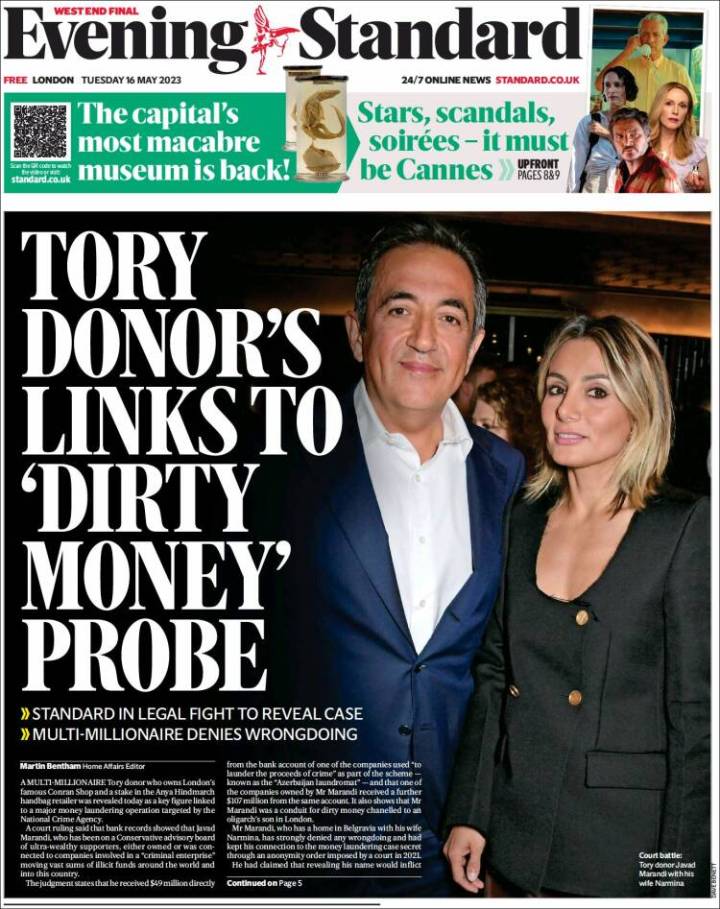
See: ‘Millionaire Tory donor and business tycoon Javad Marandi linked to major money laundering operation’ at: https://www.standard.co.uk/news/uk/conservative-tory-party-donor-javad-marandi-conran-shop-anya-hindmarch-money-laundering-nca-b1081279.html
BBC News ‘Javad Marandi: Tory donor’s link to massive money laundering probe.’ See: https://www.bbc.co.uk/news/uk-61264369
Press Gazette: “BBC and Evening Standard win right to identify man in ‘dirty money’ trial.” See: https://pressgazette.co.uk/media_law/azerbaijani-laundromat-court-open-justice/
Addition to Chapter Fourteen- Covering Inquests (and Fatal Accident Inquiries in Scotland) Friday 31st March 2023
Unprecedented anonymity order given to surgeon in double death hospital inquest proceedings
The Coroner for Mid Kent and Medway Catherine Wood issued an ‘unprecedented’ reporting ban in March 2023 on identifying the name of a surgeon who is a key witness in an inquest into deaths of patients who contracted herpes during operations.
Media lawyers and journalism bodies find it difficult to recall a similar instance of such a media prohibition order being made at an inquest hearing. The surgeon concerned may have infected the two new mothers with herpes. The coroner said the decision to ban identification is based on the surgeon’s ‘apprehension’ about being named when he takes the stand as a witness.
She said it is ‘likely impede his evidence in court’ and affect his health. See Irish Times & PA Media ‘‘Unprecedented’: Coroner prohibits naming of surgeon in herpes deaths inquest’ at: https://www.irishnews.com/news/uknews/2023/03/07/news/_unprecedented_coroner_prohibits_naming_of_surgeon_in_herpes_deaths_inquest-3114464/
There is a real risk this decision could open the floodgates to more restrictions protecting witnesses from identification in inquests. See: https://www.hilldickinson.com/insights/articles/anonymity-inquests-coroner-prohibits-naming-witness-herpes-death-inquests The decision was opposed by the bereaved families of those who died and media organisations. See: https://www.dailymail.co.uk/news/article-11808419/Agony-extended-family-mother-died-herpes-caught-surgeon-did-caesarean.htm
The Mid Kent and Medway Coroner is investigating the cases of Kimberly Sampson, 29, and Samantha Mulcahy, 32, who both died in 2018 after the same obstetrician conducted their caesareans. They were treated six weeks apart in hospitals run by East Kent Hospitals University NHS Trust (EKHUT).
Addition to Chapter 17 Reporting the Family Courts
The anonymity of medical clinicians in end of life proceedings, particularly involving infant children has been clarified by a key precedent in the Court of Appeal 31st March 2023. For the families involved Article 10 freedom of expression rights outweigh Article 8 privacy rights of medical carers.
See: Abbasi & Anor v Newcastle Upon Tyne Hospitals NHS Foundation Trust [2023] EWCA Civ 331 (31 March 2023) at: https://www.bailii.org/ew/cases/EWCA/Civ/2023/331.html
The background was explained by the Lord Chief Justice Lord Burnett: ‘These appeals concern the principles to be applied when a court considers an application to vary or discharge a Reporting Restriction Order (“RRO”) made long before in end-of-life proceedings in the High Court. Such orders often protect the identities of all those involved in the care of a patient in respect of whom an application to withdraw treatment is made. That is usually to protect the privacy of the patient, of the patient’s immediate family and of those concerned in the treatment of the patient as well as to safeguard the integrity of the proceedings.’
Lord Burnett went on to explain: ‘Such proceedings are apt to generate a great deal of passionate debate which spills over into harassment of those involved in the proceedings, picketing of hospitals and interference with the working of the hospitals. There are too many who involve themselves in these kinds of debate who lack all sense of proportion and display intolerance of anyone who disagrees with them. Some are not willing to admit that there may be two legitimate points of view. Nonetheless, the circumstances in which it is lawful or ethical to withdraw treatment is the subject of legitimate debate.’
In a unanimous ruling supported by Lady Justice King and Lady Justice Carr, Lord Burnett concluded the indefinite reporting restrictions were not correct in law because Article 10 freedom of expression rights outweigh Article 8 privacy rights.
Lord Burnett explained at paragraph 130 of his ruling: ‘The orders made in these cases provide for the indefinite continuation of injunctions against the world prohibiting publication of the names of a small number of clinicians in the Abbasi case and a wide range of health service staff in the Haastrup case. The intense focus on the specific rights being claimed delivers the clear conclusion that the article 10 rights of the parents in wishing to “tell their story” outweigh such article 8 rights of clinicians and staff as may still be in play, long after the RROs were made in the respective end-of-life proceedings. The wider systemic concerns which affect the operation of the NHS laid before the court by representative bodies cannot justify the creation of a practice, not anchored to the specific circumstances of the case, of granting indefinite anonymity to those involved in end-of-life proceedings. Such a step is one that is controversial and intensely political and suitable for Parliament rather than the courts.’
In an earlier paragraph Lord Burnett observed in paragraph 119 ‘…indefinite orders have the effect of adversely affecting open justice because they prohibit for all time an open and informed discussion of what occurred. Conferring lifelong anonymity though indefinite orders irrespective of the individual circumstances of those protected and thereby creating a broad-ranging new class of restriction on free expression is something which the courts should do only in “the most compelling circumstances.”‘
The case may be subject to appeal to the UK Supreme Court.
It is possible that this ruling could have an impact on the continued anonymity granted to the surgeon in the double death hospital inquest proceedings taking place in Kent with a full inquest hearing being heard in April 2023.
An excellent analysis of this ruling has been written by the much respected media lawyer Sam Brookman in the Hold The Front Page ‘Law Column: Reporting restrictions overturned in two end of life cases.’ She explains that the overturning of the two reporting restriction orders ‘are important legally because the judgment is another example of the courts coming down in favour of freedom of expression.’ (See: https://www.holdthefrontpage.co.uk/2023/news/law-column-reporting-restrictions-overturned-in-two-end-of-life-cases/)
New addition to Chapter 11 Social Media Law, Chapter 5 Protecting Children, and Chapter 19 Data Protection Law
The Information Commissioner fined the social media platform TikTok 12.7 million pounds 4th April 2023 for misusing children’s data.
The ICO found that more than one million UK children under 13 estimated by the ICO to be on TikTok in 2020, contrary to its terms of service.
Personal data belonging to children under 13 had been used without parental consent and TikTok “did not do enough” to check who was using their platform and take sufficient action to remove the underage children that were. See: https://ico.org.uk/about-the-ico/media-centre/news-and-blogs/2023/04/ico-fines-tiktok-127-million-for-misusing-children-s-data/
The initial fine had been set at £27 million. See: https://ico.org.uk/about-the-ico/media-centre/news-and-blogs/2022/09/ico-could-impose-multi-million-pound-fine-on-tiktok-for-failing-to-protect-children-s-privacy/ Taking into consideration the representations from TikTok, the regulator decided not to pursue the provisional finding related to the unlawful use of special category data. Special category data includes: ethnic and racial origin, political opinions, religious beliefs, sexual orientation, Trade union membership, genetic and biometric data or health data.
UK data protection law says that organisations that use personal data when offering information society services to children under 13 must have consent from their parents or carers. Companies who breach the UK GDPR and/or the Data Protection Act can be fined up to £17.5 million or 4% of the company’s annual global turnover, whichever is higher.
Information Commissioner, John Edwards said: ‘I’ve been clear that our work to better protect children online involves working with organisations but will also involve enforcement action where necessary. In addition to this, we are currently looking into how over 50 different online services are conforming with the Children’s code and have six ongoing investigations looking into companies providing digital services who haven’t, in our initial view, taken their responsibilities around child safety seriously enough.’ See ICO’s Children’s code at: https://ico.org.uk/childrenscode
This is just one of several setbacks in state regulation of TikTok across the global sphere. See Arab News ‘TikTok hit with UK fine, Australia government ban’ at: https://www.arabnews.com/node/2281316/media Italy’s competition watchdog had opened an investigation into TikTok for failing to enforce its own rules on removing “dangerous content” related to suicide and self-harm.
Australia joined a list of Western nations banning the Chinese-owned apps from government devices. The United States has been urging TikTok to split from its Chinese parent company, Bytedance. See the Guardian’s analysis by Kevin Rawlinson: “How TikTok’s algorithm ‘exploits the vulnerability’ of children.” See: https://www.theguardian.com/technology/2023/apr/04/how-tiktoks-algorithm-exploits-the-vulnerability-of-children
ICO fines TikTok £12.7 million for misusing children’s data
ICO could impose multi-million pound fine on TikTok for failing to protect children’s privacy
ICO Children’s Code for Digital online services
https://ico.org.uk/for-organisations/childrens-code-hub/
Arab News: ‘TikTok hit with UK fine, Australia government ban’
https://www.arabnews.com/node/2281316/media
Guardian’s analysis by Kevin Rawlinson: “How TikTok’s algorithm ‘exploits the vulnerability’ of children.”
New addition to Chapter 4- News Gathering, Story Finding and Public Interest
Investigatory Powers Commissioner’s Report for 2021 reveals information on intercepting journalists’ communications with sources. 11th April 2023.
It also discloses the first example of a Judicial Commissioner refusing an application to access data relating to journalists and their sources.
It seems the scale/number of state interception of journalists’ communications is substantially down on previous years.
74 authorisations in 2021 compared to 281 in 2020.
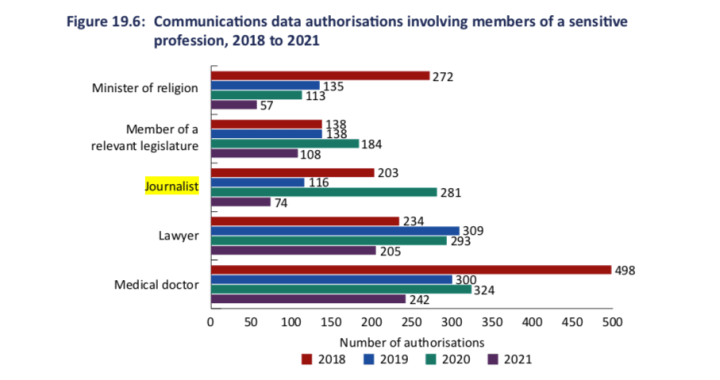
The report, for the first time, provides some more detail on the circumstances of interception and identification of the nature of contact between journalist sources and journalists.
However, the report does not identify the journalists concerned, the people they were talking to, or their publications.
Two clear examples of interception of data relates to police officers and police staff and journalists.
One case reveals the police were investigating information being leaked by a police officer to a freelance journalist for financial gain.
Another case reveals investigation of police staff for leaking information to journalists resulting in a victim being contacted. The misconduct in public office issue did not disclose this being done for financial gain.
The report reveals an instance where a Judicial Commissioner refused an application for interception of communications data between a source and journalist.
The rejection of the application was due to the fact of ‘there being no evidence the allegations had been leaked, nor had they appeared in the public domain several weeks following the suspected leak.’ The information being sought was the ‘name of an officer who was facing a misconduct hearing.’
It is not clear whether the source was a police officer, police staff or somebody else.
The report says the News Media Association and Media Lawyers’ Association met with the IPCO Chief Commissioner Sir Brian Leveson to talk about improving the reporting of this information.
Annual Report of the Investigatory Powers Commissioner 2021 and the activities of the Investigatory Powers Commissioner’s Office (IPCO) and Office for Communications Data Authorisations (OCDA).
See: https://ipco-wpmedia-prod-s3.s3.eu-west-2.amazonaws.com/Annual-Report-2021.pdf
New addition to Chapter 4– News Gathering, Story Finding and Public Interest
Highly significant European Court of Human Rights Grand Chamber ruling extending and strengthening Article 10 Protection of Journalists’ sources to the sources themselves when they act in the role of ‘good faith’ whistleblowers with public interest disclosure. Judgement in Strasbourg 14th February 2023 in the case of Halet v Luxembourg (Application no. 21884/18)
This is also known as the ‘Luxleaks case’ and was summarized and referenced on pages 161 to 162 of the printed 2022 Second Edition of UK Media Law Pocketbook.
Very briefly the case concerned Raphaël Halet, a French national, who worked for PricewaterhouseCoopers accountants in Luxembourg. The judges have ruled there was a violation of his whistle-blower’s freedom of expression, Article 10 rights as a result of his criminal conviction for disclosing confidential documents protected by professional secrecy, comprising 14 tax returns of multinational companies and two covering letters, obtained from his workplace.
He says he did this to a journalist in the public interest for no financial reward.
Up until now Article 10 protection of journalist source rights in Strasbourg cases have been robustly asserted in respect of the journalists, but this had not been clearly extended to the sources themselves when they suffered consequences from their exposure or identification.
In Monsieur Halet’s case, he had been criminally prosecuted and fined 1,000 Euros and additionally ordered to pay 1 Euro in compensation.
The Grand Chamber ruling is summarized with the following bullet-points:
Art 10 • Freedom of expression • Criminal-law fine of EUR 1,000 for disclosing to the media confidential documents from a private-sector employer concerning the tax practices of multinational companies (Luxleaks) • Consolidation of the European Court’s previous case-law on the protection of whistle-blowers and fine-tuning of the criteria established in the Guja judgment • No abstract and general definition of the concept of whistle-blower • Claim for protection under this status to be granted depending on the circumstances and context of each case • Overall assessment by the Court of the Guja criteria, taken separately, but without hierarchy or specific order • Channel selected to make the disclosure was acceptable in the absence of illegal conduct by the employer • Authenticity of the disclosed documents • The applicant’s good faith • Necessary balancing of competing interests at stake by the Grand Chamber, as the domestic courts’ balancing exercise did not satisfy the requirements identified in the present judgment • Overly restrictive interpretation of the public interest of the disclosed information, which had made an essential contribution to a pre-existing debate of national and European importance • Only the detriment caused to the employer taken into account by the domestic courts • Public interest in the disclosure outweighed all of the detrimental effects, including the theft of data, the breach of professional secrecy and the harm to the private interests of the employer’s customers • Disproportionate nature of the criminal conviction.
See the full ruling of the court https://hudoc.echr.coe.int/eng#{%22itemid%22:[%22001-223259%22]}
PDF document also available on this link
The legal summary of the case is available on this link: https://hudoc.echr.coe.int/eng#{%22itemid%22:[%22002-14005%22]}
The press release about the ruling is available on the link below:
This is not an all-encompassing template offering a strong pre-determined legal shield for journalists’ sources disclosing confidential information to journalists during their employment, but it will be influential and the seed for developing important precedents in this area.
It may strengthen the position of civil servant ‘whistle-blowers’ communicating to journalists public interest information without any financial reward or favour who under current English and Welsh criminal law face prosecution for misconduct in public office.
The judges explained there is no abstract and general definition of the concept of whistle-blower and the claim for protection under this status is to be granted depending on the circumstances and context of each case.
The ruling derived from principles developed in the 2008 Grand Chamber ruling of Guja v. Moldova which ‘had identified for the first time the review criteria for assessing whether and to what extent an individual divulging confidential information obtained in his or her workplace could rely on the protection of Article 10 of the Convention, and specified the circumstances in which the sanctions imposed were such as to interfere with the right to freedom of expression.’
The Grand Chamber judges in Halet decided that the context for whistleblowers had changed since 2008 ‘whether in terms of the place now occupied by whistle‑blowers in democratic societies and the leading role they were liable to play by bringing to light information that was in the public interest, or in terms of the development of the European and international legal framework for their protection.’
Halet is therefore important in confirming and consolitating the principles established in case-law for the protection of whistle‑blowers by refining the six criteria for their implementation:-
(1) The channels used to make the disclosure; (2) The authenticity of the disclosed information; 3) Good faith; (4) The public interest in the disclosed information; (5) The detriment caused, and (6) The severity of the sanction.
The Grand Chamber in Halet ‘verified compliance with the various Guja criteria taken separately, without establishing a hierarchy between them or indicating the order in which they were to be examined, which, while it had varied from one case to another, had never an impact on the outcome of the case. However, in view of their interdependence, it was after undertaking a global analysis of all these criteria that it ruled on the proportionality of an interference.’
The majority of 12 to 5 ruled that the interference with the Monsieur Halet’s right to freedom of expression by criminal prosecution, conviction and fine, in particular his freedom to impart information, had not been ‘necessary in a democratic society.’
The ruling has been welcomed by Protect the UK’s whistle-blowing charity ‘European Court backs LuxLeaks Whistleblower in his decision to expose tax avoidance in the public interest.’ See: https://protect-advice.org.uk/protect-luxleaks-whistleblower/
The International Consortium of Investigative Journalists was involved in reporting the Luxleaks case and reported the Grand Chamber ruling: ‘European court reverses course to rule in favor of LuxLeaks whistleblower. The European Court of Human Rights ruled that the public interest in leaking the data showing how multinationals spirited profits to the tiny nation outweighed the detrimental effect.’
Stelios Andreadakis, Reader in Corporate and Financial Law at Brunel University London, and Dimitrios Kafteranis Assistant Professor at the Centre for Financial and Corporate Integrity, Coventry University observed in their article for the Oxford Business Law Blog: ‘Apart from the undeniable impact of the judgment in relation to the right to freedom of expression, reference should be made to the notable protection offered to a whistleblower, who wanted to do the right thing, in good faith and without any intention to profit from it or to harm his employer. If the original criminal conviction had a ‘chilling effect’ on potential whistleblowers, who were considering speaking out about wrongdoings in their workplace, the Grand Chamber’s decision was a step towards the right direction: the direction of transparency, accountability and fairness.’
See: ‘Halet v Luxembourg: The Final Act of the Luxleaks Saga’ at: https://blogs.law.ox.ac.uk/blog-post/2023/02/halet-v-luxembourg-final-act-luxleaks-saga
Addition to Chapter Nine – Scottish and Northern Irish differences and issues 30th April 2023
New bill introduced by Scottish government in April 2023 to reform Scottish legal system by abolishing ‘not proven’ verdict, reduce the size of juries in criminal trials to 12 with two thirds majority verdicts, and explore ending the use of juries in trials for rape and attempted cases in a pilot project.
The proposals include reducing the number of people who sit on a jury from 15 to 12, which would be the same as the situation in the English and Welsh system.
At least eight of the 12 jurors would have to agree on a guilty verdict rather than the present situation which allows for a simple majority of eight out of 15.
The Victims, Witnesses, and Justice Reform (Scotland) Bill has been introduced to the Scottish Parliament to legislate these reforms.
The bill advocates the creation of a new specialist sexual offences court to run a pilot project where rape and attempted rape cases are tried being without a jury. A single judge would decide the facts and pronounce the verdict of guilty or not guilty and also sentence the accused.
Not proven is one of three verdicts which is unique to the Scottish legal system as an alternative to guilty and not guilty.
The outcome for defendants is the same as if they were found not guilty with the accused being considered innocent in the eyes of the law.
Part Six of the bill provides lifelong anonymity for complainants of sexual offences from the time they make an allegation: ‘This section will insert a new Chapter (Chapter 2B) into Part 6 of the Criminal Justice (Scotland) Act 2016 to make provision, through a prohibition on the publication of information likely to lead to the identification of victims of certain offences, for the lifelong anonymity of such victims.’
The prohibition will not ‘prevent the victim themselves from publishing the information. But a victim who
self-publishes information will not be covered by the exception to the extent that information they publish would be likely to lead to the identification of another person who is a victim of a relevant offence. A victim who is an adult is also able to consent to the publication of the information by another.’
Such restrictions affecting children under the age of 18 cannot be relinquished by the children themselves. An application would have to be made to a Sheriff’s Court and ‘before making a decision on such an application, the applicant and the child victim must be given an opportunity to make representations to the sheriff.’
Publications prevented from publishing information leading to the identification of complainants includes traditional forms of print and broadcast media, social media and other publicly accessible online forms of communication, such as Twitter.
Scottish ministers will have the power to add to or remove sexual offences from the list providing lifelong anonymity.
The legislation also provides the power to dispense with the restriction where a complainant receives a conviction for a ‘relevant offence’ such as ‘perjury, attempting to pervert the course of justice and making false statements and declarations.’
Useful links and further reading
Scottish Government ‘The not proven verdict and related reforms’
See: https://consult.gov.scot/justice/not-proven-verdict/
Victims, Witnesses, and Justice Reform (Scotland) Bill 2023
Victims, Witnesses, and Justice Reform Bill: factsheet
See: https://www.gov.scot/publications/victims-witnesses-and-justice-reform-bill-factsheet/
Single judge rape trial pilot
BBC News: ‘Not proven verdict to be scrapped in Scottish courts.’
See: https://www.bbc.co.uk/news/uk-scotland-65397235
What is Scotland’s not proven verdict?
See: https://www.bbc.co.uk/news/uk-scotland-glasgow-west-65394103
Scrapping ‘not proven’ could edge jurors to guilty, says study
See: https://www.bbc.co.uk/news/uk-scotland-49972637
Addition to Chapter Eleven – Social Media Law 30th April 2023
Libel ruling in social media case where the judge finds for a defendant alleging sexual assualt by blog and Facebook postings.
King’s Bench Division. William Hay v Nina Cresswell. Ruling by Mrs Justice Heather Williams 26th April 2023 in favour of the defendant.
The judge set out a summary of the case in paragraphs 1 to 9:
‘1.Mr Hay brings a claim for libel against Ms Cresswell in relation to her June and July 2020 publication of allegations that he had sexually assaulted her on the night of 27 – 28 May 2010 after the two had met in a nightclub in Sunderland.
2.Whilst there is some dispute about the precise meaning of the defendant’s publications, it is accepted that she alleged a violent sexual assault on the part of the claimant and that these words bore a defamatory meaning. It is also admitted that the claimant sustained serious harm. However, Ms Cresswell relies upon defences of truth and/or that the publications were on a matter of public interest. To a more limited extent she also relies upon a defence of qualified privilege.
3.The claimant is a tattoo artist. He says that the publications caused him great embarrassment, distress and damage to his reputation. He seeks general damages and also injunctive relief. A claim for aggravated damages is not pursued and no claim is made for financial loss.
4.The publications that form part of the claim are as follows:
i) On 4 June 2020 the defendant published a blog on the telegra.ph website (“the telegra.ph publication”);
ii) On 29 June 2020 the defendant contacted the claimant’s girlfriend and business partner, Emma Sweeney, by way of a Facebook message, attaching the telegra.ph publication (“the FB message publication”);
iii) On 3 July 2020 the defendant emailed Ms Sweeney (“the email publication”)
iv) On 22 July 2020 the defendant published two posts on Facebook (“the FB posts publications”);
v) On 22 July 2020 the defendant published a post on Instagram and shared the post to an Instagram story (“the Instagram publications”).
5.The Amended Particulars of Claim also relied upon the defendant’s Twitter post of 22 July 2020. However, this post did not name the claimant and the pleading did not rely upon extraneous material from which it was said that the claimant would have been identified as its subject. During the course of the trial, Mr Coulter indicated that he did not pursue the claim in relation to this post.
6.The defendant says that her primary intention in publishing these materials was to alert women who could otherwise become victims of sexual assault at the hands of the claimant, in particular in the context of his work as a tattooist. In summary, she says that in May 2010, when she was a 20 year old student, she met the claimant in ‘Passion’ nightclub, via a mutual friend, Richard Beston, and that he seriously sexually assaulted her as he was walking her home.
7.Further or alternatively, the defendant relies upon the defence in section 4 of the Defamation Act 2013 (“the 2013 Act”) that the publications complained of were or formed part of statements on a matter of public interest and she reasonably believed that publishing them was in the public interest, given that she reasonably believed the claimant had assaulted her and given the prevalence of sexual abuse within the tattoo industry and the need to protect women from this.
8.In relation to the FB message publication and the email publication only, the defendant also avers that the publications are protected by qualified privilege as she had a duty to communicate these matters to Ms Sweeney as the claimant’s employer or business partner, and Ms Sweeney had a duty to receive them, given the claimant would routinely come into intimate contact with unaccompanied female clients in the course of his tattooing work.
9.The claimant does not admit that the defendant was sexually assaulted on her way home from the nightclub and he maintains that if such an assault occurred, he was not the perpetrator and the defendant’s allegation in this regard is a deliberate fabrication on her part. Accordingly, he says that her truth defence and her public interest defence must fail. Furthermore, that the publications to Ms Sweeney were not on occasions of qualified privilege and, in any event the defence fails as the defendant acted maliciously in publishing knowingly false allegations.’
The judge concluded at paragraphs 215 to 217:
‘Overall conclusion and outcome
For the reasons that I have identified above I conclude that:
215) The natural and ordinary meaning of the defendant’s publications in relation to the claimant is that the claimant had violently sexually assaulted her;
216) This imputation was substantially true; the defendant has proved that the claimant sexually assaulted her in that manner in the early hours of 28 May 2010 in the circumstances that I have described. Accordingly, the statutory defence of truth provided for by section 2(1) of the Defamation Act 2013 is established;
217) Additionally, the defendant has established the defence in section 4 of the 2013 Act as she has shown that: the statements complained of were on a matter of public interest; that she believed this to be the case at the time of publishing them; and that her belief was reasonable in all the circumstances that I have discussed.
In light of these conclusions the claim fails and it is unnecessary for me to determine the further defence of qualified privilege. The question of remedy does not arise.
The parties will have the opportunity to address consequential matters by way of written submissions.’
Much attention has been given to the successful defence provided by Nina Cresswell under the public interest provision of Section 4.
The case has been reported journalistically by the Times (behind a paywall) ‘MeToo accuser wins landmark libel ruling after sex assault claim; at: https://www.thetimes.co.uk/article/metoo-accuser-wins-landmark-libel-ruling-after-sex-assault-claim-pr06kc27d and the Guardian ‘Sexual assault victim who named her attacker in blog defeats his libel action’ at: https://www.theguardian.com/law/2023/apr/26/nina-cresswell-named-sexual-assault-attacker-blog-defeats-billy-hay-libel-action and ‘My healing can start, says sexual assault victim after libel win’ at: https://www.theguardian.com/society/2023/apr/29/nina-cresswell-sexual-assault-libel-win
The Guardian reported her solicitor Tamsin Allen: ‘Allen said it was the first case of an abuser suing their victim for libel in which a public interest defence under the Defamation Act had succeeded. This applies when the statement complained of was on a matter of public interest and the defendant reasonably believed that publishing it was in the public interest, even if it turns out to be untrue.’
Legal analysis has been provided by The Good Law Project which supported Nina Cresswell. See: ‘WIN: Nina Cresswell wins libel case against William Hay who sexually assaulted her and then tried to silence her in court’ at: https://goodlawproject.org/update/win-nina-cresswell/, her counsel Jonathan Price at Doughty Stret Chambers ‘“Tattoo MeToo” libel claim won by sexual assault survivor’ at: https://www.doughtystreet.co.uk/news/tattoo-metoo-libel-claim-won-sexual-assault-survivor and her solicitors Bindmans ‘Bindmans client and sexual assault survivor wins libel action’ at: https://www.bindmans.com/knowledge-hub/news/bindmans-client-wins-libel-action/?utm_content=buffer5dce6&utm_medium=social&utm_source=twitter.com&utm_campaign=buffer
Addition to Chapter 10 Freedom of Information posted 10th May 2023
Adjudicating Section 14 FOIA- vexatious or merely irritating and inconvenient requests? Jared O’Mara v ICO and South Yorkshire Police
Many professional journalists and news publishers are familiar with public bodies resorting to the Section 14 FOIA qualified exemption to deny requests for information on the grounds that they are vexatious.
And it could be argued that over the years the Information Commissioner has tended to side with the public bodies where there are appeals.
But a ruling of the First Tier Tribunal Information Rights promulgated 19th April 2023 could place a safeguard and useful precedent against this tendency when the request, in whatever context, is clearly reasonable.
See: O’Mara v Information Commissioner [2023] UKFTT 381 (GRC) (19 April 2023)
Direct link https://www.bailii.org/cgi-bin/format.cgi?doc=/uk/cases/UKFTT/GRC/2023/381.html

Introduction and Decision Notice at the heart of the case paragraphs 1 to 3:
‘Introduction
- On 31 March 2021, Mr O’Mara made the following request for information to South Yorkshire Police (“SYP”):
I would like to place a Freedom of Information Request for all information you hold on the Police and Crime Act 2017 in relation to charging referrals made by the police after a suspect’s relevant bail period has expired and where the suspect then accordingly defaults to Release Under Investigation by way of police decision.
Please do not process any of my personal data in relation to this request.
Please also do not designate my request as being Vexatious as this information holds huge value to the general public”.
- Having had no reply, on 4 May 2021 Mr O’Mara complained to the Commissioner. After some delay concerned with the correct provision of documents, on 8 June 2021 the Commissioner contacted SYP requiring that a response be given to Mr O’Mara within 10 working days. SYP then took until 2 July 2021 to issue its response, which was that it refused to comply with the request because it considered it to be vexatious. There then followed a significant exchange of correspondence between the three parties until, on 24 March 2022, the Commissioner issued a Decision Notice ( [2022] UKICO ic-104057 ) concluding that SYP had indeed been entitled to refuse the request on that basis.
The Decision Notice
- The Commissioner agreed with SYP that the request was vexatious. SYP’s initial response to the Commissioner following Mr O’Mara’s complaint was sent by its Data Protection Officer, Ms Amanda Winder. The factors relied upon in her letter can be summarised as follows:
a. This was Mr O’Mara’s “51st request received into [SYP’s FOI] department, his 27th FOI request”;
b. Overlapping requests for the same or similar information would often be received before SYP had a chance to respond to earlier requests – a table was provided setting them out;
c. He had previously complained to the Commissioner about other vexatious requests, which SYP had reopened “out of goodwill”;
d. He had made unfounded accusations about SYP and others, for example accusing Ms Winder as Data Protection Officer of “acting in a criminal, fraudulent and corrupt manner” which was unfounded and upsetting;
e. SYP believed that Mr O’Mara acted out of a deliberate intention to cause disruption and annoyance to that organisation;
f. The present request was similar to four other specified requests.’
Conclusion on Vexatiousness at paragraphs 56 to 58:
Conclusion on vexatiousness
- We take a broad and holistic view, taking into account all the circumstances set out above without repeating them, to find that SYP were not entitled to treat the request as vexatious, and therefore as exempt from the duty at s.1 of FOIA. Without doubt, Mr O’Mara’s requests in early to mid-2020 looked likely to become disproportionately burdensome to SYP. There would have been justifiable concerns about his motive and the value of the information he sought.
- Yet in subsequent requests, Mr O’Mara changed his ways. While public authorities, the Commissioner and the Tribunal more commonly encounter a relentlessly deteriorating pattern of requests, here the opposite had occurred. It is unfortunate that this was not recognised by SYP; the present request followed a positive trend, having all the characteristics one might wish: easily complied with; politely and respectfully worded; on a new topic with an identifiable public interest; and coming some six months after any previous request. Parliament did not intend s.14 to operate as a permanent bar against making requests. If there was ever a point at which SYP was entitled to treat Mr O’Mara’s requests as vexatious, then it had long passed by 31 March 2021. There was no basis to consider that the burden of complying with the request was disproportionate to the motive and its value, given the high threshold of vexatiousness. We disagree with SYP’s characterisation of the situation, summarised at paragraphs 3 to 8 above.
- We therefore allow the appeal on the basis that, on the facts as we have found them to have been, the Commissioner was wrong in law to find that the request was dealt with in accordance with the provisions of FOIA. The appropriate decision is for the request to be re-considered without applying s.14(1).’
Eloise Spensley of the Jaffa Law Column for Hold The Front Page provided cogent and instructive analysis of this case 2nd May 2023 under the headline: ‘Why journalists should chase public bodies which miss FoI deadlines.’
Eloise Spensley observed: ‘The Tribunal found that the request in question possessed all the characteristics that one might wish of a reasonable submission and therefore found the characterisation of the request as vexatious to be unreasonable.’
The media lawyer added: ‘The Tribunal reserved harsh criticism for the Police, stating that they had not found any evidence of a “wider pattern” of behaviour that suggested Mr O’Mara had behaved unreasonably, noting that chasing a response following the passage of a deadline could hardly be classed as harassing.’
Addition to Chapter Two Guide to Court Reporting – Key facts and check-list 14th May 2023
Managing the placement of students to experience court reporting- some advice and resources.
The UK’s legal system needs public confidence and support. Access, qualitative, fair and accurate reporting in the media is a critical factor in furthering the constitutional principle of Open Justice. I believe universities educating and training journalists can encourage judges and court staff to improve and enhance the achievement of this purpose through active liaison and collaboration.
Journalism university tutors should directly reach out to the presiding judges for local court centres and their senior HMCTS managers. In partnership university and judicial institutions can facilitate and achieve trust, understanding, knowledge and in the end become models for the Open Justice provision.
Arrange a meeting. Discuss what can be achieved. Reach out and collaborate. If your university has a Law Department find out what they do and if lines of communication can be synchronized.
Tutors should be prepared to accompany student groups on any formal visits and if a busy timetable prevents this every time, they should certainly enquire, communicate and provide advance information about the student journalist groups, their purpose and presence, along with reassurance about the quality of education and training in media law being provided to them.
The students need accreditation letters, and when possible student journalist membership press cards from the CIoJ, NUJ and BAJ. (Is there not an advantage in the universities covering the costs for student membership of professional journalism bodies?)
When judges and court staff fully understand that the education and training of student journalists requires attendance and coverage of court hearings and the writing of reports with their assessment, this is more than likely to forge cooperation and most hopefully a symbiosis of appreciation and education. This can surely work both ways.
The USA developed the model many decades ago of media/bench committees at federal, state and city court centres where there would be the opportunity for the various professions to exchange views, thoughts and ideas on how they could all improve and sustain their respective aims. Whatever the decline in the infrastructure of local and regional journalistic coverage, I believe the university journalism and journalism training sectors are in a position to fill the vacuum and revive the function, purpose and extent of court reporting.
Such interaction could also extend to Coroners Courts and Youth Court centres. Yes, only accredited press card carrying professional journalists have access to Youth Courts, but might there be an argument for Youth Courts to permit student journalist reporting presence when accompanied by professional journalist tutors? The Youth Justice system needs understanding particularly at a time when so many young people are the victims and perpetrators of a worrying trend in knife crime.
Student journalists must respect the courtesies and dignity of the court by ensuring they attend on time and avoid excessive disruption of the proceedings when entering and leaving. Only do so during a lull in the proceedings. You should not be moving when the oath is being taken by a witness or juror.
It should go without saying that student journalists must dress smartly and appropriately in this environment. A guide to essential reporting published in 2007 observed: ‘They won’t actually throw you out if you turn up in jeans and a fcuk tee-shirt, but you will find them less than co-operative. Jacket and tie for men, smart outfit for women. No hats or bare shoulders.’
Student reporters should not bring food and drink into the courtroom, and must not use their smartphones and read newspapers, books and magazines during proceedings for personal entertainment. This includes those times when the court is not in session. Lawyers will be still be working in the courtroom.
Student journalists should avoid yawning openly, however boring and soporific the case and submissions. Falling asleep and snoring is another big no-no.
Raucous conversation and talking aloud, smiling and laughter should also be avoided during proceedings and adjournments. If you must talk to a colleague, whisper or write something down on paper. There is a risk that your exaggerated facial expressions could be misinterpreted by the relatives of crime victims and defendants who may be in the public gallery or well of the court.
When the court session begins everyone is expected to stand up when the judge(s) or justices enter and leave the courtroom. It is customary for solicitors, barristers and court officials to bow. You do not have to, but it would not be held against you if you do.
What does the current HMCTS ‘General guidance to staff on supporting media access to courts and tribunals’ say about student journalist/court reporters?
‘Student journalists
Student journalists will often attend court cases or hearings as part of their training. We should support this as one way to encourage greater court reporting. They are not entitled to sit in press seats but should sit in the public gallery where they are entitled to take notes without permission from the court or judge/magistrate. However, in sensitive cases (such as organised crime), it will help the judge and staff to avoid any misunderstanding if they identify themselves in advance to explain that they plan to do so. Student journalists do need to make an application to the court if they want to use text-based devices to communicate from court. If you receive a request from a student journalist, please speak to the judge presiding over
the case or trial. If a lecturer wants to attend court with a group of students
to observe a case or hearing, it is good practice (but not mandatory) to let the court know in advance.’
Here is an outline of the information which can be pulled together about the legal system in the Greater London Area as an example of what can be done regionally in other parts of the UK.
This briefing is provided by pdf file in two column format with contacts and details for the courts in the London area.
Addition to Chapter 3- Libel, Privacy, Accuracy and Balance 27th May 2023
On 25th May 2023 Mr Justice Saini gave judgment in a high profile libel trial over allegations published in an online website combined with Tweets.
The case concerned the naturalist Chris Packham who sought libel damages against the authors of the online Country Squire Magazine alleging he had misled people into donating to a tiger rescue charity.
The case is interesting in its evaluation of serious harm by online and social media publication, the engagement of truth and public interest defences and the successful defence by the third defendant on the grounds he was merely a proof-reader for the articles in dispute and he had only retweeted the libellous allegations and not been responsible for their original content.
See: Packham v Wightman & Ors [2023] EWHC 1256 (KB) (25 May 2023) at https://www.bailii.org/ew/cases/EWHC/KB/2023/1256.html
From judiciary uk website https://www.judiciary.uk/wp-content/uploads/2023/05/Packham-v-Wightman-Judgment-250523.pdf
Between paragraphs 1 to 8, Mr Justice Saini provides an introduction to the overview:
- ‘This is the trial of a defamation claim in which the Claimant (“Mr Packham”), a naturalist, television presenter and campaigner, sues three individuals in respect of articles published on the website of an online publication called Country Squire Magazine (“CSM”), and by way of social media including Twitter. The claim concerns three separate and unrelated matters.
- The first concerns the tigers Girona, Mondo, Antonella, Natasha and Zoppa (“the Tigers”), that once performed in a Spanish circus (Circo Wonderland) but were later either “re homed” or “rescued” (depending on one’s perspective) and given what have been called “forever homes” in an animal sanctuary (“the Sanctuary”) on the Isle of Wight. The Sanctuary is associated with Mr Packham and is operated by the Wildheart Trust (“the Trust”). Mr Packham is a trustee of the Sanctuary. He is alleged to have made fraudulent statements during 2018 in order to raise money from the public to fund the Tigers’ journey from Spain to the Sanctuary, and for their subsequent care in their new home. This was the focus of the trial. I will call this the “Circus Big Cats Allegation”.
- The second subject of the claim is a statement made by Mr Packham to raise money from the public for the Sanctuary during the Covid-19 Pandemic in March 2020. He is alleged to have acted fraudulently in concealing insurance payments, or availability of insurance, from potential donors which made such a statement misleading and dishonest by omission. I will call this “the Insurance Allegation”.
- The third subject is a statement made by Mr Packham, during COP26 in Glasgow in November 2021, which concerned Muirburns. A Muirburn is the Scottish term for the practice of burning off old heather to encourage new growth. Mr Packham is said to have falsely stated that this practice has the effect of burning peat below the heather, thereby releasing harmful carbon into the atmosphere. I will call this “the Muirburn Allegation”.
- On its website, CSM describes itself as “a platform for voices from the overlooked Great British Countryside” and professes a hope “to be a beacon for Truth in a world where moral relativists often have the loudest voices.” In broad terms, CSM’s slant is pro-field sports and before me has been called a voice for “traditional” countryside management. It has
previously published articles critical of Mr Packham and those who share his views on animal welfare and nature conservation issues. - The First Defendant (“Mr Wightman”, or “D1”) is the editor of CSM. He accepts responsibility for each of the publications, including those made by social media. Mr Wightman is an asset manager by profession. He explains that CSM was set up as an online magazine in 2016 by him and two other “Brexiteers” to illuminate what they perceived as the injustice of the undemocratic positions taken by some “Remainers” at that time, and to partake in the campaign to see through the national referendum result, using “the cloak of the Brexit-voting ‘countryside’ to help achieve its aims”. He describes CSM and himself as “conservative”. CSM is said to be principally focussed on current affairs and politics with about a fifth of its articles covering countryside issues. He described the magazine as a “humble blog”. That said, on his own evidence, certain of the articles in issue in these proceedings were read by numbers going into the 170,000s on Facebook.
- The Second Defendant (“Mr Bean”, or “D2”) is an IT consultant. Together with Mr Wightman, he accepts responsibility for the publications in CSM attributable to him and all his social media postings.
- The Third Defendant (“Mr Read”, or “D3”) is a retired computer programmer. He puts in issue any legal responsibility for the publications. He argues that he acted as a form of “proof-reader” in relation to the First to Fourth Articles and not as an author or editor of them. Although he was named in the by-line to these articles, together with D2, he says that was a decision made by D1 and D2, by way of a “thank-you” gesture to reflect his free proof-reading assistance. D3 says it was not reflective of any wider responsibility or role in drafting or making publication decisions. He admits sending the retweets pleaded against him but raises a number of defences to liability.’
Paragraphs 205 to 207 set out the judge’s decision on the amount of damages to be awarded against defendants one and two and a conclusion on liability for the libels:
- I turn to quantum. I was referred to a number of awards in other cases involving imputations of dishonesty. Each case must however depend on its own facts and I am not limited by the cap which Mr Packham placed on the amount sought in his Claim Form. Having regard to the data before me as to the extent of publication, the nature of the allegations, the attempt to seek his dismissal from the BBC through making them, the evidence of Mr Packham as to the effect on him, and my findings as to additional conduct, I award the sum of £75,000 in respect of the Circus Big Cats Allegation. I award £10,000 in respect of the Insurance Allegation, and £5,000 in respect of the Muirburn Allegation. Those allegations are less serious in context and were not the subject of repetition. I also bear in mind the need to ensure that any overall damages award is proportionate given that free speech interests are implicated.
XI. Conclusion - Mr Packham’s defamation claims against Mr Wightman and Mr Bean succeed. Mr Packham did not commit any acts of fraud or dishonesty. I will enter judgment for damages against Mr Wightman and Mr Bean in the sum of £90,000.00. I understand that they do not oppose injunctive relief.
- The claims against Mr Read are dismissed. I will hear further argument in relation to additional relief including orders under section 12(1), and section 13(1), of the Defamation Act 2013, and in relation to costs.
Chris Packham was represented by counsel Jonathan Price and Claire Overman.
Paul Read’s defence as advocated by Mr David Price KC is analysed and evaluated by the judge between paragraphs 53 and 76 and while the arguments are specific to the circumstances and facts of this case, the ruling could be influential to libel defendants in the future arguing that they were proof-readers and not authors or editors of online publications and the issue of serious harm in relation to retweets.
Sam Brookman has analysed the ruling for the Law Column of Hold The Front Page from the aspect of best journalistic practice to approach the subject of a story for their comment prior to publication. She concludes:
‘Whilst this case came down to more than the Defendants’ failure to approach Mr Packham for comment, in other cases such a failure could very well be the deciding factor for the public interest defence.
Every journalist is aware that best practice demands you should approach the subject of an article for comment prior to publication, and provide them with a reasonable amount of time in which to respond. Of course, commercial pressures will often mean that taking the time to make that approach for comment is not easy – after all, news is a “perishable commodity” – but if you don’t, make sure you have an exceptionally good reason for not doing so.’
Law Column: Approaching for comment, the Public Interest defence, and the Packham case
by Sam Brookman Published 13 Jun 2023. See: https://www.holdthefrontpage.co.uk/2023/news/law-column-approaching-for-comment-the-public-interest-defence-and-the-packham-case/
Coverage by mainstream media
BBC News- ‘Chris Packham wins libel claim against website’ see: https://www.bbc.co.uk/news/uk-england-hampshire-65707076
Guardian- ‘Chris Packham awarded £90,000 damages in libel case. Naturalist wins claim over articles on Country Squire Magazine website that accused him of lying about charity’ see: https://www.theguardian.com/uk-news/2023/may/25/chris-packham-wins-libel-claim-against-website-that-accused-him-of-lying
Mail Online- “Triumphant Chris Packham calls for tougher punishment for ‘online abuse and hate crimes’ as he wins £90,000 libel battle over claims he ‘manipulated’ the public into donating to wildlife charity” see: https://www.dailymail.co.uk/news/article-12124575/Chris-Packham-calls-tougher-punishments-victims-online-abuse-hate-crimes.htm
Addition to Chapter 3 Libel, Privacy, Accuracy and Balance Sunday 11th June 2023
High Court judge stops high profile defamation action and criticises the claimant saying ‘witness statements in litigation are not to be used for settling scores or advancing some wider agenda.’ (Court ruling 7th June 2023)
Mr Justice Nicklin is the head of the High Court media list and in Amersi v Leslie and others, he said the litigation brought by businessman Mohamed Amersi claiming his reputation had been seriously harmed by publication of memos to a former lord chancellor, Sir David Lidington, was ‘fanciful and devoid of reality.’
He observed: ‘The claimant’s case of serious harm to his reputation is not based on any properly premised inference. It is speculative and optimistic guesswork.’
108 page ruling of Amersi v Leslie & Anor [2023] EWHC 1368 (KB) (07 June 2023) available at https://www.judiciary.uk/wp-content/uploads/2023/06/Amersi-v-Leslie-judgment-070623.pdf
And:
Amersi v Leslie & Anor [2023] EWHC 1368 (KB) (07 June 2023)
Media coverage:-
Guardian: ‘Conservative donor has defamation case against Tory MP struck out. Mohamed Amersi criticised by high court judge for his conduct in proceedings against Charlotte Leslie.’ See: https://www.theguardian.com/politics/2023/jun/07/conservative-donor-has-defamation-case-against-tory-mp-struck-out
Independent: ‘Millionaire Tory donor’s libel action against ex-MP thrown out in ‘landmark’ ruling. Exclusive: Verdict comes after long-running legal battle between multi-millionaire donor and former Tory MP.’ See: https://www.independent.co.uk/news/uk/home-news/tory-donor-press-freedom-mohamed-amersi-b2353216.html
Law Society Gazette: ‘High-profile defamation case dismissed by judge.’ See: https://www.lawgazette.co.uk/news/high-profile-defamation-case-dismissed-by-judge/5116258.article
This is a long and complicated ruling in terms of detail. The alleged libels were in memos. The judge described the parties in paragraphs 5 and 6.
(1) The parties
5. In the Particulars of Claim in this action, the Claimant describes himself as a “businessman and philanthropist”. The Claimant is the founder of the Conservative Friends of the Middle East and North Africa Limited, a company limited by guarantee, incorporated on 21 January 2021, which aims to promote a better relationship between the Conservative Party, the UK Government and the Middle East and North Africa (“COMENA”).
6. The First Defendant is a former member of Parliament and the managing director of the Second Defendant. The Second Defendant is a company limited by guarantee, incorporated in March 2019. According to evidence filed by the Defendants, however, the organisation, the Conservative Middle East Council (“CMEC”), has been in existence for over 40 years. It was established by the former Foreign Secretary, Lord Carrington, on the instruction of the then Prime Minister, Margaret Thatcher. Its purpose was to forge and maintain relationships between the Conservative Party and the Middle East and North Africa region and included organising events, debates, facilitating interaction between Conservative MPs and Middle Eastern embassies in the United Kingdom and arranging fact-finding missions to the region for Conservative MPs. CMEC is associated with, but no longer formally affiliated to, the Conservative Party.
The judge’s view on whether there had been serious harm to his reputation caused by the publication of the memos to Sir David Liddington is set out in paragraphs 191 and 192:
‘191. The case of serious harm to reputation caused by publication of the Memos to Sir David will be as evidentially hopeless at trial as it is now. There can be no real prospect of the position improving before trial and there is no material dispute of fact that would require to be resolved at trial. It has not been suggested by the Claimant that there is any real possibility of something turning up in disclosure. Sir David has refused to get involved and so the prospect that he will provide a witness statement for the Claimant must be somewhere between remote and nil. Even if the Claimant were, by use of a witness summons, to compel Sir David’s attendance at the trial of this claim to answer questions as to the impact that the publication of the Memos had on the reputation of the Claimant, Sir David has already made clear that he cannot now differentiate between harm caused by the Memos and subsequent press coverage of the Claimant. Had the Claimant approached Sir David for a witness statement when he received the 14 May Documents, that problem might have been overcome. This is perhaps one of the pitfalls of adopting what I have found to be a tactical approach to the conduct of these defamation proceedings adopted by the Claimant.
192. Overall, the Claimant’s case that his reputation has been seriously harmed (or is likely to be) as a result of publication of the Memos to Sir David Lidington is fanciful and devoid of reality. The Claimant’s case of serious harm to his reputation is not based on any properly premised inference. It is speculative and optimistic guesswork. Applying the merits test, the time has come to bring an end to this part of the Claimant’s claim. Allowing it to continue would not serve the overriding objective. Permission to amend is refused for the case of serious harm to reputation alleged to have been caused by Publications 3 and 4 to Sir David Lidington.’
Mr Justice Nicklin’s conclusion and criticism of the claimaint can be seen at paragraphs 240 and 241:
‘240. Nevertheless, there are several aspects of the conduct of the Claimant – many of which were relied upon by the Defendants – that give real cause for concern as to (1) whether his pursuit of these proceedings has been genuinely to seek vindication rather than some other impermissible collateral purpose(s) and (2) whether he has sought to obtain this vindication at proportionate cost.
(1) First, the delay in commencing the defamation proceedings (and then taking almost the maximum permitted period to serve the claim) is inconsistent with a desire to seek prompt vindication. The Claimant had sufficient information to commence a libel claim, substantially in the form in which it has now been advanced, after receipt of the 14 May Documents. The failure to do so has not been adequately explained.
(2) Second, the Claimant has adopted an exorbitant approach to the litigation (including the Data Protection Claim) and has refused to provide information about his costs to the Court. When this defamation claim was finally commenced, it advanced multiple causes of action (including several to unidentified publishees) that substantially added to the complexity (and likely cost) of the proceedings without adding anything of tangible benefit that a more restrained approach to selection of the causes of action could not have achieved. A litigant suitably concerned about the costs of the litigation – having proper regard to the overriding objective – would not have acted in this exorbitant way. Given the overlap of defamatory meanings, the cost of pursuing multiple causes of action was likely to be wholly disproportionate to any benefit that the Claimant could legitimately achieve. Whilst conducting the proceedings in this manner, the Claimant has steadfastly refused to provide accurate information about his incurred costs to the Court (see [43] and [47]-[49] above), including on the ground that the information was confidential. It is difficult to treat that submission seriously when the Claimant was willing to share the figure of his costs with a journalist (for publication) (see [18] above).
(3) Third, in his interview with Mr Burgis, given at some point before 7 July 2021, the Claimant said that he intended to “take [the First Defendant] to the cleaners” and that once the Data Protection Action had been completed, he intended to commence a libel action. This demonstrates that, at least by early July 2021, the Claimant fully intended to bring a further claim against the Defendants for libel (which he did not finally serve until April 2022). Subjecting a person to successive civil claims can be a hallmark of abusive conduct: see Henderson -v- Henderson (1843) 3 Hare 100. Without good reason, a claimant is expected to bring all his/her civil claims against a defendant in one action. The Claimant could and should have brought his libel action when he commenced his Data Protection Action. The decision to proceed first with the Data Protection Claim was, I am satisfied, both deliberate and tactical. A claimant who was genuinely interested in vindication is unlikely to have delayed as the Claimant did. Pursuit of two sets of proceedings has also taxed the resources of the Court and the Defendants beyond what was justifiable.
(4) Fourth, the Claimant’s interviews in the media (particularly the Observer Article – see [23] above) – and some parts of his witness statements filed in these proceedings – strongly suggest that the Claimant has treated this libel action as providing him with an opportunity also to seek to embarrass (and possibly to punish) the Conservative Party for, as he perceives it, having wronged him. That is not a legitimate purpose of civil proceedings for defamation.
241. For the reasons I have explained, I do not need to resolve whether the Claimant has pursued this libel action for an impermissible collateral purpose. What I am entitled to conclude is that, by conducting the proceedings in the way I have identified, the Claimant has exhausted any claim he might have on the further allocation of the Court’s resources to this action. Although I have concluded that no purpose would be served by giving the Claimant a further opportunity to replead his claim, I am also satisfied that it would not serve the overriding objective to permit the Claimant to do so. As a result, this claim is at an end.’
Addition to Chapter 3- Libel, Privacy, Accuracy and Balance 13th June 2023
UK government announced 13th June 2023 that ‘Judges will be given greater powers to dismiss lawsuits designed purely to evade scrutiny and stifle freedom of speech through government amendments to the Economic Crime and Corporate Transparency Bill.’
The government expained:
‘Definition of an economic crime SLAPP
For the purposes of section (Strategic litigation against public participation: requirement to make rules of court) a claim is a “SLAPP claim” if—
- the claimant’s behaviour in relation to the matters complained of in the claim has, or is intended to have, the effect of restraining the defendant’s exercise of the right to freedom of speech
- the information that is or would be disclosed by the exercise of that right has to do with economic crime
- that disclosure is or would be made for a purpose related to the public interest in combating economic crime
- any of the behaviour of the claimant in relation to the matters complained of in the claim is intended to cause the defendant—
- harassment, alarm or distress
- expense
- any other harm or inconvenience
- beyond that ordinarily encountered in the course of properly conducted litigation
SLAPPs legislation will only apply to England and Wales.
Coverage in UK media
Guardian: ‘UK judges to be given powers to dismiss oppressive Slapps lawsuits at early stage. Amendments to bill address concerns that strategic lawsuits against public participation stifle free speech.’ See: https://www.theguardian.com/law/2023/jun/13/uk-judges-to-be-given-powers-to-dismiss-oppressive-slapps-lawsuits-at-early-stage
Financial Times: ‘Judges in England to gain new powers in clampdown on abusive litigation. Long-awaited restrictions on ‘Slapp’ suits will cover only economic crime cases.’ See: https://www.ft.com/content/2a9607c5-c1be-47c8-8fcd-027b5cbf4c42
Hold The Front Page: ‘Editors welcome plan to protect journalists from ‘intimidating’ legal threats.’ See: https://www.holdthefrontpage.co.uk/2023/news/editors-welcome-plan-to-protect-jour
Addition to Chapter 9-Chapter Nine – Scottish and Northern Irish differences and issues 15th June 2023
Police investigation into finances of the SNP, contempt of court, and the applicability of UK Supreme Court ruling in ZXC on reasonable expectation of privacy for crime suspects
It has not gone without notice that very high profile political figures in Scotland, namely former SNP First Minister Nicola Sturgeon, her husband and former SNP Chief Executive Peter Murrell, and the party’s treasurer Colin Beattie have all been arrested, questioned and released without charge.
Police Scotland is investigating what happened to £660,000 of donations given to the SNP by independence activists for use in a future independence referendum campaign.
The UK Supreme Court’s decision in ZXC v Bloomberg in February 2022 set a high bar of reasonable expectation of privacy versus public interest freedom of expression for crime suspects investigated by the police, questioned voluntarily, or arrested, questioned and released without charge.
But this was an English case and it is not binding in Scotland which has its own and separate media law jurisdiction. See Fergus Whyte’s article for Law Society of Scotland ‘Police enquiries: a private matter? The Supreme Court has upheld a privacy-based claim by an individual subject to a criminal investigation but not charged. This article considers the ruling, and its possible effect in Scotland’ at: https://www.lawscot.org.uk/members/journal/issues/vol-67-issue-04/police-enquiries-a-private-matter/
Mr Whyte explains another key difference in the process between Scotland and England:
‘Only after the CPS has made a decision on the case is the suspect formally charged (Director’s Guidance on Charging – Sixth Edition, Crown Prosecution Service). In Scotland, a police decision to “charge” is in fact a decision that they will refer the case to the Crown Office & Procurator Fiscal Service (“COPFS”) for it to decide what further action to take. There are a wide range of options available to COPFS other than instituting proceedings.’
What is clear is that Police Scotland did not publicly identify Nicola Sturgeon or the other people who have been arrested and questioned. See: ‘Investigation into Scottish National Party funding and finances – update’ at: https://www.scotland.police.uk/what-s-happening/news/2023/june/investigation-into-scottish-national-party-funding-and-finances-update/
The police statement also says ‘The matter remains active for the purposes of the Contempt of Court Act 1981 and the public are therefore advised to exercise caution if discussing it on social media.’
The Strict Liability Rule in the 1981 Contempt of Court Act that publication of information when a case is active (after arrest for example) will be a contempt of court if it creates a substantial risk of serious prejudice is fully engaged in such cases whether in Scotland, England and Wales, or Northern Ireland.
And this issue is being commented on and discussed in Scotland and elsewhere.
On February 7th 2023 COPFS in Scotland used its official Twitter channel to publish a reminder about the Contempt of Court Act restrictions. See:
And Roddy Doyle KC, Scotland’s Dean of the Faculty of Advocates, thought he should use his Twitter account to make a ‘public service announcement’ about contempt of court risks, presumably in respect of social media commentary:
What is the right judgment call where the suspect makes an extensive public statement declaring innocence? Early media contempt of court case law in England from 1983 established that it is possible to create a substantial risk of serious prejudice to the prosecution case as much as to that of a defendant whether or not the matter goes to jury trial.
The SNP finances police inquiry story is a difficult case history to navigate given the intense public interest status of the suspects.
An example of how the BBC is managing this is the story published online 13th June 2023: ‘Calls for Nicola Sturgeon to be suspended from SNP following arrest’ at: https://www.bbc.co.uk/news/uk-scotland-scotland-politics-65874678
The Section 5 defence in the 1981 Contempt of Court Act also applies:
‘5. Discussion of public affairs. A publication made as or as part of a discussion in good faith of public affairs or other matters of general public interest is not to be treated as a contempt of court under the strict liability rule if the risk of impediment or prejudice to particular legal proceedings is merely incidental to the discussion.’
Imagine the decisions British media would have to make should equivalent political figures in England be subject to investigation for serious criminal allegations.
These media law decisions are also influenced by any context of law officer warnings and a situation developing where the boundaries are set by the extent to which media publishers and social media communicators are pursued for alleged breaches of contempt of court law.
Fraser Myers, the deputy editor of Spiked Online, has been prompted to discuss the dilemmas and comparative media law issues in ‘Why can’t we talk about the Nicola Sturgeon scandal? Contempt-of-court laws have chilled the debate we need about the former first minister’s arrest’ at: https://www.spiked-online.com/2023/06/12/why-cant-we-talk-about-the-nicola-sturgeon-scandal/
PDF file of this brifing
Addition to Chapter 3– Libel, Privacy, Accuracy and Balance 15th June 2023
News Group Newspapers for the Sun successfully defends privacy action to enable them to illustrate their investigation into a couple making substantial profits selling PPE to the government during the COVID pandemic.
A Court of Appeal ruling 19th May 2023 enabled the Sun newspaper and other publications such as the Mail Online and Private Eye Magazine to continue publishing images of Richard and Sarah Stoute while on holiday and in proximity to a villa in the Caribbean they have bought following the profits made by their company Full Support Healthcare Ltd selling PPE in government contracts.
Stoute & Anor v News Group Newspapers Ltd [2023] EWCA Civ 523 (19 May 2023)
See: https://www.bailii.org/ew/cases/EWCA/Civ/2023/523.html
Courts and Tribunals Judiciary judgments ‘May 19, 2023 Stoute and Stoute -v- News Group Newspapers Limited’ See: https://www.judiciary.uk/judgments/stoute-and-stoute-v-news-group-newspapers-limited/
Mr Justice Johnson’s ruling 17th January 2023 in favour of the Sun’s news website sustaining his refusal to restrain publication of two photographs of the Claimants arriving at a restaurant on a public beach and ‘the claimants are not likely to succeed at trial in showing that the publication of the two photographs involved a breach of a reasonable expectation of privacy.’ See: https://www.5rb.com/wp-content/uploads/2023/03/Judgment-for-Website-Stoute-v-News-Group-Newspapers-Ltd-.pdf
See 5RB’s analysis of this ruling and report of the Court of Appeal Outcome at: https://www.5rb.com/case/stoute-v-news-group-newspapers-limited/ and https://www.5rb.com/news/appeal-dismissed-in-stoute-v-ngn/
The Private Eye coverage has been online with the headline ‘Taking the PPE. Covid profiteering’ and printed in the Issue 1599 and the following articles have been published in the Sun and Daily Mail both in their printed editions and online:
Mail Online 1st and 2nd January 2023 ‘Frolicking at their Caribbean island hideaway: The couple who netted £2 billion from PPE contracts after their firm became the biggest beneficiary of NHS protective clothing deals.’ See: https://www.dailymail.co.uk/news/article-11590919/Couple-netted-2-billion-PPE-contracts-splash-Caribbean-surf.html
Sun 31st December 2022 and updated 5th January 2023 ‘LIVING IT UP Ex-nurse whose firm netted £2billion PPE contracts enjoys luxury life in Caribbean.’ See: https://www.thesun.co.uk/news/20909304/nurse-ppe-billions-caribbean/
Sun 7th January 2023 ‘HAPPE XMAS Ex-nurse and husband who pocketed billions from NHS PPE deals swig £250 bottles of fizz in winter Caribbean break.’ See: https://www.thesun.co.uk/news/20974181/nurse-husband-billions-nhs-ppe-caribbean-break/
In the Court of Appeal ruling Lord Justice Arnold explained at paragraph 1 the key legal issue to be decided:
‘The principal issue on this appeal is whether the Claimants (“Mr and Mrs Stoute”) have a reasonable expectation of privacy in respect of photographs taken of them by paparazzi on a public beach and published by the Defendant (“NGN”) in The Sun on Sunday. Mr Justice Johnson held for the reasons given in his judgment dated 17 January 2023 [2023] EWHC 232 (KB) that Mr and Mrs Stoute were unlikely to establish that they had a reasonable expectation of privacy, and he therefore refused Mr and Mrs Stoute’s application for an interim injunction to restrain further publication of the photographs pending the trial of Mr and Mrs Stoute’s claim for misuse of private information. Mr and Mrs Stoute appeal with permission granted by Warby LJ.’
In paragraphs 2 to 5, the ruling sets out the background of why the claimants became the subject of media interest:
‘The facts
- The following account of the facts is taken largely from the judge’s judgment, which in turn was based on two witness statements made by Mrs Stoute and the correspondence between the parties, NGN not having filed any substantive evidence. I have added a few details from Mrs Stoute’s statements.
- Mrs Stoute was formerly a nurse. In 2002 Full Support Health Care Ltd (“FSH”) was incorporated by Mrs Stoute and her parents to sell personal protective equipment (“PPE”) to NHS and private hospitals. It is now owned and run by Mr and Mrs Stoute. In the accounting period to March 2019, FSH’s profits were just over £800,000. In March to July 2020 there was a huge demand for PPE as a result of the Covid-19 pandemic. FSH secured government contracts worth about £2 billion.
- Mrs Stoute’s evidence is that, since 2021, there has been a lot of press interest in her, Mr Stoute and FSH, and that they have worked hard with their lawyers to protect their privacy. She says that, prior to the events giving rise to the present dispute, there were only a few photographs of them available online from the FSH website, from when she gave evidence to the Public Accounts Committee and in an article in The Sunday Times.
- In late 2021 Mr and Mrs Stoute bought a second home which abuts a public beach in Barbados. They also bought a boat. Mr Stoute’s family is from Barbados. Mr and Mrs Stoute have three children now aged 16, 18 and 23. On 26 December 2022 Mr and Mrs Stoute went to stay at their second home, together with their children, several adult friends and their friends’ children.’
Lord Justice Arnold’s 24 page ruling concludes at paragraph 65 and 66:
65. It follows that the judge made no error in concluding that it was unlikely that Mr and Mrs Stoute would be able to establish that they had a reasonable expectation of privacy in respect of the publication of the photographs. Even if he was wrong about that, however, he made no error in concluding that the balance of the risk of injustice favoured the refusal of an injunction. Counsel for Mr and Mrs Stoute submitted that the judge had failed correctly to apply PJS as to the effect of further publication of material that has already entered the public domain, but the judge directed himself in accordance with PJS. Given that the photographs had been published three times in two national newspapers, both in print and online, he was entitled to conclude that Mr and Mrs Stoute would suffer little additional irreparable damage in the event of further publication of them before trial and that the balance favoured refusal of an injunction.
Conclusion
- For the reasons given above I would dismiss this appeal. I would nevertheless endorse what the judge said at [37]:
Judgment Approved by the court for handing down. Stoute v NGN
“This does not mean that the defendant or others may publish any pictures of the claimants with impunity. It just means that the claimants have not established their case in respect of the application for an injunction that they have made. It is entirely possible that there are pictures in the possession of the defendant or others which would, if published, amount to an actionable tort.”’
PDF file of this briefing
Addition to Chapter 2 – Guide to Court Reporting – Key facts and check-list
Judge rules governor needs to reconsider request by Life prisoner to be phone interviewed by investigative journalist podcaster in England and Wales High Court judicial review- 16th June 2023
The High Court Judge determined that the refusal by the prison governor should be quashed. The Article 10 freedom of expression issue was not fully determined.
The case law reference is Alexander, R (On the Application Of) v Eveleigh [2023] EWHC 1407 (Admin) (16 June 2023) and available at: https://www.bailii.org/ew/cases/EWHC/Admin/2023/1407.html
Also available on UK judiciary website at: https://www.judiciary.uk/wp-content/uploads/2023/06/Alexander-v-Secretary-of-State-for-Justice-judgment-160623.pdf
Mr Justice Andrew Baker introduced the background and legal issues in the case in paragraphs 1 to 9:
- The claimant seeks a judicial review of a refusal of consent for him to be interviewed
by telephone by the interested party, an independent investigative journalist. Consent
was required because the claimant is a serving prisoner following his conviction in
2010 on a charge of murdering his father. The refusal was therefore a decision made
by the Governor of HMP Coldingley in Surrey (‘the Governor’), where the claimant is
serving his life sentence, the minimum term under which was set at 16 years by the
sentencing judge.
- The defendant Secretary of State is responsible for that decision and the proper
defendant to any judicial review claim in respect of it. Permission to apply for judicial
review was granted in January 2023 by the Court of Appeal (Bean LJ), on paper, in an
application brought by the claimant for permission to appeal against a refusal of
permission in this court. - Mr Callus accepted a direct instruction to represent the claimant in March 2023, and
has done so pro bono in the finest traditions of the English Bar. He brought to what
had been well articulated, but somewhat diffuse and extensive, submissions prepared
by the claimant, both a focus, limiting the argument to a few points that mattered, and
a depth of analysis, underlying and informing the few points taken, that are hallmarks
of the skilled, experienced practitioner. I am very grateful for his assistance, the value
of which – whatever decision I might reach – was rightly acknowledged by Mr
Jolliffe, for whose assistance equally I am very grateful. - It is inevitable and proper that one consequence of imprisonment on the basis of a
criminal conviction is that the prisoner’s freedom of speech is curtailed, but prisoners
are not simply deprived of all right of free speech, nor lawfully could they be. As
Lord Steyn said in the leading case of Simms, “The starting point is the right of
freedom of expression. In a democracy it is the primary right: without it an effective
rule of law is not possible. Nevertheless, freedom of expression is not an absolute
right. Sometimes it must yield to other cogent social interests.” (Reg. v Secretary of
State for the Home Department, ex parte Simms and O’Brien [2000] 2 AC 115 at
125G). - Article 10 ECHR, as given effect under English law by the Human Rights Act 1998,
provides that the basic right to freedom of expression:
(i) “shall include freedom to hold opinions and to receive and impart information
and ideas without interference by public authority and regardless of frontiers
…” (Article 10.1), and
(ii) may be subject to inter alia conditions or restrictions prescribed by law that
are “necessary in a democratic society, in the interests of national security,
territorial integrity or public safety, for the prevention of disorder or crime,
for the protection of health or morals, for the protection of the reputation or
rights of others, for preventing the disclosure of information received in
confidence, or for maintaining the authority and impartiality of the judiciary”
(Article 10.2). The fundamental basis for the legitimacy of curtailing freedom
Judgment Approved by the court for handing down. Alexander v Secretary of State for Justice of expression is that the exercise of such freedom “carries with it duties and
responsibilities” (ibid). - It was common ground that along with Simms, the key authorities considering Article
10 in relation to the curtailment of the ability of serving prisoners to communicate
with the media are Hirst and Casciani, that is to say: R (Hirst) v Home Secretary
[2002] EWHC 602 (Admin), [2002] 1 WLR 2929; and R (BBC and Casciani) v
Justice Secretary [2012] EWHC 13 (Admin), [2013] 1 WLR 964). I note in passing
that in Simms and Hirst, the defendant was the Home Secretary since prisons and
prisoners’ rights were a responsibility of the Home Office until May 2007 when that
responsibility was taken over by the then newly formed Ministry of Justice. - Counsel’s submissions considered those authorities, and a few others, in some detail;
but as will become apparent, I have concluded that this claim succeeds on a basis that
does not require those submissions to be examined. - The grounds for judicial review pursued by the claimant, as focused by Mr Callus, are
that consent for the proposed telephone interview by the interested party was:
(i) unlawfully refused because the Governor misconstrued or misapplied the
policy set out in Prison Service Instruction (‘PSI’) 37/2010, in that:
(a) he treated the policy as requiring there to be an urgent need to
communicate such that written communication would not be effective,
whereas the criterion stated in PSI 37/2010 is that a telephone
conversation must be “the most suitable method of communication” and
urgency is but an example;
(b) he applied the wrong test and/or came to an irrational conclusion as
regards the criterion stated in PSI 37/2010 that “distress to victims
and/or outrage to public sensibilities will not result from the
broadcast”, i.e. (in this case) from the broadcasting of a recording of
the proposed telephone interview;
(ii) unlawfully refused because, if the refusal was in accordance with the policy set
out in PSI 37/2010, then that policy is unlawful in instructing prison
governors, in effect, to operate a blanket ban on telephone contact with the
broadcast media, or at all events to refuse consent in circumstances that would
infringe a prisoner’s Article 10 rights. - Mr Callus did not withdraw entirely reliance that the claimant had placed on ECHR
Articles 6 and 8 as well. However, he did not develop any argument on those
additional Articles at any length, and in my judgment they do not add anything to the
claim in this case.’
The key paragraph in the judge’s ruling is at 55:
‘The question of remedy in judicial review proceedings is discretionary, and for those
reasons I do not consider it just or convenient to pursue the possibility of declaratory
or mandatory relief. The justice of this case is served, in my view, by the quashing of
the Refusal Letter and the consequent requirement upon the Governor to consider
afresh the claimant’s request for consent to be given for the proposed telephone
interviewed by the interested party.’
At paragraph 59, he concluded:
‘The Refusal Letter was a misdirected and irrational decision to refuse the claimant’s
request to be allowed to give a telephone interview to the interested party. It will be
quashed, but I decline to grant further relief beyond that. The Governor will need to
consider the claimant’s request afresh.’
This is how the journalism trade and mainstream media has been reporting the case:
Press Gazette: ‘Man jailed for murder wins legal challenge over ban on speaking to media’ at: https://pressgazette.co.uk/media_law/mark-alexander-journalist-podcast/
Independent: ‘Murderer claiming wrongful conviction wins legal challenge over jail interview. Mark Alexander was found guilty of killing his father in September 2010.’ See: https://www.independent.co.uk/news/uk/crime/government-high-court-moj-surrey-ministry-of-justice-b2358898.html
The Judge limited his ruling to the rationality and reasonabless of the specific decision by the governor in the circumstances of this case and not wider Article 10 freedom of expression Human Rights issues about the right of prisoners to be sound record or video interviewed by journalists. Hence the Ministry of Justice saying afterwards: ‘the court did not find the policy on prisoner access to the media to be unlawful.’
PDF fil media law briefing on this subject
Addition to Chapter 3- Libel, Privacy, Accuracy and Balance Monday July 10th 2023
High Court Judge Mrs Justice Collins Rice developed new legal ground in protecting the anonymity of crime suspects on 29th June by imposing an injunction against the BBC which prevents identification of a high national and international public profile person, referred to as WFZ, who is under active criminal investigation for serious criminal sexual offences.
The judge has issued the injunction on the main ground that the court is sure to a criminal standard of proof that there would be a substantial risk of serious prejudice to the administration of justice.
The judge made clear that she would have also granted the injunction on the basis that identification of the claimant by the BBC would have been a misuse of his private information since he has reasonable expectation of privacy about having been arrested and questioned in a police inquiry prior to being charged. This was the starting point for the UK Supreme Court ruling in ZXC in February 2022.
See: WFZ v British Broadcasting Corporation [2023] EWHC 1618 (KB) (29 June 2023)
at https://www.bailii.org/ew/cases/EWHC/KB/2023/1618.html
See full pdf file of ruling at https://www.bailii.org/ew/cases/EWHC/KB/2023/1618.pdf
The judge said it was exceptional that she had heard the case in private.
The BBC informed the court it intended to report that at least a quarter of businesses in the sector in which the Claimant works have had employees investigated by the police for serious sexual offences, yet despite this the sector does not have any policies or procedures for employees who are accused of violence against women, nor any consistency of approach to allegations.
The reports would also use the Claimant’s case ‘as a stark illustration of these issues‘. The BBC was going to report the Claimant has been investigated by the police and arrested in respect of the allegations, since it is important to explain that his employer knows that this is the position and has taken no action.’
The summary of the background in paragraphs 5 to 7:-
- The Claimant is a man with a high public profile.
- On 5th June 2023, a journalist in the BBC’s News Investigation team, wrote him a ‘Right of Reply’ letter about an investigation the BBC had conducted into sexual misconduct allegations against him. It said they had spoken to a number of women who had given detailed accounts of behaviour by him including the commission of serious sexual offences. It said they intended to identify him in their reporting of this investigation. Although none of the complainants had agreed to be identified in the report, information about dates and places was provided to enable the Claimant to identify them. The letter set out the content of the allegations of four identifiable complainants, in brief, but explicit, form. It also referenced information provided by friends of the complainants and others. It recorded that the Claimant had been arrested in relation to allegations made by two of the complainants and interviewed under caution in relation to those of a third, and that police investigations were continuing.
- The Claimant thereupon sought an urgent interim non-disclosure injunction, without having issued an application or claim.
The Claimant was granted the interim injunction by Mr Justice Nicklin 8th June pending hearing the parties before Mrs Justice Collins Rice.
The key factor in deciding whether to grant an injunction on the grounds of protecting the claimant’s reasonable expectation of privacy is whether ‘he will probably (‘more likely than not’) succeed at the trial. In general, that should be the threshold an applicant must cross before the court embarks on exercising its discretion, duly taking into account the relevant jurisprudence on article 10 and any countervailing Convention rights.’
The Judge drew on two aspects of the recent UK Supreme Court ruling in ZXC, one of which was at paragraph 13 of her ruling:
…the UKSC’s confirmation, at [146], that ‘as a legitimate starting point, a person under a criminal investigation has, prior to being charged, a reasonable expectation of privacy in respect of information relating to that investigation…’. The nature of and rationale for that proposition are considered in more detail at [64]-[73]. Its rationale is that ‘publication of such information ordinarily causes damage to the person’s reputation together with harm to multiple aspects of the person’s physical and social identity such as the right to personal development, the right to establish and develop relationships with other human beings and the outside world all of which are protected by article 8 of the ECHR… The harm and damage can on occasions be irremediable and profound.’. That rationale, and the ‘negative effects of publishing information that a person is under criminal investigation’ and the ‘resulting uniform general practice’, are further expanded on at [80]-[89]. But the Court emphasised that it is a general rule or legitimate starting point only, not a legal rule or presumption; it does not replace the need for evidence and for fact-specific inquiry in every case. And much may turn on what the information and the investigation are about, and in particular how far they include information of an ‘intimate and personal nature’.’
Between paragraphs 17 and 27, the judge explored the previous case law concerning contempt of court. The potential legal ground for issuing the injunction would be derived from the 1981 Contempt of Court Act’s strict liability rule that a contemptuous media publication would have to be a substantial risk of serious prejudice to justice and Article 6 of the Human Rights Act and European Convention which protects the right to a fair trial.
At paragraph 27 she explained: ‘The authorities are in any event clear that courts should be slow to grant injunctions restraining contempt of court on a quia timet (prospective) basis. ‘It is the wise and settled practice of the courts not to grant injunctions restraining the commission of a criminal act – and contempt of court is a criminal or quasi-criminal act – unless the penalties available under the criminal law have proved to be inadequate to deter the commission of the offences’ (Pickering v Liverpool Daily Post at 381-2). Again, ‘… the courts should not award him such an injunction except in a clear case where there would manifestly be a contempt of court for the publication to take place’ (A-G v BBC [1981] AC 303 at 311-2).’
The judge said the case was active in terms of criminal proceedings because at paragraphs 33 and 34:
‘Police arrested the Claimant in 2022 on suspicion of a serious sexual offence following one of the complainants’ allegations. They released a statement to the media identifying the offence. The Claimant was not identified but the place of his arrest was. They later released another statement saying he had been further arrested on suspicion of two serious sexual offences alleged to have been committed against a different woman. The Claimant was bailed shortly afterwards. The police later confirmed it was taking no further action in relation to one of the alleged offences.
The police subsequently interviewed the Claimant under caution in relation to a third complainant, on suspicion of committing a sexual offence the year before. They issued a statement to that effect.’
The judge said at paragraph 51:
‘But the BBC naming the Claimant in connection with criminal investigations into allegations of serious sexual offending would undoubtedly be a substantial game- changer. The step up from rumour and gossip to a researched and substantiated breaking and rolling news item on a professional and edited national platform is one of orders of magnitude. The decision to identify would itself be a major and high-impact news story in its own right.’
The judge explained why she believes naming the claimant by the BBC in their reporting would be a contempt of court between paragraphs 66 and 70:
- The question I must start with is whether I can be sure that what I have called the bare minimum intended publication here – naming the Claimant in connection with his arrest and a police investigation into multiple allegations of (similar) serious sexual offending – is a publication which creates a substantial risk that the course of justice in the proceedings in question will be seriously impeded or prejudiced.
- My answer is that I can and must. This is a clear case. The risk that the course of justice in the criminal proceedings will be seriously impeded or prejudiced is substantial and manifest. The case is distinguished by the exceptional, and truly enormous, degree of publicity and public reaction I am entirely satisfied publication by the BBC would generate. It would be wholly naïve to proceed on any other basis and it was not seriously suggested that I should. I do not accept that that publicity could be managed satisfactorily or at all, including by any of the means indicated by the BBC. The identification of the Claimant in however a broad or allusive a manner in connection with the subject matter of its report would ignite a fire it could not hope to control and which would permanently disfigure him in the public mind. The BBC could not in the circumstances of this case avoid causal responsibility by pointing to others who may fan the flames of the fire it would deliberately have set. Even if responsible and regulated publishers reported nothing else at all over and above the bare minimum content the BBC proposes, the harm is inevitably done. The reality of modern public discourse must be faced. The BBC’s naming of the Claimant, not least because it is a national public service broadcaster, would inevitably be perceived as authorising unrestrained debate subject only to the anonymity of the complainants (which itself might be short-lived). That would bring into play all of the forensic problems set out above in an acute form, and risk irreparable harm to the forensic objectivity essential for any fair criminal trial.
- I am entirely satisfied on the evidence provided, and by reference to what I regard as its inevitable consequences, that the proposed publication creates a substantial risk that the course of justice in the live criminal proceedings currently under way will be seriously impeded or prejudiced by it. That is because, in the respects and for the reasons set out, I am satisfied it creates a substantial risk of impeding or prejudicing the necessary efforts to ensure that all the evidence, and only the evidence, properly forensically relevant to the trial of any criminal charges brought will be available to a jury. It consequently also creates a substantial risk of interfering with the proper making of the charging decisions themselves, depending as they do on the evidential prospects. I do not consider these risks capable of ultimately being mitigated by jury management or other measures in a way which would bring it below the substantial, because of the magnitude of the publicity and obloquy I am sure would be created by publication before the reporting restrictions attendant on post-charge proceedings have had a chance to be applied, and before any court apart from this one has had an opportunity to manage criminal proceedings in this case in a way which ensures they will be fair.
- I am therefore sure now, and that the Claimant would establish at trial, that the publication should not be allowed in a form which identifies him or enables him to be identified – that is to say, the publication of the ‘specified information’ which the BBC has undertaken until now not to publish – because to do so would amount to a contempt of court. It is not suggested that any further evidence of potential assistance to the BBC is likely to become available before a trial of the Claimant’s claim. Certainly, the course of the criminal proceedings themselves will continue to evolve, and the substance of the Claimant’s claim may be overtaken by events in due course. But that is not my concern on this application.
- In reaching my conclusion, I have had particular regard to the importance of the Convention right to freedom of expression, especially in the context of press freedom, and to the undoubted public interest in the subject matter of the proposed publication in general. The BBC has a story which brings a legitimate and serious issue of general public concern to attention. I intervene with great reluctance, and only to the extent that the BBC wishes to illustrate its story by identifying a man currently under arrest. In that respect alone, Parliament has provided that, on the facts I have before me, the press’s freedom to publish and the public’s ‘right to know’ are definitively outweighed by the powerful public interest in criminal justice, not least where very serious charges may be brought, and not least in the interests of obtaining justice for complainants if they are. That, as well as a suspect’s interests, is the public interest specifically protected by the Contempt of Court Act.
At paragraph 77, Mrs Justice Collins Rice confirmed in her ruling that if the injunction had not been granted on the ground she was sure publication would have been a substantial risk of serious prejudice and impedance to justice, she would have granted it on the grounds of reasonable expectation of privacy and the precedent set by ZXC in February 2022:
‘First, I have no hesitation in adopting the ZXC ‘starting point’ that there is a reasonable expectation of privacy in criminal allegations in the period between arrest and charge, for all the reasons set out in that case. I reject the BBC’s assertion that that starting point is of relevance only to a case in which, like ZXC itself, information has been obtained (a) in breach of confidence and (b) wholly as a result of criminal investigation by organs of the state. The former contention posits a necessary relationship between confidence and privacy which, for the reasons set out in ZXC itself, does not exist in law. I accept that the circumstances in which and the purposes for which any information comes into the hands of the publisher is a relevant Murray factor, and I consider that below. But I see no reason in law, principle or practice why the ZXC starting point is to be excluded unless breach of confidence is established. Its rationale, as explained in the case, is entirely independent of the origins of the information and is based on the consequences of identifying a suspect between arrest and charge and the harm it can do – harm and damage to human autonomy that ‘can on occasions be irremediable and profound’.’
Her decision was set out in paragraphs 89 and 90:-
- I grant the Claimant’s application to restrain publication of the information which has been subject to the BBC’s undertakings until now – that is, publication of the BBC’s report in a form which identifies him or enables him to be identified as the subject of active criminal proceedings.
- The BBC’s editorial choice is therefore either to publish its report now without identifying the Claimant, or to await charging decisions (either way) when a fully informed and balanced decision can be taken about the competing interests that might then be engaged. That is a fair and proper choice, and one to which it is rightly constrained by law.
What are the implications of this ruling for professional journalism?
The courts in England and Wales through judicial activism derived from the Human Rights Act and ECtHR jurisprudence have over the last 23 years severely limited the reach and possibilities of professional journalistic practice in covering crime and questionable moral conduct by public figures and stories which were regarded as being in the public interest- not just in terms of what interested the public- meaning their news and journalistic publication audiences.
The House of Lords ruling in Lewis v Telegraph in 1964 made it clear there could be no successful libel action taken against news publications which identified people helping the police with their enquiries and therefore being person suspect of and investigated for crime.
ZXC and other privacy cases subverted this precedent because reasonable expectation of privacy encompassed impact and damage to reputation by the very fact of publishing the truth of a police investigation and or arrest.
Media contempt law usually operated without the intervention of prior restraint injunctions.
Prosecution was only by the consent and at the behest of the Attorney General.
This would take place after publication deemed to have been judged prima facie as creating substantial risk of serious prejudice to the administration of justice.
Media contempt law had no tradition of being pursued and enforced by prior restraint injunction on the part of private claimants until now.
Mrs Justice Collins Rice engaged predictive and prospective reasoning for what she judged to have been a future media contempt that could only be convicted at some future trial according to the criminal standard of proof. That is a huge leap and reach of legal adjudication.
The judge made only one reference to what now appears to be a redundancy in respect of protection for the media in prior restraint interventions.
At paragraph 62 she observed ‘If a suspect is not charged – and if he has not yet been arrested – then the law of defamation is the principal restraint on publication and claimants face a high hurdle indeed at the interlocutory stage (the ‘rule in Bonnard v Perryman’ [1891] 2 Ch 269).’
The hurdle established in that case is a claimant will ordinarily be unable to obtain an interim injunction to restrain an apprehended alleged defamatory publication where a defendant states an intention to raise an affirmative defence.
But the developments in privacy law which telescope libel into privacy in terms of harm to reputation by the publication of true and false private information have surely circumvented this vital freedom of the press protection.
Media lawyers and academics have been discussing the death of the Bonnard v Perryman rule for some years now. See the 5RB publication online ‘How to get a libel injunction By Adam Speker KC’ at: https://www.5rb.com/article/libel-injunction/
WFZ did not seek an injunction in libel. He had no need to. As the judge explained, he would have succeeded in the context of the ZXC privacy regime. Now he has been successful in what I would suggest is an extension of prior restraint powers in media contempt law.
I would argue that the chilling effect on freedom of expression in professional journalism will be immense.
And the current furore over the high profile BBC presenter accused of paying a teenager for indecent images highlights the problem and mischief of legal restraint effectively censoring freedom of expression public knowledge exposing wholly innocent individuals and indeed groups of people to rumour and unfounded suspicion.
The law now allows WFZ to remain protected and anonymous in perpetuity should the police decide not to charge him with any offence.
This is also the case with ZXC. We shall never know if the huge time and resources deployed by the BBC and Bloomberg into long form investigative journalism served any purpose.
And if the public interest of their efforts, and like those of other journalistic publishers, is negated and obviated by no prospect of impactful publication as a result of legal restraint and apprehension of expensive litigation, then what is the point of their existence and their for public benefit inquiries?
Here lies the substantial deficit in democratic accountability and pressing social needs and purposes that arise when freedom of expression is subtracted and denuded in the equal balancing act with other rights extant in the Human Rights Act and European Convention.
Useful articles and additional references discussing this case.
Mail Online ‘Fresh fears about the gagging of the media arise after a ‘high public profile’ man wins a High Court bid for anonymity ahead of a BBC broadcast. The man won an interim injunction to prevent the BBC from identifying him.’ See: https://www.dailymail.co.uk/news/article-12253145/High-public-profile-man-wins-High-Court-bid-anonymity-ahead-BBC-broadcast.html
BBC and PA Media: “Court injunction stops BBC from naming ‘high profile’ man accused of sex offences. The judge acknowledged the BBC’s story was on ‘a legitimate and serious issue of general public concern.’” See: https://pressgazette.co.uk/media_law/bbc-stopped-naming-man-accused-sex-offences-high-court/
Informm Online: ‘High Court grants injunction to restrain publication of information concerning an arrest for sexual offences.’ See: https://inforrm.org/2023/06/29/news-high-court-grants-injunction-to-restrain-publication-of-information-concerning-an-arrest-for-sexual-offences/
Media Lawyer Eloise Spensley analysed the case for the Hold The Front Page Jaffa Law Column 11th July 2023 ‘High Court grants high profile injunction on grounds of contempt.’ See: https://www.holdthefrontpage.co.uk/2023/news/law-column-high-court-grants-high-profile-injunction-on-grounds-of-contempt/
She concluded: ‘The BBC is reportedly considering their position, so we may yet see this case come before the Court of Appeal. But an appeal carries its own risks, so there can be no certainty that an attempt will be made to overturn this High Court judgment. It would be fascinating to be able to eavesdrop on those deliberations, but as we all know, patience is a virtue. But whether there is an appeal or not, what the decision in WFZ shows is that the trend of giving anonymity to those being investigated by the police, continues apace. It’s all rather worrying.’
PDF file of this media law briefing
Addition to Chapter 3- Libel, Privacy, Accuracy and Balance July 12th 2023
The ruling of the European Court of Human Rights Grand Chamber on 4th July 2023 in Hurbain v Belgium is nothing short of a disaster for professional journalism and historians.
The court confirmed the decision of the 3rd Section lower Chamber that the right to be forgotten concept in Article 8 privacy can be extended to the anonymization of online newspaper archives. To do so is not a breach of Article 10 Freedom of Expression.
Hurbain v Belgium Grand Chamber ruling. Legal summary.
See: https://hudoc.echr.coe.int/#{%22itemid%22:[%22002-14115%22]}
Full ruling in English. See: https://hudoc.echr.coe.int/eng#{%22appno%22:[%2257292/16%22],%22itemid%22:[%22001-225546%22]}
Original first Chamber ruling HURBAIN v. BELGIUM – 57292/16 (Judgment : No Freedom of expression-{general} : Third Section) French Text [2021] ECHR 544 (22 June 2021)
See: https://www.bailii.org/cgi-bin/format.cgi?doc=/eu/cases/ECHR/2021/544.html
Previously, case law in Gonzales v Google Spain, at the EU’s European Court of Justice in 2014 had established the principle of such privacy protection to being limited to delisting of online data processing search engines. In the UK this was confirmed in UK domestic law in NT 1 and NT 2 v Google in 2018 where the parties seeking delisting were anonymised by court order in the litigation.
Biancardi v Italy in the first section ECtHR in 2021 extended the reach of privacy protection to ‘de-indexing’ of an online news site, which effectively means that on request individuals mentioned and referred to in news articles can make privacy requests, followed by litigation in the courts if necessary, for the removal of ‘tags’ in search engine optimisation.
The first ECtHR ruling in June 2021 in the Hurbain case (Patrick Hurbain was the editor of the Belgium newspaper Le Soir) was in favour of the doctor in Belgium known as G.
G had been under the influence of alcohol when he killed two people and injured three others by his driving in 1994. He was convicted in 2000 and received a suspended jail sentence of two years.
In Belgium law his criminal conviction was ‘rehabilitated’ by 2006. Le Soir published the electronic archive of the printed 1994 report in 2008.
The ECtHR judgment in 2021 sought to downplay the impact on journalism publishers.
In the last paragraph at 134 it stated: ‘The Court wishes to make it clear that the conclusion it reaches cannot be interpreted as implying an obligation for the media to check their archives systematically and permanently. Without prejudice to their duty to respect privacy during the initial publication of an article, it is for them, with regard to the archiving of the article, to carry out a verification and therefore to balance of rights at stake only in the event of an express request to this effect.’
The Grand Chamber ruling on July 4th 2023 tried to do something similar with an added legal opinion from Judge Frédéric Krenc (at page 86 and paragraphs 32 to 35 ) that he did not believe the judgment ‘sacrifice[s] press freedom in favour of an undue and dangerous focus on the right to respect for private life, by forcing news publishers to systematically anonymise their archives.’

The Grand Chamber ruling introduced the case at paragraph 1:
‘The present case concerns a civil judgment against the applicant, the publisher of the Belgian daily newspaper Le Soir, ordering him to anonymise, on grounds of the “right to be forgotten”, the electronic online version of an article in the archives which mentioned the full name of G., the driver responsible for a fatal road-traffic accident in 1994. In his application the applicant relied on Article 10 of the Convention.’
As with the judiciary in most European countries, including the UK, there is a strong argument that the majority of judges and lawyers engaged in media law and journalism rights do not fully understand the practical realities and principled exigencies and purposes of professional journalism in a democratic society.
The stubborn commitment to ‘the balancing exercise’ and the idea that rights must compete on equal terms in respect of freedom of expression with interference being judged to be ‘proportionate’ and ‘limited to what was strictly necessary’ is continually leading to the diminishing and decaying role of freedom of the media and expression in everyday life.
Unless the UK Parliament, or nation parliaments and assemblies in Scotland, Wales and Northern Ireland legislatively extend the qualified privilege in court and crime reports to privacy as well as libel, there is more than likely to be an exponential growth in formal requests for anonymising, and indeed removal of archive court and crime reports, backed up by litigation.
This is a major attack on the Open Justice principle since it posits the idea that truth is a diminishing law of return in the context of the passage of time. It loses its value retrospectively in favour of rehabilitation and the right of individuals with a criminal and questionable past not to be burdened by anyone seeking to find out about who they were and what they had said and done.
Philosophically, morally and indeed jurisprudentially it is extraordinary that judges should control history by adopting the postmodernist idea that identity is divorced from the past and something to be constructed through censorship.
It is a potential bonanza for the largely privatized and profit led media lawyer profession.
There is the likelihood that news publishers with free to access and subscription online archives, and indeed, library services, both public and commercial, which would include the British Library, will need to set up an infrastructure to receive right to be forgotten requests.
This will need to be backed up by a rational and legally reasonable and accountable adjudication decision-making process, and then the resources to defend potential litigation when anyone is unhappy with a refusal to de-list, anonymize or delete.
I raise the issue of deletion because as most litigation proceeds on the unique and particular circumstances of a case, it is virtually inevitable deletion of an entire archive article will be the next frontier in privacy litigation in the domestic courts of signatories to the ECHR convention and consequently to the ECtHR in Strasbourg.
The argument could well be made in relation to a crime or court report that redaction/anonymisation cannot effectively prevent identification, and/or the nexus of surrounding information will always lead to the identification of an individual seeking the right to be forgotten.
And might there also be a leap of this legal liability from the online and digitised platform to printed paper and written documentary form?
The ruling seriously impacts on the work of academic historians. How are they to navigate sources where past publication in the public interest is censored, redacted, and ‘fact mutilated?’
They may well enter the frame for potential litigation should their publications meet the similar threshold identified in Hurbain where the contested information- the identity of a convicted criminal responsible for killing two people in a road collision- supposedly ‘had no topical, historical or scientific interest’, was ‘not well known’, and the individual concerned had been caused ‘serious harm’ by the ‘virtual criminal record’ being continually available online for what was judged to be an excessive length of time since the original publication.
It is not as if the Grand Chamber judges had not been warned of the consequences of deciding Article 10 had not been breached.
There had been an intervention in the case from UK publishers Times Newspapers and Guardian News and Media and other press freedom organisations. They submitted that forcing news websites to remove archive material would not be a ‘proportionate restriction on freedom of expression,’ since this is an ‘essential component of modern-day newsgathering and reporting.’ See paragraphs 162 to 166 and pages 57 to 59 of the ruling
The potential mischief and negative impact of this case is shared by the NGO Article 19.
See ‘European Court of Human Rights: A blow to integrity of media archives’ See:
https://www.article19.org/resources/european-court-of-human-rights-a-blow-to-integrity-of-media-archives/
See Press Gazette ‘European Court extends ‘right to be forgotten’ from search engines to news sites’ at: https://pressgazette.co.uk/media_law/right-to-be-forgotten-hurgain-le-soir-echr/
PDF file of the media biefing
GrandChamberECtHRconfirmsextensionofrightobeforgottentojournalismarchives
Addition to Chapter 3- Libel, Privacy, Accuracy and Balance, 15th July 2023
Jeremy Clarkson apologised for the content of his Sun column denigrating the Duchess of Suffolk, Meghan Markle, and the newspaper withdrew the article from publication and also apologised.
Yet the UK’s press self-regulatory body IPSO decided to investigate third party complaints from The Fawcett Society and The WILDE Foundation and adjudicated against the Sun on the ground of discrimination in clause 12 of the Editors’ Code on press standards.
It has sanctioned the publication of the adjudication.
The ruling, somewhat curiously, does not even mention Jeremy Clarkson by name.
See: 18626-22 The Fawcett Society and The WILDE Foundation v The Sun
Decision: Breach – sanction: publication of adjudication at: https://www.ipso.co.uk/rulings-and-resolution-statements/ruling/?id=18626-22

In conclusion it states:
‘… to argue that a woman is in a position of influence due to “vivid bedroom promises”, to compare the hatred of an individual to other women only, and to reference a fictional scene of public humiliation given to a sexually manipulative woman, read as a whole, amounted to a breach of Clause 12 (i). IPSO therefore found that the column included a number of references which, taken together, amounted to a pejorative and prejudicial reference to the Duchess of Sussex’s sex in breach of the Editors’ Code.’
The decision has drawn criticism as a worrying extension of press regulation to curtail and discipline the expression of opinion however offensive.
The article was headlined “One day, Harold the glove puppet will tell the truth about A Woman Talking Bollocks” and was published 17th December 2022.
The article also appeared online in substantially the same format, under the headline “One day, Harold the glove puppet will tell the truth about A Woman Talking B*****ks”. This version of the article was published 16th December 2022.
IPSO explained: ‘IPSO’s Regulations allow it to consider complaints from representative groups – i.e., a body or an organisation representing a group of people who have been affected by an alleged breach of the Code – where the alleged breach of the Code is significant and there is a substantial public interest in IPSO considering the complaint.’
The article said the following about the Duchess of Sussex:
“I hate her. Not like I hate Nicola Sturgeon or Rose West. I hate her on a cellular level.”
“At night, I’m unable to sleep as I lie there, grinding my teeth and dreaming of the day when she is made to parade naked through the streets of every town in Britain while the crowds chant, “Shame!” and throw lumps of excrement at her.”
It also included comments about the Duchess and her relationship with her husband:
“Along came Meghan, who obviously used some vivid bedroom promises to turn him into a warrior of woke. And now it seems she has her arm so far up his bottom, she can use her fingers to alter his facial expressions.”
The article then said that “younger people, especially girls, think she’s pretty cool. They think she was a prisoner of Buckingham Palace, forced to talk about nothing but embroidery and kittens.”
IPSO acknowledged the extent of mea culpas issued by Clarkson, who they refer throughout as ‘one of the newspaper’s regular columnists’, and who tweeted:
“Oh dear. I’ve rather put my foot in it. In a column I wrote about Meghan, I made a clumsy reference to a scene in Game of Thrones and this has gone down badly with a great many people. I’m horrified to have caused this much hurt and I shall be more careful in the future.”
IPSO recognised that the Sun removed the online version of the article on 19th December 2022 replacing it with Clarkson’s tweet and accompanied with the declaration: “In light of [columnist’s] tweet he has asked us to take last week’s column down”
The Sun published a further statement on 23rd December 2022, which was repeated in a January edition:
“In The Sun on December 17, [the columnist] wrote a comment article about the Duchess of Sussex. It provoked a strong response and led to a large number of complaints to IPSO, the independent press regulator.
In a tweet last week, [the columnist] said he had made a ‘clumsy reference to a scene in Game of Thrones’, which had ‘gone down badly with a great many people’ and he was ‘horrified to have caused so much hurt’. He also said he will be more careful in future.
Columnists’ opinions are their own, but as a publisher, we realise that with free expression comes responsibility.
We at The Sun regret the publication of this article and we are sincerely sorry.
The article has been removed from our website and archives. The Sun has a proud history of campaigning, from Help for Heroes to Jabs Army and Who Cares Wins, and over 50 years of working in partnership with charities, our campaigns have helped change Britain for the better.
Working with our readers, The Sun has helped to bring about new legislation on domestic abuse, provided beds in refuges, closed harmful loopholes in the law and empowered survivors of abuse to come forward and seek help.
We will continue to campaign for good causes on behalf of our readers in 2023.”
Across paragraphs 10 to 16 of the IPSO ruling The Fawcett Society was described as ‘a gender equality charity’ and had ‘made a complaint to IPSO about the article. It complained in its capacity as “an organisation that represents women and campaigns for women’s rights”. It further noted that it had “over 3000 members and over 17,000 supporters, on behalf of whom” the complaint was made.’ The WILDE Foundation was described as ‘a charity supporting women and girls who are survivors of domestic abuse and had ‘made a separate complaint about the article. It said that it had been asked to complain on behalf of its service users, as they felt that the article “allowed, perpetrated, and promoted [violence] toward a woman.”’
The Sun’s position was that it ‘did not accept that the article breached the Editors’ Code. The newspaper said that, while it had ultimately reached the decision to remove the article and apologise, the concerns raised by the complainants were a matter of “taste and judgment” – rather than a case where the Editors’ Code had been breached. It considered that the matter had already been dealt with effectively “as a matter of taste, not one of regulation”, noting its position that “matters of subjective taste are not for the Code.”’
The newspaper’s arguments are set out across paragraphs 18 to 22 of the ruling and the complainants between paragraphs 23 to 28.
The IPSO committee explained: ‘The Code acknowledges that the right to freedom of expression includes the right to shock and challenge, but it also provides protections for individuals from discrimination. The Committee set aside the question of whether the article was offensive; the question was only whether it breached the Code.’
The Committee found that ‘this was a pejorative and prejudicial reference to the Duchess of Sussex’s’ sex and upheld the complaint of a breach of Clause 12 (i) of the Editors’ Code.’
The Committee ‘did not uphold the complaint under Clause 12 that the article contained pejorative or prejudicial references to the race of the Duchess.’
The Committee also rejected the complaints under clause 3 Harassment and clause 1 accuracy.
IPSO decided to issue the sanction of publication of its adjudication because ‘the apology had not been published in a prominent position – appearing on page 6 – and did not address the references to the Duchess’ sex in the article which the Committee had found together represented a breach of Clause 12, which the publication had not accepted.’
In respect of the online publication IPSO observed: ‘the website itself did not include any form of acknowledgment or apology on the part of the newspaper for the column – this appeared only on the publisher’s corporate website, and so would not have been visible or easily accessible to the newspaper website’s usual readers.’
At the concluding paragraph 52 of the ruling IPSO declared:
‘The terms of the adjudication for publication are as follows:
The Fawcett Society and The WILDE Foundation complained to the Independent Press Standards Organisation that The Sun breached Clause 12 (Discrimination) in an article headlined “One day, Harold the glove puppet will tell the truth about A Woman Talking Bollocks”, published on 17 December 2022.
The complaint was upheld, and IPSO required The Sun to publish this adjudication to remedy the breach of the Code.
The article under complaint was written by one of the newspaper’s regular columnists, setting out his views on the Duke and Duchess of Sussex. The article said that the columnist: “hate[d] her on a cellular level”; listed her, Nicola Sturgeon, and Rose West as people that he hated; “dream[t] of the day when” the Duchess would be subject to public punishment; and referred to her using “vivid bedroom promises” on her husband.
The complainants said that Clause 12 had been breached because “[t]he acts described by the author in his column and the language used is inherently misogynistic and sexualised, pointing to gender-based discrimination”, and that the article included what they believed to be “[r]eferences to methods historically used to punish and publicly shame women”. They also said that making references to the hatred of other women linked the hatred of one woman with hatred towards other women.
The newspaper said that the article had fallen short of its high editorial standards, and that it had removed the column, after a request from the columnist to do so, and apologised. However, it did not accept that the article breached the Editors’ Code. It said that the concerns raised by the complainants were a matter of “taste and judgment” – rather than a case where the Editors’ Code had been breached.
The newspaper also said that the complainants had interpreted the Clause 12 too broadly, and that IPSO should not uphold a complaint by applying subjective value judgments held by particular people.
IPSO noted that The Editors’ Code doesn’t prevent criticism of public figures, even when it might seem mean-spirited or cruel. However, an article can be offensive or mean-spirited and also breach the Code. The Code protects the right to shock and challenge, but not to discriminate against individuals. IPSO therefore set aside the question of whether the article was offensive. The question was only whether it breached the Editors’ Code.
IPSO found that the article included a number of references to the Duchess’ sex. Specifically: the writer’s claim that the Duchess exercised power via her sexual hold over her husband which, in the view of the Committee, was a reference to stereotypes about women using their sexuality to gain power, and also implied that it was the Duchess’ sexuality – rather than any other attribute or accomplishment – which was the source of her power; a comparison with two other individuals – Nicola Sturgeon and Rose West – and the only clear common characteristic between the three being their sex and the writer’s “hate”; it highlighted her position as a specifically female negative role model by referring to the Duchess’s influence on “younger people, especially girls”; and the end-point of these references being a “dream” of humiliation and degradation.
IPSO considered that any of these references, individually, might not represent a breach of the Code. However, to argue that a woman is in a position of influence due to “vivid bedroom promises”, to compare the hatred of an individual to other women only, and to reference a fictional scene of public humiliation given to a sexually manipulative woman, read as a whole, amounted to a breach of Clause 12 (i).
IPSO therefore found that the column included a number of references which, taken together, amounted to a pejorative and prejudicial reference to the Duchess of Sussex’s sex in breach of the Editors’ Code.’
The significance of the ruling has been met with a range of journalistic coverage and comment.
Press Gazette 30th June 2023: ‘IPSO says Jeremy Clarkson’s Meghan Markle Sun column was sexist and breached Editors’ Code’ at: https://pressgazette.co.uk/the-wire/newspaper-corrections-media-mistakes-errors-legal/jeremy-clarkson-sun-column-meghan-markle-ipso-ruling/
Press Gazette 3rd July 2023: ‘IPSO faces backlash from publishers over Jeremy Clarkson ruling. The NUJ and Women in Journalism, however, said they welcomed the decision’ at: https://pressgazette.co.uk/media_law/fraser-nelson-spectator-ipso-sun-markle-jeremy-clarkson/
Spectator Editor Fraser Nelson argued 3rd July 2023: ‘The Clarkson ruling puts Ipso in violation of its own charter’ at https://www.spectator.co.uk/article/the-clarkson-ruling-puts-ipso-in-violation-of-its-own-charter/
Mick Hume argued at Spiked Online 4th July 2023: ‘The Jeremy Clarkson ruling is an outrageous attack on press freedom. IPSO’s ruling against his Sun column will empower the easily offended to meddle in our media’ at https://www.spiked-online.com/2023/07/04/the-jeremy-clarkson-ruling-is-an-outrageous-attack-on-press-freedom/
PDF File of media briefing
Addition to Chapter 19 Data Protection Law for Journalists 26th July 2023
On 6th July 2023 the ICO finalised and submitted the ICO Code of Practice on Data Protection and Journalism to the Government and Parliament for approval and implementation by statutory instrument. The Code of Practice itself is 41 pages long (See: https://ico.org.uk/media/for-organisations/documents/4025760/data-protection-and-journalism-code-202307.pdf )and the accompanying reference notes or guidance 47 pages long (See: https://ico.org.uk/media/for-organisations/documents/4025761/data-protection-and-journalism-code-reference-notes-202307.pdf – considerably shorter than the drafts provided earlier for consultation. However, it could be said that the completed code and reference guide combines to be nearly the equivalent of the 93 page draft.


The Information Commissioner John Edwards said: ‘The crucial public interest role served by the media and its power is the reason journalism is covered by data protection law. The law includes important provisions that enable journalism, whilst also protecting people by ensuring that personal information is used lawfully.’
He re-affirmed that ‘A free media is at the heart of any healthy democracy – keeping us informed, encouraging debate and opinion, and entertaining us. It is a crucial part of the fundamental right to freedom of expression and information. A free media is also often called the public’s watchdog because of its role in uncovering wrongdoing and holding the powerful to account.’
The significance for all journalists and indeed their media lawyers is that under Section 12 of the Human Rights Act, the ICO Code of Practice for journalists becomes the fifth reference document that UK courts will need to take into account when adjudicating litigation pitching a conflict between Article 10 Freedom of Expression and Article 8 Privacy Rights.
Eloise Spensley of the Hold The Front Page Jaffa Media Law Column analysed this development 25th July 2023 ‘ICO publishes code of practice on data protection and journalists’ (See: https://www.holdthefrontpage.co.uk/2023/news/law-column-ico-publishes-code-of-practice-on-data-protection-and-journalists/ ) and warned: ‘Dry though it is, data protection cannot be ignored, and when breaches of the law are alleged, it’s a painful process to get to the bottom of what happened – and even more painful to try to extricate yourself from the problem. Trust me, I’ve been there!’
The professional challenge for journalists is in meeting the criteria for the exemption code so that the collection and processing of personal information in researching stories and content does not breach Data Protection Law. There is some concern that this is easier said than actually done. The ICO code says:
‘To apply the exemption, you must: use personal information for a journalistic purpose; act with a view to the publication of journalistic material; and reasonably believe both that: publication would be in the public interest; and complying with a specific requirement would be incompatible with your journalistic purpose.’
The potential Achilles Heel here is in failing to fulfil all those criteria in the heat of the growing complaints culture and process of litigation. The other worry is the judgements made about what the journalist considers ‘a reasonable belief’ to be ‘in the public interest’ and a ‘reasonable belief’ that complying would not be compatible with journalistic purpose’ will be made by non-journalists and this could go up the legal chain of precedent.
See below some more detailed analysis of the concern about how Data Protection Law is expected to impact on journalistic freedom and practice.
The highlights in the Code which need to be fully recognised and implemented:
Section 2 of the code says: ‘Demonstrate how you comply‘ and ‘You cannot apply the journalism exemption to the requirement to demonstrate how you comply. However, if you meet the criteria to apply the exemption, you no longer have to comply with the specific requirement to consult us if a Data Protection Impact Assessment (DPIA) reveals a high risk you cannot mitigate.’
The obligations increase and multiply in proportion to the size of the publisher and journalist organisation.
Section 3 of the code says: ‘Keep personal information secure‘ and ‘You cannot apply the journalism exemption to the requirement to keep personal information secure. However, if you meet the criteria to apply the exemption, you no longer have to comply with the specific requirement to tell people affected by a data breach when there is a high risk.’
Section 4 of the code says: ‘Use personal information lawfully‘ and ‘If you meet the criteria to apply the journalism exemption, you can rely on it to make sure your use of personal information is lawful, rather than relying on one of the usual data protection lawful bases, such as legitimate interests or consent. This section of the code sets out what the legislation says and how to comply when you are not applying the exemption.’
Section 5 of the code says: ‘Use personal information fairly‘ and ‘If you meet the criteria to apply the journalism exemption, you no longer have to comply with the requirement to use personal information fairly. This section of the code sets out what the legislation says and how to comply when you are not applying the exemption.’
Section 6 of the code says: ‘Use personal information transparently‘ and ‘If you meet the criteria to apply the journalism exemption, you no longer have to comply with the requirement to use personal information transparently. This section of the code sets out what the legislation says and how to comply when you are not applying the exemption.’
Section 7 of the code says: ‘Use accurate personal information‘ and ‘If you meet the criteria to apply the journalism exemption, you no longer have to comply with the requirement to use accurate personal information. This section of the code sets out what the legislation says and how to comply when you are not applying the exemption.’
Section 8 of the code says: ‘Use personal information for a specified purpose‘ and ‘If you meet the criteria to apply the journalism exemption, you no longer have to comply with the requirement to use personal information for a specified purpose. This section of the code sets out what the legislation says and how to comply when you are not applying the exemption.’
Section 9 of the code says: ‘Use only the personal information you need.’ and ‘If you meet the criteria to apply the journalism exemption, you no longer have to comply with the requirement to use only the personal information you need. This section of the code sets out what the legislation says and how to comply when you are not applying the journalism exemption.’
Section 10 of the code says: ‘Keep personal information only for as long as you need it‘. and ‘If you meet the criteria to apply the journalism exemption, you no longer have to comply with the requirement to keep personal information only for as long as you need it. This section of the code sets out what the legislation says and how to comply when you are not applying the journalism exemption.’
Section 11 of the code says: ‘Be clear about roles and responsibilities‘ and ‘You cannot apply the journalism exemption to the specific requirements in this section. However, if the criteria to meet the exemption is met, you no longer have to comply with the general principles for restricted transfers of personal information.’
Section 12 of the code says: ‘Help people to use their rights‘ and ‘If you meet the criteria to apply the journalism exemption, you no longer have to comply with the specific rights people can exercise relating to their personal information, except for rights about automated uses of personal information. This section of the code sets out what the legislation says and how to comply when you are not applying the journalism exemption.’
It might be wise to be highly cautious about engaging with Artificial Intelligence technology and processes with personal information data when researching stories since these could be intepreted as ‘automated uses of personal information.’
Section 13 of the code covers the application of the journalism exemption across pages 37 to 40.
These pages need to be studied and evaluated with great care and anticipation.
This is because they state the parameters and boundaries about what the ICO views as the methodology of determining ‘public interest’ and ‘reasonable belief.’
These are the key jurisprudential qualifiers in meeting the criteria for the journalism exemption.
At 13.11 and 13.12 the code explains:
‘13.11 However, journalism is not limited to professional journalists and media organisations. For example, members of the public may carry out journalism, typically online. This is sometimes known as “citizen journalism”.
13.12 The exemption can also apply when you use personal information for journalism, as well as another purpose. For example, a campaign group can use personal information for both journalism and campaigning.’
Section 14 ‘Complaints, enforcement and investigations’ informs journalists and their publishers: ‘People have the right to complain to you, us, and the courts about how you have used their personal information’ and at 14.8 the ICO last sentence of the code concludes rather bleakly: ‘We can also investigate and prosecute criminal offences when we consider it is in the public interest.’
The code’s accompanying reference document requires the same care and attention.
In particular the guidance for compliance with the journalism exemption code across pages 34 to 36 provides great detail and scale of referencing to case law.
Case example 13 – Freedom of Information Act 2000 (FOIA) – definition of journalism (paragraph 13.9 of the code) UK Supreme Court Sugar (Deceased) v BBC and another [2012] UKSC 4
Case example 14 – DPA 1998 – definition of journalism (paragraph 13.9 of the code) High Court NT1 & NT2 v Google LLC and ICO [2018] EWHC 799 (QB)
Case example 15 – Data Protection Directive 95/46 – definition of journalism (paragraph 13.9 of the code) ECJ Satamedia (Case C-73/07)
Case example 16 – Data Protection Directive 95/46/EC – definition of journalism (paragraph 13.9 of the code) ECJ Buivids (C-345/17)
Case example 17 – DPA 1998 – meaning of “acting with a view to publication” (paragraph 13.13 of the code) Court of Appeal Campbell v MGN Limited [2002] EWCA Civ 1373
Case example 18 – DPA 1998 – meaning of “reasonable belief” (paragraph 13.15 of the code) High Court NT1 & NT2 v Google LLC and ICO [2018] EWHC 799 (QB)
Case example 19 – DPA 1998, Misuse of Private information – editorial discretion (paragraph 13.16 of the code) House of Lords Campbell v MGN [2004] UKHL 22
Case example 20 – Misuse of private information – editorial discretion and evidence to demonstrate decision-making (paragraph 13.16 and 13.17 of the code) High Court Sicri v Associated Newspapers Ltd [2020] EWHC 35 41 (QB)
Case example 21 – DPA 1998. Misuse of private information – public interest and proportionality (paragraph 13.18 of the code) House of Lords Campbell v MGN Ltd [2004] UKHL 22
Case example 22 – ECHR – Importance of the right to freedom of expression and information, and the role of the press (paragraph 13.20 of the code) Sunday Times v UK (No.2) 26 November 1991
Case example 23 – DPA 1998 and Misuse of Private information – Importance of right to privacy (paragraph 13.22 of the code) House of Lords Campbell v MGN [2004] UKHL 22
Case example 24 – ECHR and HRA 1998 – balancing Article 8 and Article 10 rights (paragraph 13.22 of the code) House of Lords In re S (A Child) [2004] UKHL 47
Case example 25 – DPA 1998 – meaning of “incompatible with a journalistic purpose”(paragraph 13.26 of the code) First-Tier Tribunal True Vision Productions (TVP) v ICO (EA 2019 0170)
To list 13 precedents as guidance on the application of the journalism exemption might be considered as a useful indicator of any future framework for the ICO’s position in future litigation. Does it help or obfuscate, does it simplify or overcomplicate? These questions are a matter of open debate. The journalism industry and their legions of media lawyers may be justified in thinking the future road for journalism in data protection law is going to be hard, rocky and not so secure.
PDF file of the media law guide on the ICO Data Protection and Journalism Code of Prctice
Addition to Chapter 2 – Guide to Court Reporting – Key facts and check-list
Lucy Letby trial and Open Justice- explaining the restrictions and their implications for the English and Welsh Criminal Justice system. 29th August 2023.
The reporting restrictions imposed by judges in the criminal justice process and trial of convicted serial child killer Lucy Letby have been unprecedented and controversial.
There has been no case in British legal history, or indeed as far as I am able to establish in the history of English speaking common law legal jurisdictions such as Australia, New Zealand, Canada, and USA where the identity of seven murder victims, and ten attempted murder victims have been censored, and further reporting restrictions have given life-long anonymity to nine of the adult prosecution witnesses; namely doctors and nurses who worked alongside Lucy Letby on the neonatal unit at the Countess of Chester hospital.
The restrictions were imposed as a result of legislation passed by Parliament in 1999- the Youth Justice and Criminal Evidence Act, specifically section 45 ‘Power to restrict reporting of criminal proceedings involving persons under 18’ See: https://www.legislation.gov.uk/ukpga/1999/23/section/45 , and section 46 ‘Power to restrict reports about certain adult witnesses in criminal proceedings.’ See: https://www.legislation.gov.uk/ukpga/1999/23/section/46
The restrictions in respect of the attempted murder victims could have been much more draconian in terms of running for the lifetime of the victims had the court made orders under Section 45A of the legislation ‘Power to restrict reporting of criminal proceedings for lifetime of witnesses and victims under 18’. See: https://www.legislation.gov.uk/ukpga/1999/23/section/45A
The degree of secrecy and censorship even extended to the return of the guilty verdicts by the jury. It seems the trial judge Mr Justice Goss, imposed an order under Section 4(2) of the 1981 Contempt of Court Act preventing the media from reporting any of the verdicts until all had been returned by the jury or it was clear they were unable to return verdicts on some of the charges, which was the case in respect of some of the attempted murders.
This means there were several days when Lucy Letby had been found guilty of murder, but neither the professional media, nor indeed anyone else were permitted to report this to the general public.
The nature of the censorship is and was a form of discrimination. If you as a member of the public or a journalist (with proper accreditation) could physically gain access to any of the proceedings, you would have been able to hear the names and full identities of everyone mentioned in court. And you would have heard the return of guilty verdicts before they were all reported.
But the public gallery space in the courtroom was very limited and there would have been the added problem of actually finding the location of the murder trial.
The public listing of the trial even omitted the name of the defendant. It is not clear whether this was also on the direction of the judge.

There are still major problems analysing and reporting on the reporting restrictions themselves. I have asked journalists who reported the trial if they might send me copies of the court orders, directions and indeed the ruling of the judges.
It is understandable that they cannot because they say to do so would breach the restrictions themselves and they do not wish to be criminally prosecuted for breaching them.
Qualified barristers and solicitors would be able to see the unredacted rulings naming the murder and attempted murder victims and adult witnesses given anonymity under the legal privilege they enjoy as officers of the court.
While the trial was in progress I asked for information on the reporting restrictions and whether there had been any challenges by media publishers.
Those I asked said they were unable to assist me. An email sent to the Media Lawyers’ Association did not elicit any reply.
I have asked if the trial judge Mr Justice Goss and another High Court judge, Mrs Justice Steyn, who made one of the key rulings in respect of child victims, would be prepared to release their rulings to the National Archives, and HM Judiciary website in order to assist the teaching of media law and more accurately inform discussion and analysis of the reporting bans.
As a media law lecturer and solely for the purposes of teaching journalism students and trainee journalists, I do not want or indeed need to know the identities restricted.
I would like access to the reasoning and summary of the challenges made by counsel for the media publishers’ consortium. Would not this be possible with redacted court rulings? This is a longstanding practice on the part of courts at all levels.
The trial judge has gone on very well deserved leave given the fact he has presided over a highly sensitive, high profile, complex, demanding and long criminal trial. A decision will be made when he returns from holiday.
What we understand about these restrictions at the moment has to be based on reports by the Guardian and Telegraph newspapers.
The Guardian seems to be neutral on whether they should have been imposed though discloses it supported the applications by a media consortium of journalism publishers, which also included the BBC, to challenge them.
The Telegraph is very critical of the restrictions and their reports include comments by Geoffrey Robertson KC and the former Lord Chancellor and Secretary of Justice Sir Robert Buckland KC.
The censorship continues with a fair proportion of the parents of the victims giving extensive multimedia interviews providing great detail about their feelings and views about Letby and the NHS executives of the NHS trust which employed her.
This extends to the intense public interest and political debate about what kind of public inquiry should be held.
Will the public inquiry continue the censorship? To what extent will the head of the inquiry be bound by the judicial decisions of Mrs Justice Steyn and Mr Justice Goss?
If media groups did challenge the reporting restrictions before both judges and were unsuccessful, why did they not appeal these decisions to the Court of Appeal Criminal Division, which they could have done under section 159 of the 1988 Criminal Justice Act https://www.legislation.gov.uk/ukpga/1988/33/section/159 ?
I will try to address these issues. First here are the headlines and links to the Guardian and Telegraph articles:
Guardian 18th August 2023 by Helen Pidd: ‘Lucy Letby trial: why the babies remain anonymous. None of the 17 babies involved in the trial have been named and nine hospital staff cannot be identified.’ See: https://www.theguardian.com/uk-news/2023/aug/18/lucy-letby-trial-why-babies-remain-anonymous
Telegraph 18th August 2023 : “‘Rare anonymity orders on Lucy Letby witnesses ‘will have chilling effect on future cases’ Highly unusual reporting restrictions were imposed despite victims and families being widely named when the nurse was first charged.” (Behind paywall) See: https://www.telegraph.co.uk/news/2023/08/18/lucy-letby-court-trial-witnesses-granted-anonymity/
Former Lord Chancellor and Justice Secretary Robert Buckland said: ‘Criminal trials need to be open to secure justice for the public. Imposing reporting restrictions may now have a negative impact on the ability of the press to report an accurate version of events.’ (Behind paywall) 18th August 2023 See: https://www.telegraph.co.uk/news/2023/08/18/criminal-trials-open-secure-justice-for-public-lucy-letby/
Telegraph newspaper editorial 18th August 2023 (behind paywall) ‘A Crime of Unimaginable Horror’ See: https://www.telegraph.co.uk/opinion/2023/08/18/a-crime-of-unimaginable-horror/
The reporting of the attempted murder babies’ names was restricted under section 45 of the Youth Justice and Criminal Evidence Act 1999, while the names of the parents who were potential witnesses for the prosecution were restricted under section 46 of the Youth Justice and Criminal Evidence Act 1999 by Mrs Justice Steyn on 15th January 2021.
This followed a special hearing to rule on the reporting restrictions held during December 2020, two years before the trial before a jury even began.
It is presumed that this was not reported because it would have been covered by a reporting restriction under Section 4(2) of the 1981 Contempt of Court Act postponing reporting until the end of the future trial.
However, the restrictions imposed by Mrs Justice Steyn appear to have been retrospective. They were banning publication of information already placed in the public domain.
According to the Telegraph:
- The murder victims had already been ‘widely named’ when Lucy Letby was first charged and when she first appeared at Warrington Magistrates’ Court on November 12th 2020;
- This was done lawfully by the Magistrates Court. It has always been custom and practice and something of an immutable in Open Justice terms that alleged murder victims, even children, are identified as part of the public domain and historical record.
According to a report by the Chester Standard and other local media ‘District Judge Nicholas Sanders imposed an order restricting the reporting of the names of the surviving babies subject to the attempted murder charge.’ This would have been done under Section 45 of the Youth Justice and Criminal Evidence Act.
The Telegraph reports that the application for reporting restrictions on the identity of the parents of the murder victims, which would render the identity of the infant murder victims anonymous, was made by the prosecution:
- ‘The decision followed highly emotional arguments put forward by the police and prosecutors on behalf of the families that claimed the press would report the trial in an “irresponsible manner”, unless names were removed.’
- ‘There was also an inaccurate comment in one statement submitted to the court, suggesting the media had “released” the names of the murder victims into the public domain, when in fact that was done by the magistrates’ court.’
- ‘In a concerted bid to persuade a judge of the need for blanket anonymity, pro forma application forms were submitted on behalf of the families, stressing the negative impact press coverage would have on them.’
- ‘..the prosecution argued the ability of the victims’ parents to give evidence would be severely affected if they were named in any coverage of the trial.’
- Mrs Justice Steyn agreed saying: ‘the quality of evidence given by each of these witnesses is likely to be diminished by reason of fear or distress on the part of the witness in connection with being identified.’
- ‘…lawyers for a number of Letby’s colleagues also successfully applied for anonymity, arguing that their mental health would suffer if they were identified.’
- ‘Despite one lawyer warning that replacing the names of so many people with letters risked turning the trial into “alphabet soup”, the [Trial] judge granted anonymity orders for all those who applied.’
- ‘Throughout the trial the victims were identified only as Babies A to Q, making it difficult for members of the public to follow the evidence easily.’
The Guardian’s North of England Editor, Helen Pidd, made the following points in her report on the restrictions:
- Mrs Justice Steyn banned publication of anything that could lead to the identification of the only living children [attempted murder victims] until their 18th birthdays. Thus the orders were under section 45 and not section 45A of the Youth Justice and Criminal Evidence Act. Had they been under section 45A they would have been lifetime orders in perpetuity.
- These children were born in either 2015 or 2016 and were between six and eight years old at the time of the hearing in 2020. Some were living with profound disabilities – partly, the prosecution argued, as a result of Letby’s actions.
- The order also prohibited the publication of anything that could lead to the identification of the parents as witnesses in the proceedings, including the surnames of the deceased babies. The law is such that no court has the power to specifically anonymise the identity of any murder victim, but the anonymity can be imposed by the shadow and impact of a restriction order in respect of their parent or other family member who is a party to the proceedings by way of witness, victim of another charge or defendant.
- Consequently the nature of Mrs Justice Steyn’s order had the effect of preventing publication of the dead children’s identities, because of the sibling groups and the fact their parents would be giving evidence. Among the 17 babies were three sets of twins and one set of triplets.
- Some of the parents ‘wanted the restrictions not just to ban publication of their names and addresses but also details of their jobs, their ethnicities or nationalities, their medical conditions and the circumstances of their children’s conception, gestation and births.’
Helen Pidd’s report makes some more interesting points about the hearing before Mrs Justice Steyn.
- A coalition of media outlets through counsel argued that if such wide-reaching restrictions were imposed, the case would be impossible to properly report.
- The Judge partially agreed, ‘ruling that it was relevant that one of the parents involved worked as a GP – given their medical knowledge – and it was not in itself an identifying feature. She thought the same about nationality and ethnicity.
- ‘The judge also allowed the media to report that the triplets were naturally conceived and identical, on the grounds that such detail would be unlikely to lead to the identification of the living triplet or their parents.’
- ‘Although Steyn’s order allowed the media to report the first names of the dead babies, media organisations agreed it would be better not to name any of the children involved in the case. Each baby was allocated a letter from A to Q to protect their identities. They were named chronologically.’
There is no doubt that Mrs Justice Steyn and Mr Justice Goss had the statutory powers to make the orders that they made.
The real damage to the Open Justice principle is clearly the censorship of identities of the murder victims. But close analysis of the terms of Section 46 of the Youth Justice and Criminal Evidence Act demonstrates the wide degree of discretion granted to the court (I have put in bold those parts I think may have been relevant in the Letby case):
‘(3)For the purposes of this section a witness is eligible for protection if the court is satisfied—
(a)that the quality of evidence given by the witness, or
(b)the level of co-operation given by the witness to any party to the proceedings in connection with that party’s preparation of its case, is likely to be diminished by reason of fear or distress on the part of the witness in connection with being identified by members of the public as a witness in the proceedings.
(4)In determining whether a witness is eligible for protection the court must take into account, in particular—
(a)the nature and alleged circumstances of the offence to which the proceedings relate;
(b)the age of the witness;
(c)such of the following matters as appear to the court to be relevant, namely—
(i)the social and cultural background and ethnic origins of the witness,
(ii)the domestic and employment circumstances of the witness, and
(iii)any religious beliefs or political opinions of the witness;
(d)any behaviour towards the witness on the part of—
(i)the accused,
(ii)members of the family or associates of the accused, or
(iii)any other person who is likely to be an accused or a witness in the proceedings.
(5)In determining that question the court must in addition consider any views expressed by the witness.
And under section 46(8) ‘in determining whether to give a reporting direction the court shall consider—(a)whether it would be in the interests of justice to do so, and (b)the public interest in avoiding the imposition of a substantial and unreasonable restriction on the reporting of the proceedings.
The media only had recourse to section 46(8)(b) in challenging the probity, evidence and force of the prosecution’s application.
One only has to put oneself in the position of the court where the prosecution is saying the cooperation of its witnesses is diminished and so is the quality of their evidence if they are named.
And the witnesses themselves are providing detailed statements evidentially setting out why this is the case.
Is it really in ‘the interests of justice’ to allow that to happen?
As for measuring the public interest in ‘a substantial and unreasonable restriction on the reporting of the proceedings.’
Are the reporting bans ‘a substantial’ restriction to reporting the proceedings?
Preventing the identification of murder and attempted murder victims, and key prosecution witnesses such as physicians and medics who worked with the defendant, would certainly be so.
In view of the risk to the interests of justice by not allowing the anonymity, are the substantial restrictions to the reporting reasonable in these circumstances?
Could the prosecution and trial have proceeded successfully without the reporting restrictions?
Here are the points of criticism made by Geoffrey Robertson KC and Sir Robert Buckland KC as well as the Telegraph by way of editorial. They are more generic in terms of the consequences of such a trial taking place with these restrictions in place:
- The imposition of far-reaching and highly unusual reporting restrictions led to the abandonment of the ‘sacred principle’ of open justice and this will have ‘a chilling effect’ on future court cases.
- Geoffrey Robertson: ‘Open justice is the most sacred of all British legal traditions, yet in this case it was abandoned because witnesses and victims said they felt discomfort about being identified;’
- ‘Their claim to privacy was allowed to outweigh the public right to see justice done. But this is not a question of balancing these two irreconcilable values: open justice should always prevail except in cases of national security or where victims would be seriously harmed;’
- ‘That appears not to be the case here and the very fact these secrecy applications succeeded will doubtless encourage more attempts to suppress information about what goes on in court.’
- ‘It was unsatisfactory that in this case the application was made by the prosecution, the agent of a state that should be proud of its open justice tradition;’
- Sir Robert Buckland argued the reporting restrictions ‘may now have a negative impact on the ability of the press to report an accurate version of events. If, as the lead consultant in the neonatal unit where she worked now alleges, hospital bosses failed to investigate allegations against Letby and tried to silence doctors, and that he raised concerns in October 2015, after some children had already been killed, the ability of the press to name victims would allow the public to understand the full timelime of events;’
- ‘The principle of open justice is fundamental to our system – it reflects the principle that justice must be seen to be done. The overwhelming general presumption is that the names of witnesses and defendants are matters of public record, available for use by the media. Public knowledge of, and confidence in, the administration of justice is enhanced by comprehensive media reporting. Clear and accurate news reporting of our courts is part of the lifeblood of journalism in the UK;’
- ‘The starting point must be open justice. Much more should always be required before reporting restrictions are imposed, or we risk more criminal trials being veiled by an impenetrable shroud of secrecy.’
- The Telegraph editorial said anonymising the murder victims had ‘blunted our ability to understand the true impact of the alleged failings; [of the NHS]’
- ‘Normally, murder victims are named in court, including children, because it is judged to be in the public interest that the details of horrifying crimes such as this should be made known and, tragically, there is no longer any question of privacy;’
- The Telegraph argued: ‘Media organisations already face strict guidelines to ensure that court hearings are covered responsibly. Automatic reporting restrictions exist in law on such matters as publishing the identity of complainants in cases involving a sexual offence, modern day slavery or female genital mutilation allegations, as well as of child defendants and witnesses in youth courts. Yet in the Letby case, the limitations went further. As well as restrictions on naming the children who were murdered, the parents were also granted anonymity under section 46 of the Youth Justice and Criminal Evidence Act, to ensure that publicity did not affect the quality of their evidence.’
- ‘It is possible to feel both the greatest sympathy for the families who had their lives ruined by Letby, along with the witnesses who had to recall the circumstances surrounding her unspeakable acts, and be concerned that the decision has established a dangerous principle and that public knowledge of event s has been hindered in this particular case.’
- ‘Courts have consistently ruled that it is perfectly legitimate, and indeed in the public interest, that witnesses and victims of crime should be named. In 2017, the Supreme Court held that media reporting should be permitted, after the end of a major sexual abuse conspiracy trial, of the identity of a man referred to in the proceedings who was arrested but not charged with sex offences. Thus, media freedom outweighed his right to privacy.’
- ‘Anything else is likely to result in only the partial coverage of important cases – with the potential result that misinformation is allowed to spread. Ultimately, access to, and dissemination of accurate and vital information is the best way to shine light on the most disturbing elements of British society, as well as on failing systems.’
There are very few professional journalists and court reporters who would argue with the points and arguments put forward by Geoffrey Robertson KC, Sir Robert Buckland KC and the Telegraph’s editorial.
Yet, why did the media coalition which usually pools its financial and legal resources in cases such as this, not mount an appeal under Section 159 of the 1988 Criminal Justice Act?
[I am presuming they did not in the absence of any evidence or reference to a Section 159 Court of Appeal Criminal Division ruling on the Letby reporting restrictions in the National Archives or at https://www.bailii.org/.%5D
This right of appeal was won after a test case challenge by myself when I was a young court reporter at the Central Criminal Court around 40 years ago.
Geoffrey Robertson KC was my counsel at the Divisional Court when the NUJ and Liberty (then known as NCCL) supported my campaign to overcome the lack of any appeal rights for journalists and media publishers to challenge reporting restrictions imposed by Crown Court Judges.
The case went to Strasbourg and after a preliminary indication the UK legal system was in breach of the European Convention of Human Rights the UK government agreed to settle the action by legislating for an appeal mechanism.
Unfortunately, the reform contained flaws which I strongly argued against at the time. One of which is that under Section 159(1) ‘the decision of the Court of Appeal shall be final.’
This was ten years before the 1998 Human Rights Act.
I thought it was absurd and discriminatory that critical issues about freedom of expression should have a reduced ceiling in terms appeal. Why should Open Justice issues in the Crown Court not be adjudicated for ruling precedents at UK Supreme Court level if necessary? [At that time the highest court in the UK was the judicial committee of the House of Lords.]
In practice they can be, usually if media appellants are able to use judicial review as their mechanism of appeal.
And there are several higher court precedents which would appear to place Open Justice and freedom of expression on a higher plane of pragmatic priority than privacy rights.
The Telegraph referred to the case of PNM v Times Newspapers Ltd & Ors [2017] UKSC 49 (19 July 2017)
By 5 to 2, UK Supreme Court Justices ruled in favour of Times Newspapers, The Oxford Mail & Others.
PNM was ‘a prominent figure in the Oxford area. He was arrested at about the same time as the nine and was released on bail on terms (among others) that he surrender his passport. The reason for his arrest was that one of the complainants had told the police that she had been abused by a man with the same, very common, first name. However, she failed to pick him out at an identity parade. He was later told by the police that he would be released from arrest without charge but that the case would be kept under review. That remains the position. Police investigations are continuing, but PNM has never been charged with any offence, and there is no present reason to believe that he ever will be.’ [Paragraph 3]
He was frequently referred to by name in the criminal trial of others and he repeatedly sought and secured court reporting orders under the 1981 Contempt of Court Act preventing publication of his name.
Lord Sumption provided the majority ruling that he was not entitled to privacy protection in these circumstances.
At paragraph 16 he explained what was at stake constitutionally:
‘…restrictions on the reporting of what has happened in open court give rise to additional considerations over and above those which arise when it is sought to receive material in private or to conceal it behind initials or pseudonyms in the course of an open trial. Arrangements for the conduct of the hearing itself fall within the court’s general power to control its own proceedings. They may result in some information not being available to be reported. But in Convention terms they are more likely to engage article 6 than article 10. Reporting restrictions are different. The material is there to be seen and heard, but may not be reported. This is direct press censorship.’
[Paragraph 34(5)] ‘The policy which permits media reporting of judicial proceedings does not depend on the person adversely affected by the publicity being a participant in the proceedings. It depends on (i) the right of the public to be informed about a significant public act of the state, and (ii) the law’s recognition that, within the limits imposed by the law of defamation, the way in which the story is presented is a matter of editorial judgment, in which the desire to increase the interest of the story by giving it a human face is a legitimate consideration. PNM’s identity is not a peripheral or irrelevant feature of this particular story.’
Another influential precedent is from the Judicial Committee of the House of Lords in S (a child), Re [2004] UKHL 47 (28 October 2004)
The issue here was whether the ruling of the High Court Family Division over the privacy rights of an 8 year-old boy took precedence over the right of the media and public to the Open Justice identification of the boy’s mother as being a murder defendant accused of the murder of his 9 year-old brother by salt poisoning.
In Lord Steyn’s ruling Open Justice in the criminal proceedings was given the pragmatic priority.
At paragraph 30 he said: ‘A criminal trial is a public event. The principle of open justice puts, as has often been said, the judge and all who participate in the trial under intense scrutiny. The glare of contemporaneous publicity ensures that trials are properly conducted. It is a valuable check on the criminal process. Moreover, the public interest may be as much involved in the circumstances of a remarkable acquittal as in a surprising conviction. Informed public debate is necessary about all such matters. Full contemporaneous reporting of criminal trials in progress promotes public confidence in the administration of justice. It promotes the values of the rule of law.’
At paragraph 34 he said:
‘Thirdly, it is important to bear in mind that from a newspaper’s point of view a report of a sensational trial without revealing the identity of the defendant would be a very much disembodied trial. If the newspapers choose not to contest such an injunction, they are less likely to give prominence to reports of the trial. Certainly, readers will be less interested and editors will act accordingly. Informed debate about criminal justice will suffer.’
At paragraph 36 he said:
‘Fifthly, it is easy to fall into the trap of considering the position from the point of view of national newspapers only. Local newspapers play a huge role. In the United Kingdom according to the website of The Newspaper Society there are 1301 regional and local newspapers which serve villages, towns and cities. Apparently, again according to the website of The Newspaper Society, over 85% of all British adults read a regional or local newspaper compared to 70% who read a national newspaper. Very often a sensational or serious criminal trial will be of great interest in the community where it took place. A regional or local newspaper is likely to give prominence to it. That happens every day up and down the country. For local newspapers, who do not have the financial resources of national newspapers, the spectre of being involved in costly legal proceedings is bound to have a chilling effect. If local newspapers are threatened with the prospect of an injunction such as is now under consideration it is likely that they will often be silenced. Prudently, the Romford Recorder, which has some 116,000 readers a week, chose not to contest these proceedings. The impact of such a new development on the regional and local press in the United Kingdom strongly militates against its adoption. If permitted, it would seriously impoverish public discussion of criminal justice.’
The ‘Alphabet Soup’ syndrome in excessive reporting restrictions rendering the reporting of court cases useless is very much represented in Guardian News and Media Ltd & Ors, Re HM Treasury v Ahmed & Ors [2010] UKSC 1 (27 January 2010) where Geoffrey Robertson KC was the lead advocate for the media group appeal.
Lord Rodger’s rather famous opening paragraph highlighted ‘a widespread phenomenon’ in the British legal system. See:
“Your first term docket reads like alphabet soup.” With these provocative words counsel for a number of newspapers and magazines highlighted the issue which confronts the Court in this application. In all the cases down for hearing in the first month of the Supreme Court’s existence at least one of the parties was referred to by an initial or initials. Thanks to the relevant Practice Note, the same goes for the very last case heard by the House of Lords (BA (Nigeria) v Secretary of State for the Home Department [2009] UKSC 7; [2009] 3 WLR 1253) and the very first judgment handed down by the Supreme Court (In re appeals by Governing Body of JFS [2009] UKSC 1; [2009] 1 WLR 2353). See Practice Note (Court of Appeal: Asylum and Immigration Cases) [2006] 1 WLR 2461. Indeed, so deeply ingrained has the habit of anonymisation become that the judgment of the Court of Appeal in AM (Somalia) v Entry Clearance Officer [2009] EWCA Civ 634 was published under that name, and came on appeal to the Supreme Court under the same name, even though Maurice Kay LJ had begun his judgment by saying that anonymity was unnecessary. At the hearing of the appeal that assessment proved to be correct. See Mahad v Entry Clearance Officer [2009] UKSC 16; [2010] 1 WLR 48.’
That was then- 2010. What kind of vocabulary is available to substantially expand the problem or ‘phenomenon’ as much bigger and wider than ‘widespread’ in 2023?
The Alphabet Soup case concerned three appellants ’A, K and M’ who were brothers in their thirties. On 2 August 2007 each of them was informed that the Treasury had reasonable grounds for suspecting that he was, or might be, a person who facilitated the commission of acts of terrorism.
This was freedom of expression Open Justice versus the appellants’ claim to their rights under article 8 of the European Convention on Human Rights and Fundamental Freedoms to respect for their private and family life.
At Paragraph 63 Lord Rodger made the following observation:
‘What’s in a name? “A lot”, the press would answer. This is because stories about particular individuals are simply much more attractive to readers than stories about unidentified people. It is just human nature. And this is why, of course, even when reporting major disasters, journalists usually look for a story about how particular individuals are affected. Writing stories which capture the attention of readers is a matter of reporting technique, and the European Court holds that article 10 protects not only the substance of ideas and information but also the form in which they are conveyed: News Verlags GmbH & Co KG v Austria (2000) 31 EHRR 246, 256, para 39, quoted at para 35 above. More succinctly, Lord Hoffmann observed in Campbell v MGN Ltd [2004] 2 AC 457, 474, para 59, “judges are not newspaper editors.” See also Lord Hope of Craighead in In re British Broadcasting Corpn [2009] 3 WLR 142, 152, para 25. This is not just a matter of deference to editorial independence. The judges are recognising that editors know best how to present material in a way that will interest the readers of their particular publication and so help them to absorb the information. A requirement to report it in some austere, abstract form, devoid of much of its human interest, could well mean that the report would not be read and the information would not be passed on. Ultimately, such an approach could threaten the viability of newspapers and magazines, which can only inform the public if they attract enough readers and make enough money to survive.’
At paragraph 71 Lord Rodger outlined how M had engaged in strong public debate behind the privilege of his anonymity by issuing a press release through his solicitors criticising the UK government:
‘It is unusual, to say the least, for individuals to enter a debate, using highly charged language and accusing the Government of dishonouring a pledge, but at the same time to insist that they should have the right to hide behind a cloak of anonymity. It is also unusual for someone to assert the need for the press to respect his private and family life by not reporting his identity while simultaneously inviting them to report his version of the impact of the freezing orders on himself and members of his family. The public can hardly be expected to make an informed assessment of the argument if they are prevented from knowing who is making these points and, therefore, what his general stance is.’
The media group won this appeal. But as most journalists and specialist media lawyers will fully recognise one or two steps forward for Open Justice and Freedom of Expression in the higher courts can often be followed by one or two steps backward.
Whither a Lucy Letby trial Open Justice appeal?
Of course, in the Lucy Letby case the circumstances are different, as they always tend to be when new issues arise in the tension between freedom of expression Open Justice and privacy rights and the administration of justice.
In PNM and R: S (a child) the request for restrictions came from third parties. They were not parties to the criminal proceedings. In Letby, the request for censorship strongly citing the demands under the administration of justice argument came from the Prosecution and the police. The restrictions did fundamentally engage the parties in the trial- alleged victims and prosecution witnesses.
The Alphabet Soup case of 2010 was not a criminal trial and more in the manner of high court proceedings with the request for anonymity being made by respondents or appellants in respect of designation under terrorism financial regulation.
Mrs Justice Steyn and Mr Justice Goss are experienced and respected High Court judges who in their decision on the reporting restrictions were following the rule of law. As has been demonstrated they derived their powers from existing statute.
Is it not possible the ‘media coalition’ properly evaluated the likelihood and consequences of an appeal?
To deal with this issue, I would recommend an addressing of this further question:
Would a Court of Appeal Criminal Division have seriously overturned two High Court Judges who imposed reporting restrictions on the basis they were asked for by the prosecution because the administration of justice needed them to ensure the quality and cooperation of key witnesses in a trial of a nurse accused of seven murders and ten attempted murders?
If your answer to the question is no, then the decision not to appeal can be considered perfectly reasonable.
Recent Section 159 appeals by the media to the Court of Appeal Criminal Division have not been particularly encouraging. In Pembrokeshire Herald, Re (leave to appeal) (Rev1) [2021] EWCA Crim 1165 (27 July 2021) a weekly newspaper sought to challenge Section 46 orders in the trial of a teacher whose defence succeeded with evidence provided to the jury by his professional colleagues.
The Herald argued the Section 46 order giving these adult witnesses anonymity for life was exceptional ‘as it would in effect prohibit significant reporting of the defence case.’
The Court of Appeal rejected the appeal and said: ‘‘Decisions about reporting restrictions are evaluative in nature, involving a balancing exercise akin to the exercise of a discretion; although the fact that Convention rights are engaged means that review of the decision under challenge must be intense, the appellate court will be slow to interfere…’
And in 2013 ITN News & Ors v R. [2013] EWCA Crim 773 (21 May 2013) was another unsuccessful appeal against a Section 46 order which prevented publication of images of an adult witness and those of her children in a manslaughter trial.
It is possible to make some positive observations about the media reporting of the Lucy Letby trial.
Those UK reporters assigned to cover this extraordinarily long and complicated case have represented the profession of journalism to the highest standards.
An example of bringing outstanding ‘Open Justice’ where reporting restrictions had substantially reduced it has been the Lucy Letby Trial Podcast published by the Daily Mail with weekly reporting and production by Daily Mail northern correspondent Liz Hull and broadcast journalist Caroline Cheetham.
See: https://podcasts.apple.com/gb/podcast/the-trial-of-lucy-letby/id1653090985
By 28th August 2023 there had been 59 episodes downloaded by millions.
Episode 47 covered the subject of Open Justice with an interview with Mike Dodd- ‘former reporter and long term advisor to the Press Association (now PA Media). See: https://podcasts.apple.com/gb/podcast/the-trial-of-lucy-letby/id1653090985
Nevertheless, it can be argued that Open Justice in the British criminal justice system is in a very bad place as a result of this case.
The Section 45 orders under YJCEA 1999 for the attempted murder child victims are standard practice and began being imposed almost by default by the District Judge at the Magistrates Court as they are in most criminal courts.
Is there now ever a case where youth victims of crime in the adult courts are ever identified? That is a rare phenomenon.
Even before the Lucy Letby trial, Section 46 anonymity orders under YJCEA 1999 for adult witnesses and indeed adult victims of crime beyond the statutory automatic categories of sexual offence complainants, victims of FGM, Forced Marriage, Slavery and People Trafficking have been spreading.
An example during the past year included an adult victim of a causing injury by dangerous driving offence. He had been a passenger in the speeding car and lost a leg in the collision.
Police forces have been and will continue to use the possibility, and what may well become the potential likelihood, of anonymity at trial to persuade reluctant witnesses that they will not necessarily face the embarrassment or discomfort of media publicity by agreeing to give evidence.
They cannot guarantee something which only the court has the discretion to provide, but as in the Letby case, they can explain to the potential witnesses of the advantages of making a statement with grounds that qualify under Section 46(2) to 46(5) of the Youth Justice and Criminal Evidence Act legislation.
All families of murder victims are potential witnesses because of the system’s requirement for victim impact statements following conviction. Consequently, the restrictions in the Letby trial do provide a precedent for more orders which ‘shadow’ impact on identifying murder victims.
The reports of the content of the victim’s family statements in the Lucy Letby case reveal a disturbing trend to justify censorship on the basis of anticipating allegedly harmful media coverage rather than actual and specific evidence of coverage which creates a substantial risk of serious prejudice.
What is the threshold of risk that the courts are assessing in respect of the impact of media coverage on a witness?
Is it so they are sure or believe it is more likely than not that media coverage undermines or will undermine the quality of a witness’s evidence and willingness to cooperate and give evidence?
Lucy Letby was convicted of seven murders and six attempted murders. The jury was unable to reach verdicts in respect of four other attempted murder charges.
The anonymity means that seventeen potential local weekly newspapers were unable to fully report on a crime victim from their areas being involved in this high profile trial.
While we can be sure it was never the intention of anyone, anonymising crime victims does dehumanise their presence in media coverage.
It dissolves the essence of human interest and potential sympathy, empathy and understanding.
One of the administration of justice purposes of identifying witnesses in criminal trials and for there to be accurate and fair reporting of what they say is that the public scrutiny enhances the qualities of veracity and integrity.
Reporting of such proceedings serves to protect the administration of justice in preventing miscarriages of justice.
It means potential witnesses either for the prosecution or the defence could come forward with vital evidence.
One of the risks of too much secrecy in criminal trials and the anonymising of trial participants is that the lack of key and specific information undermines the credibility and confidence of the public in the trial process.
The development of any significant conspiracy theories and beliefs about the trial could be evidence that the undermining of public confidence in the trial process is already underway.
It is depressing that the families of Lucy Letby’s victims had such a negative and fearful anticipation and view of the media’s role in covering criminal trials. This may be part of an unfortunate and wider pattern of demonising and delegitimizing professional journalism.
The Lucy Letby trial highlights the need for journalists covering court cases to do everything they can to be vigilant about the importance of Open Justice and to do everything they can to persuade the courts they are covering to maximise openness and identification of trial participants, particularly defendants, victims, prosecution and defence witnesses notwithstanding the automatic anonymity categories.
Those journalists present, and their legal representatives should they be necessary, are still entitled to persuade judges to listen to and respond to their arguments for Open Justice, to adopt and engage in restrictions which in all the circumstances are the least restrictive on open, accurate and fair reporting.
The reporting of the Lucy Letby trial by dedicated and consummate professional court reporting journalists has been a model on how to negotiate a complex nexus of reporting restrictions.
Press Gazette 29th August 2023 ‘Reporting restrictions and writing through tears: The ‘incredibly complex’ task of reporting Lucy Letby trial. Witnesses in the case were unusually given anonymity without reasons of national security or a risk to life.’ See: https://pressgazette.co.uk/media_law/journalists-reporting-lucy-letby-trial-reporting-restrictions/
This briefing may be amended should the detail of the court rulings on reporting restrictions become available or further proceedings relating to the Open Justice issues develop in any way.
PDF file of this media law briefing
LucyLetbytrialandOpenJusticeMediaLawbriefingDownload
Addition to Chapter 4- News Gathering, Story Finding and Public Interest
The Appeal Court rules High Court can review bulk collection of journalists’ data by UK law enforcement in 2016 Investigatory Powers Act. But at the same time the review will not include use of other secret powers of surveillance in respect of journalists’ confidential information and sources. 30th August 2023.
In a ruling released on 4th August, three appeal court judges said the High Court should decide whether the act provides “adequate safeguards for the protection of a journalist’s sources or confidential journalistic material in relation to communications obtained by means of a bulk equipment interference warrant”.
See Summary in National Council for Civil Liberties -v- Secretary of State for the Home Department at: https://www.judiciary.uk/wp-content/uploads/2023/08/R-Liberty-v-Secretaries-of-State-Summmary-040823.pdf
Full detailed ruling (116 pages) at https://www.judiciary.uk/wp-content/uploads/2023/08/R-Liberty-v-Secretaries-of-State-Judgment-040823.pdf
Paragraph 4 and 5 of the summary of the ruling explain the defeat for Liberty and National Union of Journalists on reviewing the provisions for accessing data communications about journalist’s confidential data and dealings with their sources:
‘4. The appellant contended that the 2016 Act did not provide adequate safeguards against the risk of abuse or for the protection of journalistic material and sources. In particular, the appellant contended that the 2016 Act did not, in a number of respects, meet the requirements outlined by the Grand Chamber of the European Court of Human Rights in its judgment in Big Brother Watch v United Kingdom which concerned the compatibility of provisions of a predecessor statute with Articles 8 and 10 of the Convention.
5. The Court of Appeal considered in detail the legal regimes governing each type of warrant. The Court concluded that, save in one respect, the provisions contained in the 2016 Act do provide adequate safeguards against the risk of abuse and protect confidential journalistic material and journalistic sources. The Court held that there are adequate safeguards providing for the sharing of information with authorities overseas but, in respect of one category of material (that is data obtained from bulk personal datasets) those safeguards are not in accordance with law, and so not compatible with Article 8 of the Convention, because the safeguards governing such transfers are not contained in any legislation, code or publicly available policy or other document. The Court of Appeal also remitted one issue to the Divisional Court for it to determine, namely whether the provisions contained in Part 6 Chapter 3 of the Act governing the grant of bulk equipment interference warrants authorising the interference with equipment for the purposes of obtaining communications and other data and information are sufficient to provide adequate safeguards for the protection of a journalist’s sources or confidential journalistic material. The Court also held that the provisions of the Act were compatible with retained EU law.’
Press Gazette reports 8th August 2023 ‘High Court to review bulk collection of journalists’ data by UK law enforcement.The High Court will re-examine journalistic safeguards in one part of the Investigatory Powers Act.’ See: https://pressgazette.co.uk/media_law/snoopers-charter-journalistic-safeguards-court-of-appeal/
PDF file on Snooper’s charter media law briefings
Reviewofbulkjournalisticinformationin2016Snooper’sCharterMediaLawBriefingDownload
Addition to Chapter 4- News Gathering, Story Finding and Public Interest
On 27th July 2023 a key member of the Royal Family lost part of an action in media law against a UK national newspaper organisation, which is something of a rare phenomenon. The Duke of Sussex, more commonly known as ‘Prince Harry’ was unsuccessful is pursuing litigation on phone hacking against News Group Newspapers, the publishers of the Sun newspaper.
However, the judge did find in favour of the claimant in being able to pursue an action for misuse of private information through unlawful information gathering such as use of private investigators.
The action against News Group Newspapers/Sun is part of a portfolio of litigation by the Duke of Sussex.
He departed from Royal Family convention in June 2023 when he became the first senior member of the royal family to testify in court in more than a century.
He testified in a separate phone hacking lawsuit against the publishers of the Reach/Daily Mirror in which he is seeking 440,000 pounds ($563,000).
The same judge, Mr Justice Fancourt also presided in that case, the first of the Duke of Sussex’s three unlawful information gathering cases against British tabloid publishers to go to trial. The judge is expected to rule on this issue later this year.
Another judge is deciding on a similar lawsuit against the publishers of the Associated Newspapers/Daily Mail.
See the summary of Mr Justice Fancourt’s ruling 27th July 2023 at: https://www.judiciary.uk/wp-content/uploads/2023/07/Duke-of-Sussex-v-NGN-summary-270723.pdf
The full ruling (40 pages) is available to download at: https://www.judiciary.uk/wp-content/uploads/2023/07/Duke-of-Sussex-v-NGN-Judgment-270723.pdf
British and Irish Legal Information Institute online hosting of full judgment at:
Duke of Sussex v News Group Newspapers Ltd [2023] EWHC 1944 (Ch) (27 July 2023)
There has been an apparent contrast in the way the Guardian and BBC reported the outcome compared with the Mail Online and Telegraph:
See examples of the different journalism reports:
Guardian: ‘Prince Harry’s lawsuit against Sun publisher can go to trial, judge rules.High court rules prince’s claims of illegal information gathering can proceed but phone-hacking allegations cannot.’ See: https://www.theguardian.com/uk-news/2023/jul/27/prince-harrys-lawsuit-against-sun-publisher-can-go-trial-judge-rules
BBC News: ‘Prince Harry set for court showdown with The Sun publisher. The Duke of Sussex is to take The Sun’s publisher to court over claims it used illegal methods to gather information on him.’ See: https://www.bbc.co.uk/news/uk-66322279
Mail Online: ‘Prince Harry’s phone hacking case against The Sun’s publisher and claim of ‘secret agreement’ between Buckingham Palace and the Press is thrown out by a judge – but other claims against paper will go to trial.’ See: https://www.dailymail.co.uk/news/article-12343855/Prince-Harrys-phone-hacking-case-against-Suns-publisher-thrown-judge-claims-against-paper-trial.html
Telegraph (behind paywall): ‘Prince Harry’s phone hacking claim against Sun publisher thrown out by judge. Only part of the Duke of Sussex’s lawsuit will now go to trial at the High Court, which is due to begin in January next year.’ See: https://www.telegraph.co.uk/royal-family/2023/07/27/prince-harry-sun-publisher-lawsuit-trial/
This case was about a motion by News Group Newspapers to have all of the Duke’s claims struck out with summary ruling in their favour on the grounds they were out of time because his claims were made beyond the six year limit for civil litigation under the 1980 Limitation Act.
Between paragraphs 7 to 11 of the summary of his ruling, Mr Justice Fancourt explains why the Duke cannot amend his claim and the phone hacking case will be struck out:
‘7. The Duke’s original pleaded case was that he was unaware until about 2018 that he had a claim to bring, save in relation to one isolated occasion of phone-hacking in 2006.
8. In March 2023, the Duke made a witness statement explaining that there was a secret agreement, which he said required him only to bring a claim against News Group at a much later time, when it would be admitted by News Group or settled with an apology. He said that he did not bring his claim in about 2012 because he relied on this secret agreement.
9. The Duke only made an application to amend his pleaded case to rely on the secret agreement during the hearing of News Group’s application, in April 2023.
10. The Duke’s proposed amended case did not reach the necessary threshold of plausibility and cogency for permission to be granted to amend his case at this stage. There was no witness or documentary evidence to support what the Duke claimed. It raised for the first time a case that was inconsistent with the existing pleaded case. Despite the attempts of the Duke’s lawyers to enable both cases to proceed, the attempt to do so failed.
11. Accordingly, permission to amend the Duke’s pleaded case was refused.’
The judge goes onto say at paragraphs 16 and 17 the trial of the other allegations of unlawful gathering of personal information will proceed:
‘16. In relation to the other Unlawful Acts, however, the decision is that the Duke has a realistically arguable case at trial that he did not by 27 September 2013 know (and could not reasonably have found out) enough about blagging of his confidential information and the commissioning of private investigators to do other alleged Unlawful Acts, to believe then that he had a worthwhile claim.
17. Whether the Duke issued his claim for these other Unlawful Acts too late is one of the many issues in the claim that will have to be decided at trial, in 2024 or 2025. The judgment does not decide that the Duke’s claim in respect of them was issued in time: it only decides that it is not sufficiently clear at this stage that it was issued too late.’
In the full ruling Mr Justice Fancourt deals with his view of the Duke’s evidence at paragraph 75:
‘The evidence in support of the pleaded case is limited to that of the Duke. It is not strong evidence. The Duke is unable to identify between whom the secret agreement was made, or even who it was who told him about it. His case is that it might have been Gerrard Tyrrell, a solicitor at Harbottle & Lewis who acted for the Royal Family, or it might have been “someone else at the Institution”. The originally pleaded case was that the Duke became aware through legal advisers to his family in about 2018 that he could bring a claim against NGN; but by the intended amendment, that is to be changed to his becoming aware that he could bring a claim in 2017 after permission was given by The Queen. Given that Gerrard Tyrrell was acting on behalf of the Duke in 2012 – in connection with phone hacking and another matter – one might have expected to see some evidence from Mr Tyrrell, or from Ms Osman or Sir Christopher Geidt, giving support to the Duke’s factual case, but there is none.’
At paragraph 82 the judge observe: ‘…the problem with the Duke’s pleaded case is that there is nothing other than his rather vague and limited evidence to support it: there is no documentary evidence that supports a case about 2012 and his reliance; there is no evidence from those acting for the Royal Family at the time who might have been expected to support his account, if it is correct; and his own previously pleaded case and evidence in other cases are inconsistent with it.’
And at paragraph 91 the judge rules:
‘For all the reasons that I have given, I am unable to conclude that there is a sufficiently plausible evidential basis for the new case based on the secret agreement to justify the grant of permission to amend at a late stage of the proceedings. The lack of credibility arises from: the unexplained lateness of the plea, linked to the nature of the estoppel plea; the improbability of a secret agreement being made in the particular terms pleaded; the inconsistency with the Duke’s currently pleaded case, which is twice supported by statements of truth, and with his evidence in other proceedings, supported by a statement of truth; the absence of any explanation for the new factual case being raised; and the absence of any other witness or documentary evidence to support it.’
Clearly are there further significant hearings to take place and rulings to be made in the campaign of media law litigation being run by the Duke of Sussex against the News Group, Associated Press and Reach newspaper groups and I will do my best to cover them in future years.
PDF file media law briefing on this case:
Addition to Chapter 11- Freedom of Information
BBC successfully appeals against Freedom of Information request sought by another journalism publisher July 17th 2023
The BBC won a First Tier Tribunal appeal against the UK’s journalism trade online magazine Press Gazette which sought to find out the cost of commissioning a value-for-money report.
The study, conducted by MTM, found UK households “underestimated” the value of the licence fee.
On 3rd May 2022 Press Gazette sent an FOI request asking the BBC to reveal the total cost of producing this report. The BBC declined to release the information, citing section 43(2) of the FOI Act that protects “commercial interests” and upheld this decision after Press Gazette asked for an internal review.
In an appeal to The Information Commissioner’s Office, Press Gazette won their argument and ICO ordered the BBC to release the figure. The commissioner said the BBC had failed to demonstrate how the release of the information would damage its commercial interests.
But the BBC appealed to the First Tier Tribunal (Information Rights) arguing its commercial interests would be harmed because it could affect future negotiations with other market research agencies and disclosure would also ‘be likely to harm the commercial interests of MTM.’
The Tribunal ruled Press Gazette’s public interest did not outweigh the BBC’s commercial interests.
This is yet another example of the BBC as a corporate journalism publisher with imperatives to promote freedom of expression in the public interest successfully defending itself against individuals and journalism publishers seeking information in the public interest and wishing to uphold freedom of expression.
It could be argued there were two double ironies operating here: Press Gazette investigating the value for money of a value for money report, and a journalism publisher for the UK’s journalism industry asking the UK’s biggest employer and publisher of journalism to release information in the public interest.
See FTT Appeal Number: EA/2022/0376 BBC v ICO & William Turvill at: https://informationrights.decisions.tribunals.gov.uk/DBFiles/Decision/i3223/BBC%20v%20ICO%20&%20William%20Turvill%20-%20EA.2022.0376%20-%20Decision.pdf
Addition fo Chapter 17- Reporting The Family Courts
Media Lawyer Sam Brookman analysed a Family Court ruling in Derbyshire County Council v Marsden [2023] EWHC 1892 (Fam) (21 July 2023) See: https://www.bailii.org/cgi-bin/format.cgi?doc=/ew/cases/EWHC/Fam/2023/1892.html in which the High Court judge clarified that ‘Publishers can name lay justices and advisors in care proceedings.’
The case concerned Child A – a sibling of Finley Boden, who was killed by his parents after he was returned to their care two months prior to his death.
The BBC, Telegraph and PA Media made an application for the release of the Family Court judgment which allowed Finley to be returned to the care of his parents together with some supporting documents including the skeleton arguments and case summaries from the hearing in question.
Mrs. Justice Lieven allowed the disclosure of redacted versions of the documents.
The Judge also said statutory restrictions relating to care proceedings are to protect the children involved and possibly their families, and not the professionals involved.
Lay Magistrates are still judges who ‘make very important decisions that impact on children and families in the most significant way. As such, there is no case for their names not to be in the public domain when decisions are made, in the same way as would the names of judges who had made such decisions.’
The judge made the same point about legal advisors in such court cases. In her article at https://www.holdthefrontpage.co.uk/2023/news/law-column-publishers-can-name-lay-justices-and-advisors-in-care-proceedings/ Sam Brookman said: ‘With the push towards increased openness in the family courts, this is a welcome step forward and a principle which is certainly worth remembering.’
Addition to Chapter 1- Media Contempt and Reporting Crime
Reviving common law media contempt- Attorney-General’s intervention in the Russell Brand scandal September 2023
On 22nd September The Attorney General for England and Wales issued a media release titled ‘Media Advisory Notice: Russell Brand’which ‘confirms the requirement not to publish material which could prejudice any potential criminal investigation or prosecutions.’
It stated:
‘Following the airing of “Russell Brand: In Plain Sight: Dispatches” on 16 September 2023, there has been extensive reporting about Russell Brand. The Attorney General, the Rt Hon Victoria Prentis KC MP, wishes to amplify the importance of not publishing any material where there is a risk that it could prejudice any potential criminal investigation or prosecutions.
Publishing this material could amount to contempt of court.
Editors, publishers, and social media users should take legal advice to ensure they are in a position to fully comply with the obligations to which they are subject under the common law and Contempt of Court Act 1981. The Attorney General’s Office is monitoring the coverage of these allegations.’
This advisory precipitated what can be described as a furious reaction from newspapers, journalism bodies and commentators.
On 25th September 2023, Sean O’Neill of the Times wrote a ‘Thunderer’ editorial in the paper headlined: ‘Attorney-general is showing contempt for press freedom.’ He said: ‘The Attorney General is either poorly informed about the law of contempt or has taken it upon herself to issue a thinly veiled threat intended to have a chilling effect on reporting of the Brand allegations.’
He added: ‘As a journalist for more than 35 years, I have always understood that contempt of court “bites” when proceedings are active (i.e. there has been a summons, an arrest or a charge). There have been no arrests in this case. No one has been interviewed by detectives. There are no active proceedings that can be prejudiced.’
The editorial continued: ‘Prentis’s intervention is a shocking overreach. It is not her job to tell reporters to stop reporting on issues where there is merely the “potential” for criminal proceedings.’
He concluded: ‘The attorney-general’s censorious warning has no basis in law. She should withdraw it immediately.’
On the same day the Telegraph reported “Contempt of court warning on Russell Brand coverage ‘worrying and unnecessary.’ Society of Editors questions advice from Victoria Prentis, the attorney general, not to publish material that could prejudice investigations.’
Dawn Alford, executive director of the Society of Editors told the paper ‘journalists were “well versed” in contempt of court laws.’ The article also quoted media law expert and consultant David Banks ‘I expect that newspapers and their lawyers will be treating this advice with a pinch of salt.’
And the very influential law journalist and qualified solicitor Joshua Rozenberg, who is an honorary KC and honorary bencher of Gray’s Inn, said of the Attorney General’s warning: ‘some very strange things being said about contempt of court’ and ‘For the time being, we can surely put common-law contempt back in its box.’
Press Gazette waded in with the article 25th September 2023: ‘Attorney General makes Russell Brand contempt warning despite no active proceeding.s Russell Brand has not been arrested, nor is any criminal investigation currently taking place.’
See: https://pressgazette.co.uk/media_law/attorney-general-russell-brand-contempt-warning/
And on the following day Press Gazette’s editor Dominic Ponsford published a further article seeking to clarify the media law surrounding the Russell Brand developing story: ‘Russell Brand investigation: Why Met Police issued statement to media despite privacy rules.’
See: https://pressgazette.co.uk/comment-analysis/russell-brand-met-police-statement-privacy-rules/
What the media coverage demonstrates is that the journalism profession does have an excellent command and understanding of the 1981 Contempt of Court Act.
This introduced a statutory regime for media contempt which between sections 1 and 5 sets out the rudiments of a strict liability rule that operates from the time a case is active.
Schedule 1 of the act sets out the times when criminal proceedings are active: ‘The initial steps of criminal proceedings are:— (a)arrest without warrant; (b)the issue, or in Scotland the grant, of a warrant for arrest; (c)the issue of a summons to appear, or in Scotland the grant of a warrant to cite; (d)the service of an indictment or other document specifying the charge; (e)except in Scotland, oral charge;’
And at (f) there are some very rare further circumstances where a criminal case becomes active again ‘the making of an application under section 2(2) (tainted acquittals), 3(3)(b) (admission made or becoming known after acquittal), 4(3)(b) (new evidence), 11(3) (eventual death of injured person) or 12(3) (nullity of previous proceedings) of the Double Jeopardy (Scotland) Act 2011 (asp 16).’ This just goes to show how complicated statutory and indeed common law contempt law can be.
There are specialist law books on contempt law. The latest fourth edition of Borrie and Lowe on Contempt (2010) is 778 pages long and costs £736.00.
Strict liability means that intention is no defence and media contempt is defined as a publication which ‘creates a substantial risk that the course of justice in the proceedings in question will be seriously impeded or prejudiced.’
If Parliament intended this legislation to abolish the common law of contempt, it would say so.
But, it does not.
Common law contempt still applies. See Section 6 ‘Savings’ of the 1981 Contempt of Court Act:
‘Nothing in the foregoing provisions of this Act—(a) prejudices any defence available at common law to a charge of contempt of court under the strict liability rule; (b)implies that any publication is punishable as contempt of court under that rule which would not be so punishable apart from those provisions; (c)restricts liability for contempt of court in respect of conduct intended to impede or prejudice the administration of justice.’
Mainstream media publications and their editors like to refer to McNae’s Essential Law for Journalists as ‘the media law bible.’ But even the bible of media law still has sections and references on common law contempt. See pages 306-7, 164, 169 and 330 of the 26th edition (2022) and pages 262-3, 148 and 153 of the 25th (2020) edition.
And the UK Media Law Pocketbook 2nd edition at pages 11, 17, 35, 57 and 78 deals with common law contempt matters though much more briefly.
One purpose in retaining common law media contempt would be to deal with situations where there is a campaign to make allegations against somebody in order to apply pressure for the authorities to arrest and prosecute and with the campaign intending to generate so much prejudice that a future fair trial is in doubt.
If it can be proved a journalist or media publisher intended to create as much prejudice to achieve this purpose, there could be common law contempt liability.
The Attorney General would have to be able to prove intent at the criminal standard of proof. A future court trying the journalist/publisher would be a panel of judges and not a jury.
The key test cases on common law contempt prosecutions of journalists and news publications are more than 30 years old. But that does not mean the law has changed in any way.
The AG would have to prove specific intent where the accusation is that of interference with particular legal proceedings. Any potential prosecution for media law contempt will depend on the circumstances. For example, has a legal process already begun with the announcement of an actual police investigation? Can it be shown that journalists and news publishers have been heedless or reckless to the obvious risk of prejudice and can this be equated with intent.
It can be argued that a journalist could be in contempt at common law if (a) they desired to interfere with the due process of justice or (b) they did not desire it but must have realised it was highly probable or (c) they neither desired it nor realised it was highly probable, but recognised it was a possibility and deliberately took a risk or, possibly (d) they were heedless of a perfectly obvious risk. These possibilities were actually set out at page 92 in the 11th edition of McNae’s Essential Law for Journalists (1990).
The Sun was fined £75,000 in 1988 for contempt at common law when during 1986 they offered to fund a private prosecution of a doctor on a charge of raping an eight-year-old girl, and then published two articles with details of the allegation.
In one of the articles the newspaper had identified the doctor and accused him of other indecencies. Two of the Sun’s articles had been headlined: ‘He’s a real swine’ and ‘Beast must be named, says MP.’
The proceedings were not active under the 1981 Contempt of Court Act, but the court decided criminal proceedings were imminent at common law.
During the private prosecution, the doctor was accorded anonymity and evidence and information previously published about him was legally inadmissible.
The Divisional Court decided when the Sun published its articles, a criminal prosecution was virtually certain to begin in the near future and an intention to prejudice the future trial had been established.
The doctor was in fact acquitted after a trial at Chelmsford Crown Court.
Lord Justice Watkins said: ‘The need for a free press is axiomatic, but the press cannot be allowed to charge about like a wild unbridled horse.’
He continued: ‘It has, to a necessary degree, in the public interest to be curbed. The curb is in no circumstance more necessary than when the principle that every man accused of crime shall have a fair trial is at stake. It is a principle which, in my experience, newspaper proprietors and editors are usually as alert as anyone to avoid violating.
There may not have been in fact, as was suggested, another case quite like this, but the kind of threat which the articles complained of posed to the proper administration of justice is by no means novel, as reports of previous cases of criminal contempt committed by publishers of newspaper articles show.
The respondents here had very much in mind particular proceedings which they were determined, as far as it lay within their power and influence, to ensure took place.’
To those who might argue now that the common law of media contempt is redundant and has been supplanted by statutory law, it might be useful to call in mind the observations of Lord Justice Watkins in his 1988 ruling:
‘The common law surely does not tolerate conduct which involves the giving of encouragement and practical assistance to a person to bring about a private prosecution accompanied by an intention to interfere with the court of justice by publishing material about the person to be prosecuted which could only serve to and was so intended to prejudice the fair trial of that person. This is especially so where the publisher of them makes it plain that he believes the person referred to in the articles is guilty of serious crime, that he is deserving of punishment for that, and that he has committed some other similar crime.
The common law is not a worn-out jurisprudence rendered incapable of further development by the ever increasing incursion of parliamentary legislation. It is a lively body of law capable of adaptation and expansion to meet fresh needs calling for the exertion of the discipline of law.’
This precedent indicates that the circumstances in which a criminal contempt at common law could be committed were not necessarily confined to those in which proceedings were either pending or imminent.
See: Attorney General v News Group Newspapers Ltd – [1988] 2 All ER 906
In 1987 the Independent, Evening Standard, and London Daily News were held in contempt of court at common law and each later fined £50,000 for publishing material from Peter Wright’s book Spycatcher. In 1990 the fines were discharged, but convictions confirmed.
At the time of their publication interim injunctions were in force preventing the Observer and Guardian from publishing the material.
The Court of Appeal held there could be contempt of court at common law if there was an attempt to impede or prejudice the administration of justice. It was well established that an act which interfered with the course of justice was capable of constituting a contempt of court.
Furthermore, the court’s power to commit for contempt where the conduct complained of was intended to impede or prejudice the administration of justice was saved by Section 6(c) of the 1981 Act, and accordingly, where the court had made orders to preserve the subject matter of an action pending trial, a third party who knew of those orders but who nevertheless destroyed or seriously damaged that subject matter would be guilty of criminal contempt if in doing so he intended to impede or prejudice the administration of justice.
See: Attorney General v Newspaper Publishing plc and others — [1987] 3 All ER 276
In 1991 the Sport newspaper and its editor were found not guilty of contempt after they published the previous convictions of a rapist being sought by the police abroad for questioning about a missing schoolgirl.
The case was not active and no warrant for arrest had been issued, though the police had specifically asked the media not to publish the suspect’s previous convictions.
The editor justified his actions and defiance of police advice on the basis that the rapist was ‘on the run and a danger to other women.’ Publisher and editor were acquitted because the court held the AG had not proved intent beyond reasonable doubt.
There was no specific knowledge of the whereabouts of the suspect at the time of the publication and it was argued that his arrest and the criminal proceedings arising could not be said to be apparently imminent.
See: Attorney General v Sport Newspapers and others [1992] 1 All ER 503.
In a largely forgotten contempt of court prosecution by the Attorney General against Private Eye magazine and its editor Ian Hislop in 1990, the Court of Appeal eventually ruled that both respondents had committed contempt by common law and the statutory provisions of the 1981 Contempt of Court Act.
In 1989 Sonja Sutcliffe had been suing the magazine for libel over allegations about her dealings with newspapers covering the arrest and prosecution of her husband Peter Sutcliffe for multiple murders. He was known as ‘The Yorkshire Ripper.’ The libel case was to be tried by jury and the magazine had published articles in February 1989 about the impending case.
The Court of appeal judges ruled the articles went beyond fair and temperate criticism or a private warning before trial of possible cross-examination.
They held Mrs Sutcliffe up to public obloquy, were untrue, defamatory and designed to deter her from proceeding with her action by what amounted to threats to expose her to cross-examination on her alleged knowledge of her husband’s murderous activities and her alleged fraud on the social security authorities.
The court decided they accordingly amounted to improper pressure on Mrs Sutcliffe to abandon her claim against the defendants, notwithstanding the defendants’ belief at the time of publication that the articles were true or that they would be entitled to cross-examine her on the matters contained in them by way of justification.
The court ruled there was also a risk that potential jurors at the trial of the action might be prejudiced by the articles.
In these circumstances the court decided the articles gave rise to a substantial risk that the course of the proceedings would be seriously impeded or prejudiced and amounted to a contempt both at common law and under the Contempt of Court Act 1981.
The Attorney General’s appeal was accordingly allowed and the defendants each fined £10,000.
Lord Justice Nicholls in his ruling observed: ‘I do not understand how a responsible editor came to do this. This is not an instance of fair and temperate criticism. A journal was using its own columns to publish highly defamatory material, and make threats, with the view thereby of putting pressure on a plaintiff to abandon a claim—against itself—which was in the warned list and due to be heard within two or three months. Such conduct does no service to the cause of the freedom of the press. It was, I much regret to have to say, an abuse of that freedom.’
On the subject of the boundaries of the 1981 Contempt of Court Act and media contempt at common law, Lord Justice Nicolls said: ‘…the 1981 Act left untouched, and outside the strict boundaries set for the strict liability rule, cases such as the present one, where the conduct was intended to impede or prejudice the administration of justice … in my view publication of these two articles by Private Eye was a serious contempt of court at common law.’
See: Attorney General v Hislop and another [1991] 1 All ER 911
In the light of these old test cases and precedents, there is no reason why new circumstances could arise where the Attorney General may wish to respond with a move to protect the administration of justice where it was felt that the media had become by their investigations some kind of proxy police, prosecutor, and then judge and jury.
It is a long time since the last media contempt common law case, but we cannot rule out the development of a new more contemporary precedent which is not something any journalist or news publisher would like be at the centre of.
Pdf file of this media law briefing
 UK Media Law Pocketbook Second Edition
One thought on “New developments in UK Media Law”